Piasecki PV-14 / PV-18 / HUP Retriever / UH-25

Piasecki set to work on a specification, issued by the US Navy Bureau of Aeronautics in 1945, for a shipboard helicopter to be used on aircraft carriers and larger vessels for SAR, liaison, replenishment and plane guard duties.

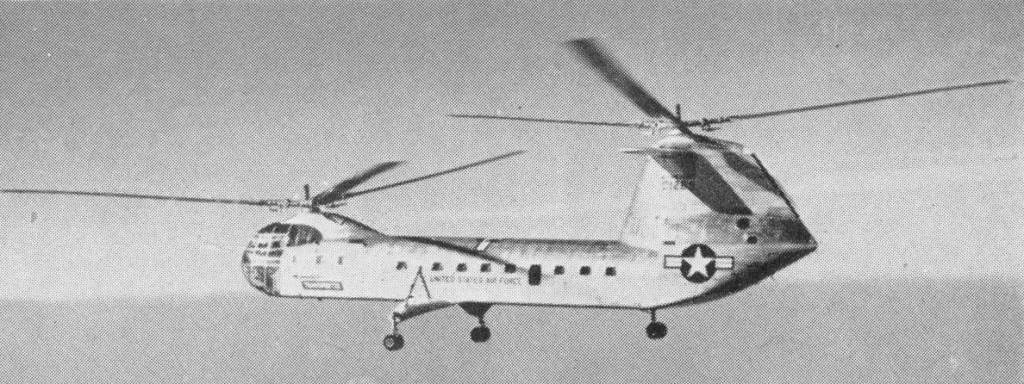
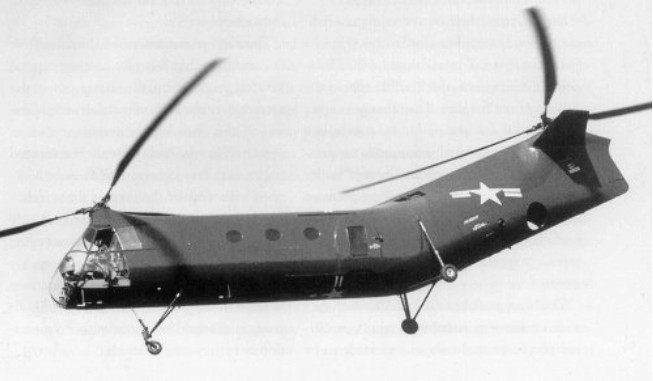
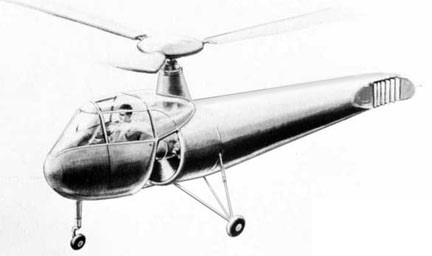
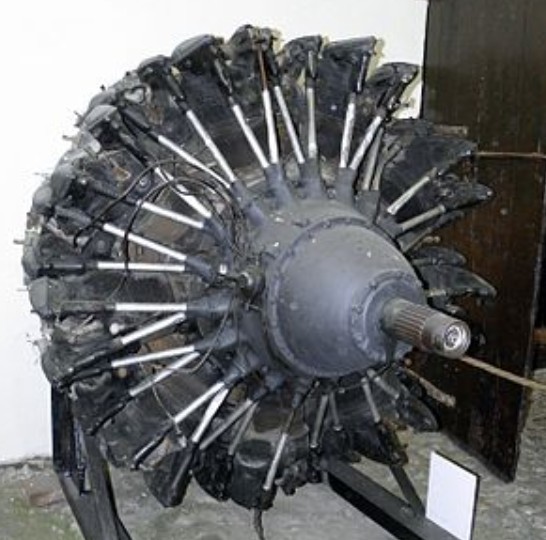
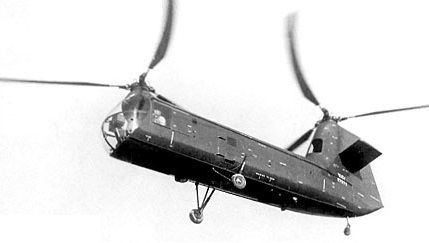
Designated PV-14 (XHJP-1 by the US Navy), two XHJP-1 prototypes (37976 and ’77) were completed for US navy evaluation and three pre-production aircraft, the HUP-1, were ordered in 1948. From 1950-52 a further twenty-two HUP-1 Retrievers (PV-18) were delivered to the U.S. Navy. They differed little from the original XHJP-1, the major apparent change being the addition of inward-sloping endplate fins to the horizontal stabilisers below the rear rotor head. Both sets of 3-blade rotors could be folded for shipboard stowage and the HUP-1, powered by a single 391kW / 525hp Continental R-975-34 piston engine, could accommodate 4-5 passengers or 3 casualty litters in addition to the 2-man crew. The power-plant was installed at the center of the fuselage, which had a steel tube framework with particularly strong, fixed tricycle landing gear. The fin of the HUP-1 was subsequently eliminated, as further improved versions were fitted with an autopilot. The US Navy versions had all-weather instrumentation and some were equipped with sonar for antisubmarine warfare.
XHJP-1 Factory prototype

The HUP-1 had a smaller, more compact fuselage than its predecessors. This enabled the helicopter to be stowed without having to fold back the rotor blades. Once acceptance trials were over, the US Navy ordered 32 aircraft including 124588/124594, 124915/124929, 126706/126715, followed by another 165 of the HUP-2, which was fitted with a more powerful engine. The first squadron, HU-2, took delivery of its initial aircraft in February 1951.

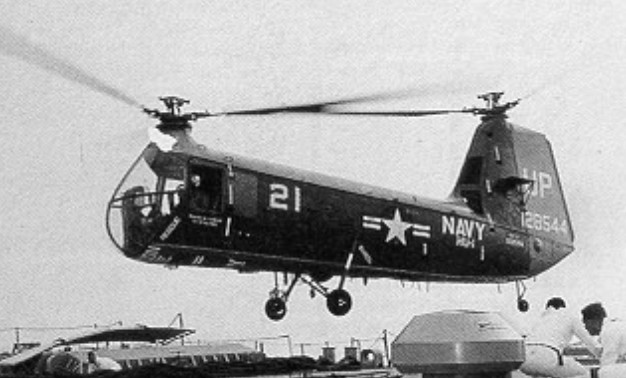
Successful tests with a Sperry autopilot in the XHJP-1 enabled the HUP-2, to be built without tail surfaces and the more powerful 410kW Continental R-975-46 was installed in this and all subsequent production models. Another feature of the Retriever was a large rectangular rescue hatch offset to starboard in the floor of the front fuselage, through which a winch inside the cabin could lift weights of up to 181kg / 400 lb at a time. The U.S. Navy machines included some completed as HUP-2S submarine-hunting aircraft with dunking sonar equipment. Another HUP-2 was given a sealed, watertight hull and outrigged twin floats for waterborne tests, presumably as part of the development programme for the Boeing-Vertol 107 / CH-46 helicopter.

Piasecki HUP-2 128543

The Marines also used 13 HUP-2, while the Army acquired 70, designated H-25A (serials 51-16572 to -16641) powered by the R-975-46A engine, 50 of which were later transferred to the Navy as HUP-3s, three serving with the Royal Canadian Navy’s Squadron VH-21. One H-25A went to the USN as the HUP-3 prototype; 51-16641=149088.

339 HUP-2 were built (128479/128600, 129418/129522, 129978/130085, 134434/134437), of which some with radar as HUP-2S for anti-sub warfare. Redesignated as UH-25B in 1962.

The first H-25A entering regular Army service in early 1953. Those Army Mules that remained in Army service were used mainly as training or medical evacuation aircraft, and the type was totally withdrawn from Army service by 1958.
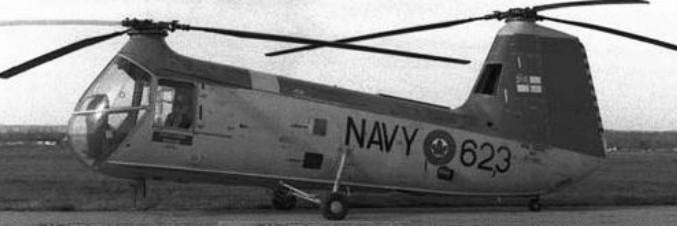
The Army H-25 Mule was basically similar in general layout to the HUP-2, sharing that aircraft’s all-metal fuselage, fixed three-point landing gear, and 550hp Continental R-975-42 engine. The H-25A differed from the Navy variant primarily in having hydraulically-boosted controls, a strengthened floor with cargo tie-down fittings, and modified doors intended to ease the loading and unloading of stretchers.
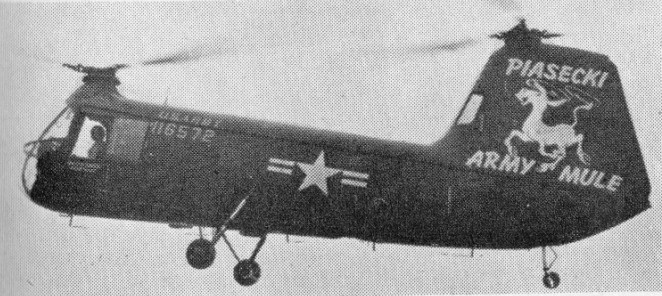
Piasecki H-25A Army Mule

In 1951 the U.S. Army ordered a version of the HUP-2 with a reinforced cabin floor and hydraulically boosted controls, for general support and evacuation work. Seventy of these were delivered as H-25A Army Mule from 1953, as were fifty similar Naval HUP-3’s (including three for the Royal Canadian Navy) for ambulance and light cargo duties. Production of the three hundred and thirty-ninth and last aircraft was completed in July 1954. Shortly after this a proposal was made to boost the speed, range and payload of all H-25/HUP aircraft still in service by refitting them with 700hp Wright R-1300-3 engines. However, this did not take place and by the time the new tri-service designation system was introduced in July 1962 only the HUP-2 and HUP-3 remained in service; these became the UH-25B and UH-25C respectively. Neither type is now in U.S. front-line service, and the French and Canadian HUP types were withdrawn from service in 1966.

The 50 HUP-3 built were 147582/147630 and 149088], redesignated as UH-25C in 1962. The last one was former Army H-25A 51-16641.

The HUP-4 has the 800-h:p. Wright R-1300-3 engine, and earlier versions could be modified to that standard.

An amphibious conversion of the HUP-2 was used for research by the Edo corporation in New York. It had a reinforced hull-type lower fuselage, all-metal outrigger floats and a new engine cooling system.

Edo Corporation HUP-2

Gallery

H-25A Army Mule
Engine: 550 hp Continental R975-42
Rotor dia: 35 ft
Length: 56’11”
Weight: 5,750 lb
Max. Speed: over 103 mph
Range: 340 mi
Seats: 6

HUP-1
Engine: 525 h.p. Continental R-975-34
Rotor diameter: 35 ft.
Rotors: 2 x 3-blade main rotors in tandem
Fuselage length: 32 ft
Loaded weight: 5,750 lb
Max speed: Over 103 mph
Ceiling: Over 10,000 ft
Typical range: 395 miles at 80 mph
Seats: 6.
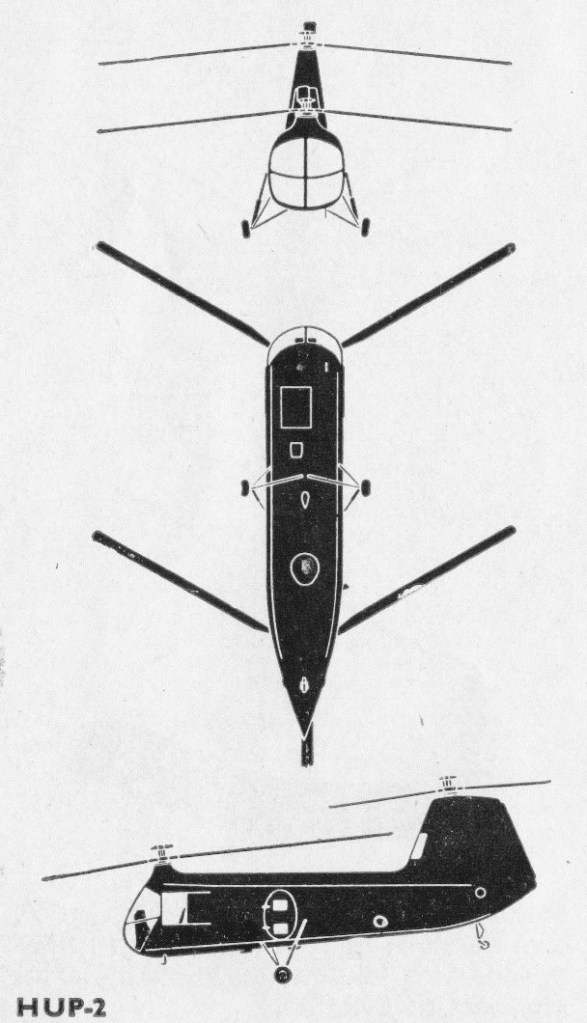
HUP-2
Engine: 550 h.p. Continental R-975-46
Rotor diameter: 35 ft.
Rotors: 2 x 3-blade main rotors in tandem
Fuselage length: 32 ft
Loaded weight: 5,750 lb
Max speed: Over 103 mph
Ceiling: Over 10,000 ft
Typical range: 395 miles at 80 mph
Seats: 6.

HUP-3
Engines: 1 x 550 hp Continental R-975-42, 410kW
Speed: Max: 170 km/h
Range: Max 550 km
Weight: Empty: 1780 kg
Max weight: 2770 kg
Rotor diameter: 10.67 m
Length rotors turning: 17.35 m
Height: 3.80 m
Disc Area: 179 sq.m
Service ceiling: 3050m
Height: 3.80 m
Disc Area: 179 sq.m
Service ceiling: 3050m

HUP-4
Engine: 800h.p.Wright R-1300-3
Rotor diameter: 35 ft.
Rotors: 2 x 3-blade main rotors in tandem
Fuselage length: 32 ft
Loaded weight: 5,750 lb
Max speed: Over 103 mph
Ceiling: Over 10,000 ft
Typical range: 395 miles at 80 mph
Seats: 6.
Piasecki PV-15 / H-16 / H-27 / Vertol H-16

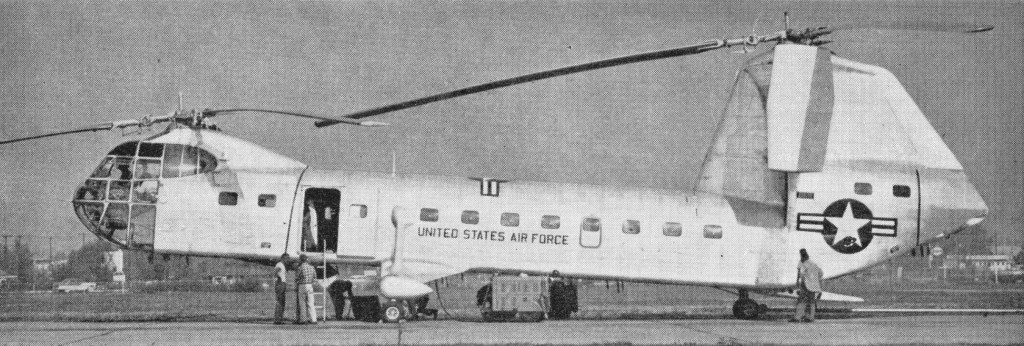
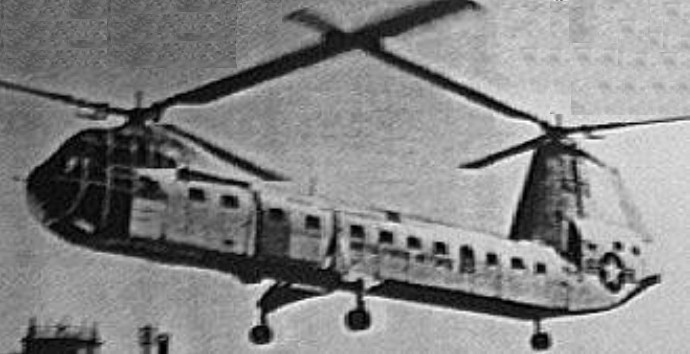
A USAF requirement for a wide-ranging helicopter capable of rescuing downed strategic bomber crews had given rise to the new helicopter. The hefty fuel capacity required to meet its specified 2250km range in part dictated its size. Without the extra fuel, the capacious aircraft also had possible military application as a large troop and cargo transport. In 1946 the Army Air Forces awarded Piasecki Aircraft a contract for the development of a tandem rotor helicopter intended for use in the long-range search and rescue (SAR) role. The resultant Piasecki Model PV-15 was originally given the military designation XR-16 (R denoting rotorcraft under the World War II system), though this was changed to XH-16 in June 1948. The Air Force placed an order for two service test and evaluation aircraft in June 1949, and subsequently allocated the serial numbers 50-1269 and -1270 for these machines.

Piasecki PV-15 Transporter Article

At the time of its inception the H-16 was the largest helicopter in the world. Though originally intended for the SAR role the Transporter, as the H-16 was ultimately named, evolved during the design process into a heavy-lift craft equipped with a tail loading ramp and optimized for troop and cargo transport. In this role the aircraft could carry up to forty troops or three light trucks within its fuselage, the interior of which was kept clear of obstructions by mounting the engines and all dynamic components in the upper fuselage. The H-16 was also capable of transporting large exterior cargo pods, and was equipped with variable-height landing gear legs in order to accommodate pods of varying sizes.

Piasecki XH-16 50-1269

It had tandem three-blade rotors, and two engines, one at the front and the other in the rear of the fuselage. The rear engine drove the rotor at the top of a tail pylon nearly 4m high. The helicopter had a horizontal stabilizer, to which vertical control surfaces were later added in order to overcome problems of directional stability during fast flight. It weighed 14 tonnes on take-off with two pilots and 40 equipped infantry on board.

It was 23.8m long and topped by two overlapping rotors each 25m in diameter. In-flight vibration was low and of a loping nature. Bonded and tapered all-metal rotor blades (built using a new company process) combined milled-aluminum skins, aluminum honeycomb filler, and a leading-edge balance weight that also served as a mechanical fastener for the skins.

These capabilities appealed to the U.S. Army, which saw in the H-16 an answer to several helicopter mission requirements of its own. It therefore joined the USAF in sponsoring further development of the YH-16.

The first Transporter (serial 50-1269) was powered by two 1650hp Pratt & Whitney piston engines and made its first flight on 23 October 1953 at Philadelphia International Airport, designated YH-16. Company personnel and military officials watched the helicopter take off, hover, and fly forward and sideways during a successful twelve-minute maiden hop flown by Harold Peterson and Phil Camerano.

The Air Force ultimately decided against procuring the H-16 for operational use, and in 1955 the YH-16 was turned over to the Army for evaluation. The Army found the piston-driven Transporter to be underpowered and therefore awarded the reorganized Vertol company a contract for the machine’s conversion to turbine power.

YH-16A second prototype 50-1270

During construction the second prototype (50-1270) was modified to Model PV-45 (first designated H-27 and then H-16A) standard through the replacement of its piston engines with two 1800shp Allison T38-A-6 turboshafts, and modified to carry up to fifty troops, and redesignated YH-16B. The change in powerplants and inclusion of various structural modifications prompted a redesignation to XH-27 in October 1952, though this was changed to YH-16A prior to the aircraft’s first flight in July 1955 with Harold Peterson and George Callaghan at the controls. This aircraft set an unofficial world record of 270km/h in 1956. Both H-16 variants were at times fitted with varying types of experimental horizontal tail surfaces, one of which incorporated large end-plate rudders, but none of these designs were adopted for permanent use.

Despite improvements the type was ultimately judged to be unsuited to sustained operations under field conditions, and the Army terminated the H-16 test programme in mid-1956.

YH-16

In December, the YH-16A broke apart in the air and crashed near the Delaware River, killing Peterson and Callaghan as they returned from a test flight in New Jersey. Investigators determined that the rear rotor shaft had failed, allowing the blades to desynchronize and wobble into the plane of those of the forward rotor. In fact, a frozen bearing in the test instrumentation had precipitated this failure by allowing a steel-tube standpipe, placed within the aluminum rotor shaft to guide wires from the instrumented blades, to undetectably inscribe a deepening groove within the shaft.

This accident caused the H-16 program to be scrapped, preempting the sixty-nine-passenger YH-16B Turbotransporter (a conversion of the YH-16 then in progress), which would have flown with two 3700shp Allison T56 engines. It also preempted Frank Piasecki’s vision of interchangeable under-body pods for the rapid transport of differing loads such as field operating rooms, communications centers, and mobile repair centers. A tall stilt landing gear had already been designed to let the YH-16B accommodate such pods.

Gallery

XR-16 / YH-16
Engines: two 1,650 h.p. Pratt & Whitney R2180-11
Rotors: 2 x 3-blade main rotors in tandem.
Rotor diameter: 25m / 85 ft
Fuselage length: 23.8m / 78 ft
Loaded weight: Over 30,000 lb
Useful load: 15,615 lb
Max speed: Over 130 mph
Range: 210 mi
Ceiling: 18,000′
Capacity: 32 stretchers, 3 jeeps or 40 troops.
No built: 1, 50-1269

YH-16A
Engine: 2 x Allison YT-38A-10 turboshaft, 1800 / 1340kW
Rotor diameter: 24.99m
Length: 23.65m
Height: 7.62m
Max take-off weight: 15244kg
Empty weight: 10218kg
Max speed: 235km/h
Hovering ceiling, IGE: 4800m
Service ceiling: 6980m
Range: 2300km

XH-27
Engines: 2 x 1800hp Allison YT38-A-10 turboshafts
Useful load: 20,250 lb
Range: 216 mi
Ceiling: 15,600 ft
Capacity: 49
No built: 1, 50-1270

YH-16B
Engines: 2 x 2100hp Allison T56-A-5
No converted: 1, 50-1270

Piasecki PV-3 / HRP / PV-17

On 1 February 1944 Piasecki received a contract to develop a tandem-rotor utility transport and rescue aircraft for the U.S. Navy.

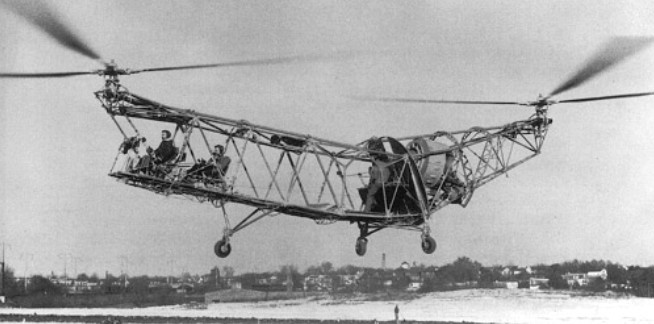
Given the factory designation PV-3, this machine was a development aircraft for the US Navy’s HRP Rescuer transport and rescue helicopter. Powered by a Wright R-975 piston engine, the tandem-rotor PV-3 first flew at Morton, Pennsylvania on 7 March 1945. The first of its kind, initially flew as a bare metal frame and was covered later. It was followed by two XHRP-1airframes, 37968 and 37969, one of which was used for static tests while the other undertook the U.S. Navy flight development programme, during the course of which the company changed its name to Piasecki Helicopter Corporation.

The XHRP-1 SDTA hovers the morning after its first flight

In June 1946 Piasecki received an initial order for 10 production HRP-1 helicopters. The test programme was completed in the spring of 1947, by which time work had already begun on an initial batch of ten HRP-1 Rescuers, 111809 to 111828. The first of these flew on 15 August 1947, powered by a 447kW / 600hp Pratt & Whitney R-1340-AN-1 engine

A second batch of ten was built later, 111834 to 111848, the final machine being delivered in 1949, with a metal-skinned rear fuselage and fabric covering over the main cabin section, although they were often flown with the fabric removed.

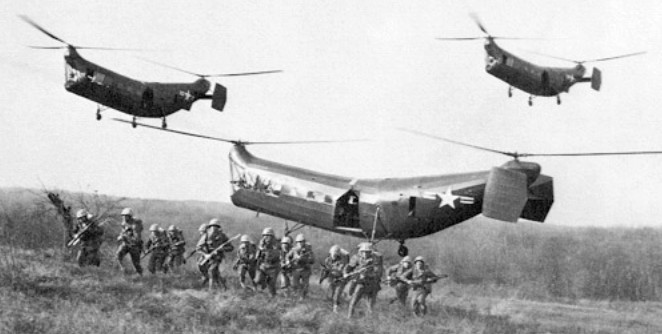
Service evaluation was undertaken by US Navy Squadron VX-3 and US Marine Corps Squadron HMX-1. Twelve of the HRP-1’s were eventually assigned to the U.S. Marine Corps for assault training, while three others, as HRP-1G’s, were used as rescue craft by the U.S. Coast Guard. After withdrawal of the Rescuer from military service in the early 1950s, about six appeared on the U.S. civil register.

HRP-1, Quantico, Va., in November 1948.

The HRP-1 (redesignated as PV-3) carried a crew of 2 sitting in tandem, and its 11.33cu.m cabin could accommodate 8 passengers, 907kg of cargo or 6 stretchers. The single engine was mounted in the rear part of the fuselage, with a clutch and gearbox amidships from which drive shafts ran to reduction gearboxes below each of the rotor hubs.

In June 1948 the U.S. Navy ordered five examples, 111829 to 111833, of the much-developed PV-17 with the designation HRP-2. The much-improved HRP-2 (PD-17) featured a streamlined metal fuselage offering better visibility for two pilots, who now sat side by side ahead of the front rotor. The most significant improvement was the HRP-2’s all-metal stressed-skin construction, and modified rotor heads. The length was 54’9″.

It used the same engine and rotors as the HRP-1, but was slightly shorter and lighter. The Piasecki team used a thinner skin and had the longitudinal members shaved down, as well as other extruded parts that could not be manufactured thinly enough. Produced by Boeing-Vertol in 1948.

Jim Ryan lifted the new Navy helicopter into the air for the first time October 29, 1949. While it was indeed better than the HRP-1, the fast pace of helicopter technology had already passed it by, and better helicopters could now be built. With a gross weight of 3260kg, the HRP-2 was simply too light to offer much utility and only five were built.

The HRP-2 formed the basis of the later PD-22 model which became the military Vertol H-21 series.

HRP-2

Robert Cummings, 23.02.2009
As a U.S.Navy pilot I was stationed in VX-1 at Key West. We had 12 of the HRP-1s and developed the dunking sonar for helicopters. Lt. Lockwood and I were later assigned to a project at Mine Counter-Measures station at Panama City, Florida where we developed towing mine sweeping gear with an HRP-1. George Spratt from Piasecki was the head engineer on that project. The time period for these projects was 1951 to 1953.

Gallery

HRP / PV-3
Engine: 600hp P&W R-1340
Rotors: 41’0″
Length: 48’0″;
Capacity: 12 passenger

HRP-1 / PV-14
Engine: 1 x Pratt & Whitney R-1340-AN-1, 600 hp / 445kW
Rotors: 2 x 3-blade main rotors in tandem
Rotor diameter: 12.50m / 41 ft
Fuselage length: 14.63m / 47 ft 2 in
Height: 3.81m
Take-off weight: 3629kg / 6,900 lb
Max speed: 193km/h
Service ceiling: 3658m / 12,000 ft
Normal range: 483km
Typical range: 264 miles at 85 mph with 100 USgals fuel
Seats: 10

HRP-2 / PV-17
Engine: 1 x Pratt & Whitney R-1340, 600 hp
Seats: 10

Piasecki HRP-1

Piasecki PV-2

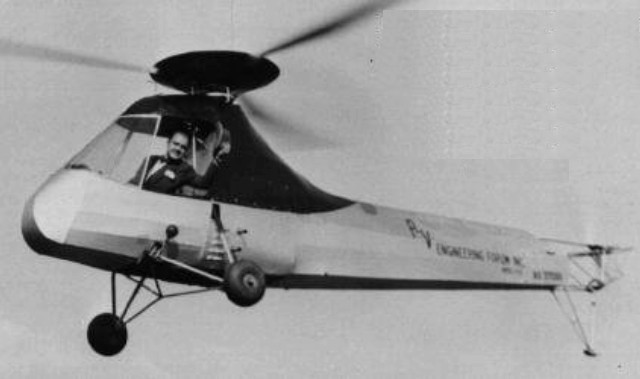
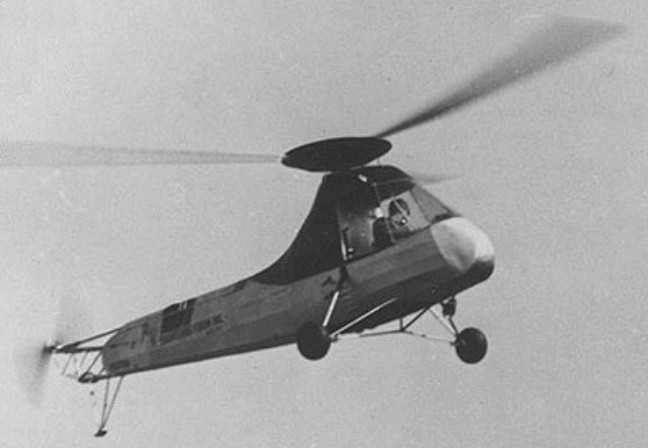
The PV.1 was an advanced design for its day with a tube and fabric fuselage and a tail-mounted anti-torque system involving an enclosed fan in the rear fuselage. This design did not fly but the single-seat PV.2 which took to the air in April 1943 was very similar – but with a conventional tail-mounted anti torque propeller. It was probably the first truly rigid rotor helicopter ever to fly.

There is room for one person (pilot), who sits in a conventional seat behind a rounded, glassed-in nose, similar to the front end of an early Aeronca light plane. The fuselage is fabric-covered. There are three blades. Two blades fold back like the wings on a fly to permit storage. Control of the PV-model has cyclic pitch control of its rotor blades. There is the conventional rudder-stick combination, rudder action manipulating a five-foot tail rotor similar to the vertical rotor on the XR-4. The PV-2 helicopter is powered with a four-cylinder, air-cooled Franklin engine, mounted with its crankshaft upright.

Piasecki himself was the pilot for the first flight, made on 11 April 1943. He flew the aircraft several times in public. Once he took off from the driveway of a private home in Falls Church, Virginia, and flew a short distance to a filling station, where he landed and spent an a ration stamp for three gallons of gasoline. The surprised attendant put in the gas, wiped off the helicopter’s windshield, and Piasecki took off again, heading for the golf course. A few minutes later he landed right beside the first tee, took his golf clubs out of the small baggage compartment, and proceeded to tee off for a game of golf.

It was then dropped because Piasecki turned his attention to the more ambitious field of large military helicopters; with the PV-3, he returned to the twin-rotor formula which had given rise to his earlier experiment.

Engine: 1 x 4-cylinder Franklin, 67kW / 90 hp
Main rotor diameter: 7.62m
Length blades folded: 6.7m
Height: 2.3 m
Width: 2.4 m
Take-off weight: 450kg
Empty weight: 340kg
Max speed: 160km/h
Cruising speed: 135km/h
Range: 240km
Endurance: 2hr
Crew: 1

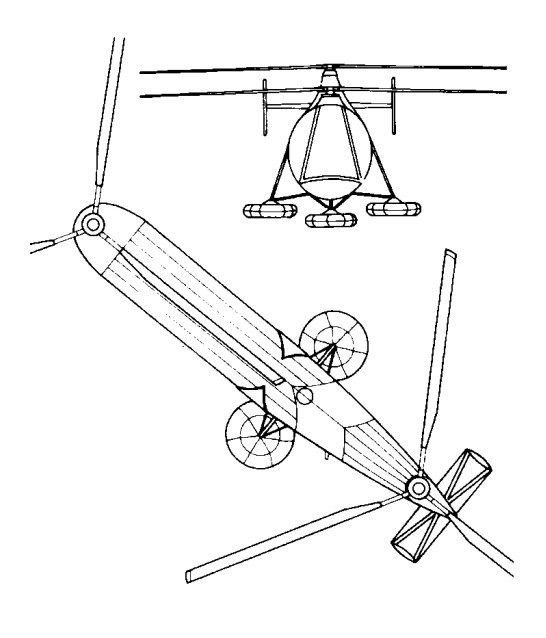
Piasecki PV-1

Piasecki PV-1 Concept art

PV-1 1940 – Frank Piasecki and his P-V Forum’s first design was to be a single-rotor helicopter with a fan-forced, anti-torque system blowing air through the tail cone, and turned by control vanes in the exit, predating the NOTAR* by several decades. PV-1 was not developed beyond the design stage due to high development risk at the early stage of helicopter design. *Acronym for “No Tail Rotor” technology whereby the tail rotor was replaced as anti-torque control by a swiveling exhaust duct at the end of a hollow tail boom.

Piasecki / P-V Engineering

Piasecki Aircraft Corporation
Piasecki Helicopter Corporation

Towards the end of 1943, Frank Nicholas Piasecki also appeared on the scene. Piasecki had worked for the Kellett Autogyro Company and Budd Aircraft. He had previously been involved in development of the Platt-LePage XR-1 and had undertaken a small-scale project of his own. Frank N. Piasecki, President of the PV-Engineering Forum, an organization he formed with F.M.Vinsie and Elliott Daland for the purpose of building his helicopter. Records show he is the first American to be granted a license to fly a helicopter before first qualifying to fly a conventional airplane. He did, however, previous to flying his own helicopter design, get in some flying time in a light plane. This helped him, too, in building the PV.

P-V Engineering Forum had completed several rotary-wing contracts for NACA and the U.S. Navy. The latter ordered an XHRP-1 helicopter which flew in 1945; following successful tests it was placed in production. Further orders followed for XHJP-1 tandemrotor helicopters for USN shipboard operations and the large XH-16, which had a fuselage of DC-4 size.

P-V Engineering became Piasecki Helicopter Corp in 1946, formed by Frank Piasecki, who was concerned in development of vertical-lift aircraft and flew the Model 59K Sky-Car flying jeep with an Artouste turboshaft engine in 1958 under a US Army contract.

Technical interchange agreements signed with Breguet Aviation in 1957 included sales rights for that company’s STOL transports in the U.S.A. and Canada, but these were dropped in 1962. Also provided engineering assistance to Agusta from 1960 for the AZ-101G and AZ-105 helicopters.

Built prototype of PiAC 16H-1C Pathfinder compound helicopter in 1962, continuing development under a U.S. Navy contract, but no production. Work included developing vectorod-thrust ducted propeller system for attack helicopters under U.S Army contract, definition of a possible U.S. Marine Corps medium-lift replacement type, and marketing the PZL Swidnik W-3A in the Americas and Pacific Rim regions.

After F N Piasecki was forced out of his company in 1955, he founded Piasecki Aircraft Corp, and his original company became Vertol Aircraft Corp, which in turn became a division of Boeing Co in 1960.

Piaggio P.XII / P.XV / P.XXII

Piaggio P.XII

The Piaggio P.XII was an Italian 18-cylinder radial aircraft engine developed in the 1930s by the aeronautical manufacturing company Rinaldo Piaggio S.p.A. The engine was used in many Italian aircraft from 1940 until the end of World War II. An up rated version was produced as the Piaggio P.XXII.

Variants:
Variants of the Piaggio P.XII include: (R – Riduttori – reduction gearing and C – Compressore – supercharged)
P.XII R.C.35
(geared, rated altitude 3,500 m (11,500 ft))
P.XII R.C.40
(geared, rated altitude 4,000 m (13,000 ft))
P.XII R.C.l00/2v
(geared, rated altitude 10,000 m (33,000 ft))
P.XV R.C. 60/2v
(geared, rated altitude 6,000 m (20,000 ft))
P.XXII R.C.35D
Higher rating with slightly higher displacement than the P.XII series engines. (geared, rated altitude 3,500 m (11,500 ft))
P.XXII R.C.35R
Same as P.XXII R.C.35D, but propeller rotates in opposite direction
P.XXII R.C.60
(geared, rated altitude 6,000 m (20,000 ft))

Applications:
CANT Z.1015
CANT Z.1018
CANT Z.511
Caproni Ca.169
Piaggio P.108
Savoia-Marchetti SM.84ter
Savoia-Marchetti SM.89

Specifications:
P.XII R.C.35
Type: 18-cylinder air-cooled radial engine
Bore: 146 mm (5.75 in)
Stroke: 176 mm (6.93 in)
Displacement: 53 l (3,200 cu in)
Length: 1,700 mm (66.93 in)
Diameter: 1,410 mm (55.51 in)
Dry weight: 850 kg (1,874 lb)
Frontal Area: 1.56 sq.m (16.8 sq ft)
Valvetrain: 2 x overhead valves per cylinder operated by rockers and pushrods
Supercharger: Centrifugal compressor, geared to 7.81:1
Fuel system: Single Piaggio downdraught carburettor with automatic boost and mixture control
Fuel type: 87 octane
Oil system: Pressure fed at 482.6 kPa (70 psi), dry sump
Cooling system: Air
Reduction gear: Epicyclic reduction gear, gear ratio: 0.62:1
Starter: Garelli compressed air starter
Ignition: 2x Marelli AQ18 magnetos, 2 x spark plugs per cylinder fed by a shielded ignition harness.
Power output:
Take-off: 1,500 hp (1,100 kW) at 2,100rpm
Military: 1,350 hp (1,010 kW) at 2,100rpm at 3,500 m (11,500 ft)
Cruising: 1,000 hp (750 kW) at 1,700rpm at 3,500 m (11,500 ft)
Specific power: 22.29 kW/l (0.49 hp/cu in)
Compression ratio: 6.5:1
Specific fuel consumption: 0.2795 kg/kW/hr (0.46 lb/hp/hr)
Oil consumption: 0.0134 kg/k/w/hr (0.022 lb/hp/hr)
Power-to-weight ratio: 1.324 kW/kg (0.8 hp/lb)