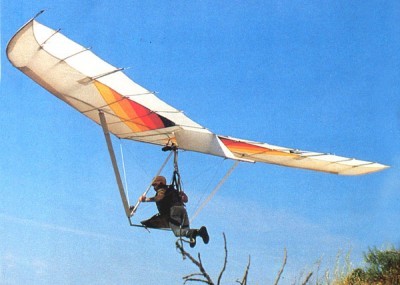
The 1984 Dawn hang glider could pack the struts up into the sail without detaching them, so the setup was fast.
Wing area: 14.40 m²
Wing span: 10.50 m
Aspect ratio: 7.68
Hang glider weight: 24 kg
The 1984 Dawn hang glider could pack the struts up into the sail without detaching them, so the setup was fast.
Wing area: 14.40 m²
Wing span: 10.50 m
Aspect ratio: 7.68
Hang glider weight: 24 kg
The Danish Dolphin tandem two-seater motor glider was designed and built by the Projekt 8 I/S company of Roskilde, and 10 construction of the prototype was taking place at three separate sites near Copenhagen,
and it was expected that the first flight was to be made late in 1978.
The Dolphin is a cantilever mid-wing monoplane of mixed constrution with a T-tail, powered by a 54hp Volkswagen VW1600 engine driving a two-blade pusher propeller, mounted on a pylon and retracting rearwards behind closed doors into the top of the fuselage aft of the wings. The wings, which have 4° dihedral, have an aluminium centre section and wood and glassfibre outer panels, flaps and ailerons; there are aluminium air brakes in the upper surfaces just ahead of the flaps. The forward fuselage is a welded steel tube framework covered with a light glassfibre shell, and the rear fuselage is a wooden structure reinforced by glassfibre. The tail unit is likewise of wood, with a fixed incidence tailplane, a central trim tab in the elevator and an inset tab at the base of the rudder. There is a semiretractable rubber-sprung mainwheel plus a nosewheel and a steerable tailwheel, as well as retractable wing tip balancer wheels. The one-piece cockpit canopy opens sideways.
Span: 61 ft 5 in
Length: 27 ft 10.75 in
Height: 4 ft 3.25 in
Wing area: 223.9 sq ft
Aspect ratio: 16.8
Empty weight: 1,058 lb
Max weight: 1,653 lb
Max speed: 163 mph
Max aero-tow speed: 77.5 mph
Min sinking speed: 2.30 ft/sec at 50 mph
Best glide ratio: 32:1 at 62 mph
The Projekt 8 I/S company of Roskilde, was formed by Helge Petersen and 10 other glider pilots for construction of the prototype Dolphin, taking place at three separate sites near Copenhagen, Denmark.
In 1989 Progress Aero R&D Inc produced the Progress Discovery, all-composite construction two place aircraft registered N81D.
Engine: 100hp Lycoming O-235
Max speed: 200 mph
Cruise: 168 mph
Seats: 2
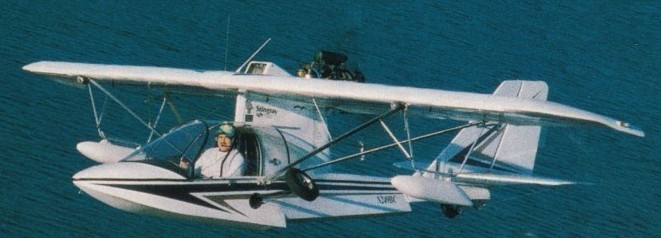
The Stingray is the single seat version of the Searay.
Engine options include the Rotax 447, 503, and 582.
Engine: Rotax 447, 40 hp
HP range: 40-65
Height: 6.2 ft
Length: 21.4 ft
Wing span: 30.83 ft
Wing area: 150 sq.ft
Weight empty: 470 lb
Gross: 800 lb
Fuel cap: 6 USG
Speed max: 85 mph
Cruise: 65 mph
Range: 100 sm
Stall: 27 mph
ROC: 600 fpm
Take-off dist: 175 ft
Landing dist: 200 ft
Service ceiling: 9,000 ft
Seats: 1
Landing gear: retractable tail wheel
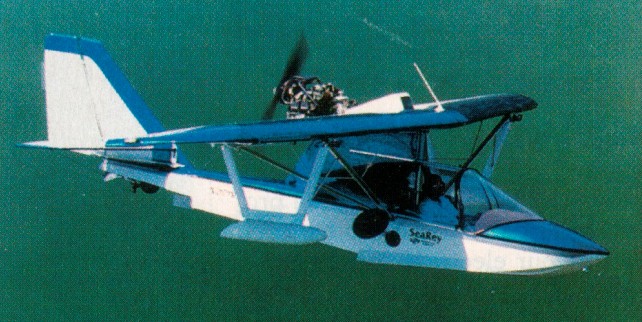
A side-by-side, high wing amphibian, related to the Adventure Air Adventurer 333. It is a high wing, pusher, tail dragger configuration, and a panoramic lexan cockpit. The wings are swept back at the leading edge with a straight trailing edge to form a tapered wing. The engine is mounted on top of the wing, which is supported above the fuselage by a vertical pylon.
The Cabin is designed with side-by-side seating. Entry into the cabin is through a sliding canopy into the 44 in/112cm cockpit. Dual flight controls enable flying from either seat. There is storage space behind the seats (L48 x W44 x H17 in.) for baggage.
The SeaRey is the ability to fly unaffected with the individual dual sliding canopies either opened or closed. The retractable landing gear handles unimproved grass runways. The take off roll on land at gross weight is about 375 feet (115m). Lift off takes place at around 45-50 mph (40 – 45 knots), and 65-70 mph (55-60 knots) is the best rate of climb speed. Rate of climb is 1,000+ ft per min (300m+ per min) Solo and around 800 feet per minute (245m per min) at gross weight.
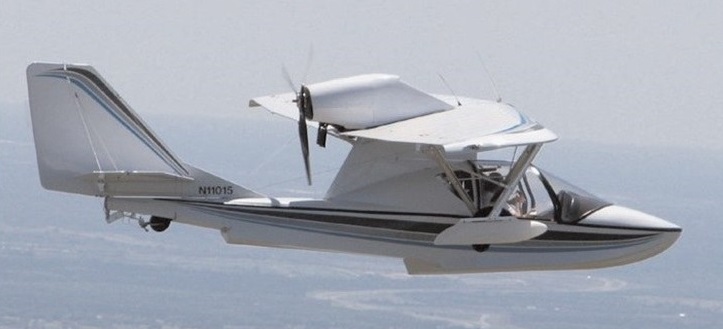
In cruise the SeaRey settles at 90 mph (80 knots). Top speed is 113 mph (98 knots). Due to the installation of special leading edge extensions on the wings, the stall is very docile and the aircraft is spin resistant. Upon throttling back and applying 20 degrees of flaps, the aircraft slows to the stall speed of around 40 mph (34 knots). The stall is gentle and straightforward and recovery is conventional. The retractable undercarriage comes with a simple manual system or alternatively an electric mechanism. An over center lock mechanism is a feature of this simple design.
Best approach speed for a water landing is 65 – 70 mph (55-60 knots) with 10 degrees of flaps. Upon reaching short final, 20 degrees of flaps can be initiated to further slow the aircraft’s touch down speed on the water. Landing flare begins lower than conventional land-only aircraft. A nice touch down speed is 45-50 mph (40-45 knots). This lands the aircraft “on step” and produces very smooth contact with the water.
The SeaRey is capable of handling quite rough water conditions but until such time as the pilot has developed their seaplane water experience, operations in moderate conditions with wave size under 12 inches (30cm), is recommended.
With 20 degrees of flaps for takeoff the SeaRey will come “on plane” in around 4 seconds. A further 6 to 8 seconds to get airborne. The hull produces a very flat spray pattern preventing water from going through the propeller. Accelerating to 45-50 mph (40-45 knots) to rotate and lift off. Established in the climb and at a safe height, reduce the flaps to 10 degrees.
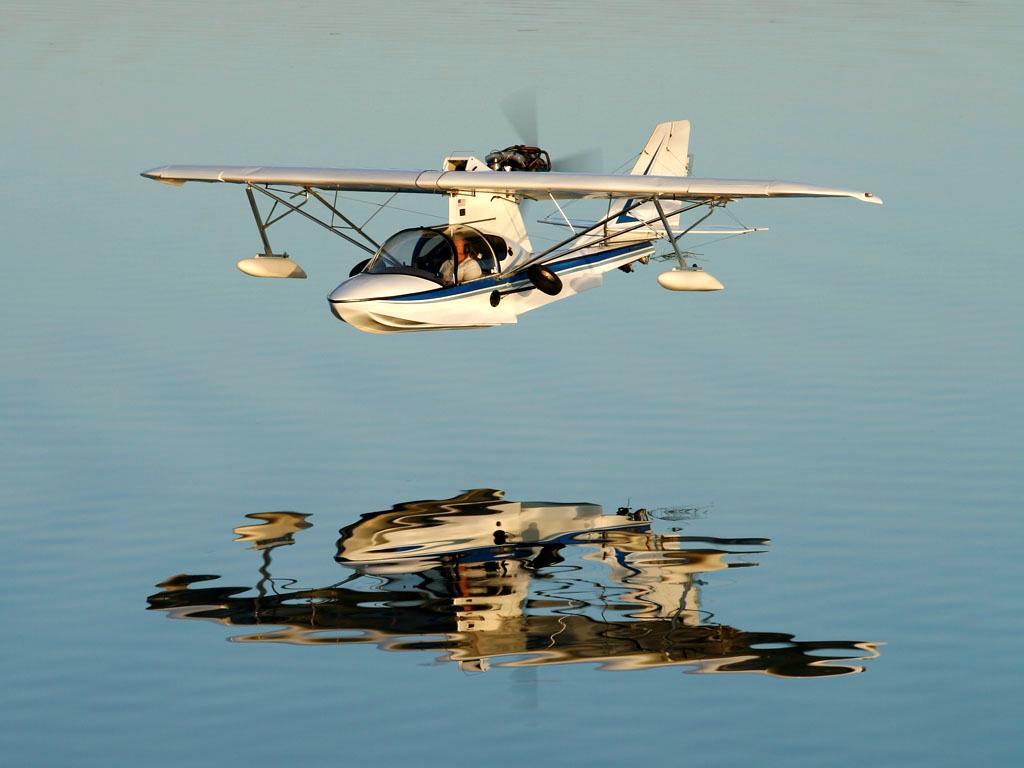
The LSA Searay has dual controls with electric trim, and engine options include 65, 74, 80, and 115 hp Rotaxs.
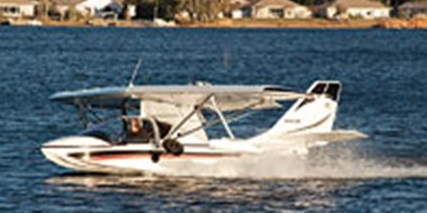
The basic kit was $21,900 less engine in 2000.
By 2012, the American-made SeaRey has been out in kit form for 21 years (600 kits delivered) and was also an S-LSA. The 2012 models were the Sport and Elite S-LSAs, and the LSX kit (E-LSA or EAB). Prices: US$144,000 (Elite); US$125,000 (Sport) and US$34,900 (LSX airframe-only kit).
SeaRay
Engine: Rotax 912 (80hp)
Cruise Speed: 85 mph
Top Speed: 105 mph
Stall Speed: 40 mph
VNE: 120 mph
Rate of Climb: 650 fpm
Takeoff Land: 400 feet
Takeoff Water: 400 feet
Empty Weight: 820 lbs
Gross Weight: 1370 lbs
Useful Load: 550 lbs
Length: 22′ 5″
Wheel Track: 78 inches
Height: 77 inches
Fuel Capacity: 18 US gallons (optional 26 gal)
Wing Span: 30′ 10″
Endurance: 3.5 to 4 hours
Wing Area: 157 sq. feet
Cabin Width: 44 inches
Root Chord: 76 inches
Cabin Height: 38.5 inches
Tip Chord: 46 inches
Above Seat: 33.5 inches
Aspect Ratio: 6.055
Baggage Area: 13 cubic feet
Taper Ratio: 0.6
Baggage l w h: 48 x 44 x 17 in.
L.E. Sweep: 7.5 degrees
Hull Draft: 10 inches
Stab. Span: 110 inches
Flap Settings: 13, 24, 35 degrees
Engine: Rotax 912s (100hp)
Cruise Speed: 93 mph
Top Speed: 113 mph
Stall Speed: 40 mph
VNE: 120 mph
Rate of Climb: 800 fpm
Takeoff Land: 375 feet
Takeoff Water: 375 feet
Empty Weight: 830 lbs
Gross Weight: 1370 lbs
Useful Load: 540 lbs
Length: 22′ 5″
Wheel Track: 78 inches
Height: 77 inches
Fuel Capacity: 18 US gallons (optional 26 gal)
Wing Span: 30′ 10″
Endurance: 3.5 to 4 hours
Wing Area: 157 sq. feet
Cabin Width: 44 inches
Root Chord: 76 inches
Cabin Height: 38.5 inches
Tip Chord: 46 inches
Above Seat: 33.5 inches
Aspect Ratio: 6.055
Baggage Area: 13 cubic feet
Taper Ratio: 0.6
Baggage l w h: 48 x 44 x 17 in.
L.E. Sweep: 7.5 degrees
Hull Draft: 10 inches
Stab. Span: 110 inches
Flap Settings: 13, 24, 35 degrees
Engine: Rotax 914 (115hp)
Cruise Speed: 100 mph
Top Speed: 120 mph
Stall Speed: 42 mph
VNE: 120 mph
Rate of Climb: 900 fpm
Takeoff Land: 350 feet
Takeoff Water: 350 feet
Empty Weight: 850 lbs
Gross Weight: 1370 lbs
Useful Load: 520 lbs
Length: 22′ 5″
Wheel Track: 78 inches
Height: 77 inches
Fuel Capacity: 18 US gallons (optional 26 gal)
Wing Span: 30′ 10″
Endurance: 3.5 to 4 hours
Wing Area: 157 sq. feet
Cabin Width: 44 inches
Root Chord: 76 inches
Cabin Height: 38.5 inches
Tip Chord: 46 inches
Above Seat: 33.5 inches
Aspect Ratio: 6.055
Baggage Area: 13 cubic feet
Taper Ratio: 0.6
Baggage l w h: 48 x 44 x 17 in.
L.E. Sweep: 7.5 degrees
Hull Draft: 10 inches
Stab. Span: 110 inches
Flap Settings: 13, 24, 35 degrees
1995-2007: 520 Clifton St, Orlando, FL 32808, USA.
Progressive Aerodyne was founded in 1991 by Kerry Richter and his business partners, Wayne Richter and Paige Lynette. With a long family history of building ultralight amphibious aircrafts, the company took the opportunity to create a new amphibious aircraft design and named it the Searey. Thus, the Searey took form and began flying in November 1992.
The next year, the Searey Classic was introduced to the general public and was very well received, assuring two years worth of orders for the company.
Progressive Aerodyne is a family business of Kerry Richter, and three generations of his family, together with their friend and partner Paige Lynette, all work in the company that has produced over 400 flying aircraft.
In 2009 Kerry is the President of the company and was in full time research and development of improvements to the SeaRey and of new aircraft designs for the future. A full time aeronautical engineer, Damir Blazevic has over 30 years engineering experience, the last 19 of which were with Airbus including on the Airbus 380 design. Damir has personally built over 9 aircraft, many of his own design. Damir’s specialty is quality control. The team works with state of the art computers and aircraft design software to ensure airworthiness and compliance with aviation standards.
In January 2010, a significantly improved model, the Searey LSX, was introduced to the aviation community. To date, close to 600 Searey Kits had been delivered to customers and over 500 are flying worldwide.
In May 2010, the company moved their headquarters from Orlando to Tavares, Florida, to facilitate its growth. A year later, Adam Yang, also a Searey pilot, owner, and builder, joined Progressive Aerodyne as CEO.
In June 2014, Searey expanded it global reach with the opening of its sales office in Shanghai, China, to support the sale of Searey Light Sport Amphibious Airplanes. The Searey was first presented to the China market at air shows in 2009, where interest in Searey airplanes was overwhelming. Since then, Progressive Aerodyne participated in subsequent air shows and invested in research and marketing in order to advance the Searey in China. The company is currently working with Chinese aviation authorities to gain certification of the Searey. The Shanghai office to manage all marketing and sales and work with government authorities in China.
Progressive Aerodyne in Tavares, Florida manufactures finished Searey seaplanes in full production of two configurations of Searey models, the Searey Sport and the Searey Elite, both of which have received FAA certification for airworthiness. In addition, the company continued to manufacture Searey Kit Airplanes.
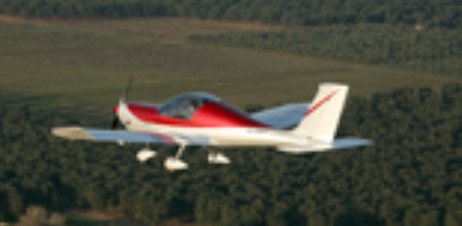
Entirely in composite and carbon-fiber. Engine options include the Rotax 912UL 100Hp.
2009 Price: 49500 EURO. The kit price was 27.000€ (without engine and instruments).
Sparviero
Stall: 31 kt / 36 mph / 58 kmh
Cruise: 103 kt / 118 mph / 190 kmh
VNE: 130 kt / 149 mph / 240 kmh
Empty Weight: 290 kg / 639 lbs
MTOW Weight: 450 kg / 992 lbs
Take-off distance (50ft obstacle): 390 ft / 120 m
Landing distance (50ft obstacle): 490 ft / 150 m
Italy
Based in Milan, Procaer built several aircraft to the design of Stelio Frati, the first being the Lycoming engined F15 Picchio, three-seat aerobatic monoplane, which flew in 1959. Cobra 400 two-seat light jet aircraft with Marbore engine was flown in 1960 but not developed. Late developments concerned the F15 and the F15F version built for Procaer by General Avia.


