The first design was the Widgeon 1, a flying boat, followed by a much larger amphibian, the Widgeon II, powered by a 440 hp A.S. Jaguar engine. In 1927, the Widgeon II undertook a 9,000 mile flight around Australia.
Author: Terry
RAAF Experimental Aircraft Station Widgeon 1
The first design was the Widgeon 1, a flying boat, followed by a much larger amphibian, the Widgeon II.
RAAF Experimental Aircraft Station
Lawrence J. Wackett (later Sir Lawrence) started his career in the Australian Flying Corps in the First World War and saw service in Egypt; when the R.A.A.F. was formed in 1921 Wackett decided to move into aircraft design and development and, after a short professional training period, persuaded the then Defence Minister, R. K. Bowden, to set up a R.A.A.F. Experimental Aircraft Station at Randwick, in order to develop aircraft suitable for Australian conditions.
The first design was the Widgeon 1, a flying boat, followed by a much larger amphibian, the Widgeon 11, powered by a 440 hp A.S. Jaguar engine. In 1927, the Widgeon 11 undertook a 9,000 mile flight around Australia.
Two other aircraft were developed at Randwick to the prototype stage: Warrigal I (a trainer) and Warrigal II a single seat fighter. As a result of a government-sponsored report, the Randwick Station was closed in 1931: Wackett resigned from the R.A.A.F. and transferred, with some personnel and equipment to Cockatoo Dockyard.
Raache LR-1 / Honroth Special
The Raache LR-1 or Honroth Special of 1947 was a single-place cabin, low wing monoplane, NX/N5595N, powered by a Continental engine.
In its first Goodyear competition, when rounding the first pylon, this racer twisted its frame so badly it limped in and was immediately retired from flying.
Raab-Katzenstein FR-2
An improved Schwalbe.
Raab-Katzenstein RK-26 Tigerschwalbe
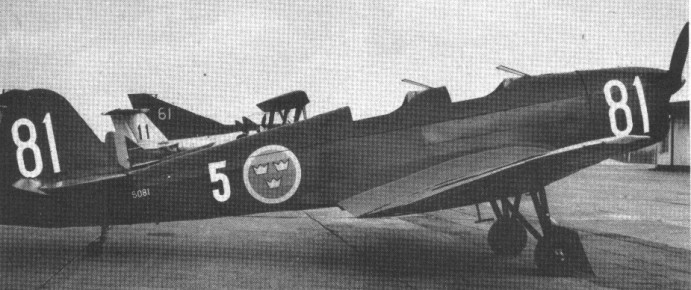
First product was Schwalbe two-seat training biplane with Siemens engine.
Twenty five were operated by the Swedish Flygvapnet as trainers.
Raab-Katzenstein Flugzeugwerke
Rheinische Luftfahrt Industrie
Formed in 1925 by Raab & Katzenstein, formerly with Dietrich Flugzeugwerke. First product was Schwalbe two-seat training biplane with Siemens engine. Built several other light aircraft before company name changed to Rheinische Luftfahrt Industrie (Rheinland), continuing manufacture of an improved Schwalbe, the FR-2.
Raab Aeroscooter
An ultralight aircraft
Raab Flugzeugbau Gmbh
Germany
Formed in 1959; took over the Italian plant of Colonel Mario de Bemardi, with plans to build his Aeroscooter ultralight aircraft in Germany. Raab Flugzeugbau also acquired rights to license-produce Ambrosini Rondone four-seat monoplane.
Raab Krähe
The Raab Krähe (English: crow) is a West German high-wing, single-seat, pusher configuration motor glider that was designed by Fritz Raab for amateur construction. The Krähe first flew in 1957, shortly after powered flight was again permitted in the Federal Republic of Germany. The most widespread problem was that engines proved unreliable when restarted in flight after being switched off for lengthy periods. Inevitably, there was a great deal of trial and error, and the Krähe was fitted with engines from various manufacturers. The aircraft was never commercially manufactured.
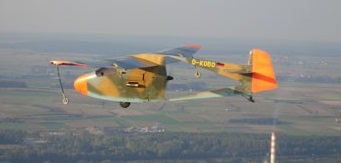
The Krähe is constructed from wood, with the fuselage made from a wooden structure covered in doped aircraft fabric. The 12.0 m (39.4 ft) span wings are built with a wooden structure and covered in plywood and fabric. The wings feature spoilers and a custom Raab-designed airfoil. The tailplane is braced with four cables to the wing trailing edge. The landing gear is a fixed monowheel.
The engine is mounted in the rear of the cabin area, with the propeller in between the top and bottom tail boom tubes. Motors used are usually of an output of about 30 hp (22 kW).
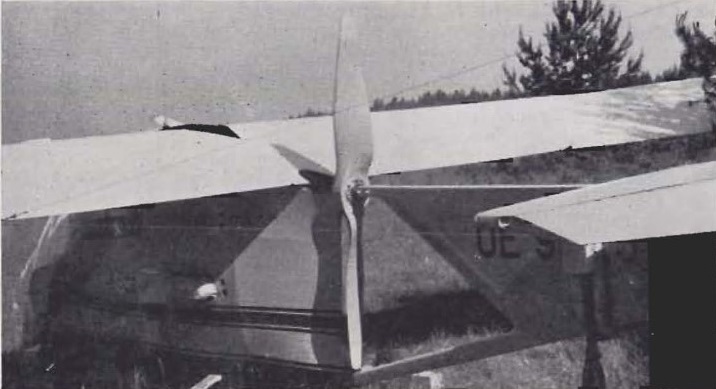
Raab designed the Krähe specifically for homebuilders. About 30 examples were reported completed by 1974.
Variants:
Krähe
Initial model with monowheel landing gear and propeller in between top and bottom tail boom tubes.
Austria Krähe
Later model with tricycle landing gear and propeller rotating around the upper tail boom tube.
Krähe
Engine: 1 × Steyr , 20 kW (27 hp)
Propeller: 2-bladed wooden fixed pitch
Wingspan: 12 m (39 ft 4 in)
Wing area: 14.3 m2 (154 sq ft)
Aspect ratio: 10:1
Airfoil: Raab
Empty weight: 238 kg (525 lb)
Gross weight: 333 kg (735 lb)
Fuel capacity: 8 U.S. gallons (30 L; 6.7 imp gal)
Fuel burn: 1.2 U.S. gallons (4.5 L; 1.00 imp gal) per hour
Wing loading: 23.3 kg/m2 (4.77 lb/sq ft)
Cruise speed: 121 km/h (75 mph, 65 kn)
Endurance: 10 hours loiter
Maximum glide ratio: 18-20:1 at 77 km/h (48 mph)
Rate of sink: 1.2 m/s (240 ft/min) at 68 km/h (42 mph)
Crew: one
Krähe IV
Engine: Hirth F 10, 19 kW
Wingspan: 12.0 m
Take-off weight: 340 kg
Best glide ratio: 20 : 1 at 78 km/h
Minimum sink rate: 1 m/s at 65 km/h
Maximum rate of climb: 1.7 m/s

