Ritchel Dirigicyle / Flying Car

Connecticut inventor Charles F. Ritchel made his mark in aviation history—and the cover of Harper’s Weekly magazine—by building a dirigible of his own and sponsoring the first controlled flight of a dirigible in America in Hartford in 1878.

Having been first flown outdoors less than two weeks before by Mark Quinlan in Bridgeport, Connecticut; Charles F. Ritchel began exhibiting his flying machine – also known as the Dirigicyle, or Flying Car – at Boston’s Tremont Temple on June 24, 1878. The demonstration, arranged by William McMahon, who played a major role in introducing Edison’s phonograph to the public, was a complete success. In addition to the indoor flights, Quinlan made an exciting ascension from Boston Common. Once in the air, the propeller gears jammed, allowing the balloon to rise dangerously high. Without a valve to relieve the increased pressure of the expanding lift gas, the envelope swelled, breaking several of the bands from which the frame was suspended. Quinlan could not slit his envelope, for there was no netting in which the fabric could gather to form a parachute. He had little choice but to tie one hand and ankle to the frame, then drop beneath the craft to make repairs with a jackknife as his only tool. He finally descended at Farnumsville, 44 miles from the Common, after a flight of one hour and twenty minutes.
Rithner Swiss Atlanta / Atlas Rithner

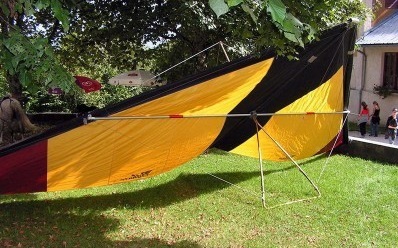
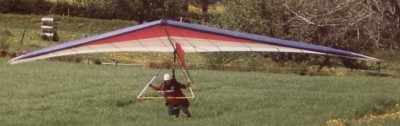
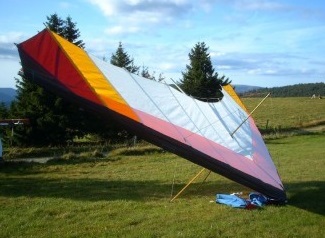
A carbon copy of the La Mouette Atlas, it was initially called “Atlas Rithner” but was eventually renamed “Swiss Atlanta” after a resounding (and justified) lawsuit brought to Etienne Rithner jointly by Marcel Lachat (the Swiss importer of La Mouette) and La Mouette itself.

A very pleasant wing with excellent finish, and tubes of 1.5in.

Rithner Piranha

The Piranha is a copy of the Comet that is even better than the Comet itself. Handling is not great but can be improved with a home-made overdrive. Note: it’s Swiss made, therefore french pilots should have paid an import tax when buying it…and they usually didn’t!!!)

Rithner Hirondelle / Hirondelle Electra

Hirondelle

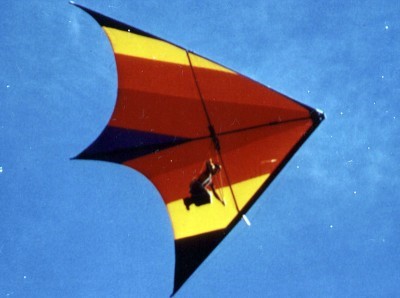
In the early 1970s, E. Rithner distributed the Bernard Danis (wing = Manta) and Electra Flyers (wing = Hirondelle) brands in Switzerland before being “inspired” to make them on his own account. Very quickly the Hirondelle Electra took over by proving to be more powerful and safer than the Manta which had the unfortunate propensity to put itself in the flag, often irreversible because the dive was stable (several accidents). Electra, which already had the “S” shaped keel (the front part was curved downwards by a cable between the upper anchorage of the trapezium and the nose, the rear part being curved upwards by the longitudinal upper cable Back), was fairly stable (slight neutral) and did not suffer from the (often fatal) phenomenon of feathering. Its fineness was of approx. 5.5, its drop rate of 2.5 – 3.0. For a weight of 18 kg.

Hirondelle Electra 1st generation

The Electra of the 1st generation had the corners of the trapezium always bent, American fashion. Undoubtedly, at this time, E. Rithner still imported a few pieces of hardware (stiffeners, screws, etc.) and US structural trapezium.

Rithner Garuda

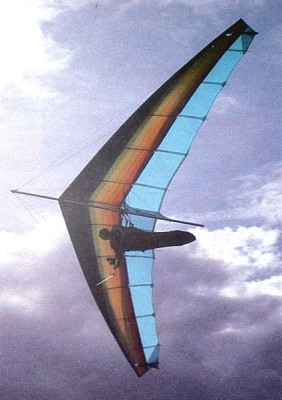
The 1984 Garuda (sometimes spelt Garouda) was a copy of the Sapphire of Bautek. Not a true copy but it was much cheaper which explains its popularity for advanced pilots.

Very good little wing, handy and light, with modest but respectable performances, wing made above all for a pleasure and pleasure of the maximum flight.

Wing area: 17 m²
Wing span: 10.8 m
Aspect ratio: 6.9
Hang glider weight: 32 kg
Minimum sink rate: 0.95 m/s
Packed length short: 3.2 m
Nose angle: 132°

Garuda 162
Wing area: 16.2 m²
Wing span: 10 m
Aspect ratio: 6.2
Hang glider weight: 26 kg
Packed length: 5.80 m
Packed length short: 2.50 m
Number of battens: 16
Nose angle: 130°

Rithner France

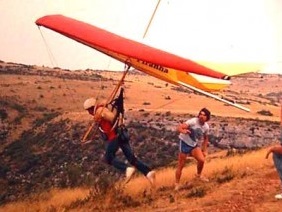
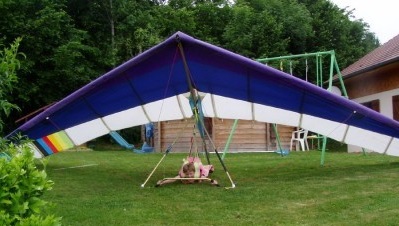
The Master and the 1984 France were absolutely identical, “inspired” of the Magic III, with 14 slats on the extrados and 4 laths of intrados. For reasons of pure marketing, E. Rithner sold this wing in France under the name of “France”.

Wing area: 15 m²
Wing span: 10 m
Aspect ratio: 6.65
Hang glider weight: 27 kg

Wing area: 16.37 m²
Wing span: 10.60 m
Aspect ratio: 6.80
Hang glider weight: 29 kg

Rithner

In the early 1970s, E. Rithner distributed the Bernard Danis (wing = Manta) and Electra Flyers (wing = Hirondelle) brands in Switzerland before being “inspired” to make them on his own account. Very quickly the Hirondelle Electra took over by proving to be more powerful and safer than the Manta

Hang glider builder

Riter Special

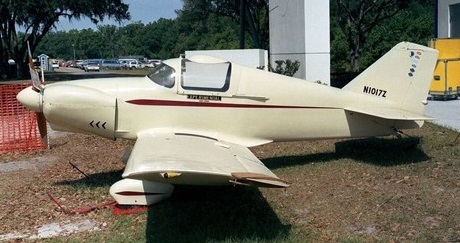
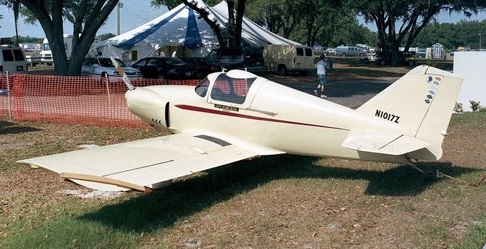
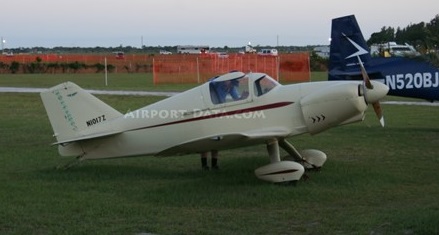
The Riter special is a single engine, low wing, single seat, retractable conventional landing gear aircraft. The wings fold upward for ground transport on a trailer. The landing gear is retracted by hand with a worm-gear mechanism.

First flown in 1961, the two seat aircraft was registered N1017Z Riter Special R.E.C. C/N 101.

Engine: Lycoming O-290 GPU
Maximum speed: 174 kn; 322 km/h (200 mph)
Cruise speed: 148 kn; 274 km/h (170 mph)
Crew: one