Back to Robinson R22


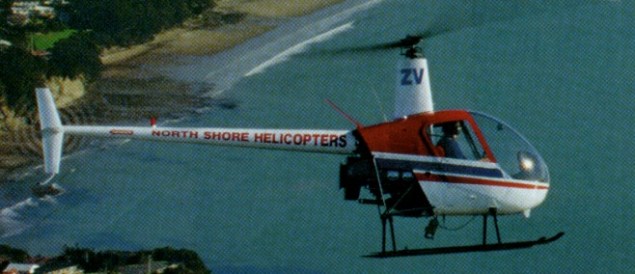
From the time that helicopters became practical aircraft their unit costs have always been high in comparison with those of fixed-wing aircraft of similar capacity. In the United States Franklin D. Robinson formed the Robinson Helicopter Company, based at Torrance in California, to design and market a lightweight civil helicopter which would be competitive in price with two-seat fixed-wing aircraft then on the market.
Robinson produced the small two-seat R-22, powered by a Lycoming piston engine and the two-blade rotor system was designed around a patented three-hinge coupling that does away with lag hinges, dampers and hydraulics. The O-320 normally runs at 2,700 rpm to produce 160 hp. Robinson reduced the rpm to 2,652 and limited the pilot to only 131 hp for five minutes and 124 hp for maximum continuous power. An elastic teeter hinge stop was later included to prevent the rotors from striking the tail boom while winding up or running down in gusting winds (Beta model). To reduce operating costs the R-22 is built from non-exotic materials, relying on standard aerospace metals with an emphasis on durability and maintainability. Other than routine maintenance every 100 hours, the helicopter only requires a factory overhaul every 2000hrs of flight.
Design began in 1973 and the first R-22 flew on 28 August 1975, followed by a second in early 1977, and these two aircraft were used to gain FAA and CAA certification on 16 March 1979 and June 1981 respectively. The R22 was the first helicop¬ter to be certificated under the new and more stringent FAR Part 27. Deliveries began in October 1979. The R-22 sold quickly and in 1983 a modified R-22A was certified to allow the helicopter to undertake IFR training and operate with US Police Forces who had shown an interest. Over 500 of these models sold world-wide and in August 1985 the R-22 Beta model was announced.
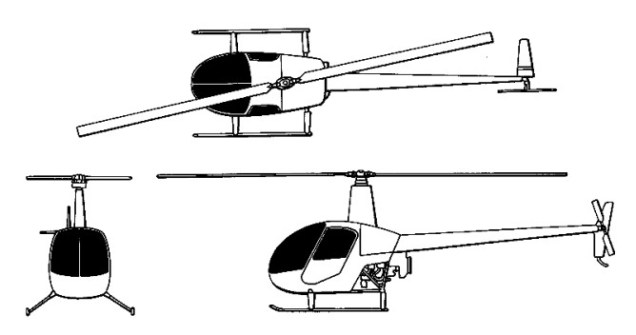
A simple, pod-and-boom light helicopter; horizontal stabiliser, starboard side only; vertical stabiliser above and below boom; offset to starboard; tall rotor mast. Horizontally mounted piston engine drives transmission through multiple V belts and sprag-type overrunning clutch; main and tail gearboxes use spiral bevel gears; maintenance-free flexible couplings of proprietary manufacture used in both main and tail rotor drives. Two-blade semi-articulated main rotor, with tri-hinged underslung rotor head to reduce blade flexing, rotor vibration and control force feedback, and an elastic teeter hinge stop to prevent blade-boom contact when starting or stopping rotor in high winds; blade section NACA 63-015 (modified); two-blade tail rotor on port side; rotor brake standard.
Flying controls are manual. Removable dual controls standard. All-metal bonded blades with stainless steel spar and leading-edge, light alloy skin and light alloy honeycomb filling; frame section of steel tube with light alloy skinning; full monocoque light alloy tailboom. Welded steel tube and light alloy skid landing gear, with energy-absorbing crosstubes.
The basic model, which became known as the R22 Alpha, was replaced from the 501st aircraft onwards, in 1985, by the upengined R22 Beta. Improvements to the R-22 Beta model include uprated 160hp Lycoming O-320-B2C engine, high-capacity oil cooler, improved heater, demister, silencer and rotor brake. This two-seater can cruise at 178km/h and with a twenty US gallon tank of fuel travel for 385km. The Beta was certified on 5 August 1985. The more powerful Textron Lycoming O-360 engine provides better high-level hover performance and allows take-off power to be sustained up to 2,285m. Previously optional, tinted windscreen and door windows were fitted as standard. Production began at c/n 2571.
Despite the company’s small size, Robinson achieved a production rate of about 30 R22s per month, with 402 produced in 1991 alone. There have also been military customers, such as Turkey, who ordered 10 for basic pilot training. Over 2300 R22s of all versions had been delivered by early 1993. Total production of the R22 had exceeded 2,500 aircraft by 1995.
Japanese certification was achieved on 18 November 2002. By September 2003, Robinson had produced 5,000 helicopters, including 390 in 2000, 328 in 2001 and 255 in 2002. Production rate 11 helicopters per week in 2003. Factory floor area 24,150 sq.m. Workforce totals 820. Company is ISO 9001 certified.
The R22 Beta II cost US$170,000 for the basic version in 2003. The engine is mounted in the lower rear section of the main fuselage, with cooling fan. Over the years, Lycoming has been so impressed with the reliability and condition of both the R22 and R44 engines that they actually increased the TBOs to 2,200 hours. Light alloy main fuel tank in upper rear section of the fuselage on port side. Transmission overhaul interval 2,200 hours or 12 years.
Two seats side by side in enclosed cabin, with inertia reel shoulder harness. Curved two-panel, tinted windscreen. Removable door, with tinted window, on each side. Baggage space beneath each seat. Cabin heated and ventilated. Electrical system, powered by 12V DC alternator, includes navigation, panel and map lights, dual landing lights, anti-collision light and battery.
Standard equipment includes rotor brake; tinted windscreen and windows; belly hardpoint; dual landing lights; navigation, panel and map lights; anti-collision light; ground handling wheels; rotor blade tiedowns; and windscreen cover.
Optional equipment includes three-cylinder engine priming system; RHC oil filter; cabin heater/defogger; metallic base or trim exterior colours; and leather seats.
The R22 was purchased by only a couple of military customers, the Turkish Army, in 1992 and Argentina, mainly for use by the Buenos Aires Police.
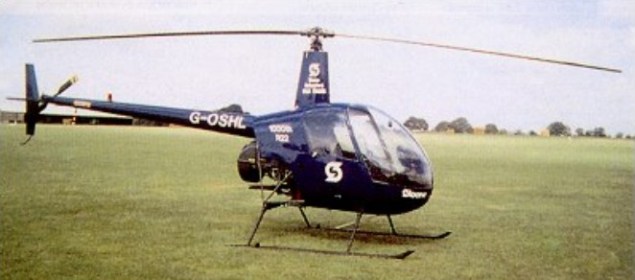
Variants:
R22 Mariner: fitted with floats and wheels, first delivered for offshore work in Mexico and Venezuela
R22 Police: version with special communications fit and optional port-side controls. Uprated electrical generator for searchlight, loudspeaker, siren and ATC transponder
R22 IFR: training version with improved flight instruments and radio for Instrument Flying Rules operations
External load R22: additional cargo hook certified to carry 181kg underslung load. When fitted aircraft has a VNE (never exceed speed) limit of 139km/h. Conversions undertaken by Classic Helicopter Corp. of Boeing Field, Seattle, Wa.
R22 Agricultural: equipped with low-profile belly hopper and spray-bar system
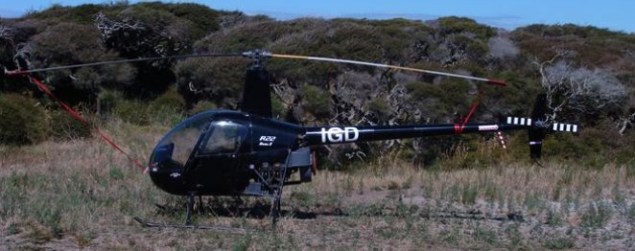
Specifications:
R-22
Engine: Lycoming O 320-A2B, derated to 124 hp
TBO: 2,000 hrs
Rotor: Two blade, teetering, 25 ft. dia
Length: 21 ft. 10 in
Height: 8 ft. 9 in
Max ramp weight: 1,300 lbs
Max takeoff weight: 1,300 lbs / 621kg
Standard empty weight: 790 lbs
Max useful load: 510 lbs
Payload max fuel: 389 lb
Disc loading: 2.6 lb/sq.ft
Power loading: 10.5 lb/hp
Max usable fuel: 20 USG/120 lbs
Max rate of climb, sea level: 1200 fpm
Max rate of climb, 5,000 feet: 1060 fpm
Max operating altitude: 14,000 ft
Max speed: 101 kts
Cruise, 65 % power at 8,000 ft: 94 kts
Fuel flow at 65 % power: 8 USG/hr
Endurance at 65% power, no res: 2.5 hrs
Max cruise: 96 kt
Max range cruise: 87 kt
Range max fuel/ cruise: 108 nm/1.1 hr
Range max fuel / range: 118 nm/ 1.4 hr
Service ceiling: 14,000 ft
Hover in ground effect: 6500 ft
Hover out of ground effect: 4500 ft
Seats: 2
199 built
R22HP
Engine: Lycoming O-320-B2C, 160 hp de-rated to 124 hp
TBO: 2000 hrs
Main rotor: 25.2 ft
Seats: 2
Length: 28.7 ft
Height: 8.8 ft
Max ramp weight: 1300 lbs
Max takeoff weight: 1300 lbs / 621kg
Standard empty weight: 800 lbs
Max useful load: 500 lbs
Zero fuel weight: 1184 lbs
Max landing weight: 1300 lbs
Disc loading: 2.6 lbs/sq.ft
Power loading: 10.5 lbs/hp
Max usable fuel: 120 lbs
Max rate of climb: 1200 fpm
Service ceiling: 14,000 ft
Hover in ground effect: 8,300 ft
Hover out of ground effect: 6,400 ft
Max speed: 102 kts
Normal cruise 75% @ 3000 ft: 94 kts
Fuel flow @ normal cruise: 48 pph
Endurance @ normal cruise: 2.3 hr
151 built
R-22 Alpha
Engine: 1 x Textron Lycoming O-320-B2C, 160hp derated to 124 hp
Instant pwr: 95 kW
Rotor dia: 7.7 m
MTOW: 1370 lb, 621 kg
Empty wt: 824 lb, 380 kg
Useful load: 240 kg
Fuel cap: (19.2 gallons) 115 lb, 75 lt
Pilot, passenger and Baggage 431 lb
Vne: 102 kts
Cruise Airspeed 75%: 96 kt
Maximum Range (No Reserve) 208 nautical miles
ROC @ 53 kt: 1000 fpm
HIGE: 6970 ft
HOGE: 5200 ft
Service ceiling: 14,000 ft
Crew: 1
Seats: 2
151 built
R22 Beta
Engine: 1 x Textron Lycoming O-320-B2C, 119kW, 131 hp for five minutes and 124 hp continuous
Main rotor diameter: 7.67m
Length: 6.3m
Height: 2.67m
Max take-off weight: 621kg
Empty weight: 379kg
Max speed: 180km/h
Ceiling: 4265m
Range with max payload: 592km
Crew: 1
Passengers: 1
R22 Beta II
Engine: Lycoming O-360, 131 hp
MTOW: 1370 lb
Empty wt: 855 lb
Usable fuel capacity: 72.5 lt
Optional auxiliary fuel capacity: 39.75 lt
HIGE: 9400 ft
Max op alt: 14,000 ft
After working for Bell, Kaman, Cessna and then Hughes, Frank Robinson formed Robinson Helicopters in 1971 to design and build a low-cost, piston engined, two-seat lightweight helicopter as the R22, which first flew in August 1975. Deliveries started 1979 and over 2,700 since sold in several versions, including improved R22 Alpha and Beta, Mariner with floats, IFR Trainer for instrument training, Law Enforcement and Agricultural versions. A four-seat development first flown March 1990 as the R44 Astro, with deliveries from 1993. Variants include IFR Trainer, Newscopter for media operations, and Police Helicopter.
1995: 24747 Crenshaw Blvd, Torrance, CA 90505, USA.
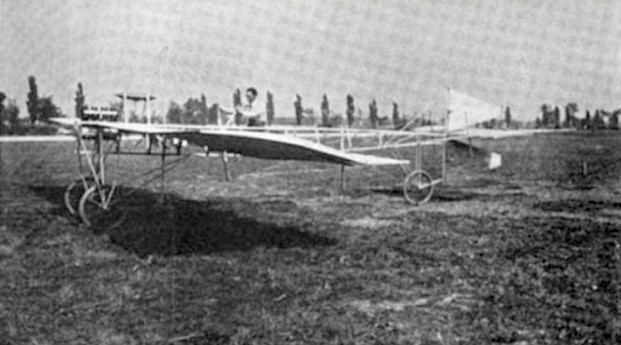
The Hugh Robinson monoplane is sometimes claimed to be the first American monoplane, this machine with a 30 hp engine was used for exhibitions in the Joplin and St Louis area in 1908.
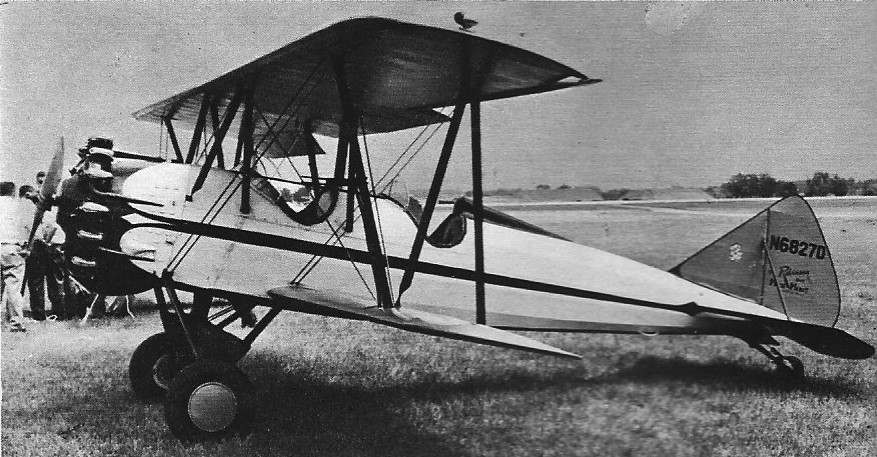
The tandem two-seat Robinson Mere Merit N6827D is actually a 2/3 scale of a 1929 Ken Royce-Rearwin and was built by father and son Cleo and Howard Robinson of Phillipsburg, Kan., SA. Construction took 21 months and $1700, including an antique-like paint job. First flying in late 1964, the wings are wood, fuselage and tail steel tube, all fabric covered.
Engine: Warner, 145 hp
Wingspan: 28 ft / 8.54 m
Length: 20 ft / 6.10 m
Empty weight: 900 lb / 408 kg
MAUW: 1400 lb / 635 kg
Cruise: 120 mph / 193 kph
Landing speed: 43 mph / 69 kph
ROC: 1000 fpm / 5.08 m/sec
Range: 400 mi / 644 km
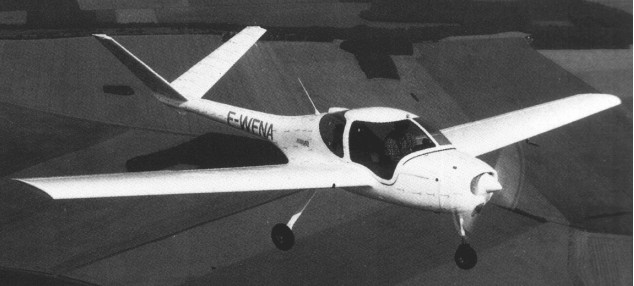
Robin began work on its Avion Tres Leger (very light aeroplane) in 1981 with the intention of producing a lightplane that would be cheap both to buy and to operate. The concept matured with a pod-and-boom fuselage whose wide side-by-side cockpit section tapers to a slim rear section terminating in a V-tail, fixed tricycle landing gear and a specially developed 35-kW (47-hp) Ateliers JPX air-cooled engine. Construction is mixed, the wings being of wood with fabric covering, the fuselage being a glassfibre/honeycomb/epoxy unit and the control surfaces are of Duralu¬min AU4G. The integral polycarbonate canopy opens by tilting forward over the front section of the fuselage and is counterba-lanced. The wing uses a modified NACA 43015 profile set at 3o incidence with a washout of 4 o; it has a coefficient of 0.5. Although with 0 o sweep back at the leading¬edge, the wing has an inverse sweep of 3o at the spar. Flaps totalling 10.4 ft 2 (0.97 sq.m) run the majority of the span and are independent of the ailerons. Operated by an electric motor, these flaps are controllable from the instrument panel and various angles can be selected between 0 and 60 o. The first example flew in June 1983, and testing led to certification to FAR Pt 22 standards. The French government ordered the type for government ¬sponsored training schools, and production is also being undertaken for private operators. The definitive version is the ATL Club with a more powerful engine and a number operationally desirable refinements.
A side by side two seat single engined low wing monoplane with conventional three axis con¬trol. Wing has unswept leading edge, swept forward trailing edge and tapering chord; V tail. Pitch/yaw control by elevons; roll control by half span ailerons; control inputs through stick for pitch/roll and pedals for yaw. Cantilever wing; wing profile NACA 43015; double surface. Undercarriage has three wheels in tricycle formation; bungee suspen¬sion on nosewheel and glass fibre suspension on main wheels. Push right go right nose¬wheel steering connected to yaw control. Brakes on main wheels. Glass fibre fuselage, totally enclosed. Engine mounted at wing height driving tractor propeller.
ATL
Length overall 22.1 ft, 6.75 m
Height overall 6.4ft, 1.95m
Wing span 32.8ft, 10.00m
Chord at root 4.9ft, 1.50m
Chord at tip 2.8ft, 0.80m
Dihedral: 6o
Sweepback: 0o
Tailplane span 9.5 ft, 2.87 m
Fin height 3.3 ft, 1.00 m
Total wing area 129 sq.ft, 12.0 sq.m
Total aileron area 10.4 sq.ft, 0.97 sq.m
Fin area 20.9 sq.ft, 1.94 sq.m
Total elevon area 5.2 sq.ft, 0.48 sq.m
Wing aspect ratio 8.3/1
Wheel track 9.7 ft, 2.92 m
Wheelbase 5.3 ft, 1.60 m
Nose¬wheel diameter overall 11 inch, 27 cm
Main wheels diameter overall 13 inch, 33 cm
ATL Club 47
Engine: PAL 1300, 47 hp
Seats: 2
Empty wt: 200 kg
MAUW: 420 kg
Cruise: 100 kt
Ceiling: 13,000 ft
Endurance: 5 hr
Range: 500 mile
ATL Club
two-seat sport lightplane
Span: 10.25m (33ft 7.5 in)
Length: 6.70m (2lft 11.8in)
Powerplant: l x Ateliers JPX 4T-60A, 44.7kW (60 hp)
Max T/O weight: 580 kg (1,279 lb)
Max speed: 112 mph at sea level
Operational range: 714 miles
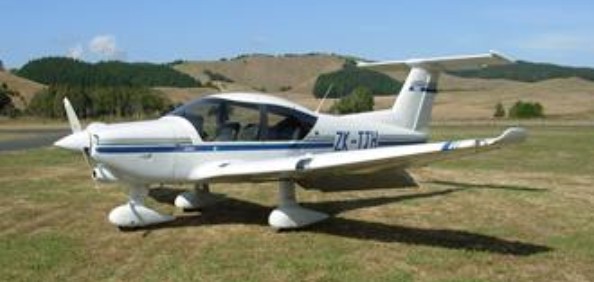
First flown in 1988 in 3000/160 form, the four seat, T tailed Robin 3000 series should appeal to both the trainer and four seat cross country light single markets. A totally new airframe, but with the original Jodel wing planform, the aircraft was available as either a 120 hp or 140 hp version. The R3140 is powered by a derated 160 hp Lycoming and cruises at 119 knots (65 per cent power) over a 640 nm range (optional tanks for extended range available) with four seats.
In 1983 Avion Robin tested a 160 hp PRV V-6 car engine (Peugot, Renault & Volvo) in their new R.3150 prototype.
Certification of the R3000/160 is under Direction Generale L’Aviation Civile France DGAC 172.
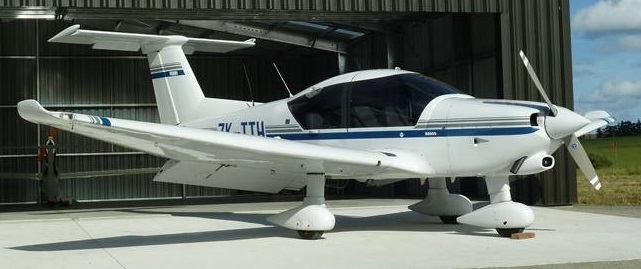
1993 R3000
Engine: Lycoming 0-360-A3A
Seats: 4 seat
R3000/120
R3140
Lycoming O-320
Cruise (65%): 119 kt
Range @ 65%: 640 nm
Seats: 4

Production of the first R2160 aircraft began in Canada in 1981, but Canadian production ceased in 1984 when the line was re¬turned to France. It was not until the early 1990s that the R2160 got a facelift for the growth of the trainer market foreseen at that time. With dual control joysticks and produced at the Dijon works of Avions Pierre Robin, the R 2000 series of all-metal lightplanes was introduced by the company in 1977 to replace the HR 200.
In general appearance, the R 2000 and HR 200 are similar, the most obvious external difference being the former’s enlarged tail unit, with a long ventral fin, designed to improve the lateral control and handling. The wing has been extensively modified, with an NACA 23015 profile instead of the earlier NACA 64A5 15, and a small increase in chord and area. Many changes have been made in the construction methods, with new tooling throughout for the metal aircraft in the Robin line, which included the R 1000 (formerly HR 100) as well as the R 2000.
The prototype of the R 2000 series flew on 15 January 1976 and a pre-production example followed on 15 July 1976, the latter having a 160 hp engine and therefore being, in effect, a prototype of the variant now in production as the R 2160. An aerobatic version of the latter is also available (certificated 1978), in which the AEIO-320 engine is used, with an inverted flight fuel system, and the same basic aircraft is offered with a 108 hp engine, in which guise it is marketed as the R 2100.
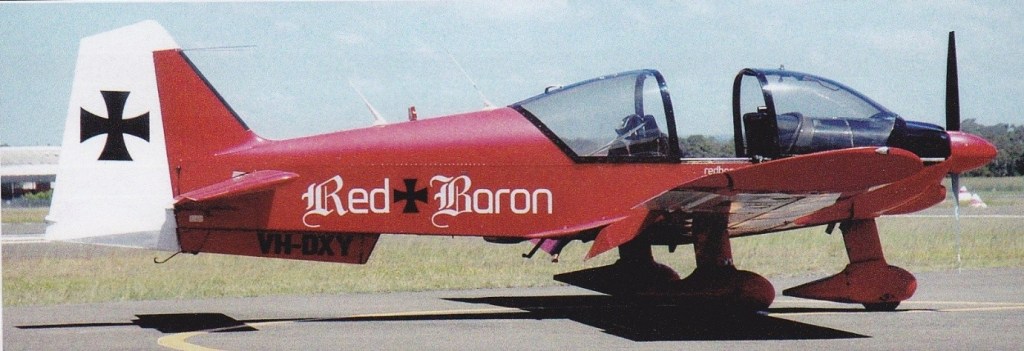
The Alpha 160 is renamed 2160. For unusual-attitude flight, the R2160’s all-aluminium alloy, semi-monocoque structure is built to the strength of FAR 23 and is certified to +6/-3g. The flap system is electric and gives up to 35 degrees.
The R2120 U (the certified model name) are referred to as the Alpha 120T (Trainer). The Alpha 120T is a non-aerobatic derivative of the Alpha 160A. Powered by a Lycoming O-235, and fitted with dual control sticks, throttles and differential brakes.
Alpha, in New Zealand, purchased the production rights in 2004.
12 April 2006 saw the first flight of a New Zealand-built Alpha 160A (formerly Robin R2160) at Hamilton Airport, New Zealand.
Certification of the R2120U, R2160 (265 and up), and R2160I is under NZ TC A-15.
2100
Engine: One 108 hp Lycoming O-235H
Fuel capacity 264 Imp gal (120 1)
Max speed at sea level, 138 mph (222 km/h)
Cruising speed at 75% power, optimum altitude, 124 mph (200 km/h)
Service ceiling, 12,500 ft (3 810 m)
Initial rate of climb, 710 ft/min (3,60 m/sec)
Range, 520 mls (838 km)
Empty weight: 1,167 lb (530 kg)
Max take-off weight: 1,718 lb (780 kg)
Wing Span, 27 ft 4 in (8,33 m)
Length, 23 ft 3½ in (7,10 m)
Height, 6 ft 1l½ in (2,13 m)
Wing area, 140 sq ft (13,00 sq.m)
Accommodation: 2
2112 Alpha
Engine: Lycoming O-235, 112 hp
2120U (Alpha 120T)
Engine: One 108 hp Lycoming O-235
Prop: 2 blade Sensenich fixed
Cruise: 105 kt
Fuel cap: 31.7 USG
Range: 550 nm
Loading: +6 / -3G
2160 (Alpha 160A)
Engine: One 160 hp Lycoming O-320-D2A or one 160 hp Lycoming AEIO-320
Prop: Sensenich 74-DM-685-2-64
Fuel capacity 264 Imp gal (120 1)
Vne: 178 kts
Vno: 127 kts
Max X-wind: 18 kts
Max speed at sea level, 160 mph (257 km/h)
Cruising speed at 75% power, 7500 ft, 130 kts (242 km/h)
Service ceiling, 15,000 ft (4572 m)
Initial rate of climb, 1,020 ft/min (5,20 m/sec)@ 78 kts
Best angle of climb: 70 kts
Range, 418 mls (673 km)
Stall: 51-63 kts
Empty weight: 1,211 lb (550 kg)
Max take-off weight: Utility 1984 lbs, aerobatic 1,764 lb (800 kg)
Max baggage: 77 lbs
Span, 27 ft 4 in (8,33 m)
Length, 23 ft 3½ in (7,10 m)
Height, 6 ft 1l½ in (2,13 m)
Wheel track: 9 ft 6in
Wing area, 140 sq ft (13,00 sq.m)
Accommodation: 2
Aerobatic
Load factor: +6/-3
2160 Sport
Engines: 1 x 160 hp Lycoming O-320-D2A
Prop: two-blade Sensenich fixed-pitch
Seats: 2
Useful load: 550 lb
Max range: 410 sm
Wingspan: 8.33 m
Length: 7.10 m
Height: 2.13 m
Under-carriage: Fixed oleo-pneumatic, steerable nose wheel
Stall: clean: 63 kts, with flap: 51 kts
Max Cruise: 150 mph
Cruise: 2,450 rpm @ 8,000 ft: 130 kts
Range: 363 nm with reserves
Fuel cap: standard tanks: 120 lt, optional160 lts
Maximum wt: 900 kg
Empty Wt: 580 kg
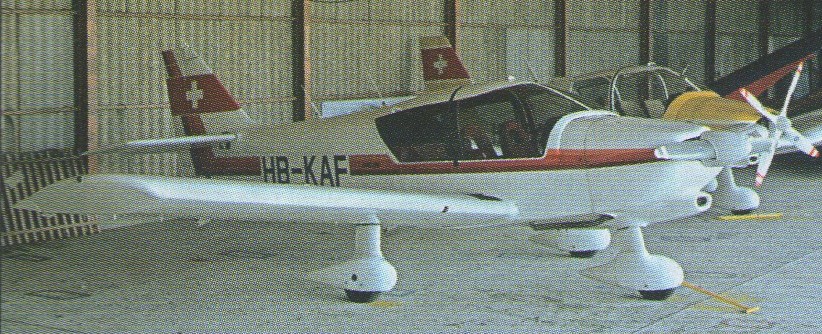
First flown in 1976, Avions Robin built 66 of the all metal, four seat, fixed gear R.1180 Aiglon before production was terminated in the early 1980s.
In 1997 Robin was set to restart production of the Aiglon II with a Lycoming O-320-A3A. The useful load is 1102 lb and cruise at 75% is 135 kt.
All R1180TD are certified under Direction Generale L’Aviation Civile France DGAC 61.
Back to Robin HR200


