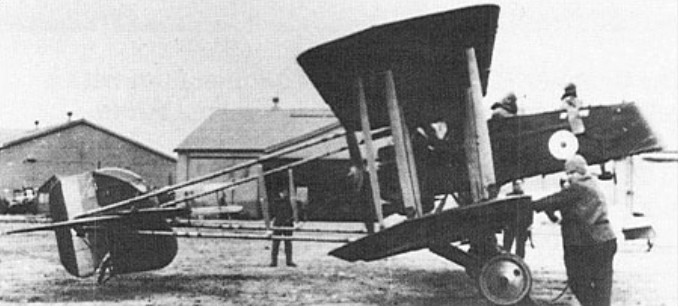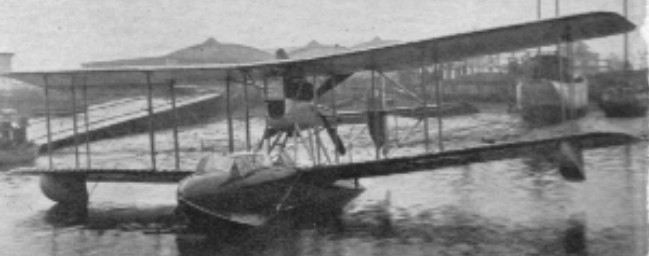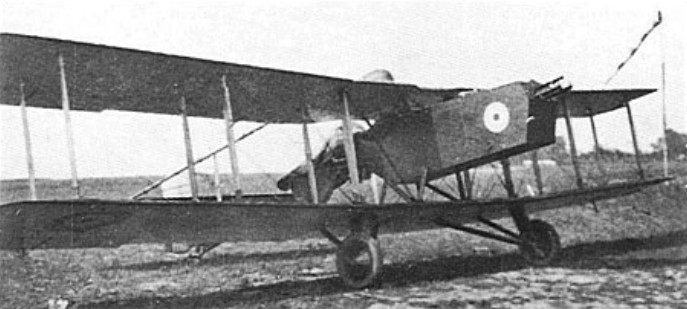
Royal Aircraft Factory AE.3 / RAM

The last aircraft type to emerge from the Royal Aircraft Factory at Farnborough, before its change of name in June 1918 to Royal Aircraft Establishment, the A.E.3 was itself an extrapolation from the N.E.1.

Designated as an “Armoured Experimental” type, the A.E.1 was intended as a specialised ground-attack fighter, for which purpose it was to mount a pair of 7.7mm Lewis guns in the nose, with a limited degree of movement in azimuth and depression. A third Lewis was to be pillar-mounted in the front, observer’s, cockpit for self-defence. Like the N.E.1, the A.E.3 was a large three-bay equi-span biplane, differing principally in the construction and shape of the nacelle, which was armoured with steel plate and provided stowage for 32 ammunition drums.

Royal Aircraft Factory AE.3 / RAM Article

Intended to be powered by the 200hp Hispano engine as used in the N.E.1, the A.E.3 prototype emerged at the end of March 1918 with a 200hp Sunbeam Arab, whilst the second, eight weeks later, had a 230hp Bentley B.R.2 rotary. Flight testing of the latter began on 4 June, and larger ailerons and rudders were fitted before this A.E.3 went to France for service trials, which aroused little enthusiasm. The third aircraft, also completed in June 1918, had an Arab engine like the first and in this form the A.E.3 was named the Ram I, whilst the B.R.2 version became the Ram II.

A proposed derivative, the Ram III, was not built and no production ensued, other, better, types having become available.

AE.3 / Ram Mk. 1
Engine: 1 x 200-h.p. Sunbeam Arab
Span: 47ft 10.5in
Length: 8.44 m / 28 ft 8 in
Height: 3.05 m / 10 ft 0 in
Wing area: 52.02 sq.m / 559.94 sq ft
Max. speed: 153 km/h / 95 mph
Seats: 2

Ram Mk. II
Engine: 1 x 230-h.p. Bentley B.R.2.
Span: 47ft 10.5in
Seats: 2
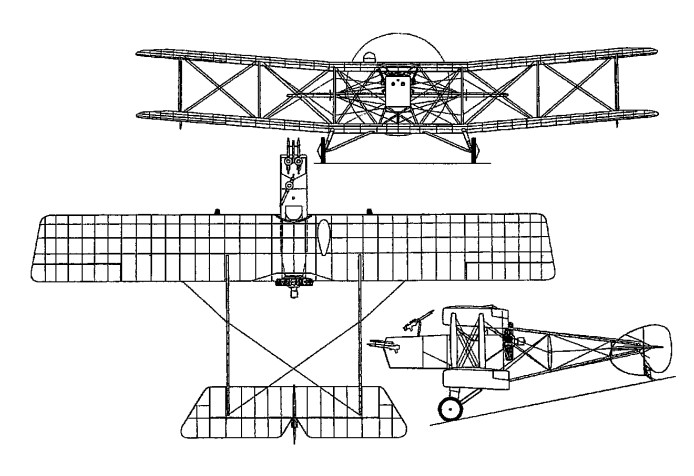
Royal Aircraft Factory A.E.3 Ram

Royal Aircraft Factory NE.1

As a derivative of the F.E.9, the RAF planned to develop a dedicated night fighter as the F.E.12. This was to have used the same 200hp Hispano- Suiza eight-cylinder Vee-type water-cooled engine, the same undercarriage, tailbooms, tail unit and wing centre section as the F.E.9, and basically the same nacelle, but with the crew positions reversed. New equi-span, three-bay wings were planned, with plain unbalanced ailerons. The pilot, in the front cockpit for the best possible view during unaided nocturnal operations, was to have a forward-firing 7.7mm Lewis gun, whereas the observer was to be armed with a Vickers rocket gun for which two mounts were to be provided for firing forwards or aft. Provision was to be made for a searchlight in the nose, and another on the forward mount for the rocket gun, with a winddriven generator under the nacelle. Six prototypes were planned, but before construction began the designation was changed to N.E.1 (for “Night-flying Experimental”) and some changes were made. These eliminated the second searchlight, increased the span of the wing centre section, changed the tail unit design, moved the boom attachment points on the tailplane outwards, and introduced a wide-track undercarriage with a divided axle arrangement.

Flown early in September 1917, the first N.E.1 was almost immediately damaged and was then modified, before resuming flying on 4 October, to accommodate the observer in the front cockpit with the rocket gun and the pilot behind with a fixed Lewis gun. In this form, the N.E.1 was submitted to official trials at Martlesham Heath in November 1917, but was not thought to have adequate performance to serve as a night fighter. The other five prototypes were all completed by January 1918, but one was used only for static testing, another probably remained unflown and only one was issued to an RFC squadron for home defence.

Engine: 1 x 200-h.p. Hispano-Suiza
Wingspan: 14.57 m / 47 ft 10 in
Length: 9.19 m / 30 ft 2 in
Height: 2.94 m / 10 ft 8 in
Wing area: 51.57 sq.m / 555.09 sq ft
Max take-off weight: 1336 kg / 2945 lb
Empty weight: 939 kg / 2070 lb
Max. speed: 153 km/h / 95 mph
Ceiling: 5335 m / 17500 ft
Seats: 2

RAF SE.5 Gallery

Back to RAF SE.5

Royal Aircraft Factory S.E.5A of the Royal Flying Corps.
Albert Ball in an early S.E.5
SE.5A restored to flying by RAE apprentices and enthusiasts in 1960
SE5A
Lt Robert McKenzie scored two of his six victories in SE5A C5382 ‘Z’ while serving in France with the Australian 2 AFC, and was awarded the MC.
SE.5A
SE.5A of 56 Sqn, RFC
SE.5a