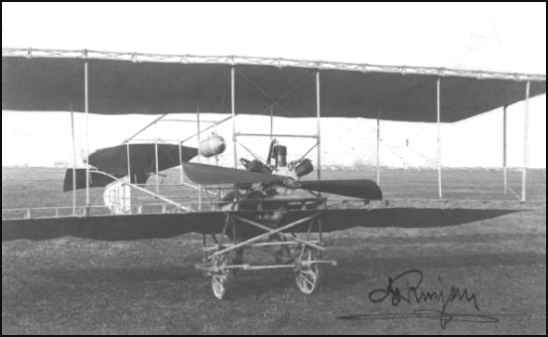
After returning to Gorica, with his brother’s help Edvard Rusjan built a motor biplane on the model of the Curtiss and Farman aircraft, which had been most successful in Brescia. In the fall of 1909, the Rusjan brothers began work on a powered airplane using a 3-cylinder, 25-horse-power. Anzani-model engine. The airplane was a canard-type biplane with paper covered wings, 8 m wingspan, with the larger part of the horizontal stabilizer forward of the wings.
Flight tests, however, fell short of expectations. By relocating the vertical stabilizer aft of the wings in what has evolved as the conventional configuration, they achieve success. On November 25, 1909, on the Mila Rojice Airfield in the neighborhood of Gorizia, Edvard made the first successful powered flight in Yugoslav Aviation history in his EDA 1 airplane.
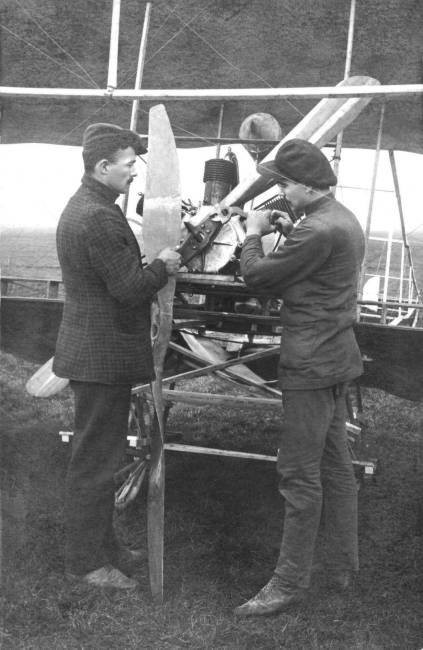
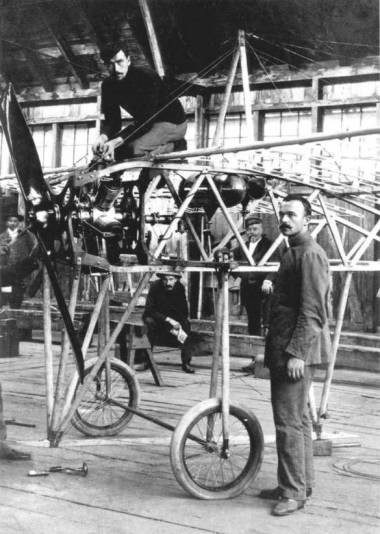
Giuseppe and Eduardo replacing the propeller of EDA I (1909)
The flight lasted about 10 seconds and Edvard traveled approximately 60 meters at a height of 2 meters. Four days later, he increased his distance to, 500 meters at a maximum altitude of 12 meters. Observers estimated that the airplane reached speeds between 50 and 60 kilometers per hours. It was a remarkable flight for Edvard – he was the first Yugoslavian to successfully fly an airplane.
After these two flights, all the Rusjan’s tests were transferred over a field called “Campagna Grande” (great meadow) by Merna.
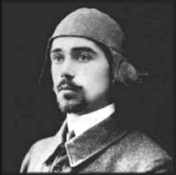
Edvard Rusjan was born in Trieste, Austro-Hungarian Empire, on July 6, 1886. While still a lad, his family moved to Gorizia where he spent his youth and attended public secondary school and an evening course in trade. During his school years, he was apprenticed barrel maker and was a successful racer.
In 1900, the Rusjan brothers made a model aircraft with a propeller drive on a spring. Edvard’s aviation career began in 1908 when he started designing and building model airplanes. One design, a helicopter that was strapped on like a backpack, was a portent of things to come decades later. With older brother Josiph’s help, he designed a glider that became a pattern for future airplanes.
They continued their self-education and in 1908, received his father’s support for the production of the first aircraft. In September 1909, Edvard Rusjan visited an international air meeting in Brescia (Italy), where he examined the construction of the most successful aircraft and got to know the French airman, Louis Blériot.
In the fall of 1909, the Rusjan brothers began work on a powered airplane using a 3-cylinder, 25-horse-power. Anzani-model engine. The airplane was a canard-type biplane with paper covered wings with the larger part of the horizontal stabilizer forward of the wings. Flight tests, however, fell short of expectations. By relocating the vertical stabilizer aft of the wings in what has evolved as the conventional configuration, they achieve success. On November 25, 1909, on the Mila Rojice Airfield in the neighborhood of Gorizia, Edvard made the first successful powered flight in Yugoslav Aviation history in his EDA 1 airplane.
From December 1909 to the end of June 1910, the Rusjan brothers built and flight tested five airplanes of entirely different designs.
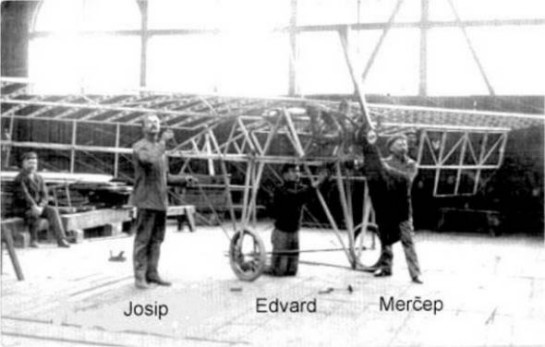
Zagreb, Eduardo and Giuseppe working
Since Rusjan could not realise the planned development of aircraft to commercial production in Slovene circumstances, in the middle of 1910 he concluded a partnership with the Serb, Mihailo Mercep, a well-known Zagreb photographer and cyclist, who planned the production of aircraft for the market. After the agreement with Merćep, they had no more financial problems and a large hangar is available for their planes. So the Mercep-Rusjan monoplane (a supplemented variant of EDA VI) was created in the first aircraft factory in Croatia.
After their successful flight demonstration with the Mercep-Rusjan, and in accord with the custom of the time, Edvard and Mercep organized a tour of European cities, the first stop being Belgrade. On January 9, 1911, despite strong gusty winds, the 24-year-old Edvard went ahead with a demonstration flight. His takeoff and flight over the town and a railway bridge over the Sava River were uneventful. However, while the airplane was returning for a landing, at an approximate height of 20 meters, a strong gust ripped off a wing and the airplane crashed against a tower wall located on the riverbank. Edvard was killed.
His work was successfully continued by his brother Joze, who built a further 3 aircraft after Edvard’s death.
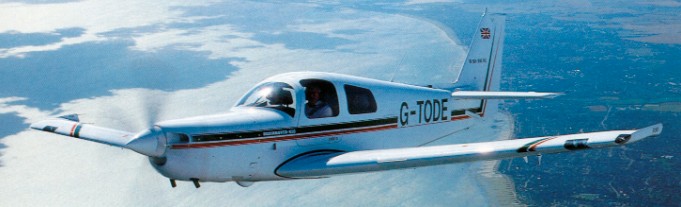
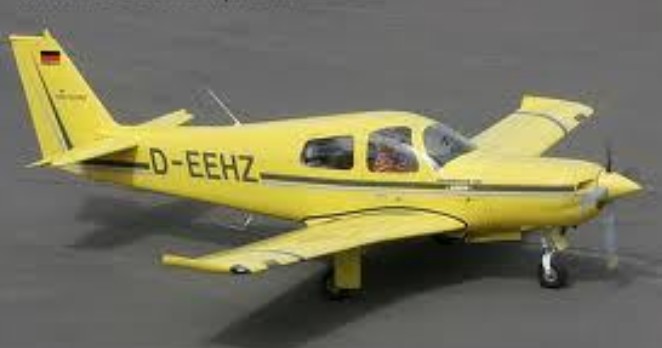
The R 90 was a new design based on the Ruschmeyer’s earlier MF85, making use of a range of modern technologies and materials. The MF85 series was powered by Porsche engines, but the unavailability of these powerplants led to the development of the Textron Lycoming powered R 90.
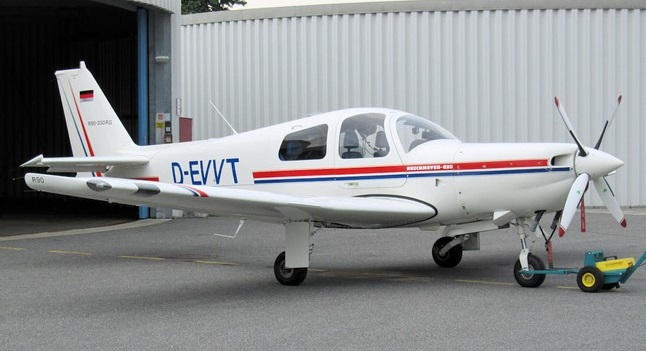
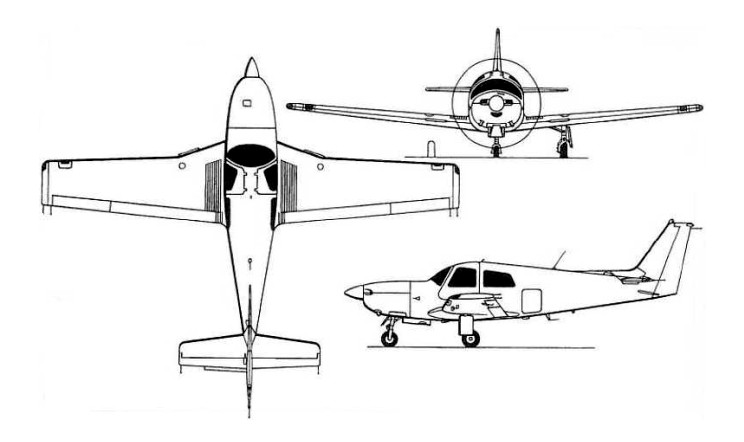
The Ruschmeyer R 90 possesses an aerodynamically clean airframe made possible by its glass fibre (with Rohacell core) construction. The advanced wing design features a `rain tolerant’ laminar flow aerofoil design, wet wing fuel tanks, upturned wingtips (for increased lateral stability, not drag reduction), small ailerons and inboard Fowler flaps.
A four-seat touring and IFR training monoplane first flown in 1991 and certificated 1992, the original R90-230 RG version with 230 hp engine and retractable undercarriage was to be joined by the R90-180 RG with a 180 hp engine and retractable undercarriage. Development of the definitive production version began in 1992 being followed by a production batch of 15 in the same year.
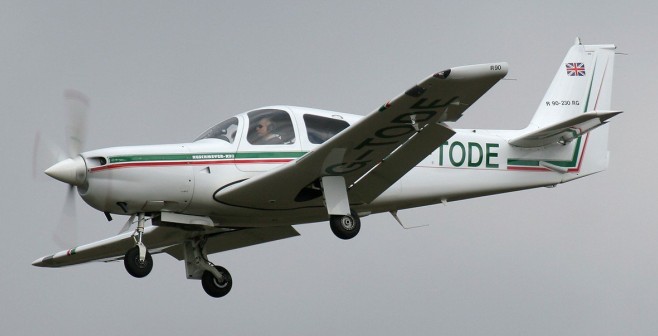
R-90-230RG
The initial R 90-230 RG production model was powered by a fuel injected Textron Lycoming IO540 flat six driving an advanced four blade composite construction propeller. A silencer on the engine, the four blade prop and the engine being derated to 170kW (230hp) from 195kW (260hp) combine to give low interior and exterior noise levels. Even though the engine has been derated, because of the R 90’s comparatively light structure its performance is quite strong.
All production R 90s were the high performance retractable undercarriage R 90-230 RG. This model first flew on August 8 1988 (as MF.85), with German certification awarded in June 1992.
Members of the planned R 90 family include the fixed gear, 175kW (235hp) O540J powered R 90230 FG and the fixed undercarriage 135kW (180hp) IO360 (flat rated to 150kW/200hp) powered R 90180 FG. The R 90350T RG, to be powered by a 185kW (250hp) turbocharged engine and capable of 435km/h (235kt) cruising speed, and the high performance five/six seat R 95 were also under development. An Allison 250B17 turboprop powered development, the R 90420 AT proof-of-concept model, was flown in 1993 and used only as a factory aircraft.
However Ruschmeyer was forced to file for bankruptcy in early 1996 and production has ceased. Twenty-two R 90-230 RGs were built before production ceased.
In 1999 Solaris Aviation was founded, and purchased the assets of Ruschmeyer. Solaris Aviation marketed the R90 as the Solaris Sigma.
R 90-230 RG Engine: 1 x Textron Lycoming IO-540-C4D5, 170kW (230hp) (derated from 195kW/260hp) Propeller: four blade constant speed Mühlbauer MTV-14-B composite. Wing span: 9.50m (31ft 2in) Length: 7.93m (26ft 0in) Height: 2.73m (8ft 11in) Wing area: 12.94 sq.m (139.3 sq ft). Standard empty: 898kg (1980lb) Max. takeoff weight: 1,350 kg (2,976 lb) Empty equipped: 920kg (2030lb) Fuel Capacity: 250 ltr Max takeoff: 1350kg (2976lb) Max speed: 324km/h (175kt, 200 mph) at 3,050 m (10,000 ft) Max cruising speed: 311km/h (168kt) Economical cruising speed: 267km/h (144kt) Stall speed: 108 km/h (58 knots, 67 mph) (landing configuration) Initial rate of climb: 1140ft/min / 5.8 m/s Service ceiling: 4,895 m (16,060 ft) Take Off Distance: 420 m Landing Distance: 480 m Max range with reserves: 1610km (870nm) Range: 2,740 km (1,479 nmi, 1,703 mi)(45% power at 915 m (3,000 ft)) Endurance: 7.8hr. Seating: four
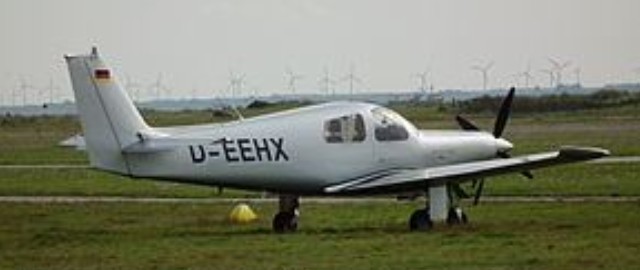
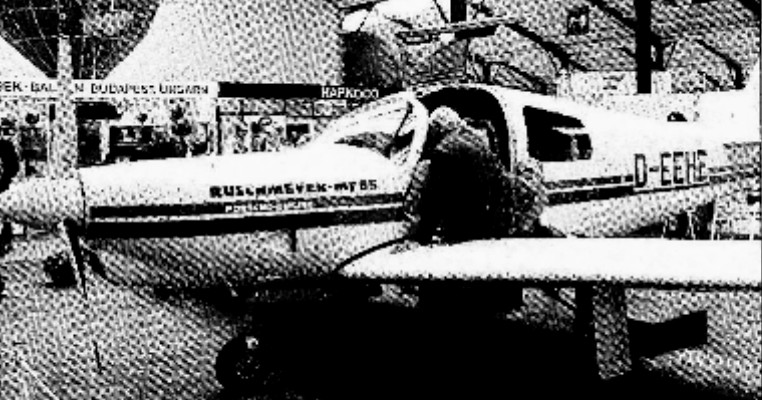
Debuted at Hannover 1987, the Ruschmeyer MF.85 prototype, D-EEHE, was built over three years by Horst Ruschmeyer’s fix based operation. The MF.85 is a composite four seat aircraft, planned to be offered with 180, 212, or 245 hp. Price was planned to be DM245,000 to DM325,000 (excluding avionics). The type could be specified as fixed undercarriage or retractable.
The prototype (V001 D-EEHE) flew with a 212 hp Porche PFM.3200N with a three bladed MTV.9 constant speed propeller engine on 8 August 1988, piloted by Horst Ruschmeyer.
V002 (D-EERO) flew on 23 September 1990, and V003 (D-EERH) on 12 February 1992.
The unavailability of the Porche PFM powerplants led to the development of the Textron Lycoming powered R 90.
Germany Established 1987, developed the R90 four-seat touring and IFR training monoplane of composites construction, first flown in 1991 and certificated 1992. Original R90- 230 RG version with 230 hp engine and retractable undercarriage is to be joined by the R90-180 RG with a 180 hp engine and retractable undercarriage, the R90-230 FG with 230 hp engine and fixed undercarriage, and R90- 300 T-RG with a supercharged 300 hp engine and retractable undercarriage. The R90-420 AT is a turboprop proof-of-concept model, first flown 1993 and used at present only as a factory aircraft.
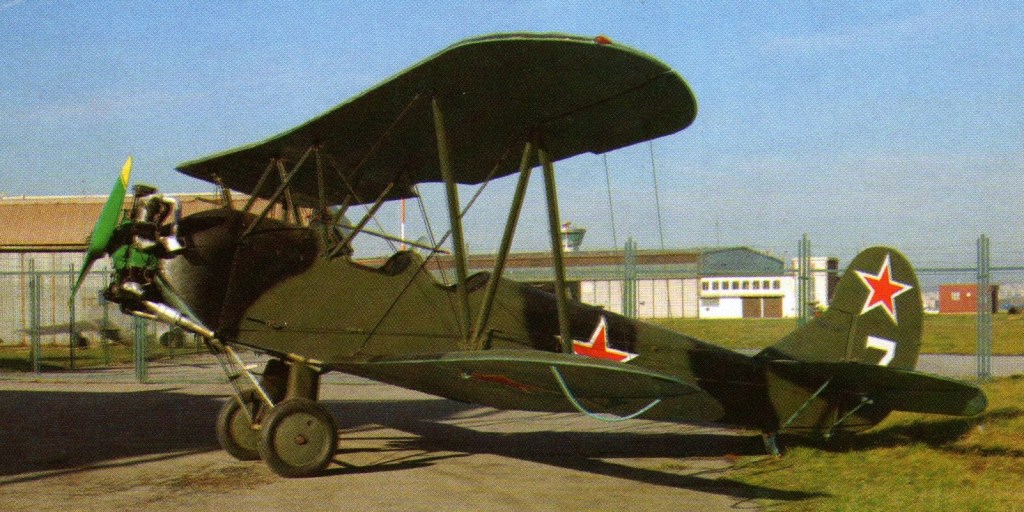
During the first flights in 2004, the Shvetsov M-11FR radial was damaged and needed to be overhauled. Albatros Aviation Services carried out the recent engine rebuild, using many hard-to-find original parts.
Slovak Republic-based Polikarpov U-2 replica ‘White 7’ (OM-LML) took to the air again after the engine overhaul on October 11, 2007. This machine was built by Rusavia in Moscow and was gifted to the Museum of Aviation collection at Kosice by Russia in August 2004.
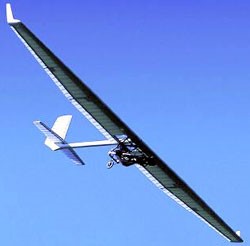
Designed by Roger Ruppert, the 1998 Archaeopteryx was conceived as a conventional glider configuration for foot launch. Primary targets were set to minimize the mass, allowing slowest possible flight speeds and providing good manoeuvrability based on a friendly stall behaviour as well as outstanding high-speed flight performances with full fairing on the cockpit. The concept permits a safe foot launch also in nil wind conditions. Excellent climb rates and an efficient riding out of extremely weak and slim thermals (microlift) are possible. No. Built: 1
Wing span: 13.6 m / 44.6 ft Wing area: 12.8 sq.m / 138 sq.ft Gross Weight: 160 kg / 353 lb Aspect ratio: 12.07 L/D Max: 24 MinSink: 0.44 m/s | 87 fpm Hang glider weight: 40 kg Minimum pilot weight: 70 kg Maximum pilot weight: 110 kg Minimum speed: 29 km/h Maximum speed: 140 km/h Packed length: 6 m Seats: 1
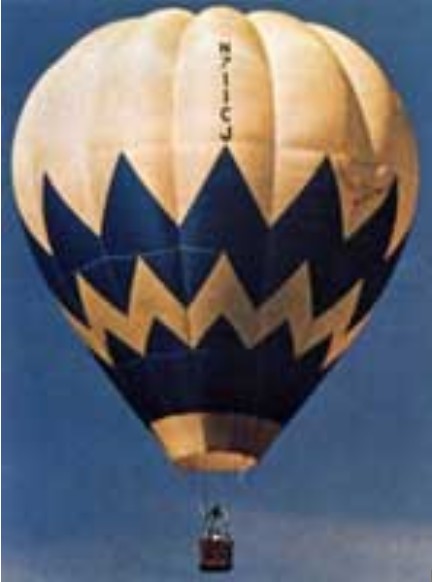
Thunder’s first U.S. sale was Cactus Jack, sold to Bob and Marge Ruppenthal, the Albuquerque couple at whose house the Thunder contingency stayed while campaigning Jumpin’ Jack in the ’73 Worlds. After modifications, the balloon was re-registered as a “Ruppenthal Eagle.”
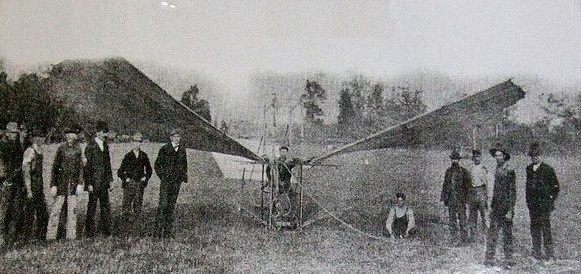
This machine was tested in October 1904, pulled by an automobile, but when the car reached a moderate speed the plane lifted, but a gust of wind tipped a wing so that the wheels on the opposite side were crushed. As a substitute, ordinary boards like skis were used, but then the car stalled without getting the plane off the ground, so horses had to be used. A team of draft horses pulled the rope and caused the plane to soar as high as the tree tops. Its builder Albert Rupel of Indianapolis, Indiana died of lockjaw less than a year later after stepping on a nail, before he could test it with a proper engine.