Back to Saab-29


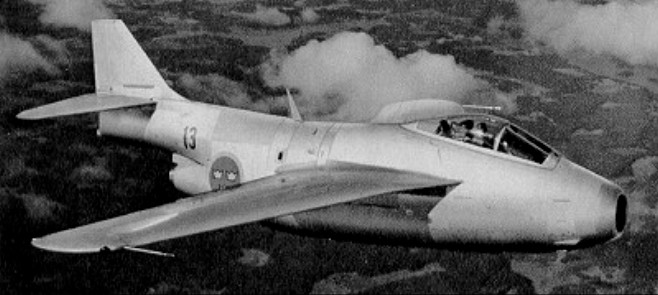
Saab’s original project for the Saab-29 had envisaged it as a conventional monoplane powered by a de Havilland Goblin turbojet, but information on German swept-wing research which became available soon after the end of hostilities in Europe (combined with development of the more powerful de Havilland Ghost turbojet) resulted in redesign to incorporate these features. As the company had no experience of the behaviour of a swept wing it was decided to use a Saab Safir lightplane to test a wing of this configuration, a reduced-scale wing with 25 degrees of sweep-back being installed and flown on this aircraft. Negotiations were initiated with de Havilland for licence-production of the Ghost turbojet in Sweden.
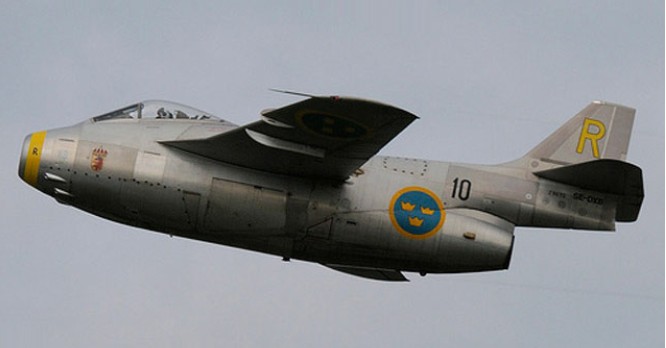
Of cantilver shoulder-wing monoplane configuration, the Saab-29 had retractable tricycle landing gear, its powerplant mounted within the rotund fuselage, and with the pilot accommodated on an ejection seat in a pressurised cockpit.
The first of four Saab-29 prototypes was flown initially on 1 September 1948, but it was not until the spring of 1951 that the aircraft was ordered into production, being the first aircraft in its class to be production-built in Western Europe.
First flown in prototype form on 1 September 1948, the initial production model was the J29A which began to enter service with the Swedish air force (Flygvapen) during May 1951 at Norrkoping.
Powered by a single Svenska Flygmotor RM2 turbojet engine (a licence-built version of the de Havilland Ghost) some 200 or so J29As were completed before production switched to the Saab-29B which was a multi-mission machine, the interceptor variant being known as the J29B (with increased fuel) while a specialised attack derivative A29B. The A29B being able to carry a variety of external ordnance including 250-kg (551-lb) general-purpose bombs, unguided air-to-air rockets with additional air-to-ground capability.
The S29C was optimized for reconnaissance tasks with the Hispano 20-mm cannon being replaced by six automatic cameras. Flown for the first time during June 1953, the S29C subsequently adopted the so-called dog-tooth’ wing leading edge which improved transonic handling characteristics.
First fitted to the Saab-29D variant, the Swedish-designed afterburner resulted in significantly greater power but only a few of the J29D subtype were built, it being supplanted by the J29E which was the first to feature extended-chord outer wings with the ‘dog-tooth’ leading edge as standard. Both after¬burner and ‘dog-tooth’ were incorporated in the definitive J29F which flew in prototype form on 20 March 1954 and possessed dual interceptor/attack capability.
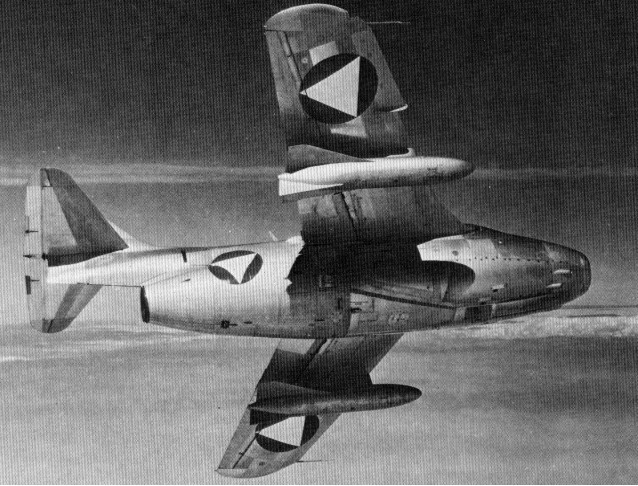
The type remaining in production until April 1956, by which time a total of 661 had been built. They remained in service until 1958 when their gradual replacement by the Saab-32 Lansen began.
In 1961-2 30 ex-Flygvapen J 29Fs were supplied to Austria as fighter-bomber and reconnaissance aircraft, those operating in the latter role using a detachable pod housing three Vinten cameras. The J29F was retired in 1972.

J29A
Engine: RM2 Svenska Flygmotor / De Havilland Ghost 50 (5004 lb)
Span: 11.00m (36 ft10.25 in)
Length: 10.23m (33 ft 6.75 in)
Take off weight: 7530-8375 kg (16600-18463 lb)
Max speed: 1035 kph (643 mph)
Cruise speed: 800 kph (497 mph)
Landing speed: 220 kph (137 mph)
Range: 1200 km (750 sm)
Max. altitude: 13700 m (44950 ft)
J/A29B
Engine: RM2 Svenska Flygmotor / De Havilland Ghost 50 (5004 lb)
Span: 11.00 m (36 ft10.25 in)
Length: 10.23 m (33 ft 6.75 in)
Take off weight: 7530-8375 kg (16600-18463 lb)
Maximum speed: 1035 kph (643 mph)
Cruising speed: 800 kph (497 mph)
Landing speed: 220 kph (137 mph)
Range: 1500 km (930 sm)
Max. altitude: 13700 m (44950 ft)
S29C
Engine: RM2 Svenska Flygmotor / De Havilland Ghost 50 (5004 lb)
Span: 11.00 m (36 ft10.25 in)
Length: 10.23 m (33 ft 6.75 in)
Take off weight: 7530-8375 kg (16600-18463 lb)
Maximum speed: 1035 kph (643 mph)
Cruising speed: 800 kph (497 mph)
Landing speed: 220 kph (137 mph)
Range: 1500 km (930 sm)
Max. altitude: 13700 m (44950 ft)
J29E
Engine: RM2 Svenska Flygmotor / De Havilland Ghost 50 (5004 lb)
Span: 11.00 m (36 ft10.25 in)
Length: 10.23 m (33 ft 6.75 in)
Take off weight: 7530-8375 kg (16600-18463 lb)
Maximum speed: 1035 kph (643 mph)
Cruising speed: 800 kph (497 mph)
Landing speed: 220 kph (137 mph)
Range: 1500 km (930 sm)
Max. altitude: 13700 m (44950 ft)
J29F
Engine: RM2B Svenska Flygmotor / De Havilland Ghost 50 with afterburner (6173 lb)
Span: 11.00 m (36 ft10.25 in)
Length: 10.23 m (33 ft 6.75 in)
Height: 3.75 m(12 ft 3.5 in)
Wing area: 24.00 sq.m (258.3 sq ft)
Wheel track: 7 ft 2 in
Take off weight: 7530-8375 kg (16600-18463 lb)
Empty wt: 4600 kg (10,141 lb)
Maximum speed: 1060 kph (659 mph) at 1500m (4,920 ft)
Landing speed: 220 kph (137 mph)
Initial ROC: 3600 m/min (11,810 fpm)
Service ceiling: 15500 m (50850 ft)
Range: 1100 km (680 sm)
Ferry range: 2700 km (1,678 sm)
Cruising speed: 800 kph (497 mph)
Armament: four 20-mm Hispano cannon, plus two Rb324 air-to-air missiles, or 24 75-mm (2.95-in) rockets, or eight 180-mm (7.09-in) or 150-mm (5.9-in) rockets, or two 250-kg (551-lb) bombs.


On 1 April 1939, the Air Force Materiel Administration invited AB Förenade Flygverkstäder to tender for a new fighter aircraft to be powered by the new Bristol Taurus engine, a sleeve-valve unit delivering 1,200 hp. The timetable was incredibly tight. Saab proposed a radical configuration (designated the Ll3) in which the engine was mounted behind the cockpit, offering the advantages of a twin-engined craft in terms of visibility and armament. Unfortunately, this proved to be impractical since the Taurus engine was air-cooled.
In March 1941, Saab was authorized to resume work on the fighter project. By this time, technology had outstripped the original Ll3 concept and a new liquid-cooled Daimler-Benz engine was available as though made to order. The modified design — the J21 — was presented to the Air Force chiefs on 1 April 1941.
The design was a cantilever low-wing monoplane having moderate wing sweep, with central fuselage nacelle to accommodate the pilot on an ejection seat. Power was a rear-mounted powerplant in pusher configuration, twin booms extending aft from the wings with twin fins and rudders united by the tailplane with elevator, and retractable tricycle landing gear.
The first of three Saab-21A prototypes was flown on 30 July 1943 and these, like a few early production aircraft, were powered by the imported Daimler-Benz DB 605; all subsequent production had a Swedish licence-built version of this engine.
The first operational aircraft was delivered to F8 Wing at Barkaby on 1 December 1945.
When introduced into service in late 1945 as the J21A-1 the new type was the only pusher-engined fighter to become operational during World War II, being followed by the generally similar J21A-2 and, finally, by the A21A attack aircraft, these three versions being built to a total of 299 before production ended in 1948.
Continuous improvements were made and a bomb-carrying version, the J21A-3, made its debut on 22 May 1947.
The A21A had the same armament as the J21A fighter, was equipped to carry rockets or light bombs on under-wing racks, and had provision for the installation of a ventral gun pack housing eight 13.2mm machine-guns.
Although increasing the speed was the first priority of the plane’s designers at this time, all attempts to achieve this aim using piston engines were abandoned with the advent of the jet engine in late 1945, and four J21A-ls were modified in an initial attempt to adopt the new technology.
Svenska Aeroplan adapted its Saab-21 design to accept the installation of a de Havilland Goblin gas turbine. This seemed a simple way to gain experience with this form of powerplant and, at the same time, extend the performance capability of the proven Saab-21 design; however, it was to prove rather more difficult a process than had been anticipated. The redesign affected 50% of the airframe rather than 20% as had been anticipated. The first requirement was for the aft fuselage nacelle to be widened to accept the new engine and the tailplane moved to the top of the fin to be clear of the jet efflux. It was also decided that because of the higher performance of this aircraft some structural strengthening was essential, and as there was no longer any need to be concerned about propeller ground clearance the landing gear struts were shortened. In this form the first Saab-21R prototype was flown initially on 10 March 1947.
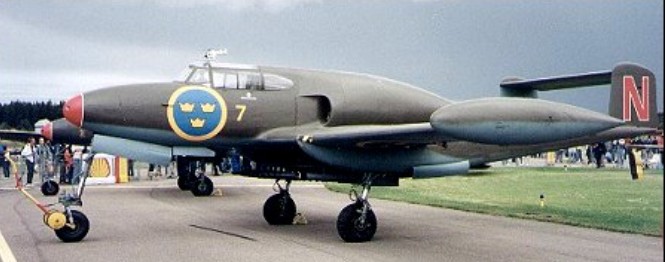
Almost two years elapsed before all development-problem fixes had been finalised, the first deliveries of production aircraft starting during February 1949.
The original Saab-21 production order had been for 120 aircraft, but because of delay in its development, a programme for the specially-designed turbojet-powered Saab-29 was well advanced, with a result that the Saab-21R order was reduced to only 60 aircraft. These were produced as the J21RA with a 1361kg thrust de Havilland Goblin 2 engine, and J21RB with a licence-built Goblin turbojet, 30 of each being built. After comparatively short service in the fighter role, all were converted as attack aircraft, redesignated A21R and A21RB respectively, and carrying 10 100mm or five 180mm Bofors rocket projectiles, or 10 80mm anti-tank rockets.
In all, 298 J21s were built. The last of these was retired from service on 23 July 1954, al¬though the J21R continued to fly until 4 April 1957.
J21A
Engine: Daimler Benz 605B, 1475 hp / 1100kW
Span: 11.64 m (38 ft 2.25 in)
Length: 10.45 m (34 ft 3.5 in)
Height: 3.96 m / 13 ft 0 in
Wing area: 22.2 sq.m / 238.96 sq ft
Take-off weight: 4150 kg (13615 lb)
Empty weight: 3250 kg / 7165 lb
Maximum speed: 640 kph (398 mph)
Cruising speed: 495 kph (308 mph)
Landing speed: 145 kph (90 mph)
Range: 1500 km (930 miles)
Max. altitude: 11000 m (36090 ft)
Armament: 1 x 20mm cannon, 4 x 13.2mm machine-guns
Crew: 1
A21A
Engine: Daimler Benz 605B, 1475 hp
Span: 11.64 m (38 ft 2.25 in)
Length: 10.45 m (34 ft 3.5 in)
Take-off weight: 4413 kg (14478 lb)
Maximum speed: 640 kph (398 mph)
Cruising speed: 495 kph (308 mph)
Landing speed: 145 kph (90 mph)
Range: 1500 km (930 miles)
Max. altitude: 11000 m (36090 ft)
21RA
Engine: De Havilland Goblin 2 (2998 lb)
Span: 11.37 m (37 ft 3.75 in)
Length: 10.56 m (34 ft 7.75 in)
Take-off weight: 5033 kg (16512 lb)
Maximum speed: 800 kph (497 mph)
Cruising speed: 700 kph (435 mph)
Landing speed: 155 kph (96 mph)
Range: 900 km (560 miles)
Max. altitude: 12500 m (41010 ft)
21RB
Engine: De Havilland Goblin 3, 3307 lb / 1500kg
Span: 11.37 m (37 ft 3.75 in)
Length: 10.56 m (34 ft 7.75 in)
Height: 2.95 m / 10 ft 8 in
Take-off weight: 5033 kg (16512 lb)
Maximum speed: 800 kph (497 mph)
Cruising speed: 700 kph (435 mph)
Landing speed: 155 kph (96 mph)
Range: 900 km (560 miles)
Max. altitude: 12500 m (41010 ft)
Armament: 1 x 20mm cannon, 4 x 13.2mm machine-guns
Crew: 1
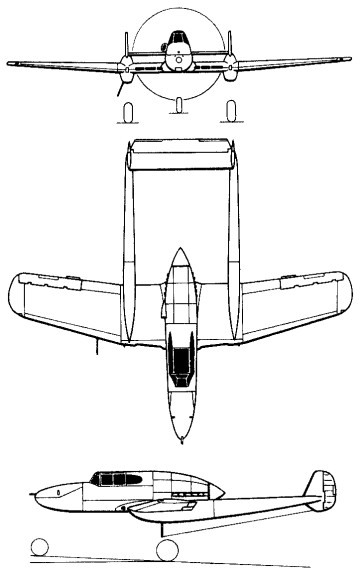
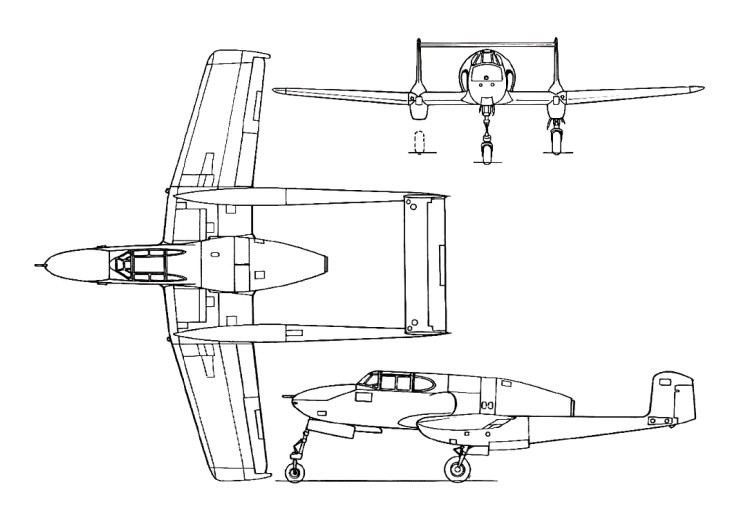

Design work on Aircraft 18 was commenced at the beginning of 1939 to meet an official Swedish requirement for a reconnaissance aircraft. The Air Force chiefs had announced a competition for the design of a twin-engined aircraft to replace the old B3. The competition was won by Saab.
A cantilever mid-wing monoplane, primarily of metal construction, the Saab-18 had retractable tailwheel landing gear, a twin-fin-and-rudder tail unit, and was powered as first flown by two 794kW Swedish-built Pratt & Whitney R-1830 Twin Wasp radial engines in wing-mounted nacelles. The crew comprised a pilot, navigator/gunner and bomb-aimer, the last having a position in the glazed nose of the fuselage.
The first prototype took to the air on 19 June 1942. As a result of changing requirements, the two Saab-18A prototypes were redesigned and equipped for the light bomber or dive-bomber role. Early testing of the prototypes revealed that the Saab-18A was underpowered, but with no immediate remedy available.
The type was ordered into production in B18A bomber and S18A photo-reconnaissance versions, built to a combined total of 60 aircraft; late production examples of the S18A also carried radar equipment. Delivered to Bomber Wing Fl in June 1944, the aircraft was designated the B18. Several B18s were con-verted for reconnaissance duties with the installation of radar and camera equipment. This version became known as the B18A.
The availability in 1944 of a Swedish licence-built version of the much more powerful Daimler-Benz DB 605B powerplant led to the single Saab-18B prototype, first flown on 10 June 1944 and followed by 120 B18B dive-bomber production aircraft. With new engines, this version was one of the fastest piston-engined aircraft in the world, reaching a top speed of 570 km/h (354 mph).
Final production version was the T18B (62 built) which had been developed to serve as a torpedo-bomber but was, instead, completed as an attack aircraft. With a crew of two, this could either be fitted with torpedoes for anti-shipping duties or armed with a single 157-mm and two 20-mm automatic Bofors cannons. Production of the last T18B ended in 1948.
242 production aircraft serviced until the last of them was retired in 1956.
B/S18A
Span: 17.04 m (55 ft 10.75 in)
Length: 13.23 m (43 ft 4,75 in)
Take-off weight: 8700 kg (1918 lb)
Maximum speed: 465 kph (289 mph)
Cruising speed: 415 kph (258 mph)
Landing speed: 135 kph (84 mph)
Range: 2200 km (1367 miles)
Max. altitude: 8000 m (26250 ft)
B18B
Engines: 2 x Daimler-Benz DB 605B, 1100kW
Span: 17.04 m (55 ft 10.75 in)
Length: 13.23 m (43 ft 4,75 in)
Height: 4.35 m / 14 ft 3 in
Wing area: 43.75 sq.m / 470.92 sq ft
Take-off weight: 8793 kg (1938 lb)
Maximum speed: 570 kph (354mph)
Cruising speed: 480 kph (298 mph)
Landing speed: 125 kph (78 mph)
Ceiling: 9800 m / 32150 ft
Range: 2600 km (1616 mph)
Max. altitude: 9800 m (32150 ft)
Armament: 1 x 7.9mm and 2 x 13.2mm machine-guns
Bombload: 1500kg
T18B
Span: 17.04 m (55 ft 10.75 in)
Length: 13.23 m (43 ft 4,75 in)
Take-off weight, kg (lb) 9272 kg (2044 lb)
Maximum speed: 595 kph (370 mph)
Cruising speed: 480 kph (298 mph)
Landing speed: 130 kph (81 mph)
Range: 2600 km (1616 miles)
Max. altitude: 9300 m (30150 ft)

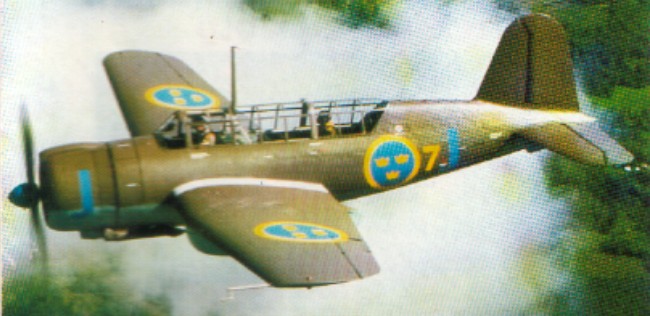
In the late 1930s, ASJA and Saab in Trollhättan (operating under the joint title of AB Förenade Flygverkstäder) competed with each other to build a reconnaissance aircraft for the Swedish Air Force. Although the order went to ASJA, its activities were taken over by Saab in early 1939 and Aircraft 17 became exclusively a Saab project.
Developed in close collaboration with American engineers, the aircraft was a mid¬wing monoplane equipped with retractable landing gear. The SAAB B17 was first designed as a reconnaissance aircraft but was mainly used as a dive-bomber.
Production was under Swedish direction, the Americans being responsible for the drafting work.
The first test flight took place on 18 May 1940, six months after the end of the American involvement in the project. Not unexpectedly, teething troubles were encountered – the cockpit canopy blew off, spin was difficult to correct and the engine stalled in a right-hand spin. However, when the Air Force came to test the plane, they found that “the aircraft and its equipment are of a generally excellent standard”.
Following the first flight the company made the proposal that its development as a bomber should be given consideration by the Flygvapen. Evaluation of the prototype led to the aircraft being developed for this role as well as for reconnaissance.
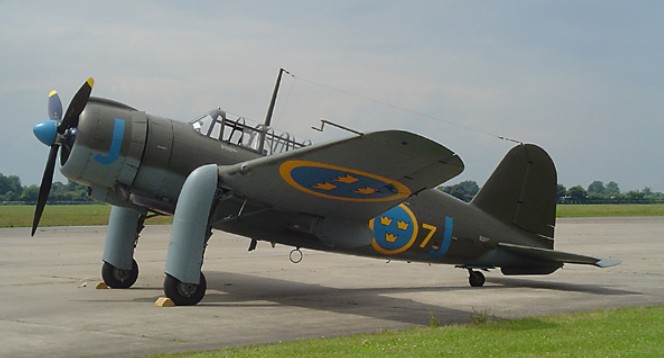
In 1940, the Swedish Air Force ordered 322 aircraft that were delivered in the period December 1941 – 1944.
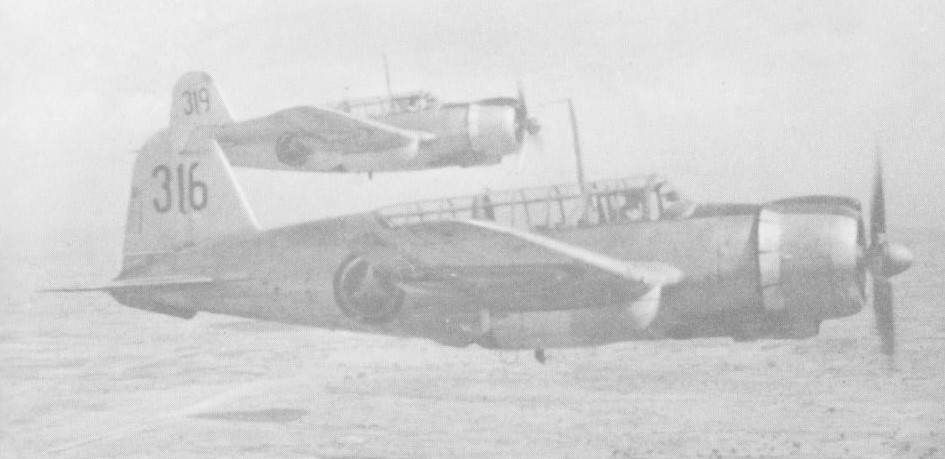
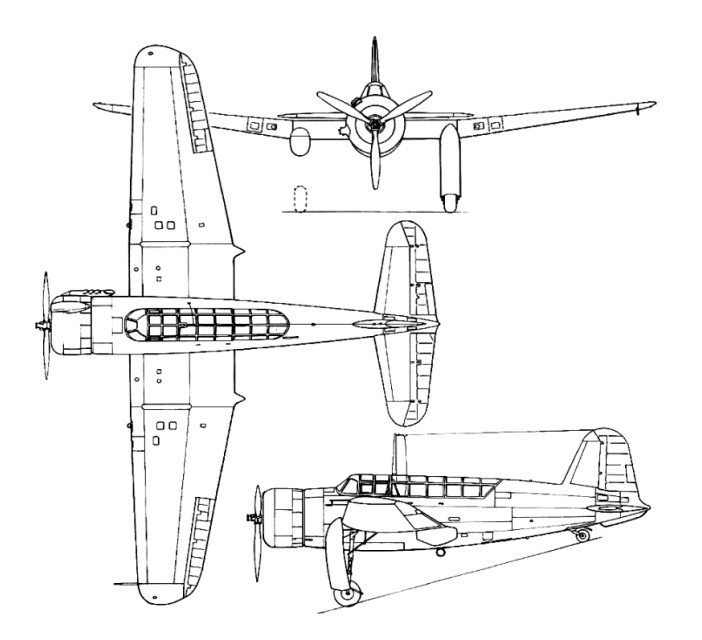
Five versions were developed out of the basic SAAB B17. A cantilever mid-wing monoplane with retractable tail-wheel landing gear, the Saab-17 had its crew accommodated beneath a long continuous canopy. Powerplant varied, the B17A dive-bomber having the 794kW / 1065 hp Svenska Flygmotor-built Pratt & Whitney R-1830-SC3G Twin Wasp radial. A light bomber, the B 17A armament consisted of two fixed 8 mm machine-guns m/22 in the wings and a moveable 8 mm machine-gun at the observers place behind the pilot. A bomb-load of 500 kg could be carried. 132 SAAB B 17A were manufactured.
The B17B dive-bomber and similar S17B (equipped for the reconnaissance role) powered by the 731kW Swedish-built Bristol Pegasus XXIV radial, and the B17C dive-bomber (which differed from the B17B only in its engine, the Piaggio P.XIbis). Included in the total production were 38 examples of the S17BS, a maritime patrol version of the B17B on twin floats. Many of the landplane versions were later given retractable ski landing gear for operation from snow-covered surfaces.
325 were built.
Entering service with the Flygvapen in 1941, the Saab-17 was notable for the robust construction that has since been a feature of the company’s designs, and the type remained in service until 1948. Although retired from active operation in 1948, the Saab 17 continued to fly as a target towplane until 1968.
After World War II 47 were delivered to the Ethiopian air force.
17A
Engine: STWC 3 Pratt & Whitney Twin Wasp/ 1065 hp
Span: 13.7 m (45 ft 1 in)
Length: 9.8 m (35 ft 1.75 in)
Height: 14 ft 6 in
Wing area: 307 sq.ft
Take-off weight: 3790 kg (8355 lb)
Maximum speed: 435 kph (270 mph)
Cruising speed: 390 kph (242 mph)
Landing speed: 125 kph (77 mph)
Range: 1800 km (1120 miles)
Max altitude: 8700 m (28550 ft)
17B
Engine: Bristol Mercury XXI V/980 hp
Span: 13.7 m (44 ft 11.25 in)
Length: 9.8 m (35 ft 1.75 in)
Take-off weight: 3605 kg (7948 lb)
Maximum speed: 395 kph (245 mph)
Cruising speed: 375 kph (233 mph)
Landing speed: 125 kph (77 mph)
Range: 1400 km (870 miles)
Max. altitude: 8000 m (26250 ft)
17BS
Engine: Bristol Mercury XXI V/980 hp
Span: 13.7 m (44 ft 11.25 in)
Length: 9.8 m (35 ft 1.75 in)
Take-off weight: 3825 kg (8433 lb)
Maximum speed: 330 kph (205 mph)
Cruising speed: 315 kph (196 mph)
Landing speed: 125 kph (77 mph)
Range: 2000 km (1240 miles)
Max. altitude: 6800 m (22300 ft)
17C
Engine: Piaggio PXI bis RC40D, 1040 hp / 761kW
Span: 13.7 m (44 ft 11.25 in)
Length: 9.8 m (35 ft 1.75 in)
Height: 4.40 m / 14 ft 5 in
Wing area: 28.50 sq.m / 306.77 sq ft
Take-off weight: 3870 kg (8532 lb)
Maximum speed: 435 kph (270 mph)
Cruising speed: 370 kph (230 mph)
Landing speed: 125 kph (77 mph)
Range: 1700 km (1060 miles)
Max. altitude: 9800 m (32150 ft)
Armament: 2 x 13.2mm + 1 x 7.9mm machine-guns
Bomb load: 680kg
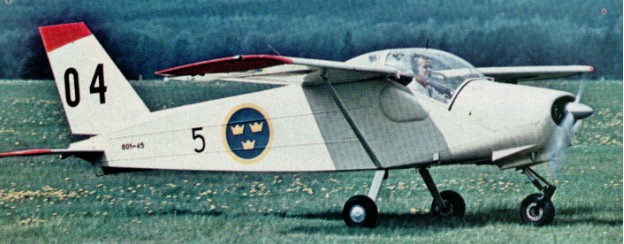
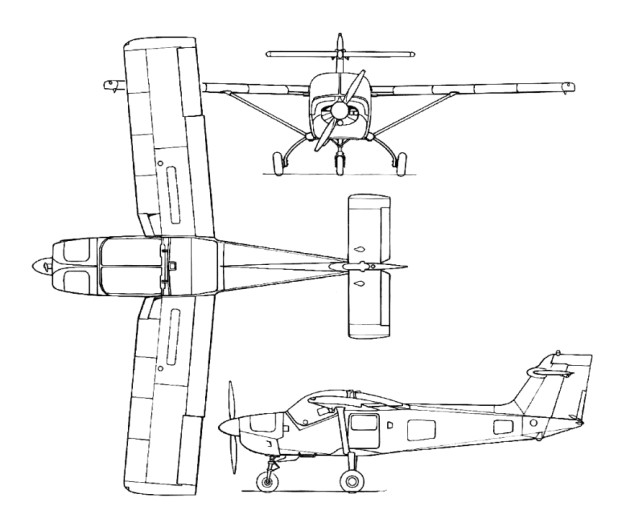
MFI had then been de¬veloping the MFI¬ 15A when Saab acquired Malmö Flygindustri (MFI) in 1968. The airplane made its maiden flight on 11 July 1969. As then flown it was powered by a 119kW Avco Lycoming IO-320-B2 flat-four engine and had a conventional low-set tailplane, but this was modified subsequently to T-tail configuration to minimise damage when operating from rough airfields. Later renamed Safari and then further developed into MFI-17 Supporter armed ground-support version. The plane was converted into an efficient weapons carrier by increasing the engine power and making some structural modifica¬tions – measures which greatly enhanced its military potential. The new version – the MFI-17 – made its first flight on 6 July 1972.
The prototype was flown on 26 February 1971 with a more powerful Avco Lycoming engine, which became the standard powerplant for the production version, which was re-designated Saab Safari. A braced shoulder-wing monoplane with fixed tricycle landing gear, available optionally with tailwheel landing gear, it provides side-by-side enclosed accommodation for two and has dual controls as standard.
A military version designated originally Saab-MFI 17 was flown on 6 July 1972 and differed from the Safari by being equipped more specifically for use as a military trainer, or for such duties as artillery observation, forward air control and liaison; this version was later named Saab Supporter.
The first purely military version, named the Supporter, was sold to Pakistan (where it was built under license as the Mushshak) in 1974. Further sales to Denmark, Norway and Zambia followed. A civilian version named the Safari was also sold to countries including Norway, Sierra Leone and Ethiopia. Counting both versions, more than 200 of the aircraft were built.
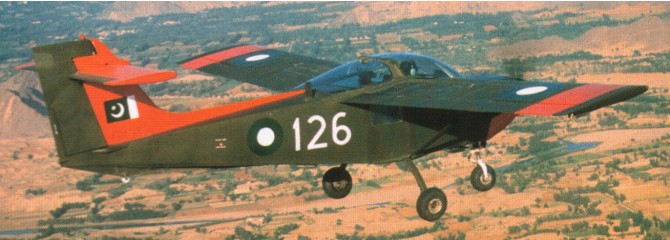
Licence production of the Saab MFI-17 Supporter two/three-seat piston-engined trainer and liaison aircraft continued at Kamra for the Pakistan Air Force and Army in 1987 by the Pakistan Aeronautical Complex, as the Mushshak.
Two MFI-17Bs were shipped to the PAF Academy in September 1974 for evaluation by trainer pilots and the Pakistan Army signed a contract with Saab in June 1974 to acquire five MFI-17B Supporters along with supply kits. The contract was signed to supercede the obsolete Howard L-19 trainer aircraft. A licence agreement was also obtained to build an indigenous aircraft based on the MFI-17B.
Assembly of Swedish-made kits began in 1976, but complete aircraft are manufactured in Pakistan using imported raw materials, engines, propellers, and avionics equipment. Licence-production of this aircraft was started in Pakistan during 1976, initially from kits supplied by Saab, but there has been a gradual change to indigenous manufacture from raw materials. Designated Mushshak in Pakistan, more than 150 have been built.
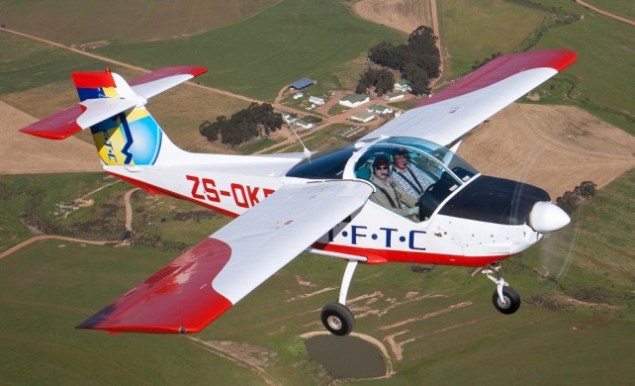
Upon taking the required suggestions from the Academy, the PAC started the development of MFI-17 Mushshak in June 1975 at its facility in Kamra, Pakistan. Saab ceased the supporter aircraft parts supply in 1982. The maiden MFI-17 Mushshak production aircraft was introduced in December 1983. The aircraft has been accredited by the Pakistan Civil Aviation Authority, and has obtained Type Acceptance certification from the South African Civil Aviation Authority.
The MFI-17 features two integral fuel tanks that carry 48gal of fuel. It also houses an electrical fuel pump for emergency missions. The aircraft is fitted with a Bendix fuel injection system, dual flight control systems, tricycle type landing gear, electrical trim, rudder pedals, ailerons and environmental control system.
It boasts a large luggage compartment on the rear side of the cockpit, which can be easily accessed through a door on the port side of the fuselage.
The glass cockpit of the Mushshak accommodates two crew members, a student pilot and an instructor. It is fitted with two adjustable seats integrated with lockable inertia reels, and there is an option for a third seat on the rear side. The round glass canopy offers clear visibility to the crew. An Enviro R-134 air conditioning system maintains constant temperature in the cockpit.
The cockpit is equipped with UHF radios, GPS, a voice-over recorder, automatic direction finder, rate of climb indicator, attitude heading reference system and an information friend or foe transponder.
The aircraft comprises six hardpoints. It is armed with two 7.62mm cannons, two 75mm unguided rocket pods, four 68mm unguided rocket pods and six anti-tank missiles.
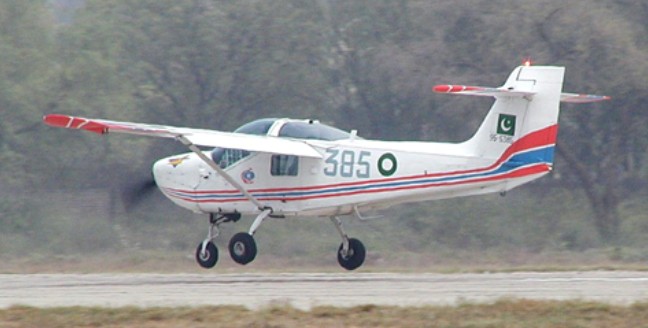
The Mushshak is powered by an AEIO-360A1B6 horizontally opposed four-cylinder piston aircraft engine, which generates 149kW of output power. The engine is designed and manufactured by Textron Lycoming. It is a fuel injected engine driven by two bladed constant speed hartzell propeller made up of aluminium.
The time between overhauls of the engine is 2,000 hours.
Orders of the MFI-17 include: the Egyptian Air Force (54), the Islamic Republic of Iran Air Force (25), the Royal Air Force of Oman (Eight), the Pakistan Air Force (149), the Royal Saudi Air Force (20) and the Syrian Air Force (Six).
The Danish airforce chose in 1974 Saab Supporter as their new trainer.
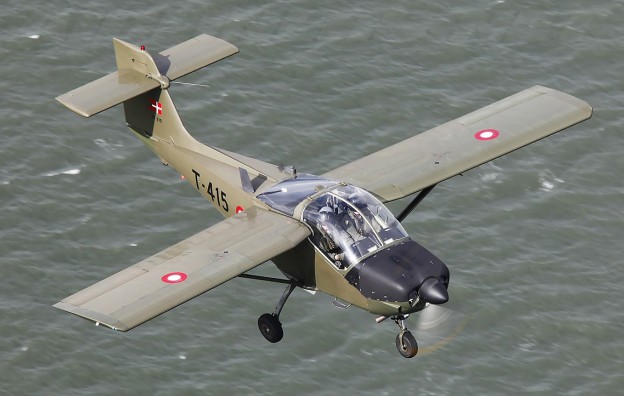
The MFI-17 was designed to train pilots of the PAF Academy located at Risalpur. The aircraft is fitted with a blind flying screen allowing for instrument flying missions. It was designed to meet the US FAR23 certification standards in utility and aerobatics classes.
The Mushshak was designed to operate on rough airfields even in adverse weather conditions. It can execute a wide range of ground attack missions including forward air control, border patrol, reconnaissance, artillery fire observation, liaison, camouflage review and transportation.
Some Mushshaks, promoted as very light strike and weapons training aircraft, served with the Iranian Revolutionary Guards.
Most of the Pakistan Aeronautical Complex Mushshak were upgraded to the more powerful Super Mushshak with a Lycoming 260 hp engine.
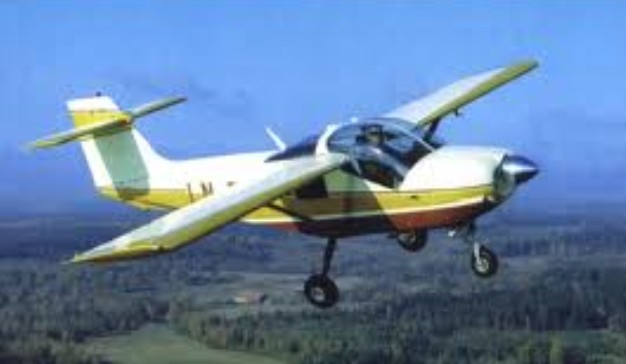
Variants:
Pakistan Aeronautical Complex MFI-395 Super Mushshak
Saab-Safari
Engine: 1 x Avco Lycoming IO-360-A1B6, 149kW / 200 hp
Max take-off weight: 1200 kg / 2646 lb
Loaded weight: 646 kg / 1424 lb
Wingspan: 8.85 m / 29 ft 0 in
Length: 7.0 m / 22 ft 11 in
Height: 2.6 m / 9 ft 6 in
Wing area: 11.9 sq.m / 128.09 sq ft
Max. speed: 235 km/h / 146 mph
Cruising speed: 208 km/h (129 mph)
Landing speed: 90 km/h (56 mph)
Range: 1050 km (650 miles)
Ceiling: 4100 m / 13450 ft
Pakistan Aeronautical Complex MFI-17 Mushshak
Engine: Textron Lycoming AEIO-360A1B6, 149kW
Propeller: two bladed constant speed hartzell
Climb rate: 5.2m/s
Maximum speed: 238km/h
Cruise speed: 210km/h
Stall speed: 100km/h
Range: 800km
Service ceiling: 4,100m
Endurance: 5 hr 10 min
First flown in 1934 DH Gipsy Six.
First flown in June 1931
Cirrus-Hermes, 105hp
Later repowered Walter Gemma, 150 hp
1929 prototype
Armstrong Siddeley Jaguar, 425 hp
1 to Swedish Air force as J5, 1 to Norway
Re-engined Bristol Jupiter VI as J6A
Bristol Jupiter VII as J6B
Svenska Aero
AB Svenska Järnvägsverkstäderna (ASJA)
Svenska Aeroplan Aktiebogalet (SAAB)
Svenska Aero, as a subsidiary of Heinkel, was taken over by AB Svenska Järnvägsverkstäderna (ASJA) in 1932.
The Bofors Company at Trollhattan formed in 1937 Svenska Aeroplan Aktiebogalet (SAAB). Following its merger in 1939 with the AB Svenska Jarnvagsverkstadernas Aeroplanavdelning (AJSA). In 1939 amalgamated with Aircraft Division of Svenska Jarnvagsverkstaderna and moved main establishment to Linkoping. From 1950 acquired other important facilities, including underground factory at Linkoping.
Built 82 Tiger Moth, 43 Hawker Hart, 11 NA-16-4M, FW-44, and Northrop 8A-5 under licence.
In 1945, in the hope of a lasting peace, the Company decided to scale down its production of military aircraft and to develop its civilian operations – a change in policy signified by the ap¬pearance of the Saab 90 Scandia airliner and the Saab 92 car.
Name changed to Saab Aktiebolag May 1965; Malmo Flygindustri became a subsidiary in 1967; in 1968 merged with Scania-Vabis group to became Saab-Scania. Current name Saab Group, comprising five main divisions: Saab AB, Saab Dynamics AB for guided weapons and electronics, Saab Training Systems AB, Saab Aircraft AB for marketing and supporting commercial aircraft, and Saab Combitech AB. Saab AB parent division established January 1997 to combine activities of previous Saab Military Aircraft, Saab Aircraft and Saab Service Partner, and develops and manufactures military and commercial aircraft within business units known as Gripen, General Military Aircraft, Future Products and Technology, Operations Commercial Aircraft, and Collaborative Programs.
First airplanes were license-built Junkers Ju 86K twin-engined bombers, Northrop-Douglas dive-bombers (Douglas 8A-1, similar to the US Army Air Corps’ A-17) and North American NA-16 trainers. First own-design production aircraft was Saab 17 dive-bomber of 1940, used widely and 60 delivered to Ethiopia from 1947. Saab 18 was twin-engined bomber of 1942, some late examples of which had ejection seats. Saab 21A of 1943 was piston-engined single-seat fighter, and 21-R was jet development of the same aircraft. Saab 29 was the so-called “flying barrel” swept-wing jet fighter, in production until 1956, while Saab 32 Lansen of 1952 was swept-wing fighter/attack/reconnaissance two-seater. Saab 35 Draken “double-delta” fighter appeared in 1955, and a squadron remained active as interceptors until 1999. Saab 105 of 1963, a twin-jet light side-by-side two-seater armed multipurpose aircraft, still in use as a trainer in 1999; Swedish Air Force aircraft have just undergone an upgrade with new engines and thus redesignated Sk 60W. Saab 37 Viggen multirole combat aircraft, first flown February 1967, has foreplane and delta wings, and with its STOL capability remains a very potent weapon system. Produced for service between 1971 and 1990, it has been continuously upgraded; redelivered in latest upgraded form 1998 for continued service in JA 37 interceptor and AJS 37 attack/interceptor/maritime-reconnaissance variants. Latest combat aircraft is Saab AB Gripen JAS 39 Gripen, first flown December 1988 and taken into Swedish Air Force service from 1996. Grippen is the world’s first combat aircraft of the new-generation type and the first to combine the roles of interceptor, attack, and reconnaissance in a single aircraft (all as primary roles) by the adoption of push-button control to select the required function in the computer programs of the totally integrated avionics suite.
Civil types have included Saab 90 Scandia twin-engined 32-passenger transport (first flown November 1946); Saab 91 Safir all-metal 3/4-seater (first flown November 1945); two/three-seat high-wing Safari (first flown in July 1969) and its military Supporter development (first flown 1972). In production until 1999 has been the Saab 340 turboprop regional transport (first flown January 1983, and finally produced in 340B and BPIus variants with accommodation for up to 37 passengers) and the Saab 2000 50/58-seat turboprop regional airliner (first flown March 1992). Saab has also developed an airborne early warning and control variant of the 340B airliner as the S100B Argus (first flight of AEW&C prototype with overfuselage radar July 1994), plus a search-and-rescue variant for the Japanese Maritime Safety Agency as the SAR-200 (delivered 1997).

