1996: Ron Sands, 89 Forrest Dr, Mertztown, PA 19539, USA.
Home built / LSA builder
1996: Ron Sands, 89 Forrest Dr, Mertztown, PA 19539, USA.
Home built / LSA builder
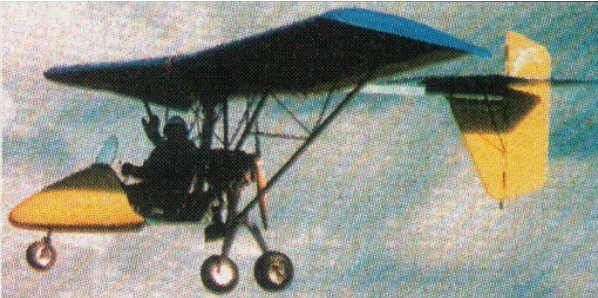
The Sandpiper XP-1, UL-1, and XP-2 kits includes engine, prop and instruments, and is equipped with full span ailerons and steerable nose wheel.
The Hirth engine was available with either gear or belt reduction.
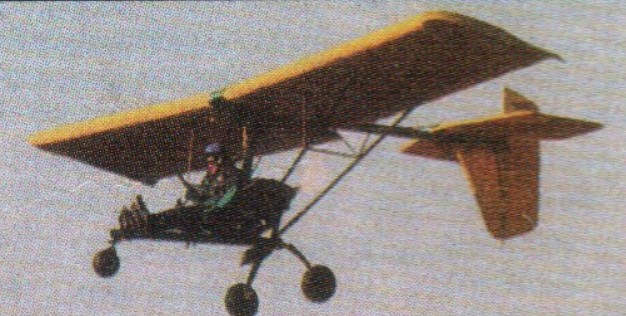

Sandpiper UL-1
Engine: Rotax 277, 28 hp
HP range: 28-65
Height: 8 ft
Length: 16 ft
Wing span: 26.5 ft
Wing area: 148.9 sq.ft
Fuel capacity: 5 USG
Empty weight: 243 lb
Gross weight: 650 lb
Top speed: 60 mph
Cruise: 55 mph
Stall: 26 mph
Rate of climb: 400 fpm
Takeoff dist: 45 ft
Landing dist: 40 ft
Seats: 1
Landing gear: tri
Sandpiper XP-1
Engine: Hirth 2702, 35 hp
HP range: 35-80
Height: 8 ft
Length: 16 ft
Wing span: 26.5 ft
Wing area: 148.9 sq.ft
Fuel capacity: 24 USG
Empty weight: 305 lb
Gross weight: 790 lb
Top speed: 90 mph
Cruise: 85 mph
Stall: 27 mph
Rate of climb: 1200 fpm
Takeoff dist: 35 ft
Landing dist: 40 ft
Seats: 1
Landing gear: tri
Sandpiper XP-2
Top speed: 85 mph
Cruise: 80 mph
Stall: 30 mph
Rate of climb: 940 fpm
Takeoff dist: 85 ft
Landing dist: 90 ft
Engine: Hirth FP23, 60 hp
HP range: 50-85
Fuel capacity: 24 USG
Empty weight: 380 lb
Gross weight: 900 lb
Height: 8 ft
Length: 16 ft
Wing span: 32.5 ft
Wing area: 182.5 sq.ft
Seats: 2
Landing gear: tri
1997: 23115 Airport Rd, NE Bldg. B, Box 4, Aurora, OR 97002, USA.
UL builder

The Sundog is a rigid wing that was designed by Californian Mike Sandlin. The Sundog is an evolution of the Skypuppy,
Sundog was a rigid wing built to test the usefulness of flaps on a hang glider. This version has full span flaps which fold under the wing for transport. There are spoilerons on the top surface of the wing for turning, actuated by side motion of the hang loop. The flaps were pulled down by a rope. The tail surfaces are just fixed stabilizers.
It was too heavy, at 90 lb and the static balance was non-existent (special launch procedures required), but it was fun to fly once you got it in the air. Full span flaps allow simple, easy landings, very similar to a drogue chute.
They were up-only ailerons, actuated from the hang loop, then returned to neutral by a bungee cord (like the spoilerons, which came later). A good system, but Sandlin wanted bigger flaps.
Low performance landings were the easiest and safest.
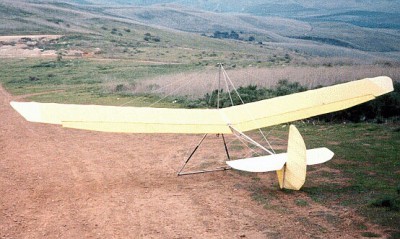
The Sandlin Skypuppy had only about 100 square feet of wing, and rudder steering. It was too fast at Sandlin’s weight for good soaring. Flown around 1986, the big flaps worked well.
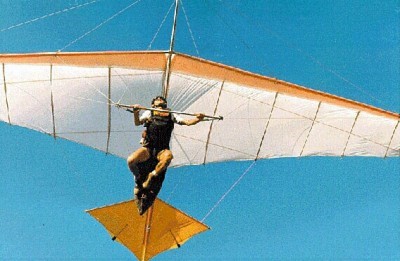
The Litewing series attempted to turn back the clock to the era of 35 lb. hang gliders. This is a bit of crude sail making, but it was fun and adventurous.
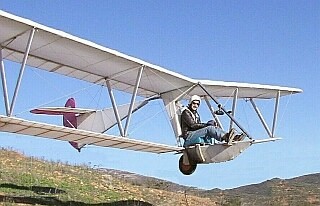
The Bug2 airchair biplane (or sesquiplane) first flew in Februauy of 1999. Bug 4 was intended to be an improved version of Bug2, and was considered superior.
The monoplane airchairs were a furthur development of the Bug4. Construction is of aluminum tubing and steel cable covered with a heat shrunk fabric.
Safety design aspects include:
Extensive frangible structure around the pilot for crash impact protection
4 point safety belts
A hand deployed emergency parachute which is intended to bring the glider and pilot down together, tail first, so that the pilot is protected by the tail and wing structure during the parachute landing

Construction of the Bug wheeled sailplane is from readily available materials without special welding, machining, or molds. The empty weight, for a not foot launchable glider, is substantially less than the ultralight regulatory weight limit; about the same weight as the pilot.

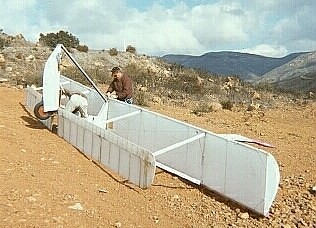
Quick assembly & roof rack transport make flying convenient. A Bug or Goat can be strapped down onto an ordinary hang glider rack, with no special saddles or pads.

Bug2 and Bug4 have demonstrated casual and comfortable airchair soaring, drogue chute landings in small fields, and novice instruction on training hills. They have been towed by trucks, winches, and ultralight airplanes. The Bugs have soared high, if not far, and have always returned for a safe landing. An airchair can be launched by ultralight aerotow, car tow, winch cable, or just by rolling down an open slope.
Accomplishments of these biplanes include:
Self launch soaring by rolling down hillsides
Self launch training by rolling down hillsides
Car top transport on non-specialized racks
The Bugs fly at about the same speeds as a hang glider, readily mixing with hang glider and paraglider traffic. No formal performance measurements have been made, but all are in the hang glider range and can stay up in good lift conditions. The Bug has soared thousands of feet above take off altitude.
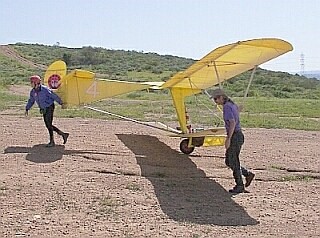
Sandlin has flown the Bug2 and Bug4 for soaring only, not aerobatics. He considers the structural redline (maximum safe airspeed) for flying to be 45 mph.
Bug2 and Bug4 performance has not been measured but seems to be about the same as a single surface hang glider. As of April 2010 only a single Bug4 is known to be currently flying .
Posting of the complete technical drawings of an aircraft on the Internet, freely available in the public domain for downloading and study.
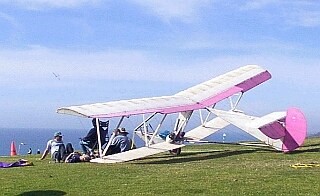
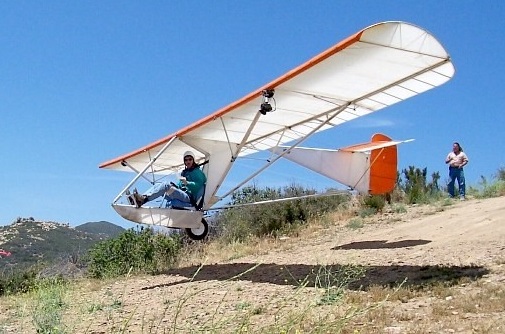
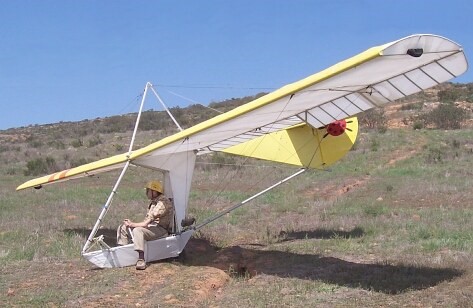
The Goat monoplane glider has been soaring in one version or another since the spring of 2003. The Goat is technically an ultralight sailplane (under United States weight rules) with conventional three axis controls, similar to the Bug4 and the commercial Super Floater. It is designed for slow speed recreational gliding and training. This glider ia an all purpose airchair, allowing comfortable open air soaring, good crash safety, quick assembly, and convenient car top transport.
The idea of an “airchair” is that it flies like a hang glider or paraglider but with improved stability, control, comfort, and crash safety. The glider can be kept at home and transported to the flying site on a simple car top rack. It can be assembled by one person in about 20 minutes. With a wing loading about the same as a hang glider, it flies and soars like a hang glider, making it compatible with many existing hang glider operations, using rolling launches, ground tows, or ultralight aerotows.
The varioius Goats feature:
Five or six major separable parts, the heaviest being the the wing panel at 35 to 42 lbs.
Emergency parachute, hang glider type, hand deployed 22 gore round canopy PDA, with bridle & swivel
16″ or 14″ diameter wheelbarrow or ultrlight aircraft wheel, tube tire
nose skid for braking (no wheel brake), tail skid at rear (or wheel)
drogue chute, hang glider type, 5 ft. diam. (flat octagonal) canopy, attached to main struts or flying cables, 27″ outboard from centerline on left side
tow hookup with weak link loop, to break at about 110% gross weight
Altimeter/variometer mounts on nose tube or strut, hang glider type
Quick assembly pins, handles & tapered ends for “drift pin” assembly, all fasteners attached to airframe
Flap panels in fixed position, or fixed trailing edge.
Four point seat belt
Conventional stick and rudder controls
There are no formal values established for performance, pilot weight, or maximum speeds or loads, because no rigorous tests have been performed to measure these values.
The Goat does not foot launch, but is either towed into the air or else launched by rolling down a hillside. Rolling launches are usually made at a site shared with hang gliders and paragliders. This glider flys very much like a hang glider and readily adapting to hang glider techniques and procedures. The Goat1 has made a cross country flight of more than sixty miles, reaching an altitude above 13,000 feet.
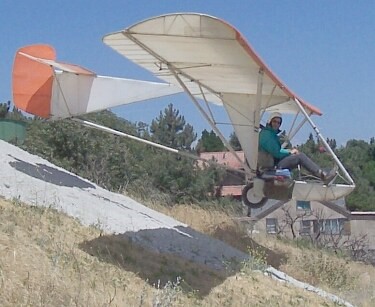
The Goat1 made it’s first flight on February 1, 2003, and since then has been flying as a weekend soaring glider. It has proven to be a pleasant and practical glider for slope launching and local flying. It is easy to tow behind an ultralight airplane. The struts fold onto the wing for transport. As of December, 2009, Goat1 had new fabric and removable, folding main struts,and is now called the Red Goat.

The biggest drawback to the Goat1 design was the large size and heavy weight of the main wing panel with regard to loading or unloading it onto a car top rack. The folded wing half weighs 42 pounds. The primary reason for the Goat2 design was to have a lighter wing panel to reduce the burden of assembly and loading.
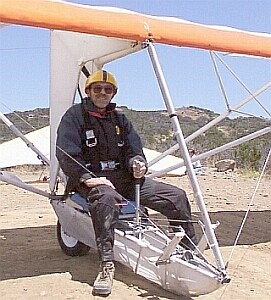
Goat2 is a simpler, lighter version of Goat1 with almost exactly the same significant dimensions. In contrast to Goat1, the wing and tail boom are cable braced (no struts) and a 14″ diameter ground roll tire is used instead of a 16″ tire. The elevator control lines now run directly to the elevator control arms without any push rod mechanisms, and the removal of the tail plane for storage and transport has been simplified.
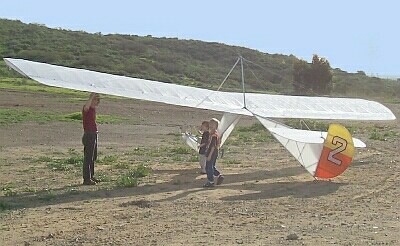
Goat3 has a smaller wing than the other Goats, with a fancier, sailplane style airfoil. The struts are removed for transport, and the wing does not have folding panels on the trailing edge. The seat back and shoulder belts are fixed in place on the nose section and do not require attention during assembly.
The reduced wing area of Goat3 forces flying faster, and the new airfoil doesn’t seem to be producing any dramatic performance improvement. As it stands, it looks as if the larger wing with the simpler airfoil (as used by Goat1 & Goat2) may be a suiperior combination for an airchair. Goat3 probably won’t stay up in light conditions as well as the others.
Goat2 was light and eliminated the bulky struts, but all those long cables created their own transport and assembly problems. This led eventually to the creation of Goat4, which retained the cable braced wing but simplified a lot of the assembly mechanics.
Goat4 is essentially a Goat2 wing with Goat3 nose and tail.
The gliders fly at about the same speeds as a hang glider, readily mixing with hang glider and paraglider traffic. No formal performance measurements have been made, but all are in the hang glider range and can stay up in good lift conditions. The Goats 1-4 have soared thousands of feet above take off altitude.
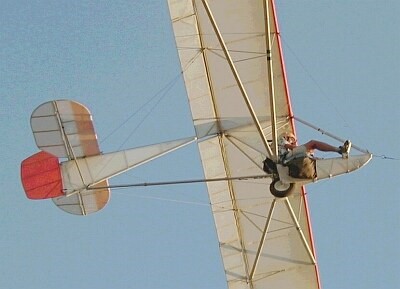
Slow flight provides the unique ability to self launch by rolling down open slopes, usually at the same mountain launch sites used by hang gliders and paragliders. This rolling launch has become a standard procedure for local weekend soaring. A launch slope of a vertical drop of about 17 feet over a rolling distance of 72 feet (so, the rolling distance is two wing spans for the Goat) is suitable.
Quick assembly & roof rack transport make flying convenient. A Goat can be strapped down onto an ordinary hang glider rack, with no special saddles or pads.
A Basic Ultralight Glider is not a hang glider (it cannot be foot launched) nor is it what is usually meant by an ultralight airplane (it has no engine). Its construction is “low tech”, at the hand drill and hacksaw level, for easy home building, from readily available materials (it is made mostly from aluminum tubing and steel cable with polyester fabric covering).
This is a home built glider, made with a low level of technology (no welding, no special machining, no molds or jigs, no spray rig) from readily available materials (mostly aluminum tubing, steel cable, aircraft bolts and heat shrink fabric). The Goat is a noncommercial project, with no product or plans for sale, but complete descriptive drawings of the Goat1 through Goat4 are on the Web. These drawings are freely available for whatever purpose the user may desire.


