In 1906, Santos-Dumont took the nacelle of his dirigible balloon no. 14 and added to it a fuselage and biplane wings and an Antoinette V8 engine. The airplane flew rear-first and was denominated 14-bis (since it was descendent of the dirigible balloon no. 14).
Author: Terry
Santos-Dumont No.12
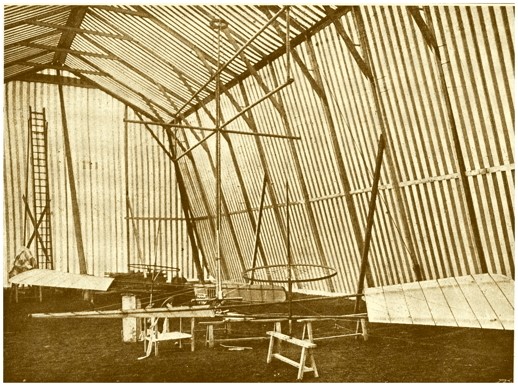
This helicopter was built to perform the first “kilomètre en circuit fermé” 50,000 francs challenge of Deutsch and Archdeacon. The challenge was won by Farman two years later.
The Santos-Dumont No.12 was a bamboo framework hélicoptère designed and built during 1905/06 at Neuilly St. James. It had two rotors and a propeller, powered by a 24 hp Antoinette V-8.
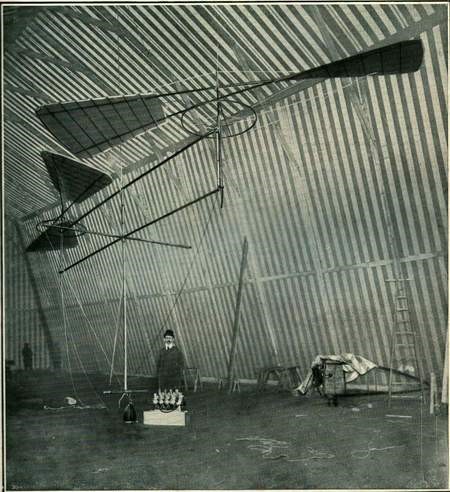
The apparatus was abandoned soon after mechanical tests revealed inherent flaws in the transmission of power to the contra-rotating rotors.
Santos-Dumont No.9 Baladeuse
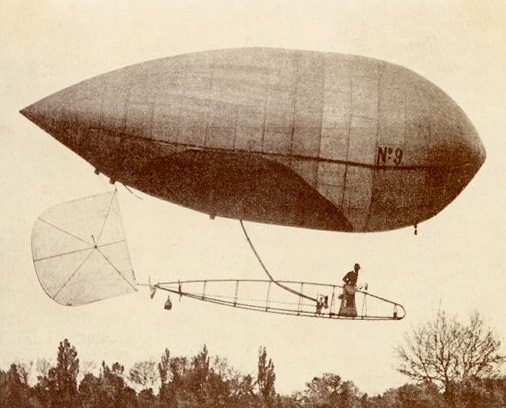
Santos built 14 airships in all, of which his diminutive No. 9 Baladeuse was the best-known and most successful. On this personal runabout he challenged a friend’s after-dinner remark that his dirigibles were no more than ‘scientific curiosities’ by flying right into the heart of Paris, landing in the Avenue des Champs-Elysées and mooring it on the railings of his house on the corner of Rue Washington while he went inside for coffee. Thereafter Parisians became quite blasé about the sight of No. 9 parked outside fashionable restaurants or in the grounds of the country houses of Santos’s many friends.

Santos-Dumont No.6
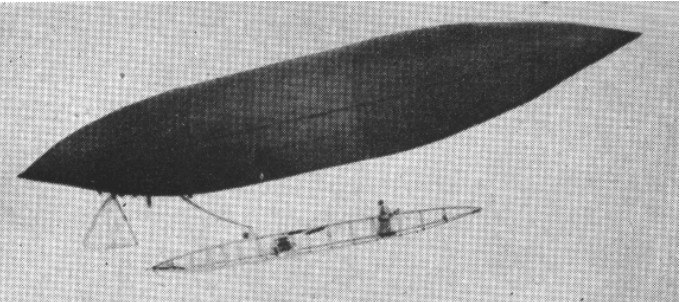
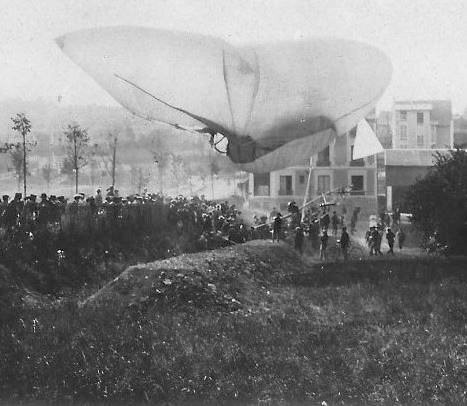
Alberto Santos-Dumont dirigible No.6 of 1898 was powered by a petrol motor of 12 hp. After some tethered trials on September 5th, 1901 Santos-Dumont made his first flight in the airship on 6 September. A series of mishaps ended with a hard landing which damaged the gondola. This accident, shown in the photo, took place at Gare des Coteaux in Saint-Cloud, west of central Paris and close to Santos-Dumont’s home base.
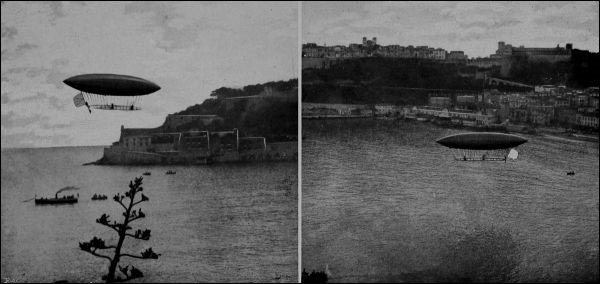
It was soon repaired and October 19th won the Deutsch de la Meurthe prize of 125,000 francs to the first machine capable of flying from the Aéro-Club de France’s flying field at Parc Saint-Cloud to the Eiffel Tower and back to the starting point; a distance of 7 miles, which he accomplished in thirty minutes. The ship had a length of 22 metres, a diameter of 6 metres and was powered by a Buchet four-cylinder inline water-cooled engine of 12 hp.
Santos-Dumont No.5
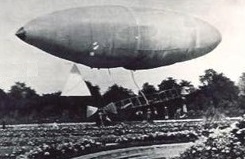
Santos embarked on an ambitious development programme after this modest triumph, and soon became a familiar sight puttering over the Paris suburb of Neuilly-Saint James on his latest dirigible. In the summer of 1901 he made two attempts to win a 125,000-franc prize offered by Henri Deutsche de la Meurthe for a flight from the parc d’aerostation at St Cloud to the Eiffel Tower and back, a distance of about 12 km (4 miles), in half an hour. The first began on 13 July. With a following wind Santos’s No. 5 dirigible was soon rounding the Eiffel Tower, but on his return trip the little airship could make no headway, the time limit elapsed and the engine stopped. Santos valved off hydrogen and settled into a large chestnut tree in the grounds of Edmund de Rothschild’s house. During his second attempt, on 8 August, Santos again circled the Eiffel Tower but was foiled on the way back, crashing noisily and explosively on to the roof of a hotel at Trocadéro. Shaken and singed he climbed through an attic window and was held by the manager on suspicion of cat burglary.
Another dirigible was hastily constructed to replace the wrecked No. 5, and on 19 October 1901 Santos just succeeded in making the round trip within the specified 30 minutes. Typically philanthropic, he divided the prize between his workers and the Parisian poor, keeping not a centime for himself.
Santos-Dumont No.4
Santos-Dumont No.3
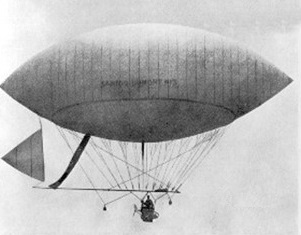
Santos-Dumont No.2 America
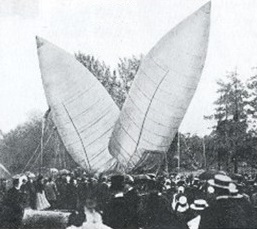
The second balloon of Alberto Santos-Dumont, “America,” had 500 cu.m of capacity and gave Santos Dumont the Aero Club of Paris’ award for the study of atmospheric currents. Twelve balloons participated in this competition but “America” reached a greater altitude and remained in the air for 22 hours.
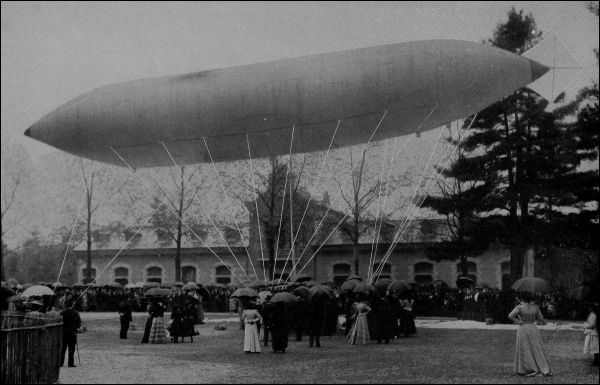
Santos-Dumont No.1 / Brazil
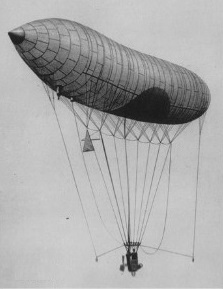
The first dirigible was 25 m (8½ ft) long and contained 180 cubic metres (6400 cubic feet) of hydrogen gas beneath which he suspended a 3½ hp petrol engine, called “Brazil”. On 18 September 1898 he took off from the jardin d’acclimatisation in the Bois de Boulogne and promptly ended up in a clump of trees. Know-all bystanders had advised him to take-off downwind. Two days later he was back, this time rising effortlessly into wind to complete a figure of eight 400 m (1300 ft) above an astonished, cheering crowd. ‘Le Petit Santos’ — for he weighed just 49 kg (108 lb) — was an instant hero.


