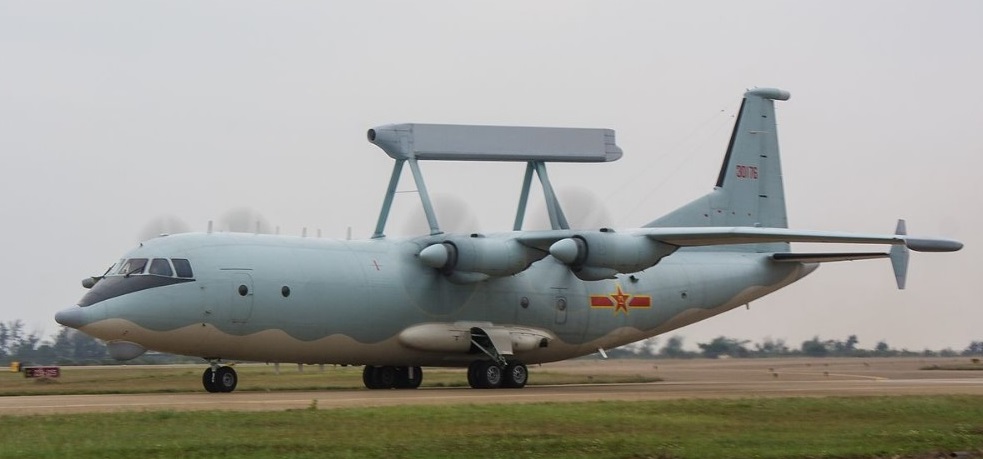
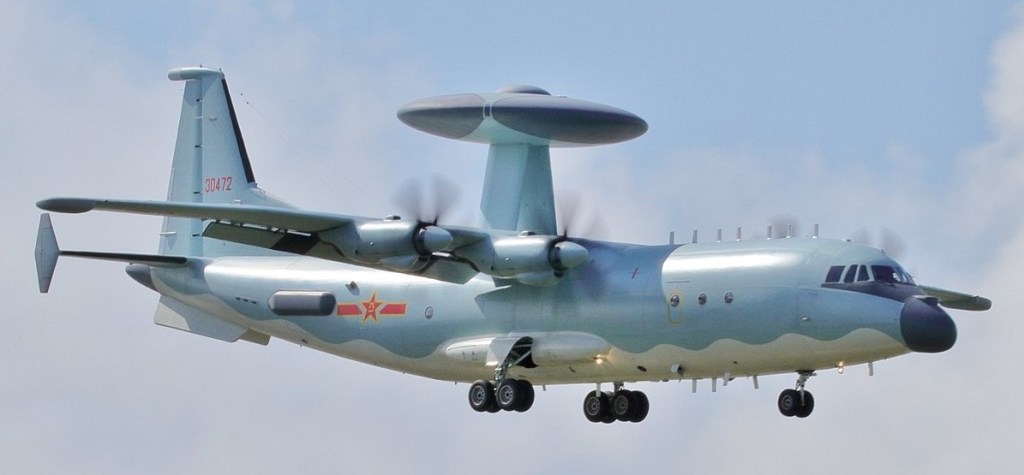
The KJ-200 (Chinese: 空警-200; pinyin: Kōngjǐng Liǎngbǎi; literally: “Airwarn-200”) NATO reporting name: Moth or Y-8 Balance Beam system, is an Airborne early warning and control (AEW&C) program developed by Shaanxi Aircraft Corporation. (KJ is from the first characters of the Pinyin spelling of 空警, (Kōng Jǐng), short for 空中预警 (Kōng Zhōng Yù Jǐng), which means Airborne Early Warning).
The key component of this aircraft is an AESA radar system, visually similar to the Saab Erieye system, mounted on struts above the rear fuselage, as well as ventral sensor domes. The platform of this aircraft is based on the Shaanxi Y-8F-600 and it has been reported that Pratt & Whitney Canada PW150B turboprops and Honeywell avionics have been incorporated.
The general designer of the KJ-200 is Ouyang Shaoxiu (欧阳绍修), the same general designer of the Y-8. According to Ouyang the KJ-200 has been significantly modified (around 80%) from the original Y-8. including the adoption of a glass cockpit.
The project experienced a major setback in 2006, when a KJ-200 crashed into a mountain in Guangde County while undergoing tests.
During the National Day of the People’s Republic of China military parade 1 October 2009, a KJ-200 took the role as a lead aircraft.
In February 2017 a US Navy Lockheed P-3 Orion and a KJ-200 inadvertently came close to each other over the South China Sea. The aircraft were within 1,000 feet (305 meters) of each other.
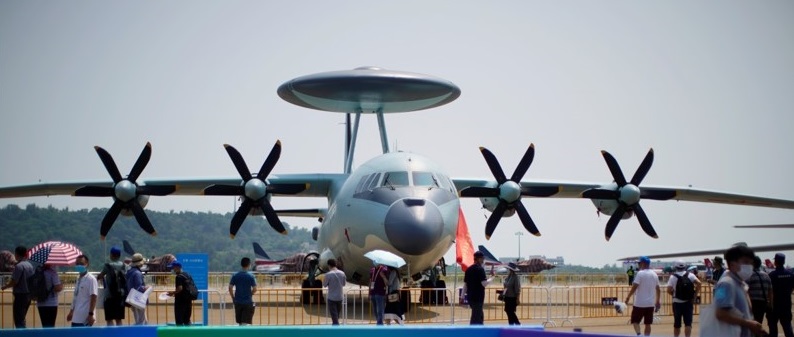
The Shaanxi KJ-500 (Chinese: 空警-500; pinyin: Kōngjǐng Wǔbǎi; literally: “Air Warning 500”) is a third-generation airborne early warning and control (AEW&C) aircraft used by the Chinese People’s Liberation Army Air Force. It was built by Shaanxi Aircraft Corporation, and is based on the Y-9 airframe.
China started the development of the KJ-500, its third AEW&C, in the late 2000s. The KJ-500 was required to have good detection capability, good identification ability, and quick responsiveness. The KJ-500 was also required to be the core force of the information combat system, its equipped technology has four major characteristics, which are networking, multi-functionality, high-integration, and lightweight.
The aircraft carries a fixed dorsal radome containing three AESA radar arrays for 360-degree coverage, and is said to be more efficient than the two-planar ‘balance beam’ array design used on the earlier KJ-200. Production of older AEW&C types reportedly ceased production in 2018 in response to the KJ-500 reaching full operational capability.
The KJ-500 is the base variant with the KJ-500A improved variant with an aerial refuelling probe debuted at the Zhuhai Airshow 2022.
Max speed: 550 km/h Max range: 5700 km Max endurance: 12 h Max takeoff weight: 77 tons Range against fighter sized targets: 470 km
China First flew in December 1974 a Chinese derivative of the Antonov An-12B freighter, as the Y8, of which some 60 have gone into military and civil use. Maritime surveillance prototype also flown with Litton radar.
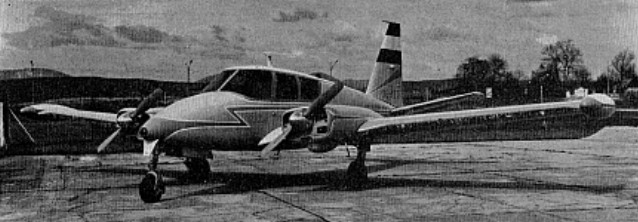
The SGP M-222 Flamingo was an Austrian twin engine, four seat light aircraft, developed with a series of prototypes into the early 1960s. There was no series production.
In the 1950s Simmering-Graz-Pauker A.G. (SGP) was a large manufacturing concern but the M-222 Flamingo was their first aircraft. Designed by Erich Meindl, it was a conventional twin engine monoplane, smaller than many but seating four in two rows.
The wings of the Flamingo had a laminar flow airfoil and were made entirely of wood. The first prototype was powered by 150 hp (112 kW) Lycoming O-320 flat-four engines but later aircraft had 200 hp (150 kW) Lycoming IO-360 flat-fours. These were conventionally mounted ahead of the leading edge in long cowlings with their propeller shafts, driving two-blade airscrews, centred above the wing upper surface. There were fuel tanks in the thin wings, with more fuel in wing tip tanks.
The Flamingo was fitted with both flaps and airbrakes. The flaps were of the camber changing type, to increase lift at low speed; they were split into three sections on each wing and slid rearwards and downwards on concealed rails. The airbrakes were wing mounted spoilers for losing speed. Like the wings the empennage was all-wood; the cantilever tailplane was set low on the fuselage.
The Flamingo’s fuselage had a welded steel tube structure, skinned forward with light alloy and aft with laminated plastic. Its two rows of seats were enclosed under a three part canopy which merged at the rear into the raised fuselage. There was a wide door on either side for cabin access and a separate baggage space behind the seats. It had a retractable tricycle undercarriage with the mainwheels, fitted with brakes, behind the engines. The nosewheel was steerable. The undercarriage, like the flaps and airbrakes, were hydraulically powered. The M.222 was aerobatic when carrying a pilot and one passenger.
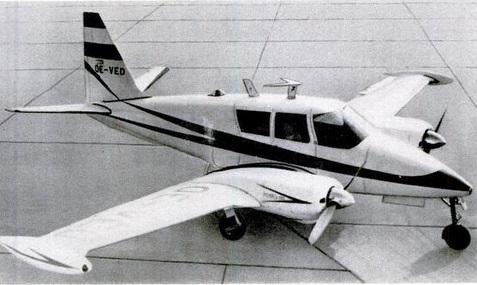
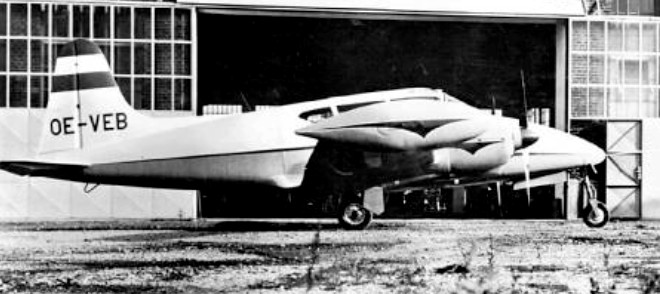
The first prototype M.222V1, registered OE-VEA c/n 1, flew for the first time on 15 May 1959 but was lost in a crash during single engine tests on 2 August 1959, the pilot Eduard Stefl and flight engineer Leopold Schwingenschlögl were killed instantly. Development work in the Rax-Werke in Wiener Neustadt continued on a second aircraft, OE-VEB, which first flew in 1960 and a third M.222V3 c/n 3, followed in 1962. The fourth aircraft, now renamed the Simmering-Graz-Pauker SGP.222 was intended as a production prototype and demonstrator and appeared at the 1964 Hamburg show, though it turned out to be the last of the line. It incorporated several changes in response to the lengthy development trials. The wing leading edges had breaker strips added and there were new fillets in this edge at the root and on the outboard side of the engine cowlings. The ailerons were mass balanced and fitted with ground adjustable trim tabs, and the upper hinge gaps sealed with fabric. The most obvious external changes were to the empennage where the horizontal tail now had positive dihedral and the previously rounded vertical tail had been enlarged and given severe straight taper, assisted by a ventral fin to improve low speed handling. Both elevators and the rudder had trim tabs. One independent report of this fourth aircraft’s handling found it well behaved, stable but responsive with a docile stall and brisk climb.
The type was redesigned by the glider designer Ruediger Kunz, in order to build the machine in compliance to USA regulations, and hence the fourth prototype was designated SGP.222VS (VS for Vereinigte Staaten, German for United States) briefly used but this was later changed to SGP.222A. Initially registered OE-VED, the aircraft was reregistered OE-FEC after it received its Austrian and FAA Type Certificates on respectively February 15 and March 3, 1964, where after it was also redesignated SGP.222A. However, at the end of 1964 the program was cancelled and the prototypes were scrapped.
Second prototype Powerplant: 2 x Lycoming IO-360, 150 kW (200 hp) Propellers: 2-bladed Length: 8.80 m (28 ft 10 in) Wingspan: 11.90 m (39 ft 1 in) Height: 3.05 m (10 ft 0 in) Wing area: 18.38 sq.m (197.8 sq ft) Aspect ratio: 7.68 Empty weight: 1,250 kg (2,756 lb) equipped Max takeoff weight: 1,900 kg (4,189 lb) Fuel capacity: 380 L (100.4 US gal, 83.6 Imp gal) Maximum speed: 330 km/h (205 mph; 178 kn) at sea level Cruising speed: 280 km/h (174 mph; 151 kn) economical, 65% power Range: 1,650 km (1,025 mi; 891 nmi) Service ceiling: 6,100 m (20,013 ft) service Rate of climb: 7.5 m/s (1,480 ft/min) at sea level Wing loading: 103 kg/m2 (21 lb/sq ft) Power/mass: 160 W/kg (0.096 hp/lb) Landing speed: 105 km/h (65 mph; 57 kn) Landing run: 135 m (443 ft) using brakes Take-off run: 300 m (985 ft) to 15 m (50 ft) Crew: One Capacity: Three passengers
Austria A well-known engineering company which, in early 1960s, planned production of its four-seat twin-engined SGP- 222, which had first flown May 1959. Plans abandoned by mid-1960s, though several prototypes built.
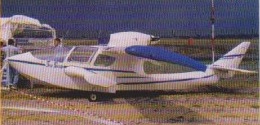
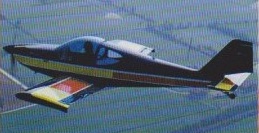
First seen in 1997 at the Bassano show, the Seastorm is aimed at the American kit plane market. Entirely composite, a 900kg MAUW four seater was under development.
Engine: Midwest 110, 115 hp Wing span: 9.27 m Wing area: 12.24 sq.m MAUW: 500 kg Empty weight: 300 kg Fuel capacity: 120 lt Max speed: 270 kph Cruise speed: 210-240 kph Minimum speed: 62-73 kph Climb rate: 4.5 m/s Seats: 2 Fuel consumption: 18-32 lt/hr Price (1998): $89,000 Kit price (1998): $45,000
Engine: Midwest 105, 105 hp HP range: 105-115 Top speed: 171 mph Cruise: 148 mph Stall: 44 mph Range: 1040 sm ROC: 1200 fpm TO dist land/water: 400 ft / 820 ft Ldg dist land/water: 425 ft / 620 ft Service ceiling: 13,700 ft Fuel cap: 26.5 USG Empty wt: 682 lb Gross wt: 1340 lb Height: 6 ft Length: 24.6 ft Wing span: 30 ft Wing area: 131 sq.ft Seats: 2 Undercarriage: tail
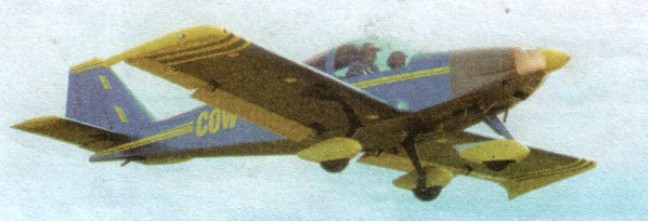
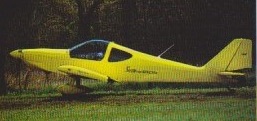
The Storm is derived from the P 220 Pottier, using pop-riveted sheet dural.
The Storm 400Ti is a three seat version of the Storm 280, designed specifically for the US kitplane market.
Storm 400Ti
Storm 280 Engine: Rotax 912, 80 hp Wing span: 8.6 m Wing area: 11.6 sq.m MAUW: 450 kg Empty weight: 262 kg Fuel capacity: 90 lt Max speed: 225 kph Cruise speed: 200 kph Minimum speed: 65 kph Climb rate: 5 m/s Certification: vVZ Seats: 2 Fuel consumption: 13 lt/hr Price (1998): 88,328 DM Kit price (1998): 33,335 DM
Storm 300 Engine: Jabiru, 120hp Fuel cap: 55 lt main + 2 x 28 lt wing.
Storm 300 Engine: Rotax 912 Fuel cap: 90 lt.
Storm 300 Engine: Midwest 105, 105 hp HP range: 80-120 Top speed: 200 mph Cruise: 171 mph Stall: 35 mph Range: 650 sm ROC: 1500 fpm TO dist: 450 ft Ldg dist: 360 ft Service ceiling: 12,000 ft Fuel cap: 23 USG Empty wt: 617 lb Gross wt: 992 lb Height: 6.4 ft Length: 20.9 ft Wing span: 26 ft Wing area: 119 sq.ft Seats: 2 Undercarriage: nose or tail.
Storm 300 Special Engine: Midwest 105, 105 hp HP range: 80-120 Top speed: 200 mph Cruise: 171 mph Stall: 42 mph Range: 650 sm ROC: 1500 fpm TO dist: 450 ft Ldg dist: 360 ft Service ceiling: 12,000 ft Fuel cap: 38 USG Empty wt: 710 lb Gross wt: 1155 lb Height: 6.4 ft Length: 20.9 ft Wing span: 26 ft Wing area: 119 sq.ft Seats: 2 Undercarriage: nose or tail
Storm 400Ti Engine: Lycoming O-235, 116 hp Wing span: 7.20 m Wing area: 11.06 sq.m MAUW: 720 kg Empty weight: 400 kg Fuel capacity: 90 lt Max speed: 242 kph Cruise speed: 220 kph Minimum speed: 81 kph Climb rate: 5.5 m/s Seats: 3 Fuel consumption: 20 lt/hr Kit price (1998): 65 000 000 L