Sharp Tartan

Tartan/Nimrod

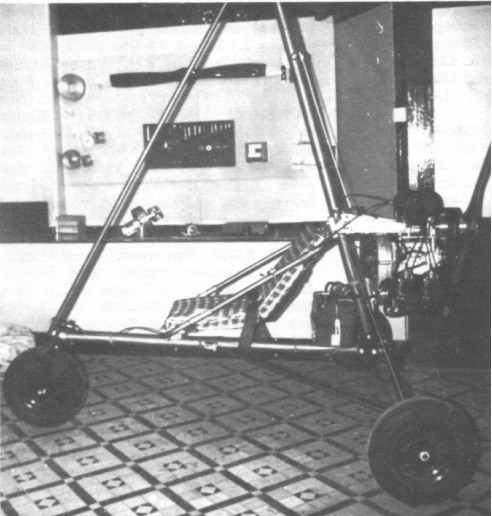
Single seat single engined flex wing aircraft with weight shift control. Rogallo wing with keel pocket. Pilot suspended below wing in trike unit, using bar to control pitch and yaw/roll by altering relative positions of trike unit and wing. Wing braced from above by kingpost and cables, from below by cables; floating cross tube construction with 70% double surface. Undercarriage has three wheels in tricycle formation; no suspension on any wheels. Push right go left nosewheel steering independent from yaw control. No brakes. Aluminium tube trike unit, with optional pod. Engine mounted below wing driving pusher propeller.

By 1982 four Tartan trike units have been made; three with 330 cc Robin engines and one with a 250.

The Tartan, so named because of its distinctive seat covering, is most commonly flown with an Airwave Nimrod wing and was largely inspired by the Ultrasports Tripacer. It is a beefier structure using heavier gauge tube, a cast engine bearer and solid plastic tubing inserts, to prevent bolts crushing the tubing.

While the Tartan is a thoroughly conventional trike unit, a high proportion is made in house not just the tubework but also the engine bearers, propeller, silencer and reduction drive.

Engine: Robin EC34PM
Propeller diameter and pitch 54×30 inch, 1.37×0.76m
Toothed belt reduction, ratio 2.3/1
Fuel capacity 2.4 US gal, 2.0 Imp gal, 9.1 litre
Length overall 11.8ft, 3.60m
Wing span 32.8ft, 10.0m
Nose angle 120 deg
Total wing area 165 sq.ft, 15.3 sq.m
Wing aspect ratio 6.5/1
Nosewheel diameter overall 16 inch, 41 cm
Main wheels diameter overall 16 inch, 41 cm
Max climb rate at sea level 650 ft/min, 13 m/s

Engine: Robin EC25PS
Propeller diameter and pitch 54×27 inch, 1.37×0.69m
Toothed belt reduction, ratio 2.3/1
Fuel capacity 2.4 US gal, 2.0 Imp gal, 9.1 litre
Length overall 11.8ft, 3.60m
Wing span 32.8ft, 10.0m
Nose angle 120 deg
Total wing area 165 sq.ft, 15.3 sq.m
Wing aspect ratio 6.5/1
Nosewheel diameter overall 16 inch, 41 cm
Main wheels diameter overall 16 inch, 41 cm

Sharp & Sons

By the spring of 1983, Sharp & Sons was widely known as the maker of probably the best engineered reduction drives in the UK, as well as a source of props, engine bearers and any other awkward part that no one else is willing to cast or machine.

1982: Sharp & Sons, 104 6 Green Road, Colne, Lancashire BB8 8AJ, Great Britain.

Sharp DR90 Nemesis

The Nemesis originated as an attempt by Jon Sharp to build a Shoestring racer, with composite skins over a steel frame. Along the way, Dan Bond convinced him to use an airfoil with extensive laminar flow and finally, Steve Ericson helped Jon design a sleeker, all composite airframe. All that remains of the original “plastic Shoestring” is the horizontal tail. The steel space frame was sold to Dan Gilbert and became the guts of his Shadow Formula One air racer. Although Shadow looks much like Nemesis it is fabricated differently and has a completely different wing.

The Formula One racing Sharp DR 90 Nemesis was built at the Mojave Airport by the Nemesis Air Racing Team. The aircraft is powered by a modified Continental O-200 piston engine.

Between 1991 and 1999, the plane won 45 of the 48 race events in which it was entered, including nine consecutive Reno Gold National Championships. During each of the race seasons from 1994 through 1999, Nemesis finished as the International Formula One points champion. Nemesis was awarded the George Owl Trophy for its design in 1991, three Louis Blèriot Medals from the Fédération Aéronautique Internationale (1993, 1996 and 1998), and four Pulitzer Trophies (1993, 1994, 1995 and 1999). The aircraft set 16 world speed records, and in one of those records, Nemesis was clocked at over 290 mph (467 km/h). Because of its successes, the National Air and Space Museum has described the plane as “the most successful aircraft in air racing history”.

After the end of the 1999 racing season, Jon Sharp donated the aircraft to the National Air and Space Museum and it is now on display at the NASM’s Steven F. Udvar-Hazy Center.

The success of the aircraft led Jon Sharp to design a follow-on type, the Nemesis NXT.

Variant: Rolls-Royce ACCEL

Engine: 1 × Continental O-200, 100 hp
Wingspan: 20 ft 6 in (6.25 m)
Wing area: 66 ft2 (6.13 m2)
Length: 18 ft 6 in (5.64 m)
Height: 3 ft 4 in (1.02 m)
Empty weight: 520 lb (236 kg)
Loaded weight: 770 lb (350 kg)
Fuel capacity: 5 US gal (18.9 liters)
Maximum speed: 292 mph (470km/h)
Stall speed: 90 Kias (167 km/h)
Crew: 1
G-Loading limits: +6, -4
Cabin height: 35 in (89 cm)

Sharapov-Verzilov Piervieniets

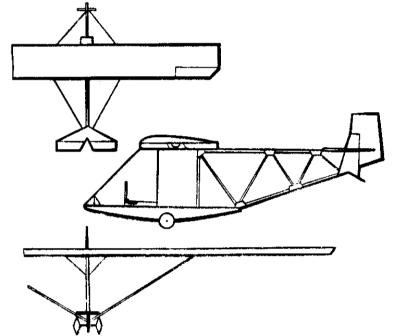
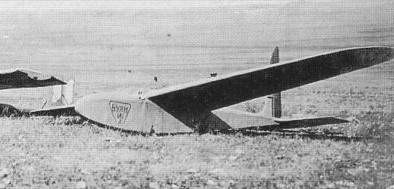
The Sharapov-Verzilov “Piervieniets” (First) (Russian: Шарапов-Верзилов “Первенец”) was designed as a single-seater training glider.

Conceptually the “Piervienets” was designed as a high wing glider braced by four uprights. The wing had a rectangular shape in the plane with ailerons in the outer area.

The fuselage was in the form of a low-sided “bathtub” to which a flat, uncoated wooden structure was attached, ending in the conventional tail.

The landing gear consisted of two wheels located on the sides and a tail skid.

The pilot sat in a fully exposed seat. The cabin space was so wide that flights were carried out with a passenger behind the pilot.

Built in Simferopol in 1927 by AN Sharapov and VN Verzilov and flying that fall, the “Piervieniets” glider was entered in the IV edition of the national glider competitions. During competitions it was the most popular glider, flying 274 training flights.

Piervieniets
Wingspan: 12 m
Wing area: 18 m²
Aspect ratio: 8
Length: 6.5 m
Empty weight: 125 kg
Wing loading: 11 kg / m²
Aileron surface: 2.6 m²
Accommodation: 1

Sharapov-Verzilov Buyán

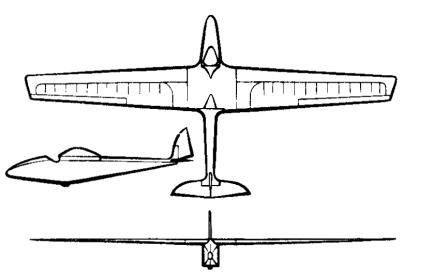
The Sharapov-Verzilov ”Buyán” (Russian: Шарапов-Верзилов “Буян”) was designed as a single-seater racing glider. The “Buyán” was a cantilever-wing monoplane. This wing, with a trapezoidal shape in the plane and slanted straight ends, was located high in the fuselage.

The fuselage had a fusiform shape with straight gunwales. At the top and inside it had a curved shape. At the front was the open cockpit.

The shape of the tail surfaces was reminiscent of the fins of a dolphin. The landing gear featured a wheel partially inserted into the centerline of the fuselage.

Built in 1928 in Simferopol by AN Sharapov and VN Verzilo, it was a participant in the 5th round of national gliding competitions after first flying in the fall of 1928.

Shapley Kittiwake

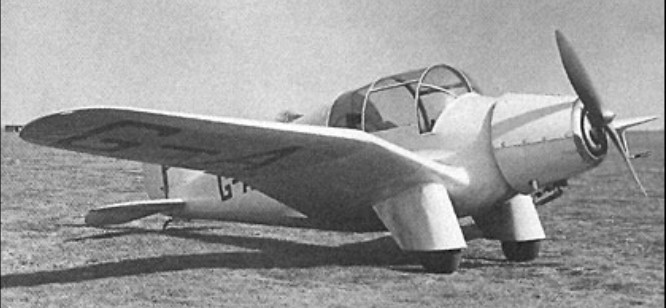
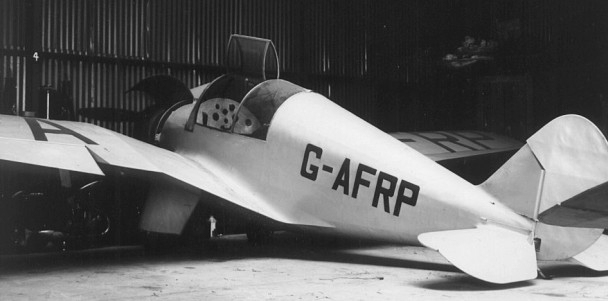
Designed and built by Errol Spencer Shapley at Torquay, Devon, the Kittiwake was a two-seat monoplane with a gull wing and a fixed landing gear. The first aircraft, a Mark 1 registered G-AEZN (c/n ESS.1), with an open cockpit was powered by a 50 hp (37 kW) Continental A50 piston engine and first flown at Roborough in 1937. A Captain F Symodson was the test pilot. The second aircraft, a Mark 2 registered G-AFRP (c/n ESS.2), was a cabin monoplane powered by a 90 hp (67 kW) Pobjoy Niagara III engine and first flown at Roborough in 1938.

The Mark 1 aircraft was dismantled before the Second World War. The Mark 2 was stored during the war only to crash on Dartmoor in December 1946.

Kittiwake Mark 2
Engine: 1 × Pobjoy Niagara III, 90 hp (67 kW)
Wingspan: 32 ft 0 in (9.76 m)
Length: 20 ft 10 in (6.35 m)
Empty weight: 901 lb (409 kg)
Gross weight: 1600 lb (726 kg)
Cruise speed: 110 mph (176 km/h)
Crew: 1
Capacity: 1