Shenyang FT-6

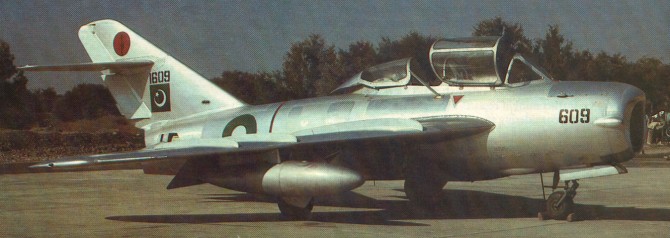
The two seat Shenyang development of the MiG-19SF, the FT 6, is not widely known, despite service with Egypt as well as Pakistan.

Although the Soviet Union built a small number of MiG¬-19UTI two seat trainers, the V VS concluded that a two seat MiG 19 conversion trainer was unnecessary for transitioning and production was terminated, and the Shenyang built FT 6 appears to owe little or nothing to its Soviet predecessor.

Whereas the Russian tandem two seat modification was accommodated within the existing fuselage, the forward section of the FT 6 was lengthened by some 33 in (84 cm) over the original 41 ft 4 in (12,6 m), (without the long nose pitot) by the Shenyang design team to allow room for the second occupant.

This necessitated the addition of two more ventral strakes beneath the rear fuselage as compensatory side area to prevent snaking, giving the FT 6 a total of three strakes in all.

Other differences from the standard F 6 are few, although, in view of the already very limited endurance, to make up for the loss of fuel capacity resulting from the second cockpit, extra tankage had to be provided. A prototype two seater appeared with small tip tanks to rectify this deficiency, but these apparently proved unacceptable on a 58 deg (leading edge) swept wing. The solution adopted on production FT 6s was to remove the two 30 mm NR 30 wing root cannon and insert extra fuel tanks in their bays, leaving only the single similar weapon under the nose for armament training. This leaves the FT 6 with only 150 or so litres (33 Imp gal) less fuel than the single seat version and allows a safe average training sortie time of about 45 minutes.

With the same twin Tumansky RD 911 811 (WP 6) axial flow turbojets as the single seat F 6, with a military rating of 5,732 lb (2600 kg) each, or 7,165 lb (3 250 kg) with reheat, the FT 6 offers virtually identical performance and handling to the F 6, with a maximum limit speed of around Mach 1.25 1.4, and a nominal low level supersonic capability in the clean configuration of some 723 knots (1340 km/h). At a gross weight of around 19,274 lb (8 742,5 kg), with two 167 Imp gal (760 lt) drop tanks, the F 6 has a thrust/weight ratio of 0.86:1. The F 6’s low speed stability and handling are somewhat critical, particularly for inexperienced pilots, and the requirement for a two seat version for conversion training is therefore logical.

Pakistan received its first FT 6s in September 1980. Transitioning pilots complete 20 dual landings in the FT 6 before going solo, plus about 66 sorties in the F 6 to complete the OCU course.

In the opinion of the PAF, the F 6 is probably the cheapest combat aircraft to operate of any in its class, and costs about one sixth as much as the Mirage III or 5 per flying hour. Both types have about the same manpower requirements, at around 50 60 maintenance man hours per flying hour, but spares for the F 6 from China are very considerably cheaper. The F 6 has suffered from the limitations of very short component lives engine TBO, for example, is only 100 flying hours, and 600 hours for the airframe.
Shenyang FT-5

The Chinese developed two seat version of the MiG-17, built at Shenyang and designated the FT 5, emerged from complete obscurity. The FT 5 appears uniquely Chinese, in that no similar two seat conversion of the MiG 17 ever appeared in the Soviet Union.

The FT 5 is based on the two seat MiG-15UTI, or FT-2, built in very large numbers in both the USSR and the People’s Republic of China, and as a modification of the early MiG 17, with a non afterburning Klimov VK 1 centrifugal turbojet derived from the Rolls Royce Nene (designated TJ 5D by the Chinese), and developing only 5,952 lb (2700 kg) thrust for take off, offers little more in the way of performance. It remains firmly subsonic, with no transonic capability limiting speed is around Mach 0.92 and has a fixed rather than all moving tailplane.

Although the forward and centre (ie, forward of the rear frame of the engine plenum chamber) fuselage of the FT 5 remains essentially similar to that of the MiG 15UTI, the rear fuselage of the MiG 17 is lengthened 35.4 in (90 cm), the tailplane sweep is increased and the wing is substantially different, with a consequent major improvement in handling.

The thinner and almost crescent wing of the MiG 17, with inner leading edge sweep of 45 deg reducing to 42 deg on the outer panels, plus three large and strategically placed fences appears to result in much “softer” and less critical handling characteristics.

Cockpit arrangement, both internally and externally, seems basically similar to that of the MiG 15UTI alias FT 2, a few of which remain in PAF service for instrument training. In Pakistan, the FT 5 began replacing the Lockheed T 33 and F¬-86F Sabre for advanced training in early 1975.

The FT 5 is equipped with a single 23 mm Nudelman Rikhter cannon under the starboard nose for air to ground gunnery, apparently in conjunction with a radar ranging sight through a di electric antenna in a small radome above the intake.

Although so far identified in foreign service outside China only in Pakistan, the FT 5 has been built in substantial numbers. The JJ-5 is the export derivative.

Wing span: 31 ft in (9,63 m)
Length: 37 ft 7.2 in (11,46 m)
Height: 12 ft 5.5 in (3,8 m)
Max level speed: 486 kts (902 km/h) at 32,000 ft (9753 m)
Service ceiling: 45,000 ft (13715 m)
Max endurance @45,000ft: 2 hr 38 min with two 88 Imp gal (400 lt) drop tanks

Shenyang No.1

With a Chinese built 160 hp M-11FR engine in a helmeted cowling, and rounded wingtips, the Aviation College in Shanghai built the prototype in 75 days. It flew in the winter of 1958-59 and production of passenger, liasion, ambulance and agricultural versions was said to be planned.
The wings were fitted with full span slots and split flaps. Normal accommodation is for a pilot and three passengers.

Span: 41 ft 4 in
Length: 28 ft 10.5 in
Wing area: 257 sq.ft
Gross weight; 2645 lb
Max speed: 121 mph
Service ceiling: 11,500 ft

Shenyang Red Banner No.1

The all metal Red Banner resembles a Yak-12 except for a shallow tail boom and clam shell rear loading doors. Power is from a 240 hp AI-14R radial with a Type V-530D variable pitch proeller. Payload is up to 6 passengers of 1100 lb of freight.
The prototype was built in Peking.

Span 41 ft 8 in
Length: 29 ft 10 in
Height: 11 ft 2 in
Wing area: 260 sq.ft
Gross weight: 3330 lb
Empty weight: 2425 lb
Max speed: 111 mph
Cruise speed: 84 mph
Service ceiling: 13,780 ft
Range: 310 miles

Shenyang Peking 1

Peking 1

This aircraft carries a crew of 2 and 8 assengers. Power is by a Chinese built 260 hp AI-14 radial. It is a conventional all-metal low-wing monoplane, with retractable tricycle undercarriage. Full span slots are fitted.
The Peking No.1 was built in 100 days at the Institue of Aeronautical Engineering in Peking.
It flew for the first time on September 24, 1958, and was handed over formally to the national civil aviation authorities a week later, on October 1.
Since then, little has been heard of it.

Span: 57 ft 5 in
Length: 42 ft 8 in
Max speed: 186 mph
Service ceiling: 15,750 ft
Range: 670 miles