Back to Short Stirling


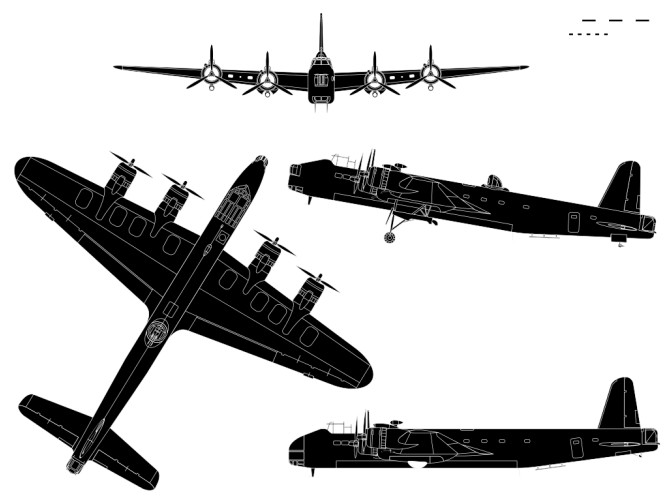
In 1936 the RAF also decided to investigate the feasibility of the four-engined bomber. The Air Ministry Specification B.12/36 had several requirements. The bomb load was to be a maximum of 14,000 lb (6,350 kg) carried to a range of 2,000 miles (3218 km) or a lesser payload of 8,000 lb (3,629 kg) to 3,000 miles (4,800 km) (incredibly demanding for the era). It had to cruise at 230 or more mph at 15,000 ft (4,600 m) and have three gun turrets (in nose, amidships and rear) for defence. The aircraft should also be able to be used as a troop transport for 24 soldiers, and be able to use catapult assistance for takeoff. The idea was that it would fly troops to far corners of the British Empire and then support them with bombing. To help with this task as well as ease production, it needed to be able to be broken down into parts, for transport by train. Since it could be operating from limited “back country” airfields, it needed to lift off from a 500 ft (150 m) runway and able to clear 50 ft (15 m) trees at the end, a specification most small aircraft would have a problem with today.
Initially left out of those asked to tender designs, Shorts were included because they already had similar designs in hand and they had ample design staff and production facilities. Shorts were producing several four-engined flying boat designs of the required size and created their S.29 by removing the lower deck and boat hull of the S.25 Sunderland. The new S.29 design was largely identical otherwise: the wings and controls were the same, construction was identical and it even retained the slight upward bend at the rear of the fuselage, originally intended to keep the Sunderland’s tail clear of sea spray.
In October 1936, the S.29 was low down on the shortlist of designs considered and the Supermarine Type 317 was ordered in prototype form in January 1937. However it was decided that an alternative design to Supermarine was needed for insurance and that Shorts should build it as they had experience with four-engined aircraft. The original design had been criticized when considered and in February 1937 the Air Ministry suggested modifications to the original Short design, including considering the use of the Bristol Hercules engine as an alternative to the Napier Dagger, increasing service ceiling (28,000 ft) and reducing the wingspan. Shorts accepted this large amount of redesign. The project had added importance due to the death of Supermarine’s designer causing doubt in the Air Ministry. The S.29 used the Sunderland’s 114 ft (35 m) wing and it had to be reduced to less than 100 ft (30 m), the same limit as that imposed on the P.13/36 designs (Handley Page Halifax and Avro Manchester). In order to get the needed lift from a shorter span and excess weight, the redesigned wing was thickened and reshaped. It is often said that the wingspan was limited to 100 ft so the aircraft would fit into existing hangars. “The wing span was limited by the Air Ministry to 100 ft” but the maximum hangar opening was 112 ft (34 m) and the specification required outdoor servicing. The limitation was to force the designer to keep overall weight down.
The original layout of the bomber was tried out by the construction of a half-scale model S.31 fitted with four 97kW Pobjoy engines. Flying trials with this proved the feasibility of the design. Short had originally decided on an incidence of 3° giving the best possible cruise performance, but the RAF asked that the incidence be increased to 6.5°, being more concerned with improving take-off performance than the cruising speed. In order to accommodate the RAF request for increased wing incidence a major re-design of the central fuselage would have normally be undertaken, but because of time restraints, Short decided on a “quick fix” by lengthening the main landing gear legs to give a higher ground angle.
At the end of 1938, this change was incorporated on the Short S.31 prototype.
While testing with the S31/M4, construction began on two full size prototypes now officially known as the Stirling MkI/P1. Shortly after construction of the prototypes began, the Air Ministry decided to order the Stirling into production with a contract of 100 Stirling MkI’s as the second string for the Supermarine 316 and formally ordered in October. 1938. The prototype S29 was rolled out of the company’s Rochester factory on 13 May 1939.
Given the RAF serial number L7600, the prototype made its maiden flight on 14 May 1939 (with four Bristol Hercules II engines). After a graceful takeoff and short test flight it suffered an undercarriage failure on landing and was damaged beyond repair. The failure was traced to the light alloy undercarriage back arch braces which were replaced on succeeding aircraft by stronger tubular steel units.
The second prototype (L7605) was fitted with the strengthened undercarriage and made its maiden flight on 3 December 1939. For this flight the gear was left down, but happily for both Short and the RAF, the revised undercarriage held up when put to the tests of retraction, lowering and landing. During the spring of 1940, the prototype spent four months undergoing service tests at Boscombe Down.
Deliveries of production aircraft to the RAF began in August 1940. It was built initially by the parent firm at Rochester and by Short and Harland at Belfast, where the Air Transport Auxiliary (ATA) opened No.8 Ferry Pool (FP) to clear them.
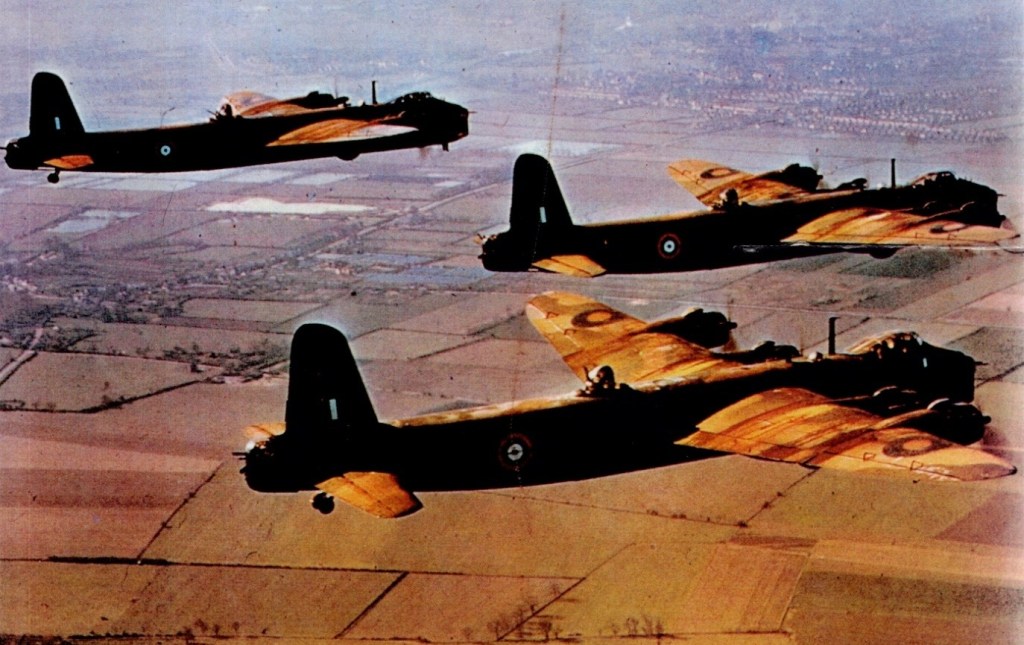
The first production version for the RAF was the Stirling I powered by four 1185kW Bristol Hercules XI radial engines and without a dorsal turret fitted. First in action in February 1941, the Stirling carried 7 tons of bombs for 590 miles, and was armed with eight machine guns. It went into service with 7 Squadron at Leeming in August 1940, and remained in production throughout the war. Prior to its first operational sortie, ATA is recorded as having ferried 12.
Both the factories were bombed in the summer of 1940, after which production was further distributed to the Austin Motors shadow factory at Longbridge, Birmingham, and to a new Shorts factory at South Marston, Swindon.
The Stirling II, only a few of which were completed, was a conversion of the Mk I with Wright R-2600-A5B Cyclone engines. The Mk III had four 1,230kW Bristol Hercules XVI engines and featured a mid-upper turret.
In order to train pilots on the new aircraft, each Stirling squadron formed its own conversion flight and in December 1941, a training unit was created at Thruxton with the specific purpose of training ATA pilots who would have to ferry them. This unit moved to Hullavington in May 1942, to Marharn in August and to Stradishall in October.
When by 1943 the output of heavy bombers had risen to over 400 a month, more ATA four-engined rated pilots were urgently needed to move them. When in February 1943 an ATA Halifax training unit, which had been opened at Pocklington stood down, to fill the gap in four-engined training, ATA reverted to a previous arrangement for its pilots to be given conversion courses with 1647 Stirling Conversion Unit at Stradishall.
From 1943, when the Stirling was no longer a suitable bomber, unlike the Mk III, the Stirling IV was produced from new as a long-range troop transport and glider tug (Horsa glider), the nose and upper turrets being removed and replaced by fairings, although the four-gun tail turret was retained. Up to 24 paratroops or 34 airborne troops could be carried. The final version of the Stirling was the Mk V, an unarmed military transport and freighter with a redesigned nose.
Total production of the Stirling – the Mk III of which was the major variant – was about 2,380.

On the night of 7-8 April 1945, RAF Stirlings of 38th Group dropped two battalions of French parachutists, including both regular soldiers and members of the French Resistance, into Holland south of Groningen. The aim was to support the advance of the Canadian Second Division.
Stirling I
Max speed: 260 mph
Range: 1930 miles
Crew: 7/8
Armament: 8 x .303 Browing mg
Bombload: 14,000 lb
Stirling Mk III
Engines: 4 x Bristol Hercules XVI, 1230kW / 1627 hp
Max take-off weight: 31751 kg / 69999 lb
Empty weight: 19595 kg / 43200 lb
Wingspan: 30.2 m / 99 ft 1 in
Length: 26.59 m / 87 ft 3 in
Height: 6.93 m / 23 ft 9 in
Wing area: 135.63 sq.m / 1459.91 sq ft
Max. speed: 235 kt / 435 km/h / 270 mph
Cruising Speed: 200mph (323kmh)
Service ceiling: 5180 m / 17000 ft
Max range: 1747 nm / 3235 km
Range w/max.payload: 950 km / 590 miles
Range: 2,010 miles (3,242km) with 3,500lb (1,589kg) bombload
Armament: 8 x .303in / 7.7mm machine-guns
Max. bomb load: 14,000 lb / 6,350 kg
Crew: 7-8


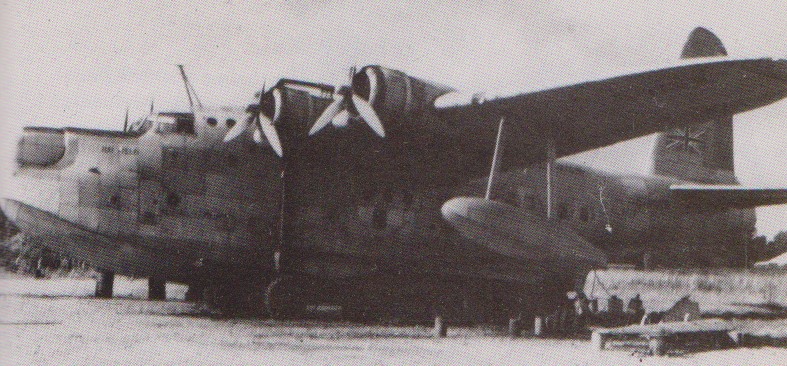
Following on from the Empire class flying boats, Short was keen to explore the limits of the flying-boat design, while also investing in the S.32 land airliner. A number of drag and stability improvements were proved and then embodied in the enlarged version of the Empire boat named the G class, or Golden Hind, and featuring improved power and range. The intention for this design (of which three were ordered by Imperial Airways) was to implement a regular scheduled service across the Atlantic in association with Pan Am.
World War II intervened and the three G boats were sequestered by the RAF and converted for ASW/reconnaissance use for which gun turrets and depth charge housings were installed. In 1942 they were reconverted to carry up to 40 passengers and used on services to Africa.
In late 1941 the two surviving G boats were returned to civil duties, but only one example survived the war. After a brief operational period the aircraft fell into disuse.
Engines: 4 x Bristol Hercules IV or XIV 14-cylinder radial, 1380 hp
Wingspan: 40.90 m / 134 ft 2 in
Length: 31.40 m / 103 ft 0 in
Height: 11.45 m / 38 ft 7 in
Wing area: 2159.904 sq.ft / 200.66 sq.m
Weight empty: 37712.1 lb / 17103.0 kg
Max take-off weight: 33800 kg / 74517 lb
Max. speed: 181 kts / 336 km/h / 209 mph
Cruising speed: 157 kts / 290 km/h
Service ceiling: 16896 ft / 5150 m
Cruising altitude: 7497 ft / 2285 m
Range: 2781 nm / 5120 km / 3182 miles
Crew: 5
Passengers: 40
Armament: 12x cal.303 MG (7,7mm), 907kg Bomb.
Back to Short S.25 Tasman Class Sandringham / Sunderland
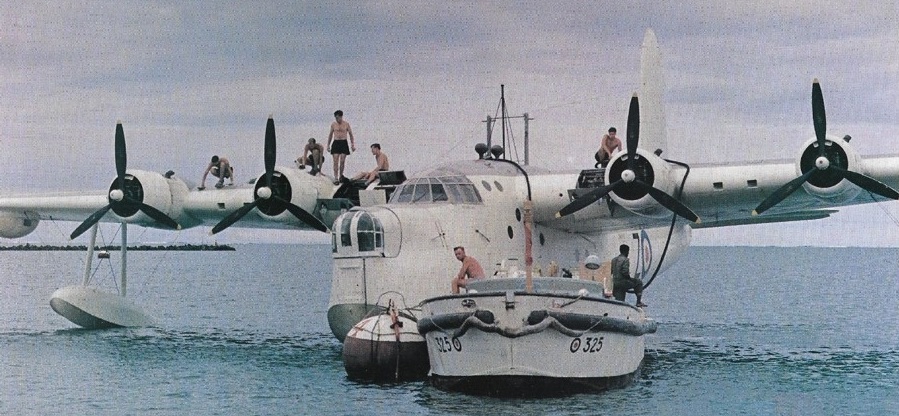

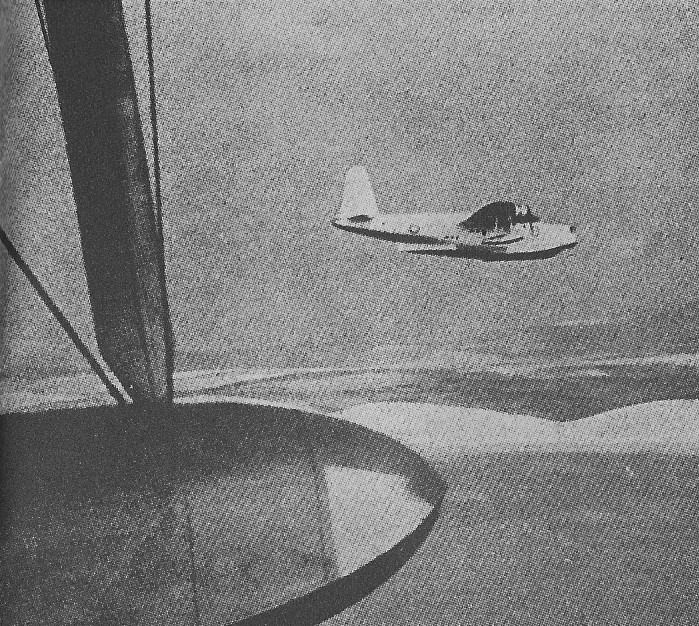

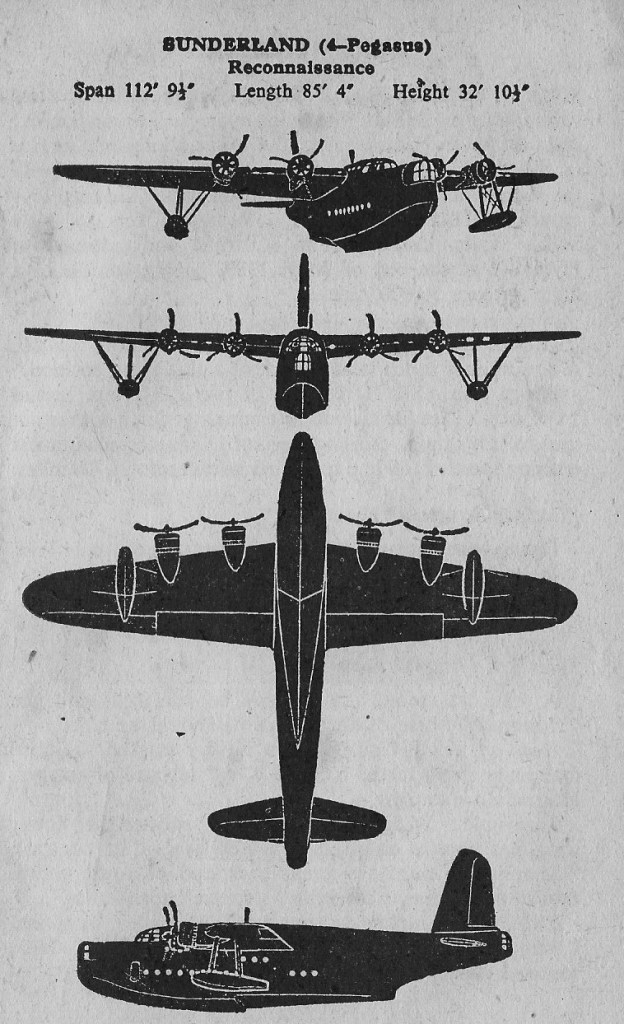
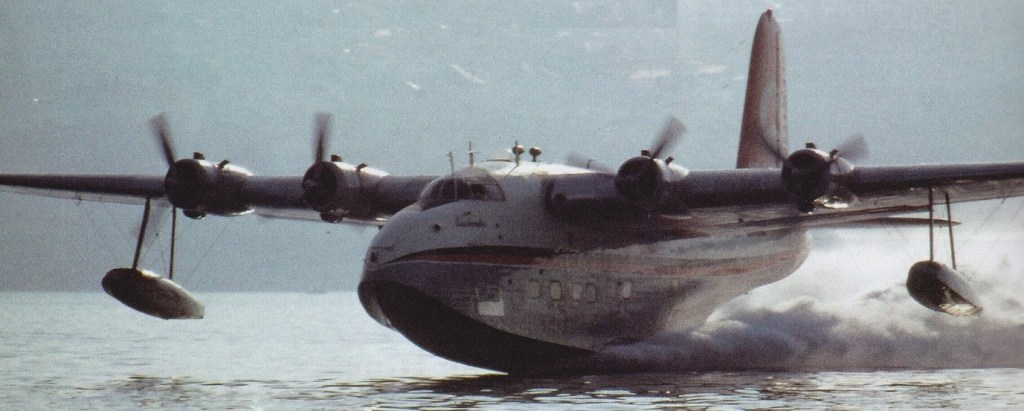
Back to Short Sunderland

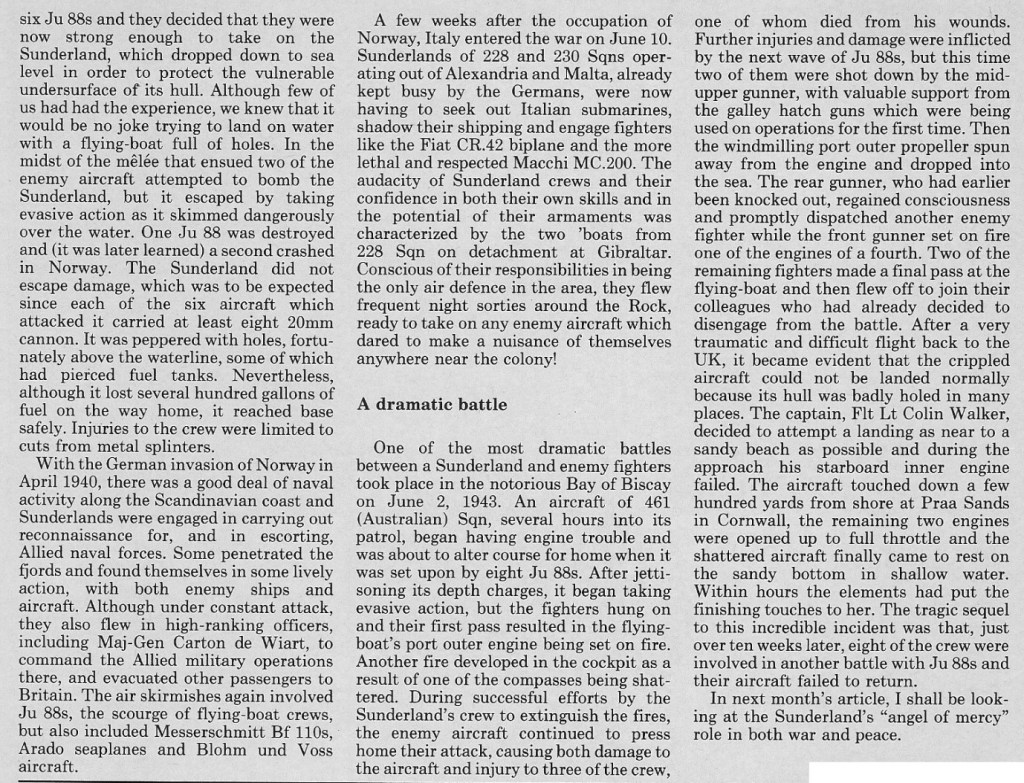


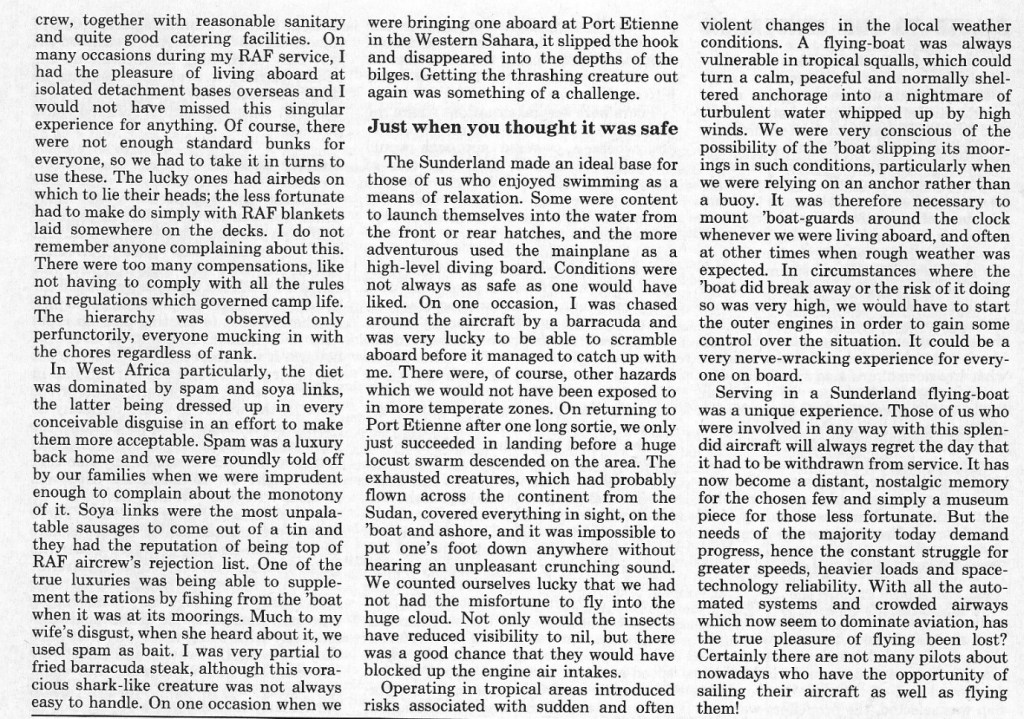

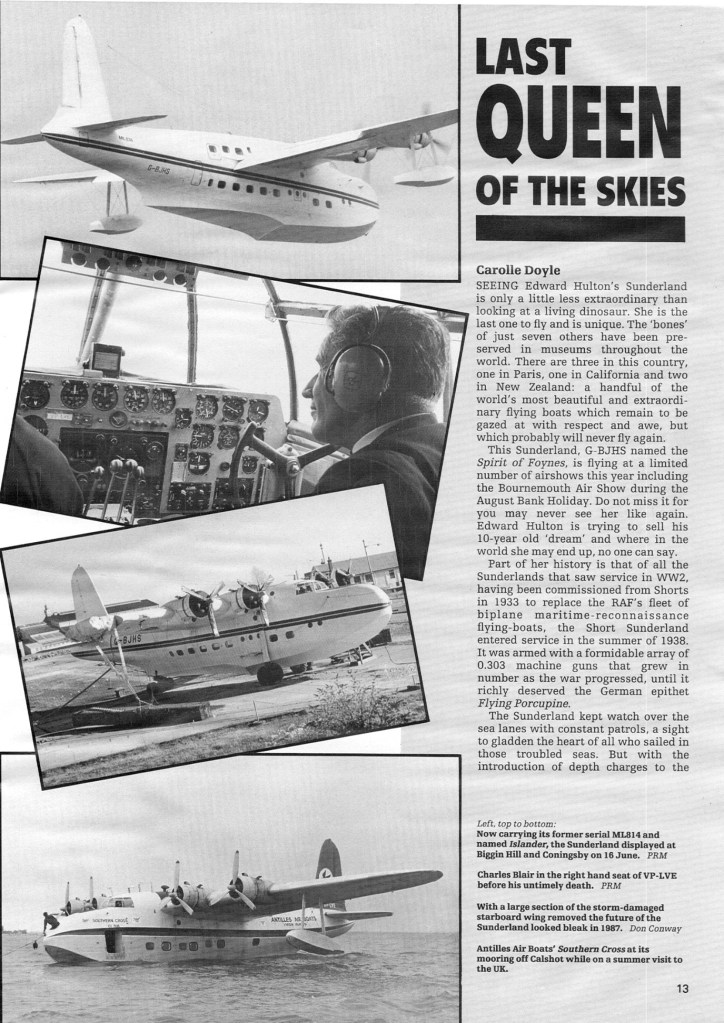
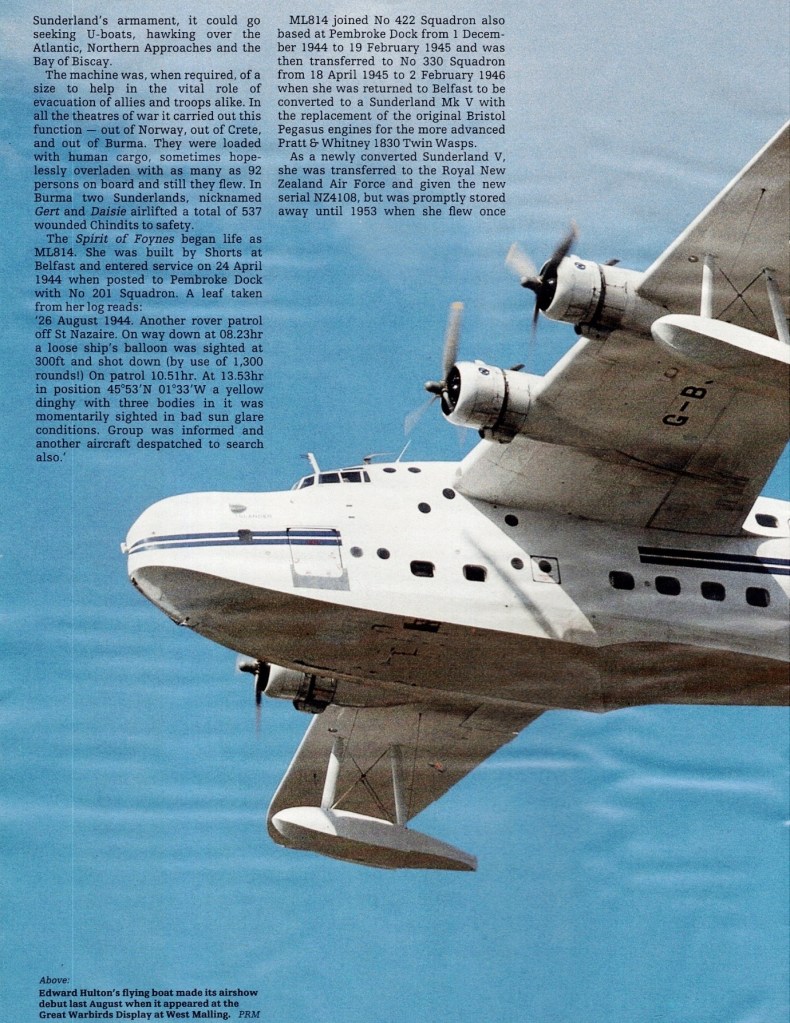

The amazing adventures of Sunderland flying boat T9114
In 1943, a number of ’flying boat’ seaplanes and other vessels found one thing going wrong after another. But in the end, aviation history was made in West Wales
If you lived in Pembroke Dock during the 1940s you would have heard the thunderous roar of the Sunderland flying boat overhead. RAF Pembroke Dock was on the south side of the Milford Haven Waterway, opposite the town. By 1943, 99 flying boats rested on water or land there. From the quayside you could see their rows stretching across the water, moored to buoys.
The station’s motto, ‘Gwylio’r gorllewin o’r awyr’, means ‘To watch the west from the air’. Its seaplanes played a vital part in winning the Battle of the Atlantic, undertaking multiple roles including reconnaissance, tracking enemy shipping, Air Sea Rescue (ASR), Anti-Submarine Warfare (ASW), and convoy escort. If Britain had lost that battle the outcome of the second world war might well have been radically different.

There was constant activity at the base during the war. On 28 May 1943, Sunderland flying boat JM675 (UT-O) from 461 Squadron took off on an operational patrol to rescue the crew of a downed Armstrong Whitworth Whitley bomber. Its survivors were eventually spotted in a dinghy and the flying boat radioed for permission to land.
The aircraft descended and bounced off three swells on touchdown, before stalling and diving vertically into the next swell. Its bow was torn off up to the cockpit, killing Flight Lieutenant WSE Dods and leaving the First Pilot badly injured. The survivors climbed into their own dinghy and joined those of the downed Whitley, lashing the two dinghies together and waiting for help.
Early the next day another Sunderland (T9114) from the same squadron, flown by pilot PO Singleton and his crew, took off on a normal anti-submarine operation. They were soon diverted and told to look for any survivors of the two downed aircraft. The crew of 11 included an engineer, a bombardier, a navigator, a wireless operator, two pilots, and five aerial gunners.
Crew members were capable of undertaking more than one role, with duties organised in shifts. The wireless operators, for instance, did an hour in the mid-upper turret, an hour as wireless operator, and half an hour on radar, because of the stupor and eye-strain that could be suffered after a short time.
A solitary aircraft might patrol up to 12 or 13 hours – 500 miles in the Atlantic – but was well-equipped for it. Compared with other aircraft, the Sunderland boasted comfortable features including upper and lower decks, a wardroom, two bunks, and a flushing toilet, washbasin, and mirror. Also, essentially, a galley where drinks and hot food like corned beef rissoles or spam fritters could be served.
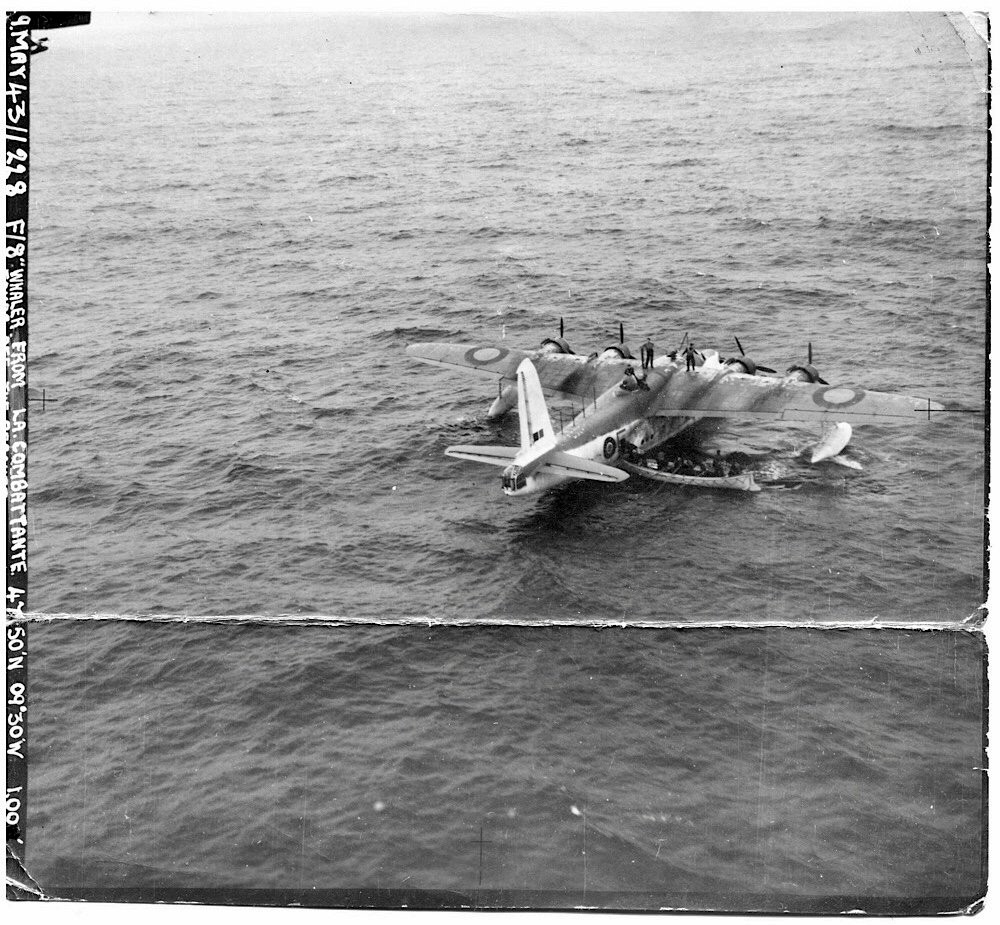
Just after 6:30am, Sunderland T9114 spotted the survivors and dropped smoke floats and green dye to determine wind and sea conditions. The sea was considered borderline, but nevertheless they landed 175 nautical miles southwest of Bishop Rock. The plane was overloaded and takeoff proved impossible, with 16 survivors, 11 crewmen, eight depth charges, and 1500 gallons of fuel aboard.
While rescue operations were taking place, another Sunderland and a Wellington circled overhead. Singleton asked them to locate a Royal Navy ship known to be in the area – La Combattante, a Free French destroyer. It rescued all the Whitley survivors and five of the T9114 crew.
Sunderland T9114 was then taken under tow and they headed back to the UK. During the four-hour trip the aircraft narrowly missed a floating mine and the tow line parted twice, the mooring post finally snapping and casting the Sunderland adrift.
Fortunately, the swell had moderated, giving Singleton and his crew an opportunity to take off. To lighten the load further, the destroyer sent an armourer to disarm the eight depth charges aboard, which were then jettisoned. T9114 turned into the wind and Singleton hauled back the controls to reach maximum take off speed. But just as the plane lifted it was hit by a particularly large wave, which smashed into the hull.
A crew member was sent below to inspect the damage. He informed Singleton that a seven-feet-wide hole had opened below the waterline. This made any sea landing impossible and, with no parachutes aboard, only one deadly option existed. The Sunderland was a flying boat, not an amphibious craft. It was designed to land on water and had no undercarriage, wheels, or brakes.

Singleton chose RAF Angle, not far from Pembroke Dock, for a crash landing. The aircraft signalled those intentions to base. As they approached the coastline, the skeleton crew threw out heavy items, excess equipment, and anything flammable on board. They adopted crash positions as RAF Angle came into sight.
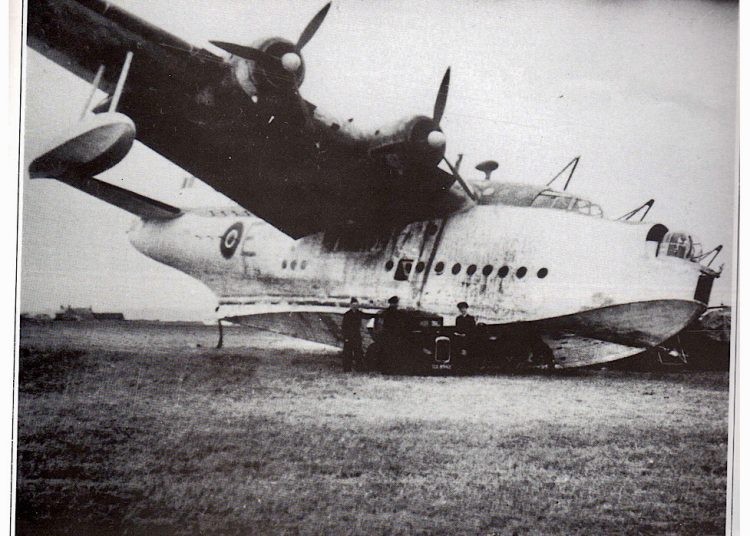
Planting a 27-tonne flying boat on land had never been tried before. Singleton lined the plane up as he glided over the aerodrome boundary and brought T9114 down onto the grass, parallel with the runway. The hull cut an enormous furrow in the earth. The Sunderland tilted on its port side as the port float was torn off, causing it to skew around in a partial arc before coming to a halt.
Half of 461 Squadron had turned out to see the landing. The whole episode was captured by the Commanding Officer through his cine-camera in a chasing car.
The motley crew, much of their dry flying gear having been given to the other survivors, exited unscratched through the astrodome. They slid or scampered down the tilted wing to a warm reception below, leaving the engines still running before some climbed back in to turn them off.
Rather than moving a safe distance from the aircraft, some crew lit cigarettes, oblivious to fire risk and perhaps not realising the magnitude of what had just happened – the significance to aviation history of the first-ever landing by a flying boat on soil. The feat has never been repeated. The only-ever such landing.
The Free French destroyer delivered all passengers to safety, including the injured Sunderland JM675 pilot. All able personnel returned to duty, but Sunderland T9114 never flew again. The removed forward section of the nose was used at RAF St Athan as a synthetic trainer for flight engineers.
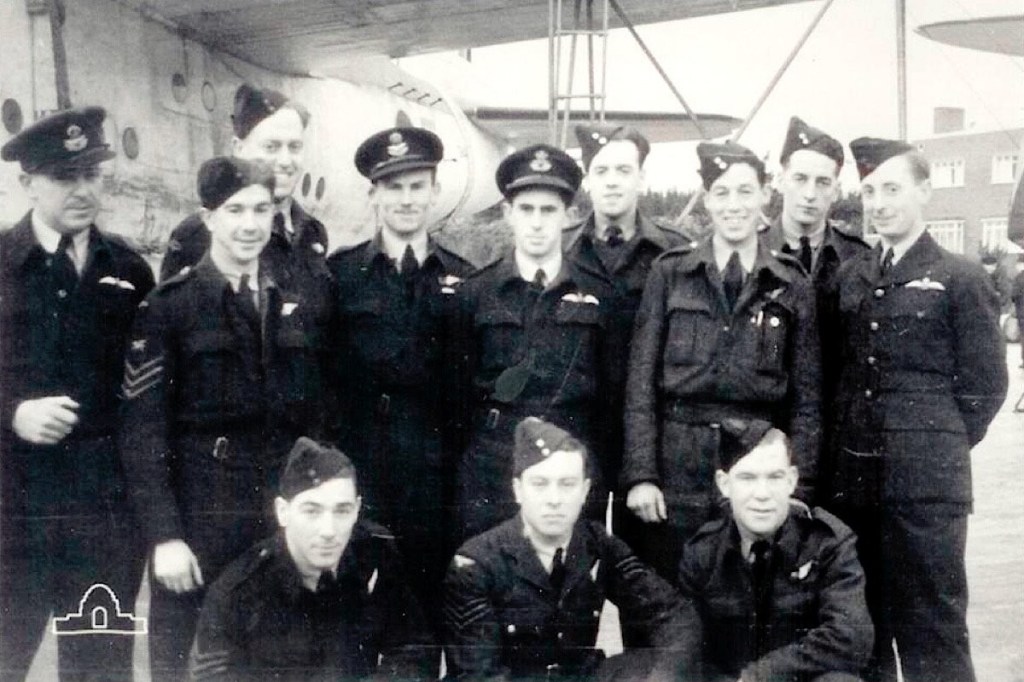
Sunderland T9114 crew: F/O George Singleton, Pilot (Captain). P/O Howe, 2nd Pilot. F/Sgt Taplin, Engineer. F/Sgt Hules, Bombardier. F/O Harry Winstanley DFC, Navigator. Sgt H Hall, Wireless Operator. Sgt Hammond, Aerial Gunner. F/Sgt Ronald Church, Aerial Gunner. F/Sgt John ‘Johnny’ Lewis, Aerial Gunner. F/Sgt Stevens, Aerial Gunner. P/O George Viner, Aerial Gunner.
Gordon Singleton of St Kilda, Australia married a local girl and settled in Britain. He was a great supporter of the Pembroke Dock Heritage Centre, the only museum focusing largely on the RAF Flying Boat Service. When he died aged 97 in 2013, his ashes were scattered on the airfield where he made aviation history.
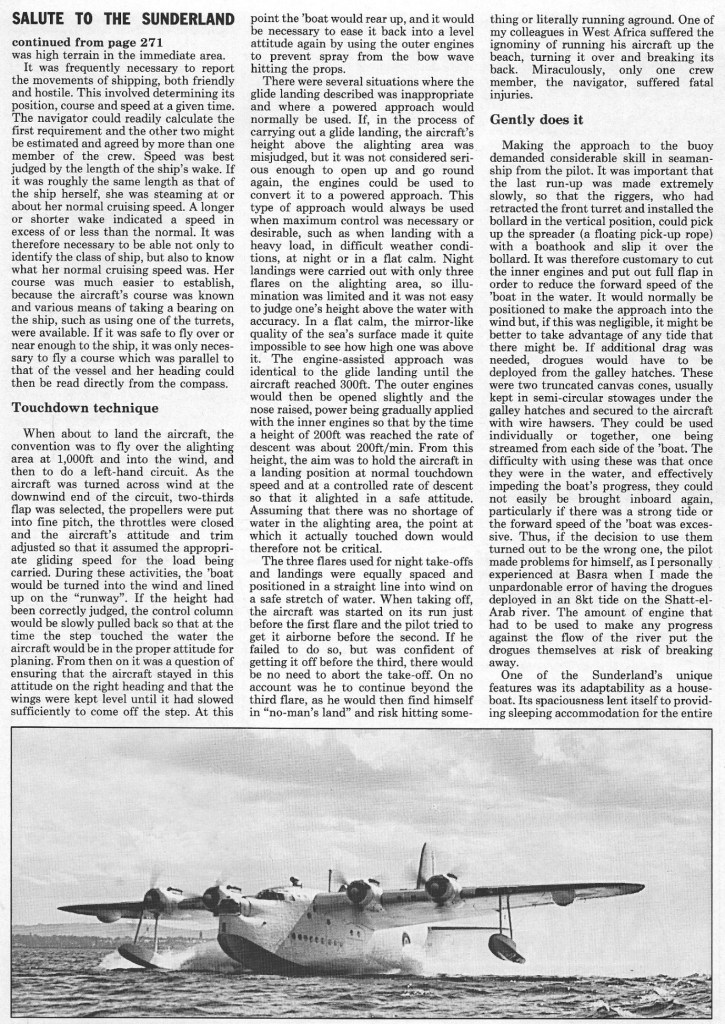
The Short Sunderland continued with a great safety record, remaining in service for the RAF Far East Air Force at Singapore until 1959 and the Royal New Zealand Air Force No. 5 Squadron until 1967. It’s an amazing testimony to longevity for any aircraft, especially one that first entered service in 1938.
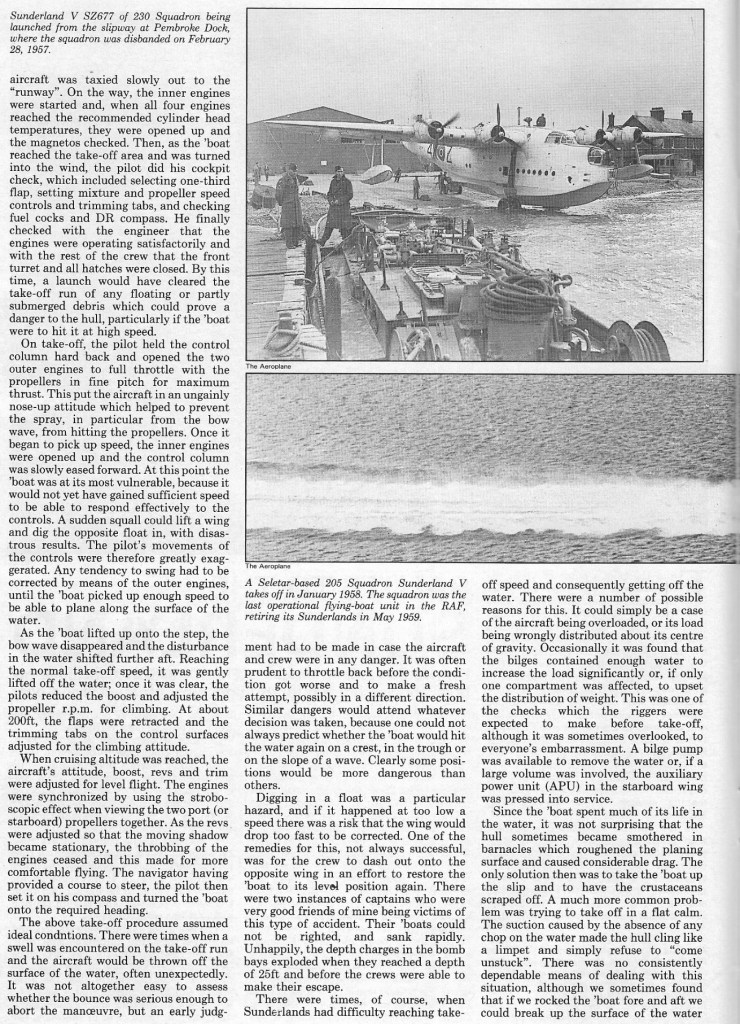
The last RAF Pembroke Dock flying boat squadrons were disbanded in 1957, and the base closed in 1959. But it would take part in one last operation, code-named Magic Roundabout, in 1979. In its eastern hangar was built another flying boat, a full-scale Millennium Falcon, for the Star Wars film The Empire Strikes Back.

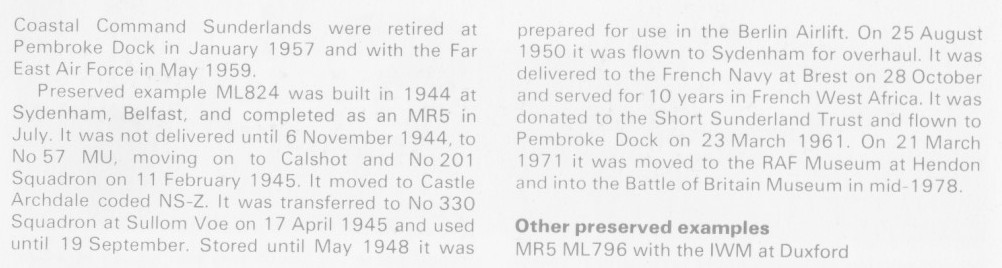
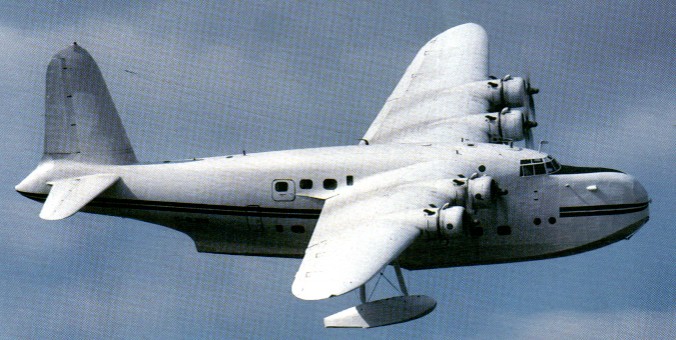
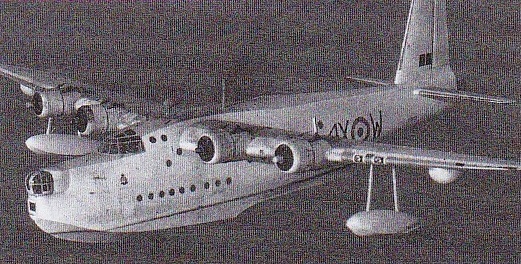
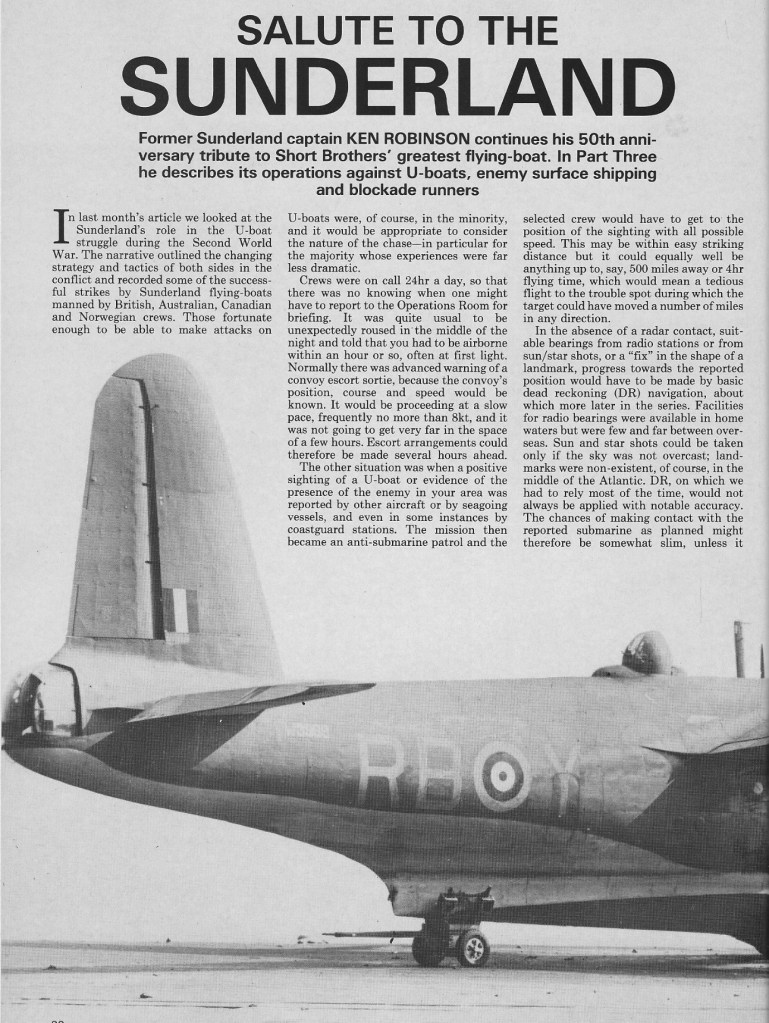
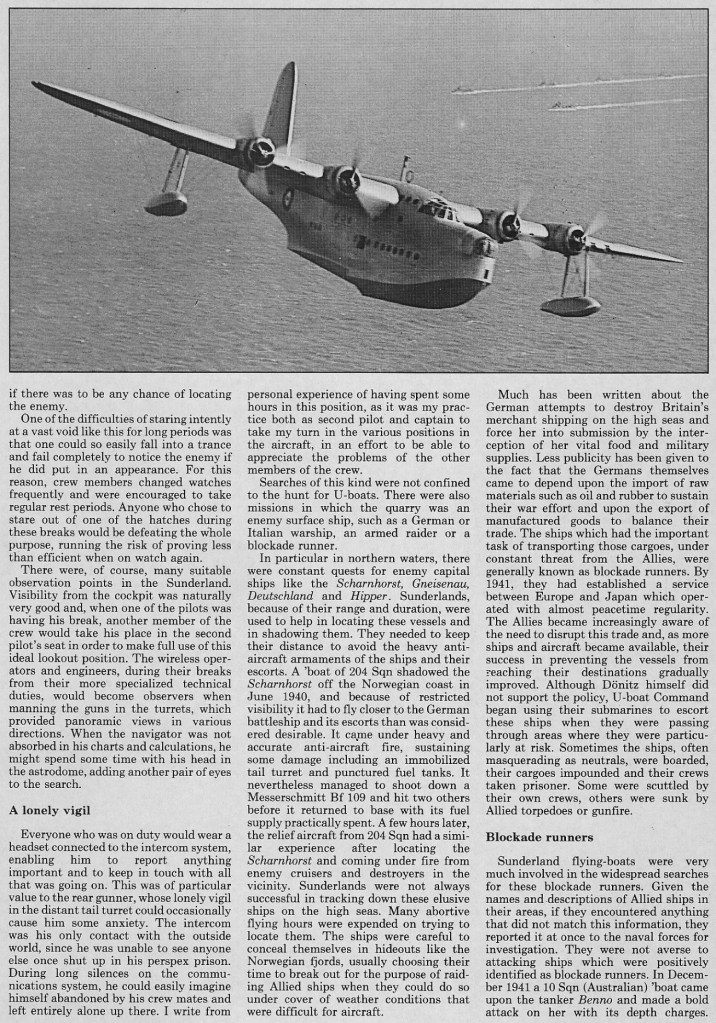
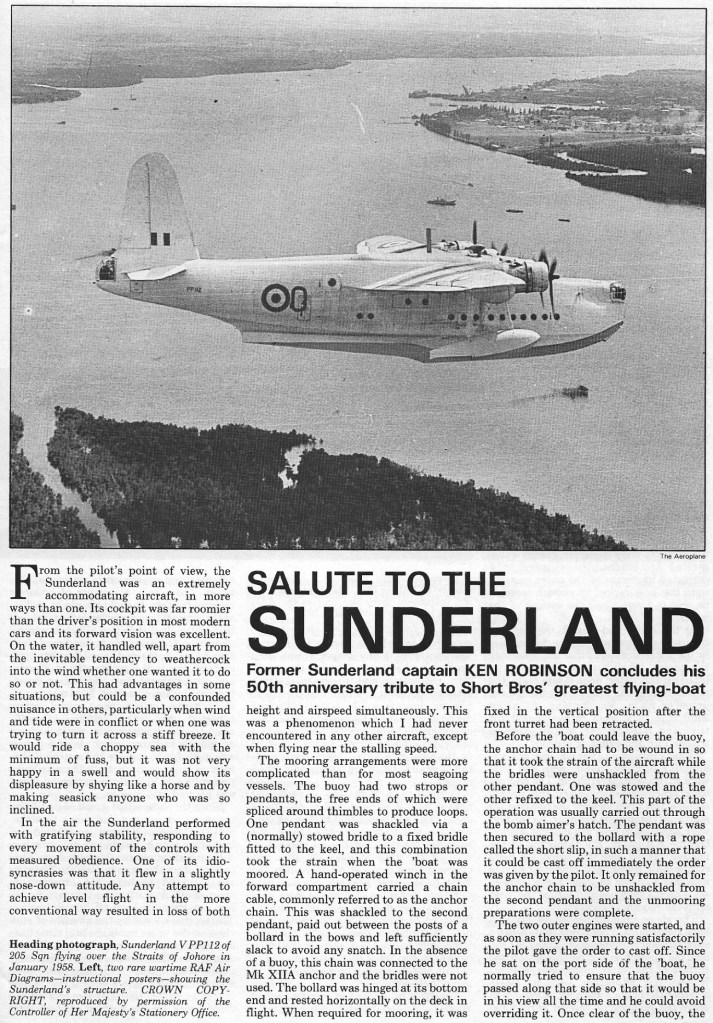
The Sunderland maritime-patrol and reconnaissance flying-boat was designed to meet the requirements of Air Ministry Specification R.2/33 and was virtually a military version of the Empire boat. The prototype flew for the first time on 18 October 1937, just over a year after the first Empire began its trials.
Entering service in June 1938, by the outbreak of war there were three squadrons of RAF Coastal Command operational with it and others in the process of re-equipping or forming. The Sunderland was notable for being the first flying-boat to be equipped with power-operated gun turrets.
The first production version was the Sunderland I powered by Bristol Pegasus 22 engines and armed with eight 7.7mm machine-guns: two in a Fraser-Nash nose turret, four in a Fraser-Nash tail turret, and two on hand-operated mountings in the upper part of the hull aft of the wing trailing edge.

The Sunderland II had Pegasus XVIII engines, but was otherwise similar to the Mk I, although late models were fitted with a two-gun dorsal turret in place of the manually operated guns.
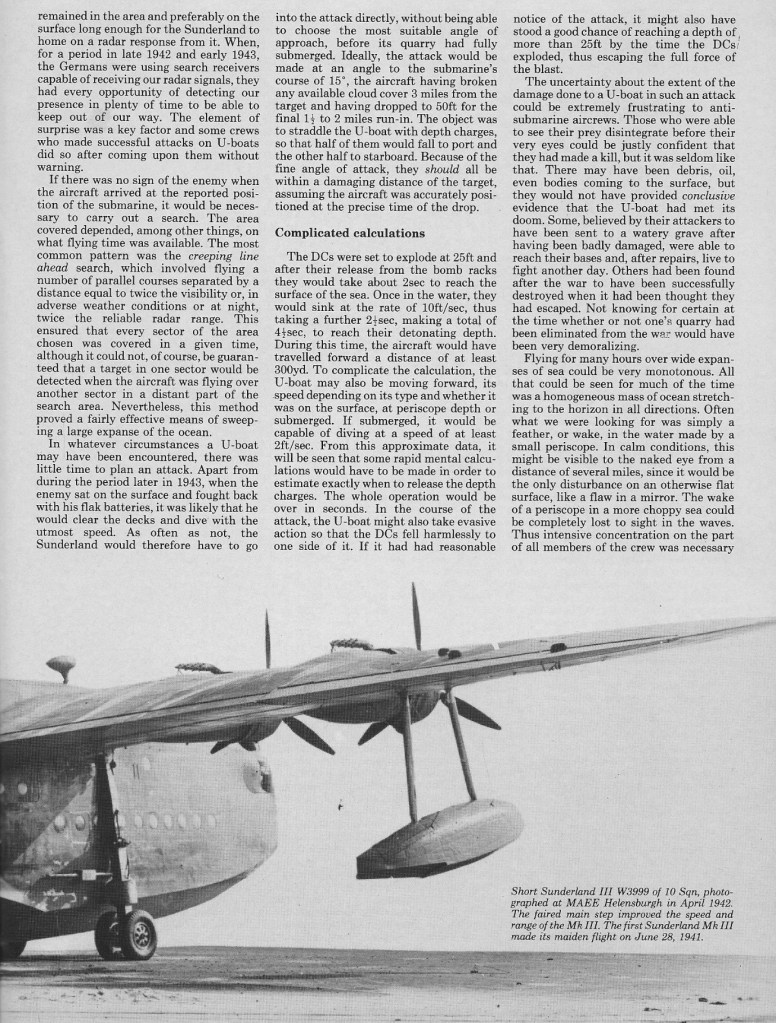
The Mk III used the same power plant as the Mk II, but had a modified hull with a stream-lined front step and a dorsal turret as standard.
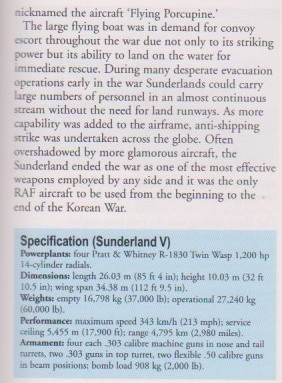
The final military version was the Sunderland V, the IV having become the Seaford. The Mk.5 was used mainly as a maritime reconnaissance flying boat they were powered the more powerful l200hp Pratt & Whitney R-1830 Twin Wasp. Wing span remained the same, however, the aircraft was slightly longer at 85’ 4”. Due to the increased power, the MAUW was 65,000lbs, but the maximum speed remained relatively unchanged. Armed with six Browning .303 machine-guns carried in two turrets (four in the rear and two in the forward), and four .303s fixed, that were controlled by the pilot. There were also two 0.5 Browning, which were manually operated, positioned in the beam hatches. Eight depth charges were carried on racks which were run out from the bomb room, along rails which extended under the wings. As with all the guns, these could be reloaded in flight.
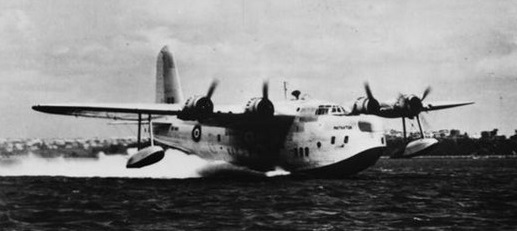
Production continued until October 1945 and seven hundred and forty-nine Sunderlands were built, and they served throughout the war. The final Coastal Command Sunderland operational mission was in June 1945 over four weeks after the German surrender. Long-range Sunderland operations also took place overseas from bases in Africa and the Far East.
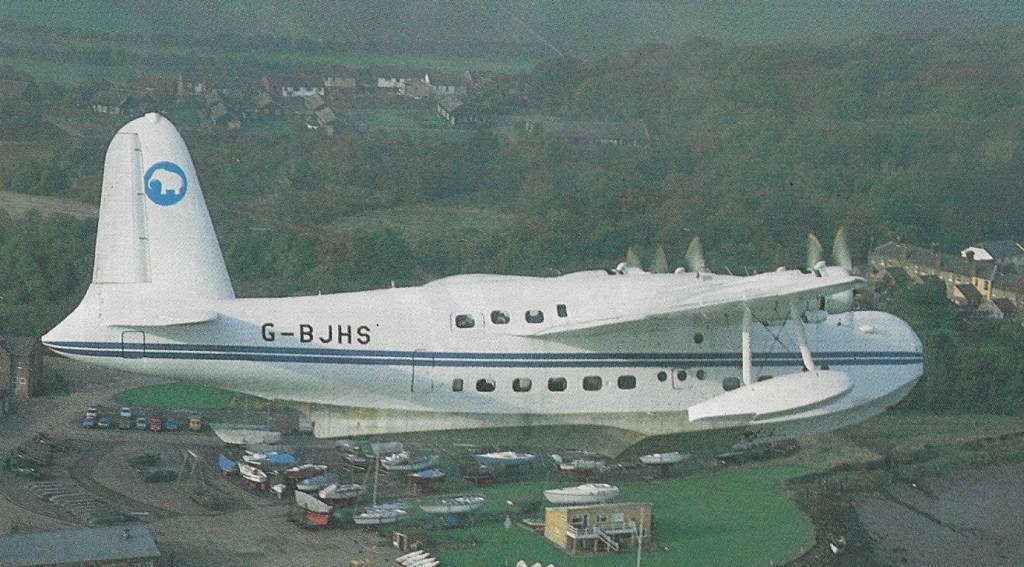
In 1943 a number of Sunderlands were de-militarised, equipped to carry 20 passengers and turned over to BOAC. The Short S.25 Sandringham was produced during the Second World War by the demilitarized conversions of Short Sunderland military flying boats previously operated by the Royal Air Force.

Post-war the type took part in the Berlin Airlift carrying 4920 tonnes (4847 tons) of freight. During the Korean War Sunderlands based in Japan undertook nearly 900 operational sorties totally over 13350 hours of flying. The Sunderland finally retired from RAF service in 1959 when the last aircraft were scrapped at RAF Seletar, Singapore.

Sandringham
Engines: 4 x Bristol Pegasus XVIII
Cruise: 200 mph
Pax capacity: 16-24
Sunderland Mk. III
Engines: 4 x 1065hp Bristol Pegasus radials
Wing span: 112 ft 10 in
Length: 84 ft 4in
MAUW: 58, 000 lb
Top speed: 210mph at 7,000ft
Sunderland Mk V
Engines: 4 x Pratt-Whitney R-1830-90B Twin Wasp, 895kW / 1200 hp
Max take-off weight: 29480 kg / 64993 lb
Empty weight: 16740 kg / 36906 lb
Wingspan: 34.38 m / 113 ft 10 in
Length: 26 m / 85 ft 4 in
Height: 10.52 m / 35 ft 6 in
Wing area: 156.72 sq.m / 1686.92 sq ft
Max. speed: 185 kt / 343 km/h / 213 mph
Cruising speed: 116 kt / 214 km/h
Service Ceiling: 5455 m / 17900 ft
Range: 2337 nm / 4300 km / 2672 miles
Armament: 2 x .5in / 12.7mm Browning machine-guns, 10 x .303in / 7.7mm machine-guns
Bombload: 2250kg / 8 x depth charges
Crew: 13

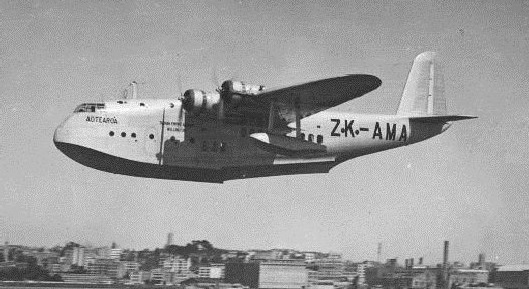


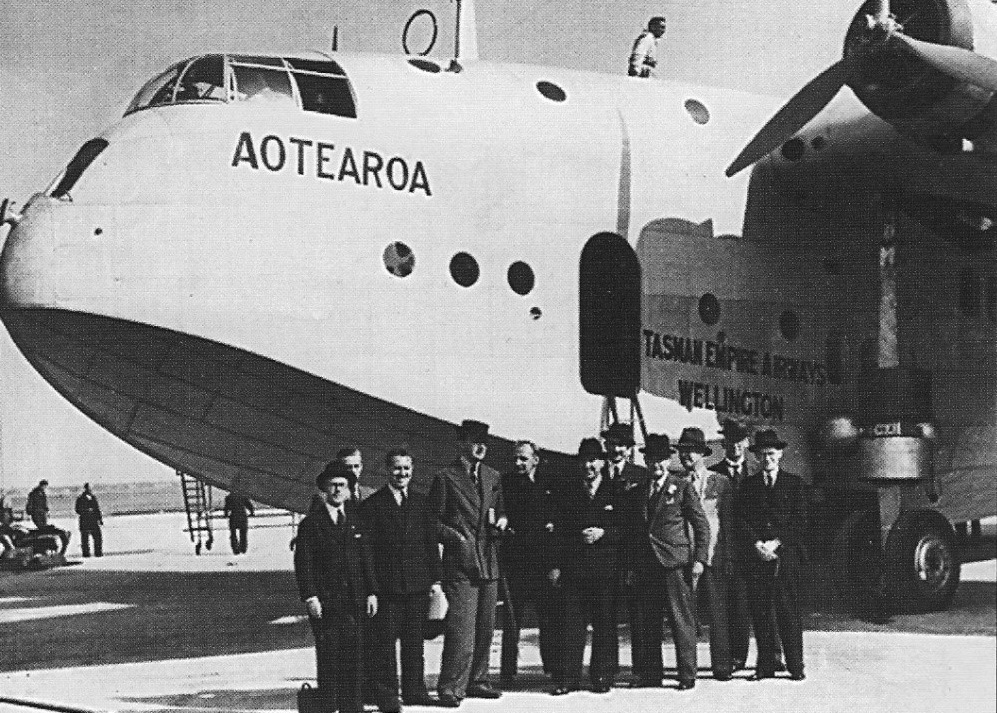
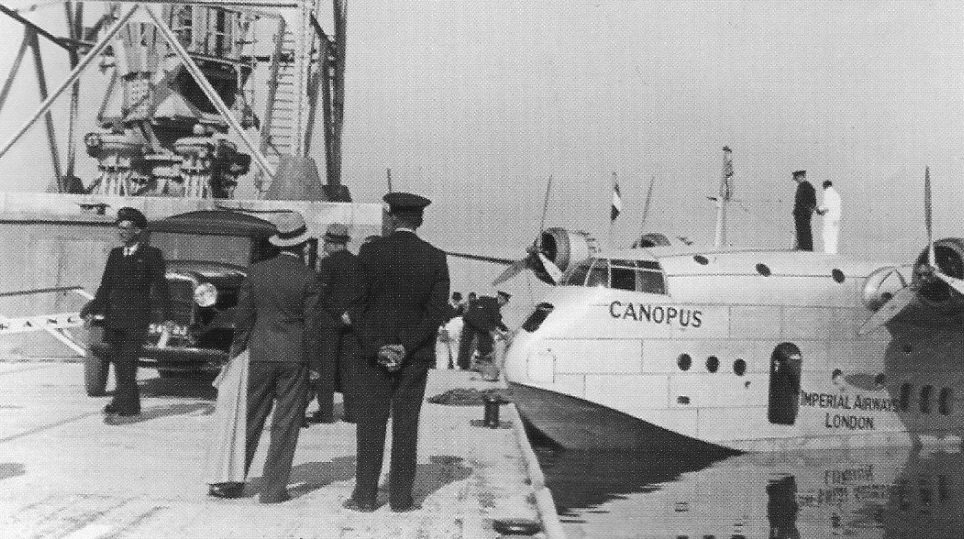
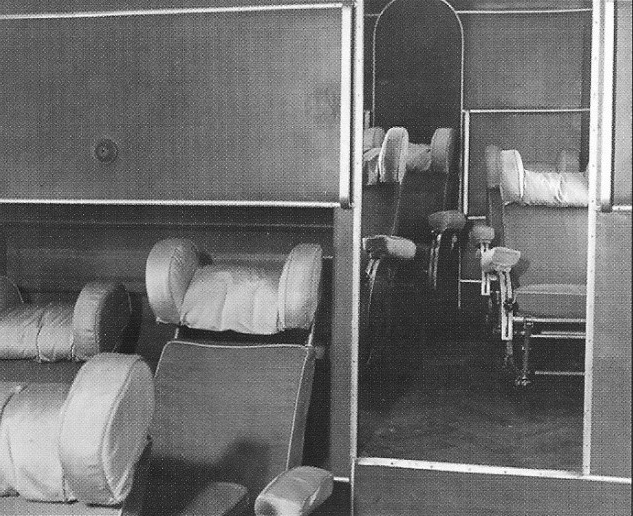
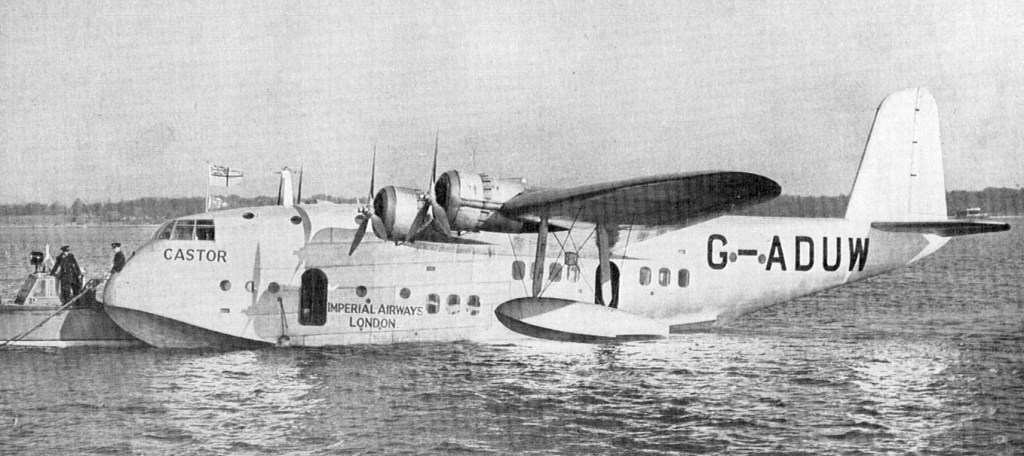
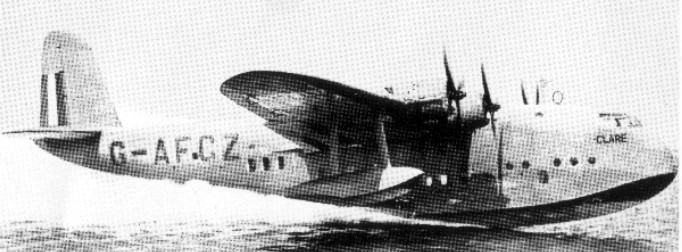
In 1935 the British government took the bold decision to carry all mail within the Empire at the ordinary surface rate. Combined with increasing passenger traffic, this called for a sudden expansion of Imperial Airways and the equally bold decision was taken to buy 28 of a totally new flying-boat, known as the C Class Empire, ‘off the drawing board’ from Short Brothers, at a cost of over £2,000,000. They were four engined cantilever monoplane with a hull of advanced lines.
Features included light-alloy stressed-skin construction; a cantilever high wing with electric Gouge flaps; four 685kW Bristol Pegasus Xc radial engines driving DH Hamilton two-position propellers; and a streamlined nose incorporating an enclosed flight deck for captain, first officer, navigator and flight clerk. A steward’s pantry was amidships and in the normal configuration seats were arranged in front and rear cabins for 24 passengers. On long hauls sleeping accommodation was provided for 16, with a promenade lounge. On some routes experience showed that the mail capacity had to be raised from 1.5 to 2 tonnes, reducing the passenger seats to 17.
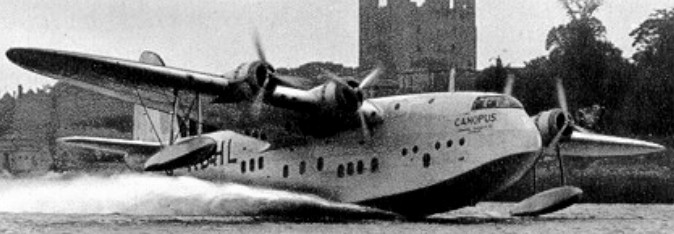
The prototype, the Short S.23 named Canopus, flew on July 4, 1936. Less than four months later, on October 30, it was in passenger service. Others followed at fortnightly intervals and by 1937 the fleet was already covering 113,196 miles per week on scheduled services.
The original C Class boats had four 910 hp Bristol Pegasus engines and could carry 17 pass¬engers, plus two tons of mail and freight for 810 miles at 164 mph. They were soon followed by seven more with 900 hp Perseus engines and double the range of the first batch.
All 28 were delivered, plus three for Qantas (Australia). Two were long-range boats with increased weight and transatlantic range. Eleven S.30s (eight for Imperial and three for Tasman Empire Airways) had 663kW Perseus XIIc sleeve-valve engines and greater range – the first four also being equipped for flight refuelling to greater weight. The final two boats were S.33s with increased weight and Pegasus engines.
On 5 August 1935, Imperial Airways began regular trans-Atlantic airmail flights using Short Empire flying boats which were refuelled in the air.

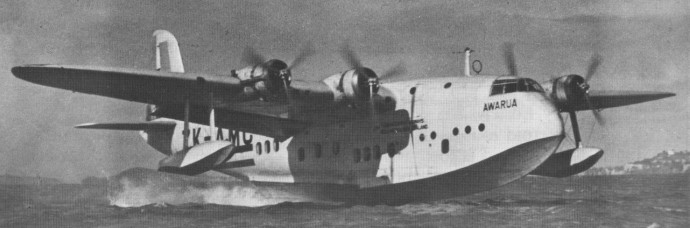
During World War II most of these great aircraft served on long routes all over the world. Four were impressed for RAF use with radar (two being destroyed in Norway in May 1940) and most were re-engined with the same 752kW Pegasus 22 engines as the Sunderlands (the derived military version). Their achievements were amazing: one made 442 crossings of the Tasman Sea, two evacuated 469 troops from Crete and one was flown out of a small river in the Belgian Congo in 1940. Others maintained schedules on the North Atlantic, between Britain and Africa, the dangerous Mediterranean route from Gibraltar to Malta and Cairo, and the Horseshoe route between Australia, India and South Africa. Most were retired in 1947.
The prototype completed 2,024,745 miles of safe flying in her ten years of service.
S.23 C-Class
Engines: 4 x Bristol Pegasus XC, 790 hp / 686kW
Wing span: 114 ft 0 in (34.75 m)
Length: 88 ft 0 in (26.82 m)
Height: 31 ft 9.75 in (9.68 m)
Wing area: 139.35 sq.m / 1499.95 sq ft
Empty weight: 10659 kg / 23499 lb
Max TO wt: 40,500 lb (18,375 kg)
Max level speed: 200 mph (322 kph)
Cruise speed: 265 km/h / 165 mph
Ceiling: 6095 m / 20000 ft
Range: 1223 km / 760 miles
Crew: 5
Passengers: 17-24
S.30
Engines: 4 x 910 h.p. Bristol Pegasus
Length: 88 ft. (26.82 m.)
Wing span: 114 ft (34.74 m.)
Weight empty: 23,500 lb. (10,660 kg.)
Max speed: 200 mph
Max cruise: 165 mph (265 kph)
Ceiling: 20,000 ft. (6,000 m.) fully loaded
Range: 800 miles (1,300 km.)
Crew: 5
Pax cap: 24


1935
S.22
Engines: 4 x 90hp Pobjoy Niagara III
Wingspan: 16.76 m / 55 ft 0 in
Length: 12.80 m / 42 ft 0 in
Wing area: 37.16 sq.m / 399.99 sq ft
Max take-off weight: 2608 kg / 5750 lb
Empty weight: 1504 kg / 3316 lb
Max. speed: 225 km/h / 140 mph
Cruise speed: 195 km/h / 121 mph
Ceiling: 3658 m / 12000 ft
Range: 676 km / 420 miles
Crew: 1-2
Passengers: 10

Tests had proved that an Imperial Airways’ Empire flying-boat could achieve a transatlantic crossing only if its entire payload consisted of fuel. Since it is well known that an aircraft can be flown at a much greater weight than that at which it can take off from the ground, Robert Mayo proposed that a small heavily loaded mailplane be carried to operational altitude above a larger ‘mother plane’ and then released to complete its long-range task. The proposal was accepted by the Air Ministry and Imperial Airways, which jointly contracted Shorts to design and build such a composite unit.
The Short S.21 Maia, the lower component, was a slightly enlarged and modified version of the Empire boat; the Short S.20 Mercury, the upper long-range unit, was a new high-wing twin-float seaplane with four 254kW Napier Rapier H engines giving a cruising range of 6116km with 454kg of mail.
This eight engined part time biplane composite was first tested on 4 January 1938. During take off and before separation Mercury’s flying controls were automatically locked in the neutral position, Maia’s pilot having full command; the parasite’s engines were started from inside the mother ship and combined with those of Maia to get the two components airborne.
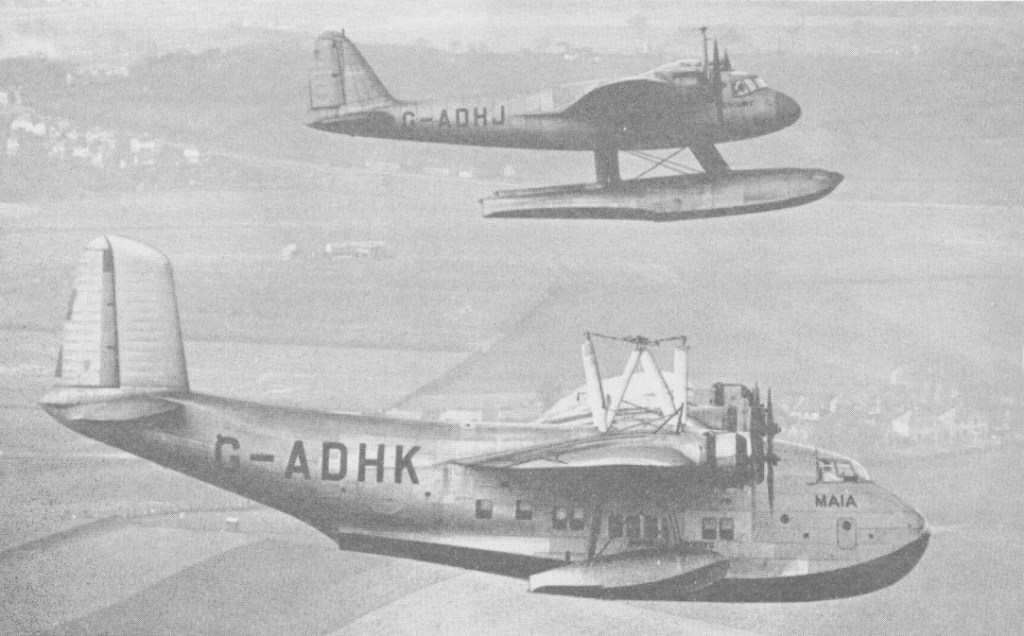
The first airborne separation took place on 6 February 1938, over Rochester, Kent, and after a number of experimental flights Mercury was air-launched over Foynes Harbour, County Limerick, Ireland crewed by Captain Donald Bennett, on 21 July 1938. Mercury carried 5455 litres (1200 Imperial gallons) of fuel in its wings and 508 kg (1120 lb) of newspapers, mail and newsreel footage in her twin floats. Bennett flew on to Montreal nonstop, covering the 4715 km (2930 miles) from Ireland in 13 hours 29 minutes, then set off again for New York, where for the first time ever English newspapers were on sale at the news stands on the day after publication.
From 6 October 1938 Mercury and Bennett made news again with a nonstop flight of 9728 km (6045 miles) from Dundee, Scotland to Orange River, South Africa in 42 hours 5 minutes.

The Composite subsequently operated a scheduled nonstop mail service between Southampton and Alexandria, Egypt which continued until the outbreak of World War II.
Mercury was eventually broken up at Rochester and Maia destroyed by enemy action during May 1941.

