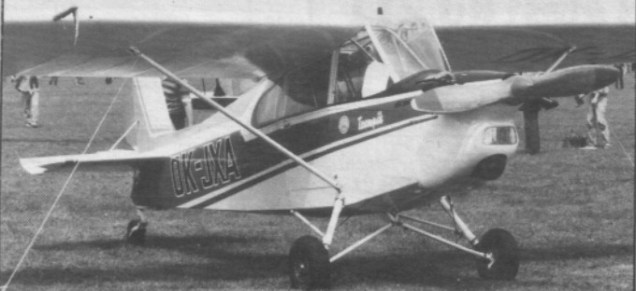
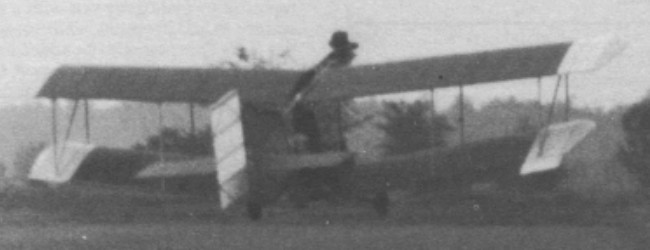
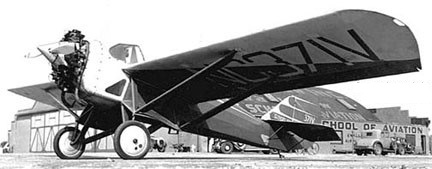
Single seat single engined biplane with con¬ventional three axis control. Wing has un¬swept leading and trailing edges, and constant chord; cruciform tail. Pitch control by fully flying tail; yaw control by fully flying rudder, with additional fin; control inputs through stick for pitch/roll and pedals for yaw. Wings braced by struts and trans¬verse X cables; wing profile; double¬surface. Undercarriage has three wheels in tricycle formation; glass fibre suspension on nosewheel and suspension on main wheels. Push right go right nosewheel steering. Aluminium tube framework, without pod. Engine mounted level with top wing driving tractor propeller.
The aim of the Little Bi is to provide a simple lightweight fun biplane, rather than a machine with pretensions to high performance. Its framework is con¬structed of aluminium tubing, while the wings are made from styrofoam with glass fibre ribs and non porous Dacron covering.
Though initially flown with a Yamaha KT100S engine, the aircraft was sold as an engineless kit and it is up to the builder to supply a power plant. The 215 cc Cuyuna 215R with 20hp driving a 54 inch (1.37m) propeller is recommended, but a 22hp Zenoah or the Yamaha are listed as alterna¬tives, each working through a reduction drive.
Two kits are offered, neither of which involves any tube bending or welding: the fast build kit for $2845 (50 60 h) or an economy kit for $1825 (100 120 h) in 1982, the latter requiring the builder to purchase some basic materials locally. Neither kit covers anything more than the structure of the aircraft, items like seat and fuel tank being extras, for $49.95 and $65 respectively. For the builder who wants to spread the construction cost over a period, five part kits were available.
Engine: Yamaha KT100S, 15 hp
Propeller diameter 48 inch, 1.22m
Belt reduction
Max static thrust 75 lb, 34 kg
Power per unit area 0.08 hp/sq.ft, 0.9hp/sq.m
Fuel capacity 4.3 US gal, 3.5 Imp gal, 16.1 lt
Upper wing span 24.0 ft, 7.32 m
Lower wing span 20.0 ft, 6. 10 m
Sweepback 0 deg
Total wing area 178sq.ft, 16.5 sq.m
Empty weight 190 lb, 86kg
Max take off weight 430 lb, 195kg
Payload 240 lb, 109kg
Max wing loading 2.42 lb/sq.ft, 11.8 kg/sq.m
Max power loading 28.7 lb/hp, 13.0kg/hp
Max level speed 50mph, 80kph
Cruising speed 40mph, 64 kph
Stalling speed 20 mph, 32 kph
Take¬off distance 125 ft, 38 m