Sky-World, is based at an airfield on the outskirts of Volgograd (formerly Stalingrad) in Russia, and developed the PJ-11.
Author: Terry
Skywise Ultraflight SV-200

The SV-200 was a two-place version of the Sadler Vampyre first flown in 1989. Equipped with brakes, flaps amd instrumentation.
Engine: Limbach
Seats: 2
Skyways Amphibienne
The 1930 Skyways Inc Amphibienne was a two-place amphibious open-cockpit biplane. Built at Granville Brothers’ repair shop in Boston, N835H crashed to destruction in May 1930 when the test pilot tried a half-roll followed by a half-loop, a maneuver for which the fragile amphibian wasn’t quite suited.
Engine: 145hp Warner Scarab
Seats: 2
Skyways Inc
1928: Skyways Inc,
Boston MA.
USA
Built the Amphibienne in 1930.
Skyway Engr Co
1959: Skyway Engr Co,
Carmel IN,
USA
Patent licensee for Autogyro AC-35 roadable autogyro.
Skyway Moondial
These backpacks feature a carbonfbre shell holding an ergonomically designed tank, electric start, and the option of 2 or 3 blade prop.
Moondial Light
Empty weight: 17 kg
Engine: K160, 17 hp
Reduction: 1:2.7
Prop diameter: 109 cm
Fuel capacity: 12 lt
Price (1998): 6900 DM
Skyway Belvedere
These backpacks feature a carbonfbre shell holding an ergonomically designed tank, electric start, and the option of 2 or 3 blade prop.
Belvedere Light
Empty weight: 16 kg
Engine: C135, 15 hp
Reduction: 1:2.9
Prop diameter: 109 cm
Fuel capacity: 12 lt
Price (1998): 6590 DM
Skyway
1998:
Am Anger 7
D-D-92353 Postbauer Heng
Germany
Paramotor builder
Skywalk Chili

Skywalk Cayenne
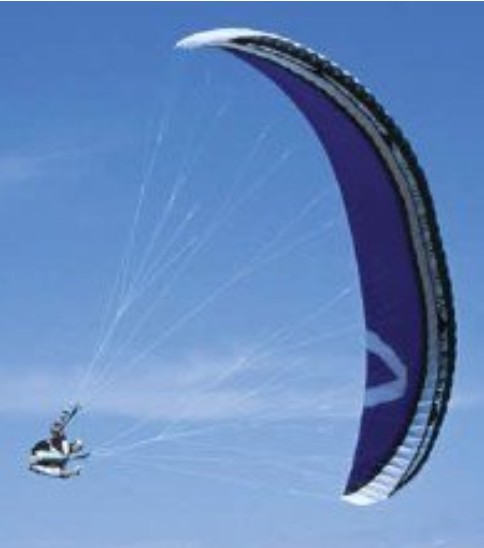
The Cayenne was developed after a research process at the Daimler Chrysler Aerodynamic Test Centre, which included video studies with micro-cameras attached to the flying canopy, in the wind tunnels. The profile MP12 used was directly refined from these studies, and it is claimed to offer “high performance and exceptional safety”. Other features include partially closed cells; reinforcements along the leading edge; diagonal reinforcement connectors and Fingerrib-Construction throughout the canopy (for stability); an original fabric for the sail (water repellent, light-weight, high UV-resistance, according to Skywalk); and a velcro outlet with air-tube for easy emptying of debris. “Manoeuvrability and performance are the ingredients of this high-end intermediate”, say the creators of this spicy glider, who also remark its “exceptional” handling and “an uninhibited max fun at max safety”. It was to be available in 4 sizes, from XS to L, when certification of the XS and L sizes was finished.
The new DHV 2 model created a good impression in the last Bregenzerwald Cup (that has replaced the Stubai Cup) in Austria.
Skywalk has completed certification for all 4 sizes of their new DHV 2 glider, Cayenne. The range covers lightweight pilots and big ones as well, starting with a take-off weight of 60 kg (XS) up to 130 kg (L).

According to Skywalk, the glider has a sensitive handling “combined with very good performance and well balanced safety characteristics” which make it for “an enormous flying fun”.

