(Eiler C) Sundorph Aeronautical Corp,
Cleveland OH.
USA
Built civil aircraft circa 1932-37.
(Eiler C) Sundorph Aeronautical Corp,
Cleveland OH.
USA
Built civil aircraft circa 1932-37.
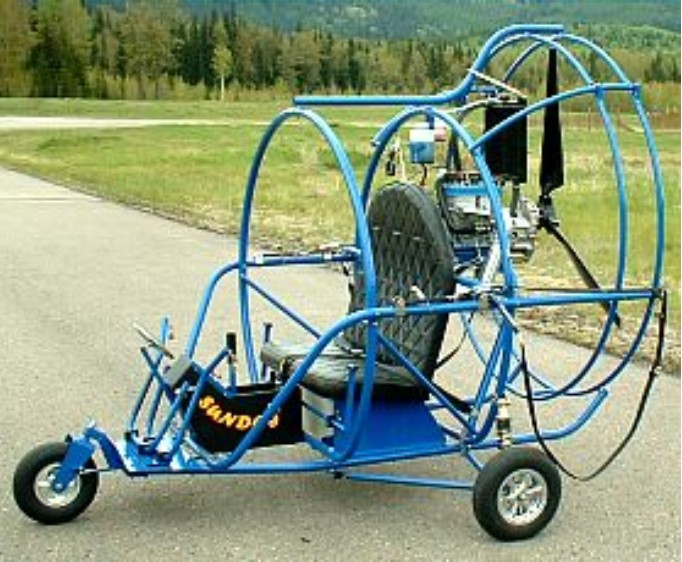
A two-seater powered parachute, constructed with 6061T6 – Tubing + Plate, 304SS – Stainless Steel, and AN bolts. The risers are nylon webbing. The airframe/ cart, seat belts, and upholstery colour range is optional.
Dual Controls: Throttle + Steering
2009 Kit Price: 15,995 US$
2009 Price: $20,750.00 Canadian Dollars, assembled.
Engine: Rotax 582, 65 hp
E box, electric start
Fuel Tank: 10 USG
Parachute: Apco 500
Prop: Powerfin or GSC
Empty weight: 152 kg / 336 lbs.
MTOW Weight: 222 kg / 489 lbs
Length: 101 in
Width: 76 in
Height: 84 in
Air Speed: 28 to 33 mph
Takeoff Distance: 60 – 200 ft
Landing Distance: 30 – 100 ft
Glide Ratio: 4 – 5 to 1
Rate Of Climb: 400 – 800 ft/min.
Sink Rate: 500 – 700 ft/min.

A one-seater powered parachute, constructed with 6061T6 – Tubing + Plate, 304SS – Stainless Steel, and AN bolts. The risers are nylon webbing. The airframe/ cart, seat belts, and upholstery colour range is optional.
Single Controls: Throttle + Steering

Price: $17,000.00 Canadian Dollars, assembled, in 2009.
Engine: Rotax 503, 52 hp
B box, recoil start
Prop: Powerfin or GSC
Length: 101 in
Width: 76 in
Height: 84 in
Parachute: Apco 500
Empty weight: 302 lb
Maximum Payload: 377 lbs
Air speed: 28 to 33 mph
Takeoff Distance: 60 – 200 ft
Landing Distance: 30 – 100 ft
Glide Ratio: 4 – 5 to 1
Rate Of Climb: 300 – 800 ft/min.
Sink Rate: 500 – 700 ft/min
Fuel Tank: 5 or 10 UGS
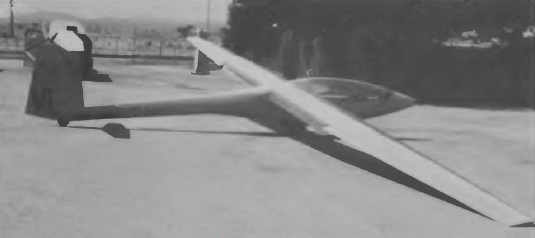
In 1972 the MOBA-2A, designed by an aircraft engineer, Gary Sutherland, was one of the two winners of an Australian Gliding Federation competition to design a 13 m (42 ft 8 in) sailplane which could be built in a small workshop with limited tools.
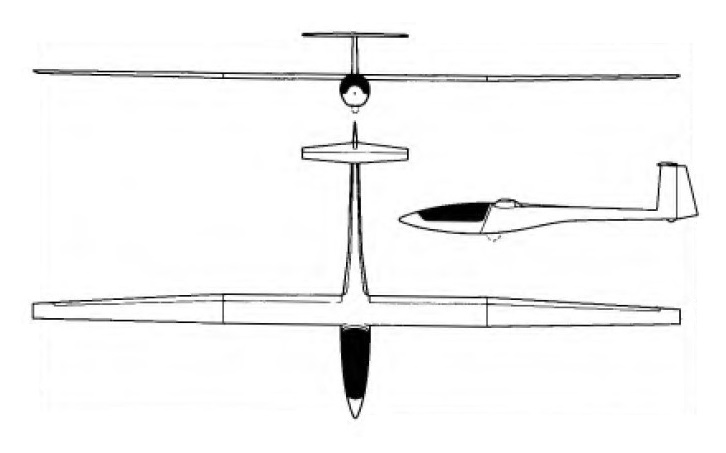
Designed and built by Mr Gary Sunderland of Heatherton, Victoria, an engineer with the Australian Department of Civil Aviation, the MOBA 2C is a Standard Class single-seater developed from the MOBA 2A, one of two 13m span sailplanes that competed with each other in 1972 in a design competition organised by the Australian Gliding Federation. MOBA is an acronym for My Own Bloody Aircraft, and the MOBA 2B was a 15m span version of the 2A; the 2C is an improved version of both the earlier models with a 15m span and the fin and rudder height increased to 4ft.
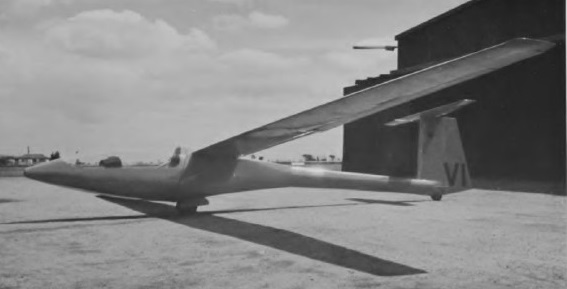
The prototype 2C made its first flight on 12 December 1979 and is a cantilever high wing monoplane of mixed construction with a T-tail; series production was not intended. The single-spar wings are built in three pieces and have plywood ribs with PVC foam infilling, and a skin of pop-riveted aluminium alloy sheet covered with glassfibre. The plain aluminium alloy flaps on the trailing edge also serve as air brakes, and the wooden ailerons are plywood-covered. The nose and centre fuselage are box structures of sheet aluminium alloy with a non-structural glassfibre skin, while the tail boom is of flush-riveted aluminium alloy sheet. The fin and rudder are also of flush-riveted aluminium, while the tailplane and elevator are of wood and plywood. Landing gear consists of a retractable monowheel and a fixed tailskid, while the pilot sits under a forward-sliding canopy.
MOBA-2A
Wingspan: 42 ft 8 in / 13 m
MOBA-2C
Span: 49 ft 2.5 in / 15.0 m
Length: 22 ft 3in / 6.78 m
Height: 4 ft 4 in / 1.32 m
Wing area: 97.7 sq ft / 9.08 sq.m
Wing section: Wortmann FX-67-K-150
Aspect ratio: 24.74
Empty weight: 499 lb / 226 kg
Max weight: 730 lb / 331 kg
Max wing loading: 36.5 kg/sq.m / 7.48 lb/sq ft
Max speed: 121 mph / 105 kt / 194.5 km/h (in smooth air)
Max aero-tow speed: 101 mph / 88 kt / 163 km/h
Stalling speed: 42 kt / 78 km/h
Min sinking speed: 2.0 ft/sec / 0.61 m/sec at 52 mph / 45 kt / 83 km/h
Best glide ratio: 37:1 at 57.5 mph / 50 kt / 93 km h
The Sunbird Nova is a 1979 hang glider.
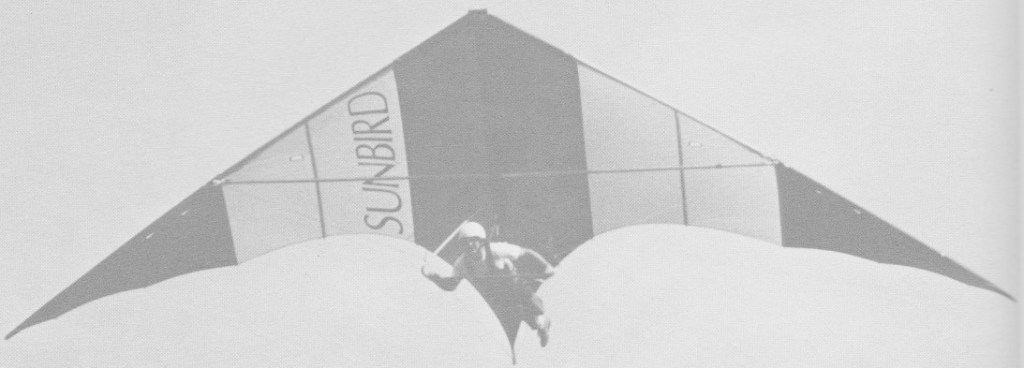
The Strato is a high aspect ratio, high performance glider that replaced Sunbird’s discontinued “Standard” and “Cut-Keel Standard” designs. In addition to expected improvements in L/D and sink rate, roll rate, response, roll control power, pitch stability, and stall charastics were improved.
As a third generation Standard, it was used by flight school students, intermediate and advanced pilots.
Unique Tensor trailing edge mormalises distributed sail loads and helps to control washout. Roaching of the outboard wing sections results in improved low speed performance and control. The centre f gravity is adjustable and no specific hang rating was required.
The leading edges are 6061-T6 or 6063-T835 1.75in x .049 seamless drawn aluminium tubing, reinforced with inner sleeves of 6061-T6 1 5/8in x .058 tubing. The 6061-T6 1.5in x .058 tubing is used for the keel and crossbar. All tubing is bright anodised.
The rigging is nylon coated 3/32ib 7 x 7 stainless steel cable, double swaged. Quick-release tensioners were optional.
The sail is 3.9oz Bainbridge stabilised dacron. Fully battened with light-weight tapered fibreglass battens. All seams are stitched double zig-zag with stress points reinforced. Custom colours were standard, and airbrush and sail painting optional.
Saddles, tangs, and noseplate were by UP. Bolts, nuts, clevis pins etc were all AN or MS standard.
The pilot support was the original Hammock Harness. The body of the harness is constructed of a closed cell, high density foam pad, covered with strong, abrasion resistant 22oz Cordura cloth. The primary support web is constructed of 1.75in nylon web with a minimum breaking strength og 6500 lb and the knee hangers are constructed from an extra wide 3in herringbone web with a velro closure designed to stay closed.
Leading edge: 20 ft
Keel length: 14.5 ft
Wing span: 31 ft
Wing area: 175 sq,ft
Aspect ratio: 5.5
Nose angle: 101˚
Pilot weight: 135-175 lb
Best glide ratio (L/D): 7.5-1
Min sink: 250 fpm
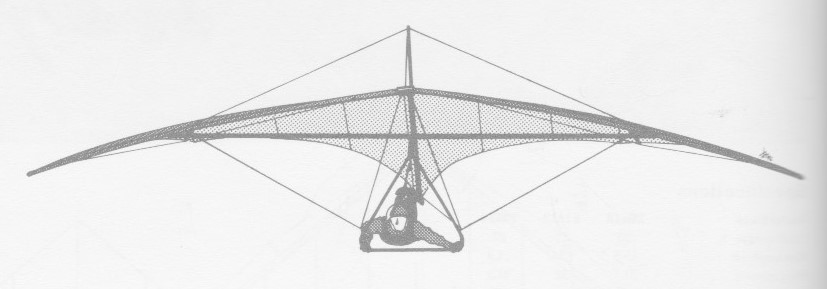
Louis Coatalen concentrated on water-cooled engines for the most part, but did design an air-cooled V-12 named Spartan. Little is known of this engine which had a bore of 105 mm (4 in) and stroke of 130 mm (5 in), capacity of 14.03 l (856 cu in) and output of 149 kW (200 hp) driving a propeller through a reduction gearbox. The single overhead camshaft operated two inlet and two exhaust valves per cylinder via rockers and ignition was supplied by two 6-cyl. Magnetos supplying spark to one spark-plug per cylinder.
Produced in 1916/17 as prototypes only, testing was conducted in a Saunders T.1.
Specifications:
Spartan
Type: V-12 air-cooled piston engine
Bore: 105 mm (4 in)
Stroke: 130 mm (5 in)
Displacement: 14.03 l (856 cu in)
Designer: Louis Coatalen
Valvetrain: Single overhead camshaft, two exhaust and two inlet valves per cylinder
Fuel system: gravity fed
Fuel type: Gasoline
Oil system: Dry sump, pressure fed
Cooling system: Air-cooled
Reduction gear: ratio not known
Power output: 149 kW (200 hp)
At the end of the First World War there was an expectation that Britain would continue the development of airships to provide air travel throughout the British Empire. To power the expected airships Louis Coatalen designed the large Sikh V-12 engine delivering 800 hp (597 kW) at only 1,400 rpm, from 64.1 litre (3,913 cu.in) displacement in a 60-degree V12 configuration, with six valves per cylinder operated by rockers actuated by overhead camshafts.
First run on 11 May 1919 and passing Air Ministry acceptance tests in time for one to be displayed at the 1919 Paris Aero Salon and the 1920 Olympia Aero Show where it generated much interest, due to its size, but no production orders. Competition to power what little airship production there was came from the Rolls-Royce Condor and the Napier Cub. Development work continued till the engine produced 1,000 hp (746 kW) by 1923.
To power smaller airships or Blimps, Coatalen used one cylinder bank to create the Sikh II aka Semi-Sikh, a straight six-cylinder developing 400 to 425 hp (298 to 317 kW) @ 1,400 rpm. As with the Sikh, the market for airship engines dried up after the war, so no production Sikh II engines were built.
In the late 1920s large airships were in favour again, so Coatalen revised the Sikh and developed the Sunbeam Sikh III for the R100 and R101 airship families. Retaining the bore, stroke and displacement of the earlier engine, detail refinements included five valves per cylinder and enclosed valve-gear. The Sikh III was displayed at the 1929 Olympia Aero Show, generating interest due to its large size, weight and power. After the R101 disaster the large Empire airships were abandoned, and the airship market for Sunbeam engines disappeared for a second time, leaving the Sikh III with no orders.
No Sikh engines of any version were sold.
Variants:
Sikh
The original 800 hp airship engine intended for use by airships to be developed after the war, which were cancelled.
Sikh II
Following his previous practise Coatalen developed a straight six version of the Sikhusing a single bank of cylinders. Also intended for airships to be developed after the war,the Sikh II was cancelled when the airships did not materialise.(32.1L / 1,957 cu.in)
Semi-Sikh
Alternative name for the Sikh II.
Sikh III
In the late 1920s, renewed interest in airships, which spawned the Empire Airship programme, also encouraged development of engines to power the airships with. The Sikh III was one of these; closely following the Sikh in construction, major differences included two inlet valves instead of three and enclosed valve-gear.
Specification:
Sikh III
Type: V-12 60-degree water-cooled piston engine
Bore: 180 mm (7.1in)
Stroke: 210 mm (8.3in)
Displacement: 3,912cu in (64.113l)
Length: 2,185 mm (7ft 2in)
Width: 1,018 mm (3ft 4in)
Height: 1,652 mm (5ft 4.5in)
Dry weight: 1,252 kg (2,760lb) Dry
Valvetrain: overhead camshaft two inlet and three exhaust valves per cylinder
Fuel system: 2x six-cylinder carburettors
Oil system: Dry sump, pressure feed
Cooling system: Water-cooling through radiators
Reduction gear: Spur gear 38:67
2x magneto
Power output: 746 kW (1,000 hp) @ 1,650 rpm
Compression ratio: 5:1
In March 1916 Louis Coatalen, the chief designer at Sunbeam, responded to the Admiralty’s request for more powerful engines by designing the 90 degree, V-8 Nubian, also called the Sunbeam 155 hp. The Nubian featured the twin overhead camshafts and four valves of his pre-war engines for Grand Prix and TT racing cars. With a bore of 95 mm (4 in) and stroke of 135 mm (5 in) the Nubian displaced 7.685 l (469 cu in) and was rated at 155 hp (116 kW) with a reduction gear ratio of 0.615:1.
The original engine was built with 60 degree angle between cylinder banks but severe vibration problems forced Coatalen to redesign it with a 90 degree angle, emerging as the Nubian II. Intended to power the Supermarine AD Flying Boat the teething troubles of the Nubian forced Supermarine to use a 150 hp (112 kW) Hispano-Suiza V-8 engine instead.
Deliveries of the Nubian II began in October 1917, by which time the Nubian was overshadowed by the more powerful V-8s from Hispano-Suiza and the 200 hp (149 kW) Sunbeam Arab. The only aircraft known to have been powered by a Nubian was the Saunders T.1, but some of the 36 engines built, of 50 ordered, are believed to have been supplied to the Imperial Russian Air Service.
The Nubian suffered from a poor design decision at first and was overtaken by events which prevented widespread use, but its cousin, the V-12 Sunbeam Afridi and its family members found greater success.
Variants:
Sunbeam Nubian
The initial V-8 engine with 60 degree Vee and rated at 155 hp (116 kW).
Sunbeam Nubian II
Re-designed with 90 degree cylinder angle to alleviate severe vibration problems, the Nubian II was late in delivery and was not widely used.
Applications:
Saunders T.1
Blackburn GP – handed left and right
Specifications:
Nubian II
Type: V-8 90 degree Vee, water-cooled piston engine
Bore: 95 mm (4 in)
Stroke: 135 mm (5 in)
Displacement: 7.685 l (469 cu in)
Length: 1,052 mm (41 in)
Height: 765 mm (30 in)
Dry weight: 310 kg (683 lb)
Designer: Louis Coatalen
Valvetrain: Twin direct overhead camshaft, two exhaust and two inlet valves per cylinder
Fuel system: gravity fed
Fuel type: Gasoline
Oil system: Dry sump, pressure fed
Cooling system: Water-cooled by radiator
Reduction gear: 0.615:1
Power output: 115.6 kW (155 hp)
The Viking was a W-18 utilising the blocks of the Cossack and retaining its attributes. Intended for the AD.1000 floatplane for the RNAS. Production of the 50 ordered was halted after nine had been built; those not used in the sole AD.1000 built were fitted to motor-boats.

