A Thomas Taylor in the USA in 1910 built a biplane aircraft type with a 90hp LeBlon (N19985 c/n 1).
Author: Terry
Taylor Aero Plane
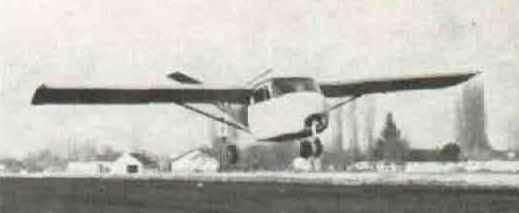
The 1958 Taylor Aero Plane was a four-place version of the Aero-Car built strictly as an airplane by eliminating the “car” components. It was built by Aerocar of Longview, Washington. The engine was behind the cabin and the wings fold for storage.
Engine: Lycoming, 143 hp
Span: 34 ft
Weight: 1,150 Ib
Taylor Bullet
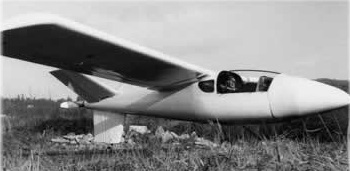
The 1982 Taylor Bullet was a two-seat counterpart of Micro-IMP. With retractable undercarriage, power was a 2100cc Revmaster pusher. He used the best features of his earlier designs, including the GA(PC)-1 airfoil with full length flaperons and optimal adaptations of TPG. With significant assistance from Jerry Holcomb, Molt wound up with a contoured fiberglass shell that gave no impediments to the smooth passage of air over it. The wings had a high angle of attack, allowing it to get in and out of small airstrips. Molt kept the nose low (tail high) for maximal forward visibility during low-speed take-offs and landings. This allowed him to mount the propeller on the tail and give clean airflow over the fuselage and wings. Its reverse pitch capability shortened the ground run after landing. By sweeping the wings forward and placing the Revmaster engine at the front of the plane, Molt assured that variations in pilot/passenger weight would not disturb the Bullet’s center of gravity.
As with most prototypes, there were some annoying glitches, such as difficulties with the long Flexidyne coupling between the engine in front and the propeller at the tail, and some trouble retracting the main gear, which were left extended during the 50 hours of flight-testing. Eventually the owner, Jim Berry, donated his Bullet to the Oregon Air Museum in Eugene, where it remains on display.
Engine: Revmaster 2100cc, 70 hp
Wingspan: 31’0″
Length: 18’9″
Useful load: 550 lb
Max speed: 150 mph
Stall: 50 mph
Range: 500 mi
Seats: 2
Taylor Mini-Imp Gallery
Taylor Mini-Imp
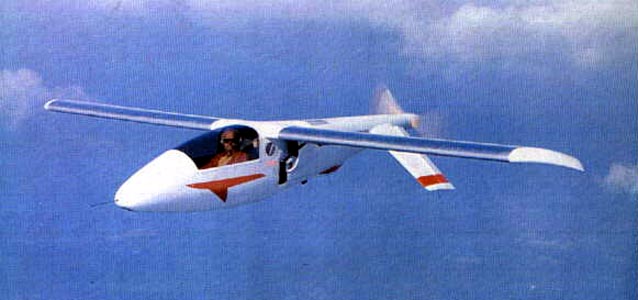
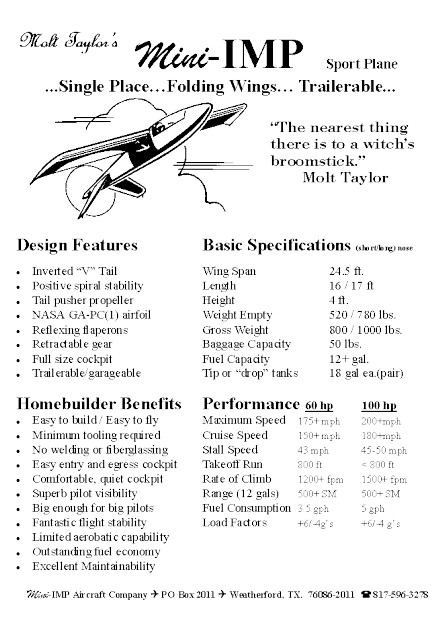
During the energy crisis of the mid 1970’s Moulton B. (Molt) Taylor decided to turn to a small, easy-to-build, light plane which focused on maximum cruise speed and efficiency. The result is the Taylor Mini-IMP.
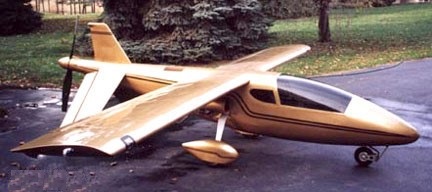
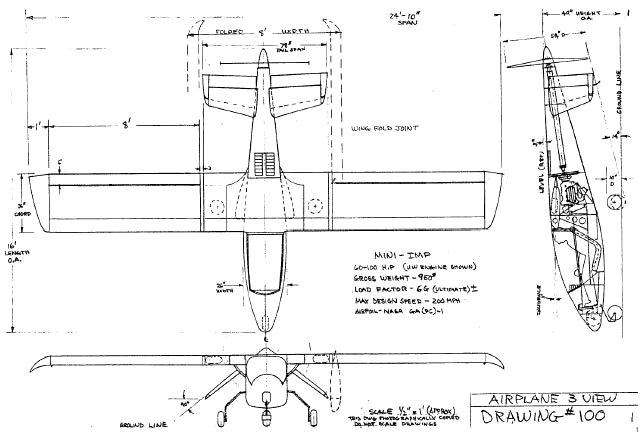
The Mini-Imp is a two-seat version of the single-seat Imp designed in 1975. It features an unusual configuration with a pusher prop aft of an inverted V-type tail assembly and cantilevered high wing that folds back for towing and storage. The wing is the latest NASA design with spoiler and flaps. The retractable gear is the tricycle spring-legged type. A controllable propeller is available. Power is provided by any engine from 60 to 115 hp with the 60-hp Franklin, 60-hp Limbach VW, 70-hp Turbo Revmaster VW, 100-hp Continental or 115-hp Avco Lycoming modification being the most common. The aluminum and fiberglass Mini-Imp requires a minimum of tools to construct, and all hard-to-build parts are available. It offers unequalled safe flyability and stability, positive spiral stability, limited acrobatic capability (stressed to 9 Gs), and good fuel economy (3 1/2 gph).
The O-200 powered price in 1982: $10,000 (Includes complete kit). All metal construction. Year. Units delivered to June 1982: 50.
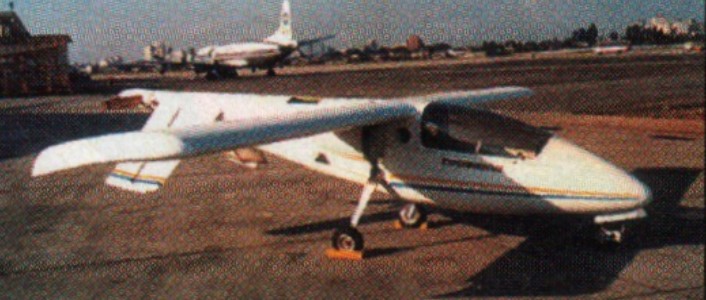
The Model “C” version of the Mini-IMP is the long nose version which was developed after the prototype was flown with the Limbach converted VW engine. The Model “C” is powered with the Continental O-200 engine (100 HP at sea level at full throttle). The Model “C” also incorporates a larger baggage compartment and the nose is lengthened 12 inches so that the pilot sits one foot further forward of the main bulkhead. This lengthening of the nose required the installation of an additional vertical fin on tip of the tail boom giving the “long nose” Mini-IMP an inverted “Y” tail configuration. This addition was used instead of lengthening the tail boom to accommodate the longer nose length of the design rather than lengthen the shaft and to accommodate the further aft placement of the propeller (with its weight effect on the CG).
The O-200 powered Mini-IMP requires the use of a different propeller and due to the increased weight of the engine a heavier landing gear is used. The drawings indicate several other areas of change for the Model “C” needed to accommodate the higher power and resulting performance increases. These include heavier side frame members and a different nosewheel installation. When ordering “kits” be sure to advise of your preference in this regard. The same set of drawings is used to cover either version of the Mini-IMP (the long nose or the short nose).
It is practical to use the long nose version with the big baggage compartment if the builder intends to use the turbocharged Revmaster engine and controllable propeller. However, if the normally aspirated Revmaster engine and a fixed pitch propeller (or other such VW conversion) is to be used, the short nose configuration should be used.
A prototype of the Model “C” has been flown extensively and its improved performance with the higher power is evident. Flight tests of the O-200 powered Mini-IMP “C” have shown a cruise speed of approximately 175 MPH at 4000 foot altitude at 75% rated power. Climb speeds of better than 1500 FPM are initially available at full throttle. These performances are obtained at approximately 1000 pounds gross weight. Exact performance to be obtained with any engine combination is of course dependent on the power level the builder wants to pull from his engine/propeller installation. The O-200 Model “C” requires approximately the same takeoff and landing run as the VW versions, with exact performance dependent on temperature, altitude, and gross weight.
Following Taylor’s death, the plans and licensing for the Mini-IMP have been marketed by the Mini-IMP Aircraft Company of Weatherford, Texas. The Mini-IMP Aircraft Company was formed to provide builder support and to further promote the design.
Engine: Continental O-200, 100 hp
Hp range: 8-125
Speed max: 200 mph
Cruise: 170 mph
Range: 500 sm
Stall: 45 mph
ROC: 1500 fpm
Take-off dist: 600 ft
Landing dist: 600 ft
Service ceiling: 20,000 ft
Fuel cap: 13 USG
Weight empty: 700 lb
Gross: 1000 lb
Height: 4 ft
Length: 16 ft
Wing span: 27 ft
Seats: 1
Cockpit with: 26 in
Landing gear: retractable nose wheel
Engine: 60-hp
Gross Wt. 800 lbs
Empty Wt. 500 lbs
Fuel capacity 12+ USG
Wingspan 25’
Length 16’
Cruise 150+ mph
Stall 48 mph
Climb rate 1200 fpm
Takeoff run 800 ft
Range 500 sm
Taylor Imp
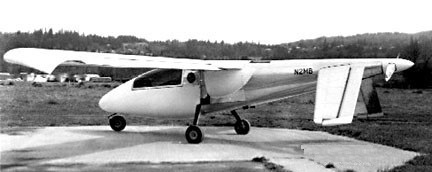
The Mini-IMP is a “second generation” version of the original, 2+2 place, Taylor IMP (an acronym for Independently Made Plane) homebuilt aircraft. This original version proved to be too complicated and too costly to build for the “average” homebuilder.
Design work began in 1973 for all-metal construction with a two-blade controllable-pitch prop aft of the negative-dihedral V-tail.
Engine: Limbach, later 200hp Franklin 4R pusher
Wingspan: 29’0″
Length: 22’0″
Useful load: 450 lb
Max speed: 150 mph
Stall: 50 ph
Seats: 4
Taylor Micro-Imp
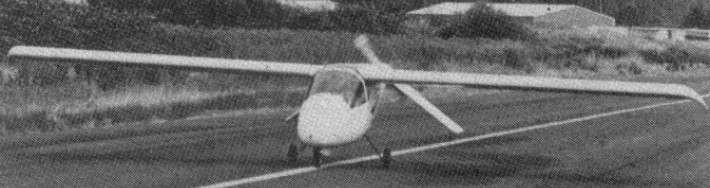
In 1978, with the success of the Mini-IMP program, Molt Taylor and his friend, Jerry Holcomb began construction of the prototype Micro-IMP aircraft. It was intended as an alternative to the then-new “Quickie” aircraft, a Burt Rutan design, which was being offered by Quickie Aircraft Company of Mojave, CA. Like the Quickie, the Micro-IMP was intended to be a very light-weight, low-power and low cost sport plane. Molt and Jerry chose to use a new building material that they had developed for the primary structure, a special resin-impregnated, fiberglass-reinforced paper that they called TPG (Taylor-Paper-Glass).
The Micro-IMP was basically a smaller, lighter version of the Mini-IMP and embodied most of the Mini-IMP features and design ideas. It featured a fully retractable tri-cycle landing gear, full span, reflexing flaperons, a NASA GA-PC(1) airfoil, a unique two-position propeller and a fully trimmable inverted “V” tail.
Molt had intended to have Wicks Aircraft Company, a leading supplier of materials for experimental aircraft builders, provide complete kits for the Micro-IMP, with all the parts pre-printed on the TPG paper stock, so that the builder would only have to cut out the pieces and laminate them with the cloth. The kit would have included all instrumentation and materials to build the airplane. The engine which powered the prototype was a 25-hp Revmaster converted 620cc Citroen 2CV automobile engine which has been produce in the millions in Europe. The engine, which was intended to put out about 32-38 h.p. simply couldn’t be persuaded to put out more than about 16-18 h.p. and thus the prototype was severely underpowered. A planned 800 cc version of the engine never got produced.
The Citroen 2CV engine has been extensively modified to provide an excellent, low cost, durable, aircraft power plant and includes such features as solid state magneto, anti-reversion exhaust manifolding, injection carburetor, electric starting with alternator, etc.
The Micro-IMP was finished in 1981 and was last flown at a demonstration during Oshkosh 1982. At that time, the airframe was hung up in the rafters at Molt’s shop awaiting inspiration, time and money to install another, more powerful engine.
Due to other events, notably the Bullet 2100 project and Molt’s declining health, the Micro-IMP was not developed further. Jerry Holcomb went on however to develop, build and fly a refinement of the Micro-IMP design which he named the “Perigee”. Information packages were sold but plans and kits never materialized.
Prior to Molt’s death, the “hulk” of the Micro-IMP was sold to a teenager in the local area and its whereabouts at this time is unknown.
Designed in 1975, first built in 1976.
The limited tooling for the Micro-IMP and the production rights to the design were in the possession of the Mini-IMP Aircraft Company. A large collection of Molt’s original drawings and shop sketches for the Micro IMP have been found. These drawings along with a large number of B/W photographs were being made available on a compact disk. While there are no plans at this time for Mini-IMP Aircraft Co. to develop the design, they were interested in a joint venture with interested individuals or companies to further refine and market this aircraft.
Engine: 620cc Citroen 2CV, 25 hp
Gross Wt. 700 lb
Empty Wt. 360 lb
Fuel capaci¬ty 7 USG
Wingspan 27’
Length 15’
Max speed: 120 mph
Cruise 110 mph
Stall 45 mph
Climb rate 500 fpm
Takeoff run 800 ft
Range 500 miles
Undercarriage: retractable
Taylor Coot
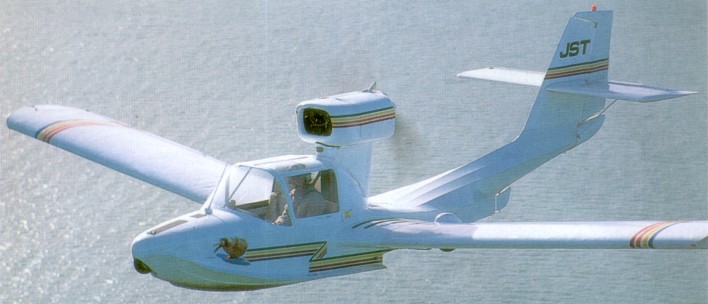
Molt Taylor developed his Coot Amphibian from a World War II Marine assault glider design that featured the unique low “Float-wing” common to both Coot A and Coot B models. The former features a fiberglass hull, the latter a twin-boom tail. Both prototypes have been flying for a number of years. The Coot Floatwing design eliminates the need for tip floats for lateral stability, provides a “deck” to step on for hand-cranking the propeller, protects the engine and propeller from spray, and provides ground-cushion effect for shorter takeoffs. Taylor considers the optimum engine to be the Franklin 180-hp Sport Six, which permits a smooth-water takeoff at 1950 pounds gross in six to eight seconds from a standing start though power can be supplied by any engine from 150 to 220 hp with a controllable propeller. A deep-V hull design permits rougher water operations than possible with twin-float designs, and a low thrust-line offers optimum elevator response for faster water liftoff. The Coot is a comfortable two-place ship with side-by-side seating and dual controls. The folding wings make road towing and home storage possible. With all his aircraft designs Molt Taylor emphasizes that performance and specification figures are greatly dependent on such variables as engine size, fuel capacity, etc.
The first Coot-A flew in 1969. Two prototypes were built, Coot A with a single tail, and Coot B with twin tail booms. Sooper-Coot Model A was a series version of the former.
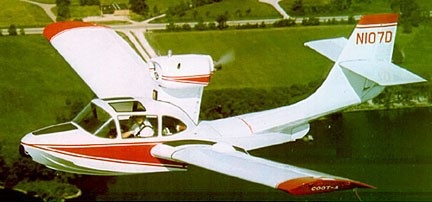
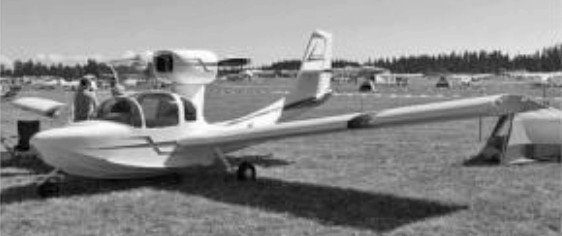
The Sooper-Coot-A two place amphibian price in 1982 was $12,000 (Excludes engine and instruments). Units delivered to June 1982: 100.
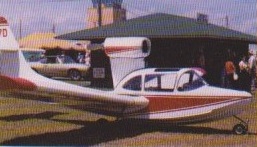
Over 400 reportedly were being constructed by home-builders by 1977 with various 100-180hp engines.
Coot
1969
Engine: Franklin 335, 180hp
Wingspan: 36’0″
Length: 20’0″
Useful load: 850 lb
Max speed: 140 mph
Cruise speed: 130 mph
Stall: 56 mph
Seats: 2
Coot A
Engine: Franklin, 180 hp
HP range: 100-225
Construction: wood/fiberglass
Wingspan 36’-37’
Wing area: 180 sq.ft
Weight empty: 1450 lbs
Gross: 1950 lbs
Baggage 100 lb
Fuel capacity 24-50 USG
Height: 7 ft
Length: 22 ft
Seats: 2
Landing gear: retractable nose wheel
Speed max: 140 mph
Cruise 100-130 mph
Climb rate: 600-1250 fpm
Stall 45-50 mph
Takeoff run (land) 200-600 ft
Takeoff time (water) 10-12 seconds
Service ceiling: 15,000 ft
Range: 500 sm
Designed: 1967
First built: 1968
Coot A
Empty weight: 700 kg
Wing span: 11 m
Wing area: 14 sq.m
Fuel capacity: 151 lt
Engine: Lycoming/Continental
MAUW: 1043 kg
Seats: 2
Max speed: 190 kph
Cruise speed: 177 kph
Minimum speed: 97 kph
Climb rate: 5 m/s
Fuel consumption: 23 lt/hr
Plan price (1998): $205
Sooper-Coot-A
Gross weight: 1,950 lb
Empty weight: 1,250 lbs
Useful load: 700 lbs
Seats: 2
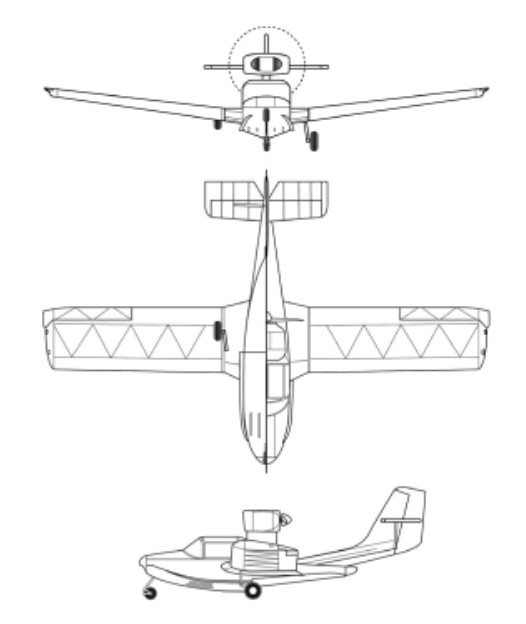
Taylor Aerocar Gallery
Back to Taylor Aerocar
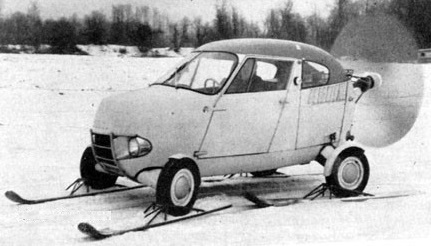
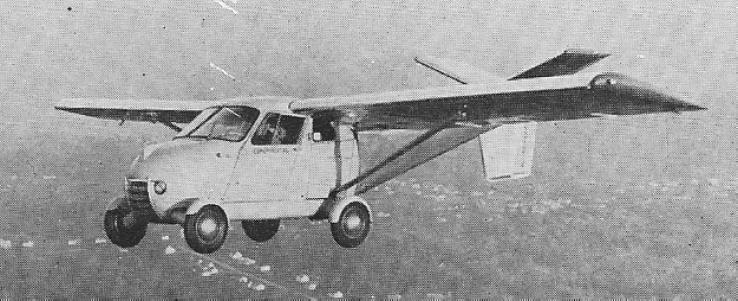
Taylor Aerocar
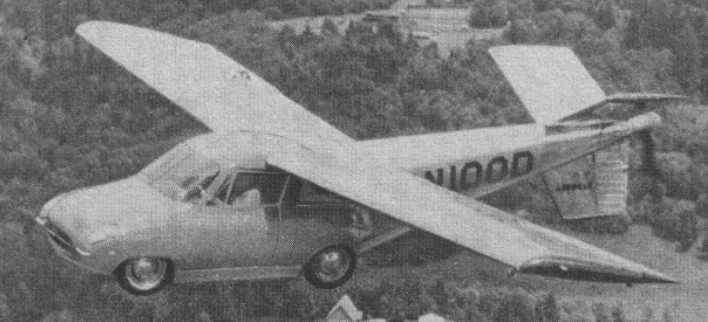
Extensive development was undertaken to enhance flight and road performance. Accumulated road travel on six Aerocars exceeded 200,000 miles (321,865 km) and more than 5,000 flying hours.
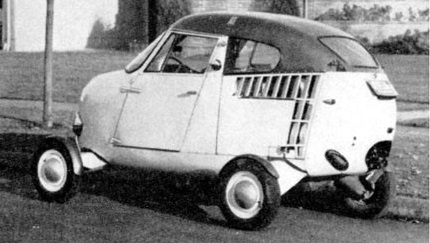
One prototype was built in 1949 (N31214/N4994P), sold to B F Goodrich Co c.1952 for $10,000. In 1956 production under 4A16 totalled 5 (N100D/103D), plus 1 unlicensed for testing. Certification was in 1956.
With business recessions in the 50’s and 60’s, a war priorities in Korea and Vietnam, the Aerocar was never put into large scale production.
The most famous was NC102D, serial number 4, sold to actor/pilot Bob Cummings who used it on his long running TV show, as well as for everyday transportation. That machine was specially fitted and certified with a 135hp O-290 Lycoming. The other Aerocars were powered with 143hp versions of the O-320.
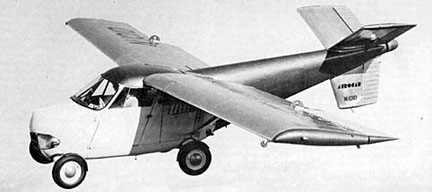
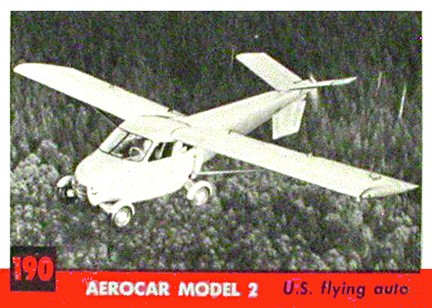
The Aerocar II Aeroplane aka 1-A of 1964 was a four seat non-roadable tri-gear version of the original Aerocar using many of its components and with a fiberglass cab. Power was a135hp Lycoming O-290-D2 pusher. The project was considered by Ford Motor Co but never pursued. The Model II first flew in August 1953.

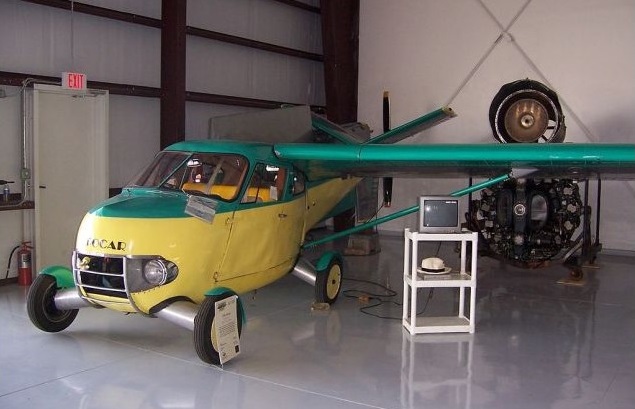
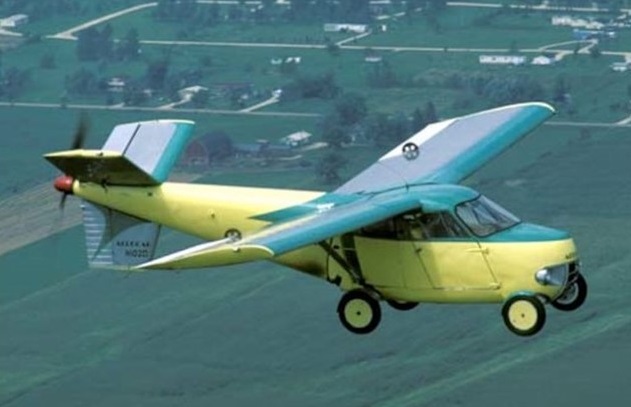
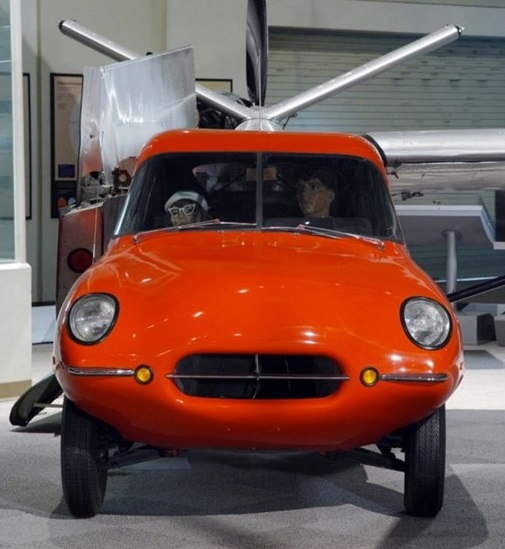
The Aerocar (TC 4A16) was developed through three models, and the two place Aerocar III, aka 1-C, first flew in 1968. A small, streamlined red car about the size of a Honda Civic, with a pair of bucket seats, deep pile carpet and a woodrim steering wheel. It has a 143 hp Lycoming engine with a fluid drive system for its retractable road wheels and dry fluid drive for the Hartzell ground-adjustable pusher propeller mounted behind the aircraft’s distinctive Y shaped tail unit. In the air it would cruise at 217 kph (135 mph), at 97 kph (60 mph) on the road, and go 24 km (15 miles) for every 4.55 litres of fuel burned, flying or driving. The car is 11 feet long and five feet wide. The wings and tail fold to only eight feet wide for highway travel. When it turns into an Aerocar, the plane is 23 feet long. Possibly was the one advertised as Sky Car in a non-flying version.
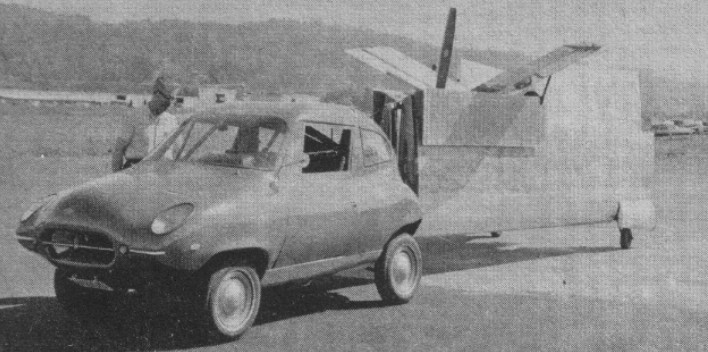
The most famous was NC102D, serial number 4, that was sold to actor/pilot BobCummings who used it on his long running TV show, as well as for everyday transportation. That machine was specially fitted and certified with an O-360 Lycoming. The other Aerocars were powered with versions of the O-320.
With business recessions in the 50’s and 60’s, a war priotites in Korea and Vietnam, the Aerocar was never put into large scale production.
Extensive development was undertaken to enhance flight and road performance. Accumulated road travel on six Aerocars exceeded 200,000 miles (321,865 km) and more than 5,000 flying hours.
The Aerocar was developed through three models, and the Aerocar III first flew in 1968. A small, streamlined red car about the size of a Honda Civic, with a pair of bucket seats, deep pile carpet and a woodrim steering wheel. It has a 143 hp Lycoming engine with a fluid drive system for its retractable road wheels and dry fluid drive for the Hartzell ground-adjustable pusher propeller mounted behind the aircraft’s distinctive Y shaped tail unit. In the air it would cruise at 217 kph (135 mph), at 97 kph (60 mph) on the road, and go 24 km (15 miles) for every 4.55 litres of fuel burned, flying or driving. The car is 11 feet long and five feet wide. The wings and tail fold to only eight feet wide for highway travel. When it turns into an Aerocar, the plane is 23 feet long.
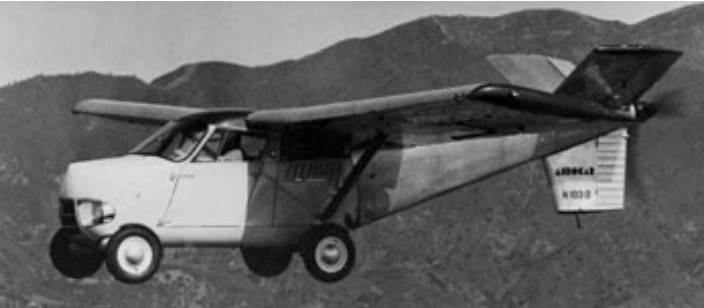
The Model II Aerocar was a pure aeroplane (non-roadable) that used the Aerocar I wings, tailcone and tail plus some fuselage parts. It has a tricycle gear instead of the Aerocar I’s 4-wheel landing gear. Molt sold this maching to Ed Sweeney (who also owned Bob Cummings machine).
The Aerocar III was an updated version of the Aerocar I with a more modern shape for the car body that incorporated an improved fiberglass body and retractable wheels. The machine is displayed at the Museum of Flight in Seattle.
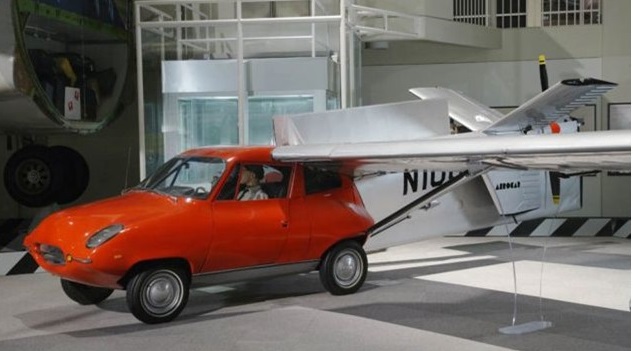
Aerocar I serial number 2, registered N103D was owned by Gary Norton.
Molt Taylor donated the prototype of his flying automobile, the Aerocar, to the EAA Aviation Foundationn. A complete restoration was commenced at Hales Corner. This halted during the move to Oshkosh. The Buehler Foundation then provided a grant to provide the financial resources and the skilled manpower to complete the restoration. Molt Taylor was providing photographs, documentation, and his knowledge to assist.
Ford Motor Company wanted to build Aerocars, but the Federal Aviation Administration said no way did they want the sky full of flying automobiles. They were going to build 25,000 of them the first year and with their dealer organization they figured they could sell them. It never happened.
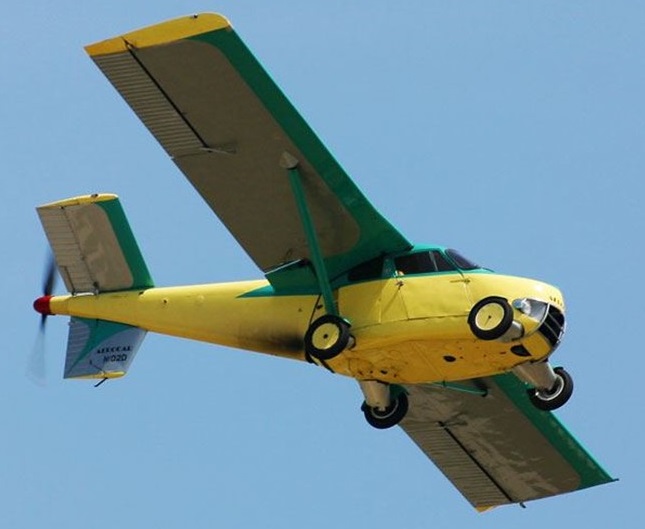
Aerocar I
Engine Lycoming O-290, 135-hp / Lycoming O-320, 143 hp
Wing span: 34’0″
Length: 21’6″
Gross wt. 2,050 lb
Empty wt. 1,400 lb
Fuel capacity 24 USG
Top speed 112 mph
Cruise 100 mph
Stall: 50 mph
Range 300 miles
Ceiling 12,000 ft
Initial climb rate 500 fpm
Takeoff run 655 ft
Landing roll 300 ft
Seats 2
Aerocar II / 1-A
Engine: 135hp Lycoming O-290-D2
Wingspan: 34’0″
Wing area: 168 sq.ft
Length: 22’9″
Height: 7 ft 2 in
Empty weight: 1408 lb
Loaded weight: 1950 lb
Useful load: 900 lb
Max speed: 112 mph
Cruise speed: 100 mph
Stall: 50 mph
Range: 300 mi
Ceiling: 13,000′
ROC: 500 fpm
Price: $9,995
Seats: 4
Aerocar III / 1-C
Engine: Lycoming O 320 AlA 4 cylinder, 143 hp (auto 40 hp)
Length: 21 ft 6 in
Wingspan: 36 ft
Useful load: 720 lb
Max speed (air) 137 mph, (road) 67 mph
Cruise spped: 120 mph
Stall: 50 mph
Ceiling: 12,000 ft
Range: 500 miles
Seats 2

