Textron Inc

Textron Inc reached a deal to buy Beechcraft Corp. for $1.4 billion in December 2013. The Providence, Rhode Island-based company will purchase all outstanding equity interests in Beech Holdings LLC, the parent of Beechcraft, it said in a statement yesterday. The deal, which includes the repayment of Beechcraft’s working capital debt, will be financed by a combination of available cash and as much as $1.1 billion in new debt.

Adding Beechcraft models such as the twin-engine King Air will complement a Cessna lineup that ranges from two-seaters to the Caravan turboprop. That market segment is less competitive than private jets, where Cessna has struggled because it doesn’t build the large, long-range planes now favored by corporate buyers.

Textron will take over service for Hawker jets and hopes to convert those owners to Cessna jets, Donnelly said. The company is expecting low revenue from the T-6 military training plane as the U.S. military winds down it purchases and foreign sales of the plane would be a plus, he said.

Of the aircraft in service, 6,400 are King Airs and 2,250 are Hawker jets. The Beechcraft business was in good shape even with the bankruptcy and Textron wasn’t expected to invest extra to fix it.
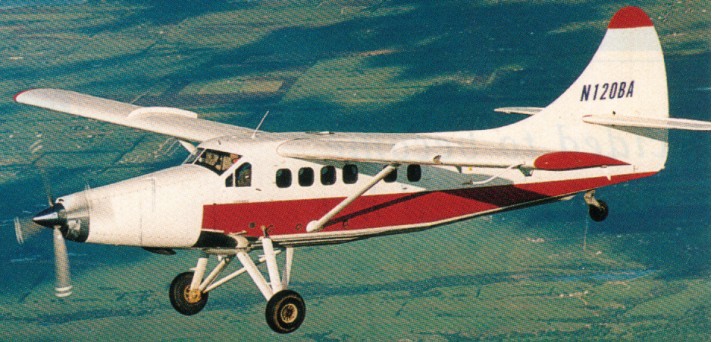
Texas Turbine Conversions DHC-3 Otter

Airplane modifier Texas Turbine Conversions has begun flight testing of its conversion of the de Havilland DHC-3 Otter. The modification includes the replacement of the original 600 hp, nine cylinder Pratt & Whitney radial with an AlliedSignal/Garrett TPE331 10 turboprop engine flat rated to 900 horsepower. While the airframe is limited to a 125 knot airspeed, the additional power helps the Otter climb better and fly at max speeds to much higher altitudes than it could with the radial. The engine swap saves 400 pounds, which translates into a better useful load, and gives operators a greatly increased TBO up to 5,400 hours over the P&W radial.

Texas-Temple Airplane

An unidentified type was built c/n A-1 registration NC6525, which had the same registration as a Curtiss JN-4C.

One on-line copy of the FAA register contains a suggestion that this may have been a Curtiss rebuilt by the Corporation. No proof is given. It could be the Commercial Wing with the Curtiss OXX engine.

Texas-Temple Trimotor

A 1929 Trimotor designed by Carroll was noted as being test flown by Williams on 5 October 1929. It was to be powered by three 60 hp Velie and used as a photographic survey plane.

On 6 October 1929 the plane was flown to San Antonio for use by West Texas oilman Joe Palmer of the Texas Pacific Coal and Oil Company of Fort Worth.

Texas-Temple Sport / Sportsman

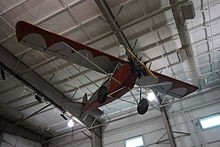
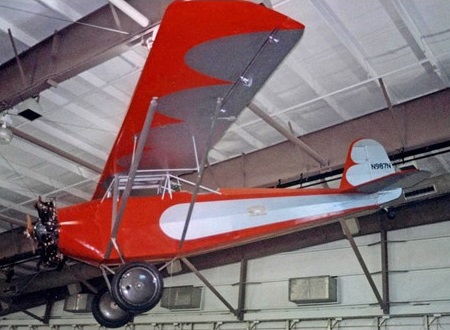
Temple Sportsman N987N on display at the Frontiers of Flight Museum at Dallas, Texas

Designed by George W Williams and George Carroll, the Sportsman was a parasol winged monoplane, equipped with two seats arranged in tandem. The cockpit had an open layout. A fixed tail-wheel undercarriage was fitted. The tailplane was set low on the fin. A 100 h.p. Cirrus III was initially fitted.

Three examples of the Sportsman were completed: NC480 manufacturers number 1; NC852H and N987N manufacturers number 107. There was no N987N registered in FAA records at the time, so it is likely to be from a later registration. There was an NC987H, but that was the registration for a different make of aircraft, a Smith S-1 with a Velie engine. The Sportsman was suitable for operation by individual sporting pilots. Williams was killed during 1930 in the crash while flying with a trainee pilot. The company folded after the accident.

One Texas-Temple Sportsman still exists. It had been found in bits by an airplane restorer, Jerry D Ferrell, who reconstructed it. The plane undertook its airworthiness test on July 26, 1990. Ferrel donated the plane for display at the Frontiers of Flight Museum, Love Field, Dallas, Texas. The plane is fitted with a Clyde Cessna modified engine, the Anzani.

The Texas-Temple Sportsman on display at the Frontiers of Flight Museum

Texas Helicopter M79 Jet Wasp II

The 1979 M79S Wasp II was a two place Ag modification of the Bell 47G. First flown on 6 January 1979.

First flown in 1979 with a piston engine, the M79T Jet Wasp II was a two-seat turboshaft powered modification of the Bell TH-13T helicopter. One was built (N1001X) in 1982.

M79S Wasp II
Engine: TVO-435, 270hp
Rotor: 37’1″
Length: 36’0″
Useful load: 1480 lb
Max speed: 106 mph
Cruise: 80 mph
Range: 300 mi
Seats: 2

M79T Jet Wasp II
Engine: Soloy-Allison 250
Seats: 2

Texas Helicopter M74 Wasp

Certified in 1976, the M74 Wasp was a single-seat piston-engined agricultural/utility modifications of Bell OH-13E (Bell 47) helicopter.

The 1977 M74A Wasp applied the modifications to Bell OH-13H.

M74 Wasp
Engine: Lycoming TVO-435-A1E, 200hp
Rotor: 35’1″
Length: 31’5″
Useful load: 1020 lb
Max speed: 100 mph
Cruise: 80 mph
Range: 150 mi
Seats: 1

M74A Wasp
Engine: Lycoming TVO-435, 240hp
Seats: 1