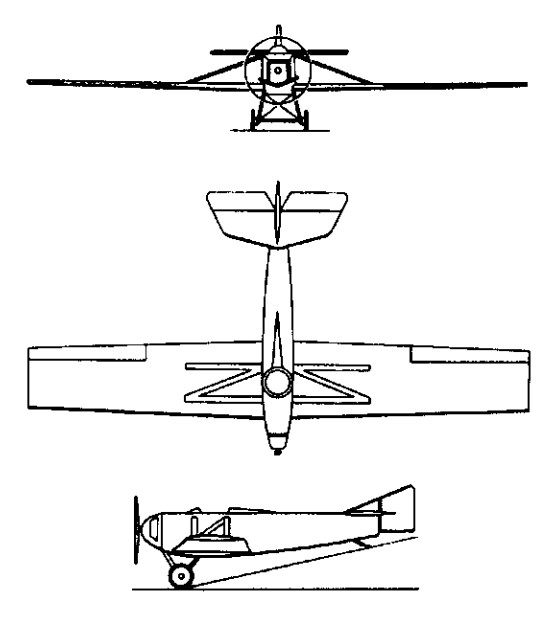
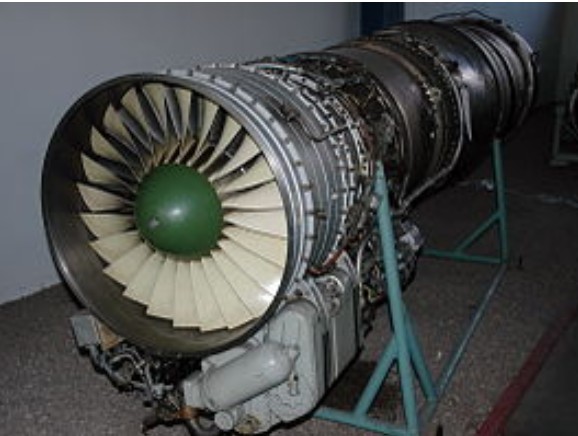
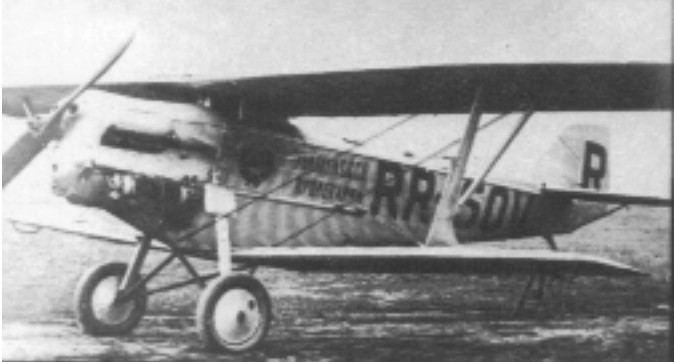
Tupolev ANT-3 / R-3

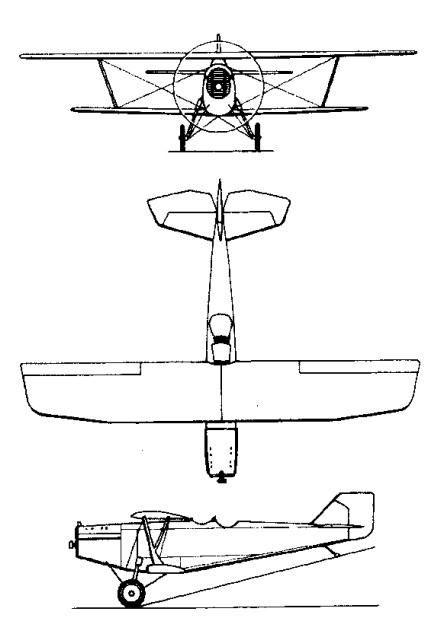
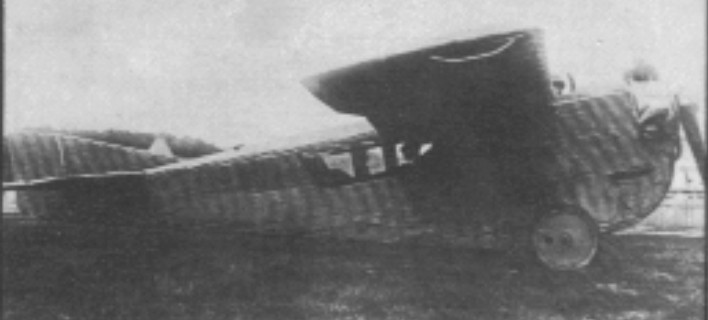
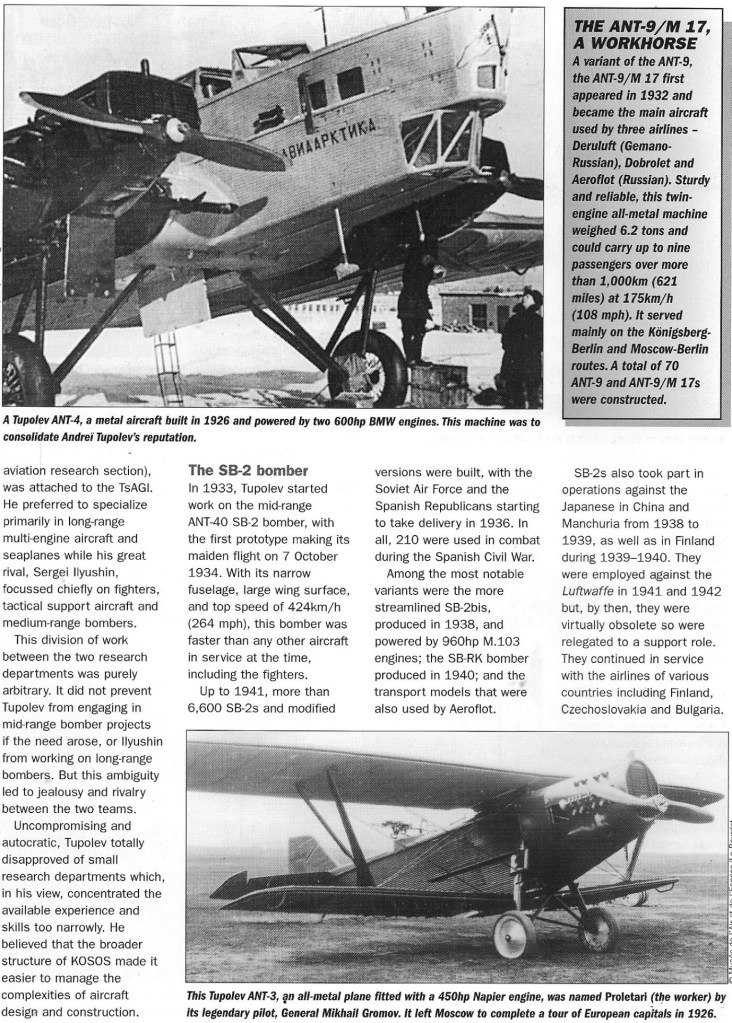
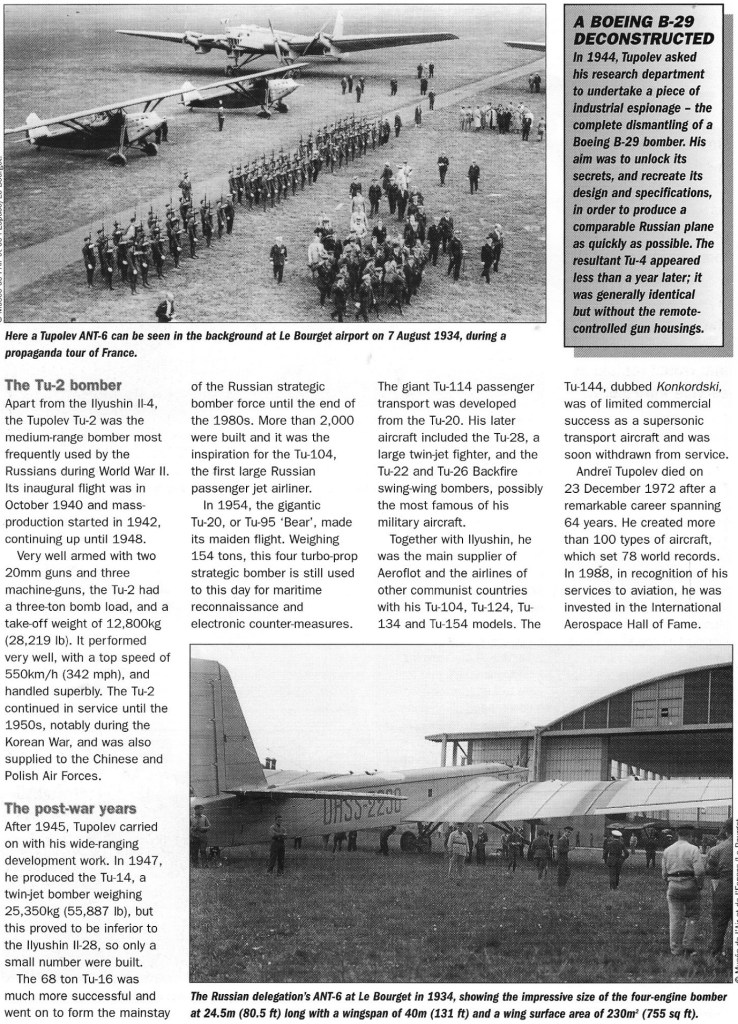
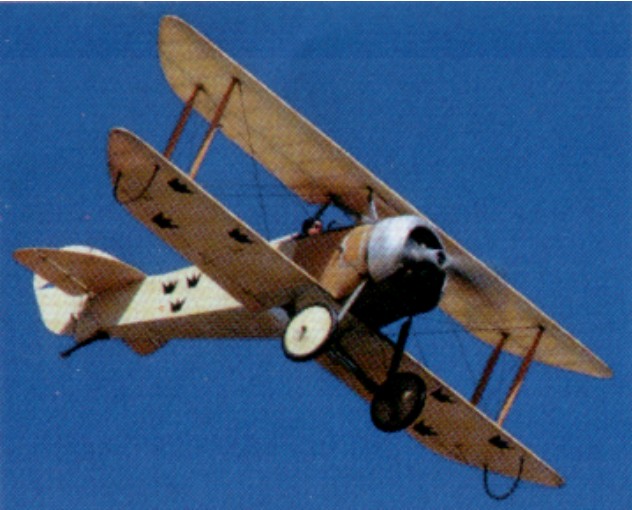
The first production aircraft designed and built by Tupolev at TsAGI was the ANT 3 two seat biplane, which made propaganda flights abroad in 1926 and 1927 and was used by the air force for reconnaissance until about 1932.

The prototype flew for the first time in August 1925. An unequal-span biplane, intended for reconnaissance duties, it was of all-metal construction with corrugated sheet covering.

The original 298kW Liberty engine was replaced by a 336kW Napier Lion, the aircraft then being redesignated R-3NL The first 12 series aircraft had Liberty engines but the next 18 had the Soviet development of this powerplant, which was designated M-5. The final 79 aircraft with the 336kW Lorraine Dietrich engine were designated R-3LD, and one ANT-3 was tested with a 507kW BMW VI. Most R-3s saw military service, but a few retaining the ANT-3 designation were flown as mailplanes or used for liaison and for propaganda flights. The R-3LD version had a maximum speed of 205km/h, was armed with three 7.7mm machine-guns and could carry 10 10kg bombs on external racks. Plans for a Shturmovik version with 400kg of armour protection came to nothing.

ANT-3
Engine: 1 x M-5
Max take-off weight: 2103 kg / 4636 lb
Empty weight: 1351 kg / 2978 lb
Wingspan: 13.0 m / 43 ft 8 in
Length: 9.9 m / 33 ft 6 in
Height: 3.9 m / 13 ft 10 in
Wing area: 36.0 sq.m / 387.50 sq ft
Max. speed: 204 km/h / 127 mph
Ceiling: 4600 m / 15100 ft
Range: 750 km / 466 miles
Armament: 3 x 7.62mm machine-guns
Crew: 2

Tupolev ANT-3 / R-3

Tupolev ANT-2

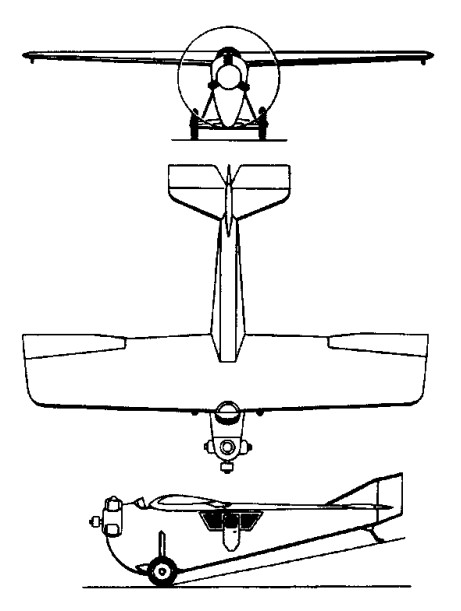
The ANT 2, completed in 1923, was a single engined, three seat monoplane, with cabin accommodation for two pas¬sengers. It had a thick multi spar wing, triangular section fuselage and thin cor¬rugated duralumin covering, called Kol¬chugalumin after the village where it was produced. The overall design was not un¬like that of the Junkers K 16 of 1922, and indeed a close study of Junkers design and practice had been made at TsAGI since the first Junkers C.1 was captured during the civil war. Tu¬polev’s ANT 2 represented an advance over the Junkers concept of the all¬-metal (corrugated aluminum alloy), cantilever low wing monoplane. First flew on May 26, 1924.

ANT-2
Engine: 1 x Bristol Jupiter
Max take-off weight: 836 kg / 1843 lb
Wingspan: 10.5 m / 34 ft 5 in
Length: 7.6 m / 25 ft 11 in
Height: 2.1 m / 7 ft 11 in
Max. speed: 170 km/h / 106 mph
Ceiling: 3000 m / 9850 ft
Crew: 1
Passengers: 2

Tupolev ANT-2

Tupolev ANT-1

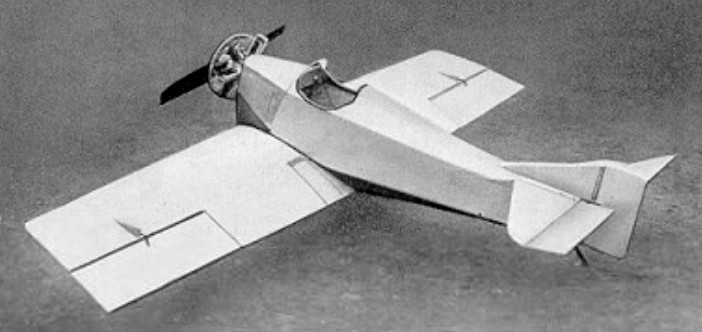
In 1922 Tupolev designed the ANT-1. First flew on October 20, 1923.

ANT-1
Engine: 1 x Anzani
Max take-off weight: 355 kg / 783 lb
Empty weight: 205 kg / 452 lb
Wingspan: 7.5 m / 25 ft 7 in
Length: 5.0 m / 16 ft 5 in
Height: 1.7 m / 6 ft 7 in
Wing area: 10.0 sq.m / 107.64 sq ft
Max. speed: 120 km/h / 75 mph
Cruise speed: 100 km/h / 62 mph
Ceiling: 400 m / 1300 ft
Range: 400 km / 249 miles
Crew: 1

Tupolev

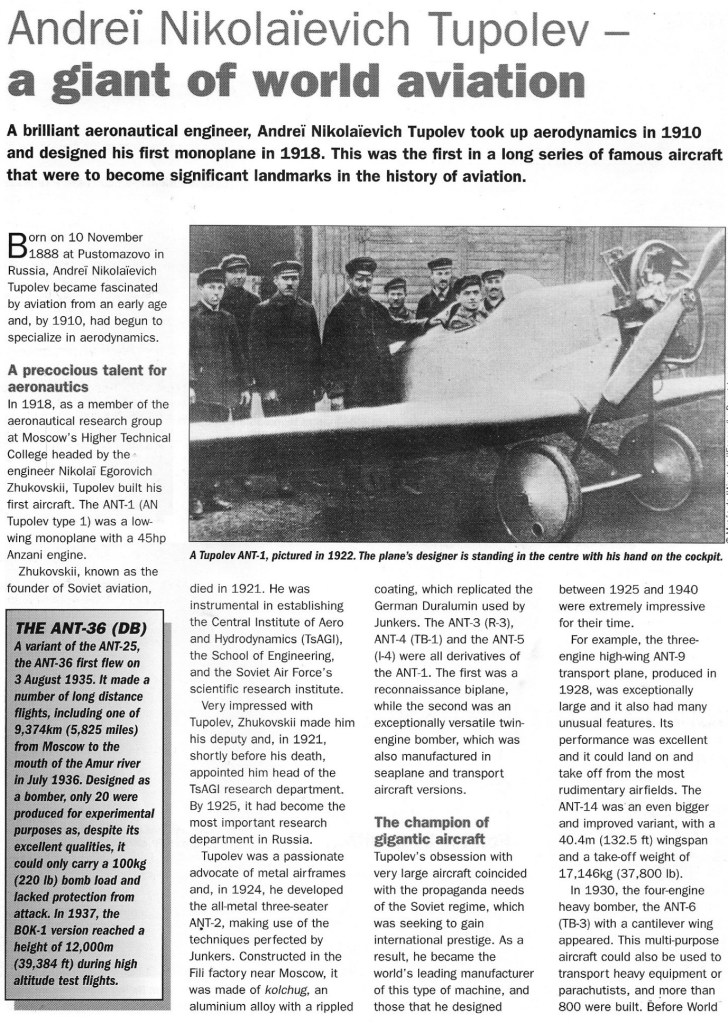
Born in 1888, Andrei N Tupolev was an early pupil, at the Moscow Technical High School, of the internationally famous aerodynamicist, Professor N E Zhukovski. His studies and early gliding experiments were, however, interrupted in 1911 when he was arrested for revolutionary activities. During part of the first World War, Tupolev worked in the Duks aircraft factory in Moscow, then the largest in Russia.

Andrei Tupolev Article

After the Bolshevik Revolution, Tupolev became one of Zhukovski’s leading assistants in setting up the Central Aero and Hydro dynamics Institute (TsAGI). This brought together pre war Russian research establishments with other, newly created bodies, and in 1920 Tupolev became head of its design department (AGO) and president of commission to design and build all-metal aircraft 1922.

Initially followed Junkers formula, using corrugated metal skins; first to appear were ANT-1 and ANT-2 (A. N. Tupolev) cantilever monoplanes. Became head of AGOS department of the Moscow TsAGI in 1922; during 1920- 1936 most designs bore ANT designations although some emanated from his design team leaders, chief deputy A. A. Archangelskii, W. M. Petlyakov and P. O Sukhoi (e.g. Sukhoi designed ANT-25 and 37).

Tupolev’s first major design was ANT-4 (TB-1) heavy bomber of 1925, forerunner of several very large machines including ANT-6 (TB-3) bomber; ANT-9 commercial passenger transport and huge ANT-20 Maxim Gorkii propaganda aircraft of 1934. Also designed ANT-40 (SB-2) twin-engined medium bomber.

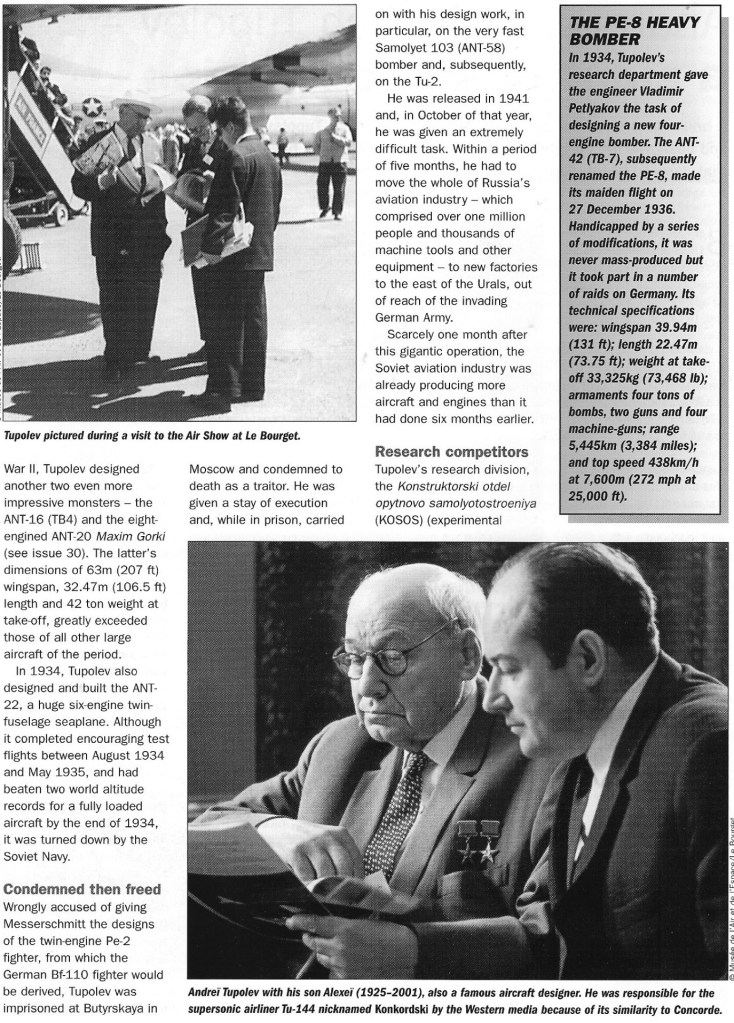
The enormous creativity of the Tu¬polev group stemmed in part from this designer’s ability to train and direct others, such as Sukhoi and Petlyakov. Petlyakov, for example, was responsible for the PE 8, a four en¬gine bomber that was larger and more powerful than the B 17.

In 1936 Tupolev was arrested during Stalin’s purges and condemned to death, but sentence commuted and after some five years’ imprisonment was released and restored to favour (ostensibly in recognition of Tu-2 medium bomber, designed while in prison) and given his own design bureau. After Second World War continued to place emphasis on large aircraft; Tu-4 copy of Boeing B-29 Superfortress helped win him a Stalin Prize in 1948.

Main early post-war products included Tu-14 twin-jet naval medium bomber; Tu-16 intermediate-range twinjet bomber (first flown April 1952; also produced in China as the Xi’an H-6); and a quartet of four-turboprop swept-wing giants: the Tu-95 long-range strategic bomber (first flown November 1952 and built up to 1992), Tu-142 naval variant for long-range antisubmarine warfare and communications relay (first flown June 1968), Tu-114 200-passenger transport based on Tu-95 (first flown November 1957) and Tu-126 AWACS aircraft (first flown 1962).
Later military types included the twinjet Tu-22, the first Soviet supersonic bomber that first flew in 1959, and the Tu-128 very large all-weather interceptor (first flown March 1961), the variable-geometry wing Tu-22M Backfire intermediate- range Mach 1.8 bomber and missile launcher (first flown August 1969 and 514 built during 1971-90) and the variable-geometry wing Tu-160 Blackjack heavy missile bomber with a speed of Mach 2.05 and range of over 12,215km without in-flight refueling (first flown December 1981 and entered Soviet service from 1987), while projects include the Tu-204P maritime patrol derivative of the Tu-204 airliner, Tu-2000 hypersonic bomber, and a subsonic strealth bomber.

Early turbojet and turbofan powered transport aircraft included twin-jet Tu-104 (based on Tu-16 and first flown June 1955); Tu-124 (first flown March 1960); Tu-134 (first flown July 1963) and tri-jet Tu-154 (first flown October 1968). Tu-144 became, in December 1968, the first supersonic airliner in the world to fly. It exceeded Mach 2 for the first time in May 1970 and was the first of its type to enter regular service when, in December 1975, it began freighting for Aeroflot prior to initial passenger services in 1977. However, Tu-144 was not a success and services were terminated in June 1978; in November 1996 a converted Tu-144D flew again as the Tu-144LL, used thereafter for an international High-Speed Civil Transport research program to assist in the development of a nextgeneration supersonic transport.

Most recent Tupolev commercial transports, programs and projects include the convertible cargo/passenger Tu-130 (to fly on standard and liquid natural gas in the 21st century), Tu-136 projected light passenger/cargo transport with twin Pratt & Whitney turboprop engines, Tu- 155/Tu-156 conversions of Tu-154 to use cryogenic fuel engines (Tu-155 for research flew 1988), Tu-204 medium-range airliner for typically 214 passengers (first flown January 1989) and its projected Tu-206 cryogenic fuel derivative, Tu-214 and Tu-224 airliners based on Tu-204 but featuring increased take-off weights and longer range (first flight of Tu-214 March 1996), Tu-230 projected light/medium freighter, 166-passenger Tu-234 airliner as a short-length variant of Tu-204, Tu-244 projected supersonic airliner, Tu-304 and Tu-306 (cryogenic fuel variant) projected long-range airliners for up to 392 passengers, projected Tu-324 regional and business transport, Tu-330 and liquid-gas Tu-338 freighters, Tu- 334 medium-range airliner for typically 102 passengers (first flown February 1999) and its Tu-336 cryogenic fuel derivative, Tu-404 projected giant 850-seat airliner, and Tu-414 projected 70-passenger regional jet.
Tupolev general-aviation projects include Tu-34 pressurized five/seven-seat STOL transport with twin turboprop engines and pusher propellers, Tu-54 single-seat agricultural monoplane, Tu-400 eight/ten-seat business jet with regional airliner potential, and Tu 4X4 four/seven seat business jet as smallest aircraft in the Tu- 324/400/414 range.
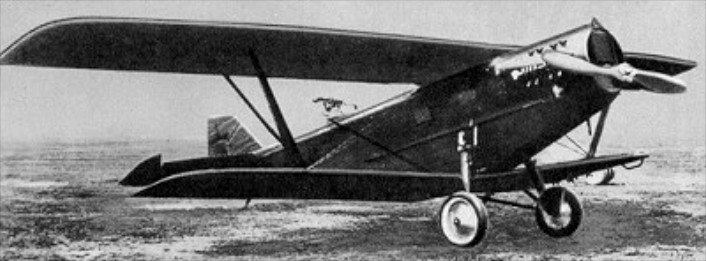
Tunison Scout / Scout Airplane Co 1929 Monoplane

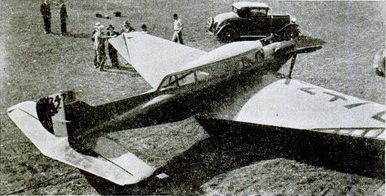
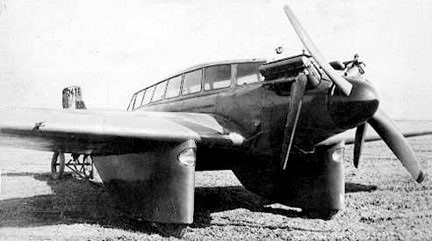
Designed by M.C.Tunison, the 1930 plywood Scout was in the $2500 class. Influenced by the French Antoinette Monobloc design, it has wide-chord, sparless, molded-plywood wings with only four ribs on each side, bias ailerons. A monocoque fuselage with a “vista dome” canopy and deep, faired gear with built-in landing lights. Won a $2,300 prize for design.

It was especially constructed for photographic work and equipped with skies to accompany the Antarctic Byrd Expedition. Over 1500 photos of the region were taken.

Tunison Scout NX425

First flown on 21 December 1928 (piloted by Jimmie Angel) it was registered NX247E c/n MC-1, re-registered NX425, then refitted with 600hp Miller and re-re-registered as NX13795.

Plans by financial group, Pacific Air Industries, to produce three models of the plane with 150-480hp motor options never materialized.

NX13795 is the Zion Tunison Scout c/n 1, according to the 1936 register: “Community of Zion, Elsinore CA; Zion Tunison Scout; 3PCLM; #1 ’34; Miller 600hp or 800hp.” This is probably N425 rebuilt.
In 2/9/29, Air Transportation N425 is listed as a Junkers! “Scout Airplane Sales Co, Los Angeles CA. Long wing Junkers MC1 – Hispano-Suiza 3.” Tunison Scout might have been a heavily rebuilt Junkers-Larsen JL-6.

Engine: Wright-Hisso H-3, 300hp
Wingspan: 36 ft 0 in
Length: 29’0″
Useful load: 1391 lb
Max speed: 190 mph
Cruise speed: 165 mph
Stall: 45 mph
ROC: 1000 fpm
Range: 600 mi
Seats: 3

Tumansky R-21

The Tumansky R-21 was developed at Tushino motor plant (part of OKB-300), headed by Nikolai Georgievich Metskhvarishvili, as a twin-spool axial-flow afterburning turbojet. It was based on the Tumansky R-11 with the goal of increasing thrust and airflow, using a new six-stage compressor with a larger diameter and different rotor blades than its predecessor as well as a new afterburner chamber and variable exhaust nozzle. The increased pressure ratio and turbine inlet temperature required components to be fabricated from advanced alloys.

Several contemporary Soviet aircraft were planned to use the R-21, including the Sukhoi T-58, Sukhoi T-6 and the Mikoyan-Gurevich Ye-8. On September 11, 1962 an R-21, fitted to a Ye-8, exploded in mid-air after compressor failure; test pilot Mosolov survived the ejection at Mach 1.78, but he never fully recovered. Shortly afterward the Ye-8 program was cancelled along with R-21 development in favour of heavier fighter planes such as the Mikoyan-Gurevich MiG-23, which required more powerful engines.

The R-21F-300 was the only version built.

R-21F-300
Type: Afterburning turbojet
Diameter: 987 mm (38.9 in)
Dry weight: 1,250 kg (2,755 lb)
Compressor: Six-stage axial compressor
Maximum thrust:
46.1 kN (10,361 lbf) military power
70.6 kN (15,873 lbf) with afterburner

Tumansky R-11 / AM-11 / Shenyang WP-7

The Tumansky R-11 (initially AM-11) turbojet engine was developed by A.A. Mikulin, S.K. Tumansky, and B.S. Stechkin as a twin-spool axial-flow high-altitude non-afterburning turbojet for Yakovlev Yak-25RV reconnaissance aircraft. This engine was the first Soviet twin-spool turbojet. It was first run in early 1956. The basic design was very successful and it was evolved into Tumansky R-13 and Tumansky R-25. Also experimental Tumansky R-21 was an evolution of R-11. A total of 20,900 R-11 engines were built.

Variants:
R-11V-300 – first production version, high-altitude, non-afterburning
R-11F-300 (R-37F) – afterburning version, entered production in 1956, used on MiG-21F, P and U.
R-11AF-300 – improved version for Yakovlev Yak-28B, L and U.
R-11F2-300 – new compressor, afterburner and nozzle, used on MiG-21P, PF and FL.
R-11AF2-300 – R-11F2-300 adapted for Yakovlev Yak-28I, R and P.
R-11F2S-300 – upgraded version for MiG-21PFM, PFS, S, U and UM, and for Sukhoi Su-15, UT and UM.
Shenyang WP-7, Chinese license built copies of the R-11

Specifications:
R-11F2S-300
Type: Afterburning turbojet
Length: 4,600 mm (181.1 in)
Diameter: 906 mm (35.7 in)
Dry weight: 1,124 kg (2,477 lb)
Compressor: Axial compressor
Maximum thrust:
38.7 kN (8,708 lbf) military power
60.6 kN (13,635 lbf) with afterburner
Overall pressure ratio: 8.9:1
Turbine inlet temperature: 955 °C (1,750 °F)
Specific fuel consumption:
97 kg/(h·kN) (0.95 lb/(h·lbf)) at idle
242 kg/(h·kN) (2.37 lb/(h·lbf)) with afterburner
Thrust-to-weight ratio: 53.9 N/kg (5.5:1)