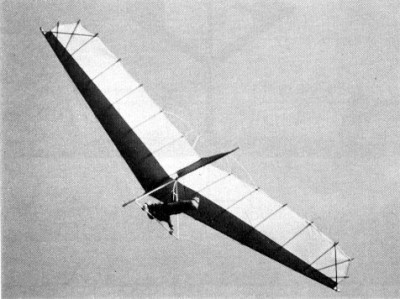
A 1980 hang glider.
A 1980 hang glider.
1902: (Willard L) Velie Carriage Co.
1908: Velie Motor Co.
More known for his carriages, automobiles and racers, and motors, Velie (grandson of John Deere) also capitalized and manufactured the initial 55-65hp Monocoupe aircraft upon acquisition of controlling interest in Central States Aircraft Co in 1927, hence early popular reference to “Velie Monocoupes” signifying not only the powerplant but the constructor.
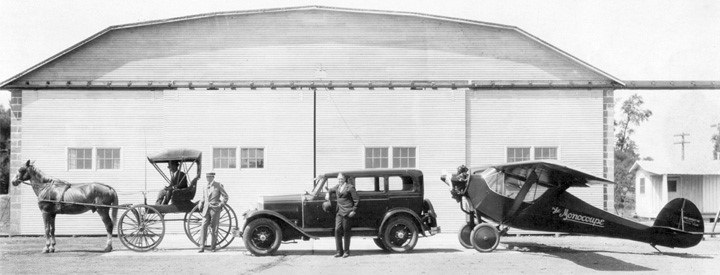
When Velie died of an embolism in Oct 1928, his son took the reins but he, too, suffered a heart attack in Mar 1929 and Don Luscombe took over.
1928: Mono-Aircraft Corp (pres: W L Velie),
1616 McGee St,
Moline IL.
USA
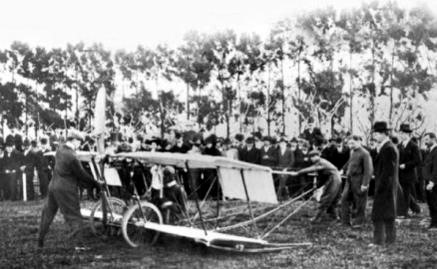
The machine was designed and built by the four (!) brothers Escofet and Enrique Martinez Velazco together with the Frenchman Henri de Rosiers. It was built as a glider then fitted with an Anzani engine but flight could not be achieved. Parts of the Escofet I were used in the second model. The Escofet II was momentous as it was the first machine in Uruguay to have actually flown on August 26, 1910. This first flight was also the last for the machine as on landing after about 200 meter it crashed severely, wounding the pilot.
Parts of the Escofet I were used in the second model.
Victor Vejraska built the Arrow in 1936. A two place open cockpit biplane, powered by a 65hp Velie M-5.
Friend NB.
USA
Victor Vejraska built the Vejraska Arrow in 1936.
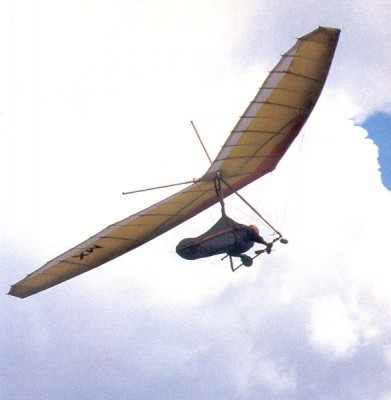
The MX was a 1989 hang glider. It was followed by the 1990 MX 2 for advanced pilots.
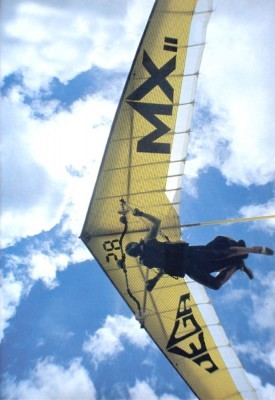
The MX 2 Austrian glider allowed Manfred Ruhmer – Vega test pilot at the time – to score 2nd in the 1990 European championship. Some features of this glider have been copied by other manufacturers. It was imported in France by Survol-Fun en Bulle, in Crolles.
MX
Wing area: 14.3 m²
Wing span: 10.5 m
Aspect ratio: 7.7
Hang glider weight: 31 kg
Nose angle: 129°
MX 2 143
Wing area: 14.3 m²
Wing span: 10.5 m
Aspect ratio: 7.7
Hang glider weight: 34 kg
Minimum pilot weight: 65 kg
Maximum pilot weight: 100 kg
Maximum speed: 95 km/h
Max glide ratio (L/H): 10.84
Max glide ratio speed: 42 km/h
Minimum sink rate: 0.91 m/s
Number of battens: 28
Nose angle: 133°
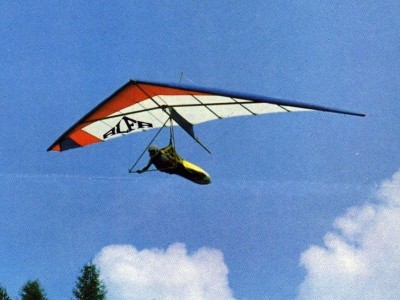
A 1989 hang glider.
Wing area: 15.8 m²
Wing span: 9.75 m
Aspect ratio: 6
Hang glider weight: 26 kg
Nose angle: 120°
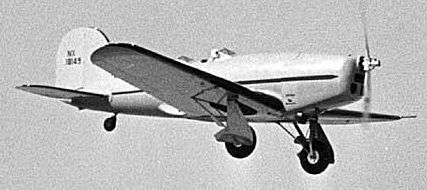
The 1938 Vega Flying Test Stand (ATC 2-423) was designed by Jack Wassall and W N “Wally” Wallace, and assembled from various Lockheed components. First designated Lockheed Altair 8-G and registered NX18149, it was used to test experimental 520hp Menasco U-520 Unitwin (twin 260hp Super B with single propeller) for use in a planned Starliner.
Sold to Lockheed dealer Howard Batt when it was no longer needed, repowered with 450hp P&W Wasp SC under (2-423) in 1939 and reregistered as Lockheed Altair 8-D in 1940.
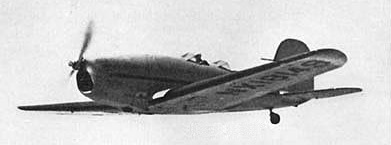
Engine: 520hp Menasco U-520 Unitwin
Wingspan: 42’9″
Length: 28’11”
Seats: 2
Vega Airplane Company
USA
Vega Airplane Co was known formerly as Airover Company, Victory Blvd and Empire Ave, Burbank, California, formed at 923 E San Fernando Rd, Burbank, California, as associated company of Lockheed Aircraft Corporation in 1937. Began research/development experiments with light aircraft, devising (with Menasco) a unit called Unitwin; two small engines coupled side-byside to drive single propeller flight-tested in Lockheed Altair in 1938. Then designed five/six-seat Starliner twin-tailed low-wing cabin monoplane using similar powerplant. Small batch of radio-controlled targets built in 1939. Factory expanded 1940, and mid-year received contract to build large numbers of Lockheed Ventura bombers for RAF. Then, in conjunction with Boeing and Douglas, mass-produced Boeing B-17 Flying Fortress bombers; became wholly owned subsidiary of Lockheed in 1941 as Vega Aircraft Corporation (pres: Courtland S Gross).
From 1941 Vega Aircraft Corp became Vega Airplane Company; continued production of Lockheed-Vega B-34 Ventura twin-engined medium bomber for USAAF/USN/RAF and Boeing B-17 Flying Fortress for USAAF between 1941 and 1944. Absorbed into Lockheed Aircraft Corporation 30 November 1943; name Vega abandoned; Vega plant became Lockheed’s Factory A. Ventura B-34 production ended 1943; PV-1 naval version and Boeing B-17 manufacture continued until 1944 under responsibility of Lockheed.
Two I-18 two-seaters developed from earlier Pulins/lrbitis I-8.

