A two-seat tourer/trainer low-wing monoplane, first flown 1948; slightly modified Musca 1Ws appeared in 1949.
Author: Terry
Viberti
Italy
Formed shortly after Second World War by Dr. Angelo Viberti to build light aircraft. First product, Musca 1 two-seat tourer/trainer low-wing monoplane, first flown 1948; slightly modified Musca 1Ws appeared in 1949. There were designs for Musca 2 three-seat cabin monoplane and Musca 4 high-wing version of 1, and floatplane variant, but doubtful if they were built. Probably dissolved about 1950-1951.
Verzilov Staliniets 5
Encouraged by the excellent results obtained by his gliders in the competitions of 1934 and 1937, for the XII National Competitions, Verzilov presented a last model called “Staliniets-5” (Russian: Верзилов “Сталинец-5”), designed as a record-breaking single-seater for long-range flights and also built in the facilities. from the Yeisk Naval Pilot School.
The “Staliniets-5” was designed as a single-seater monoplane with a cantilever wing of medium implantation, characterized by its gull-like shape. The shape in the plane was trapezoidal with a marked decrease in the chord and an R-III profile. The trailing edge featured long louvered ailerons covering the entire span to the point of angle change.
The glider was characterized by the presence of a closed celluloid-coated cockpit, equipped with instrumentation to be able to carry out night and blind flights and with radio equipment to maintain contact with the ground.
The landing gear consisted of a wooden ski with an extension located at the bottom of the keel.
Like the previous models, the “Staliniets-5” stood out for its good construction finish.
The atmospheric conditions during the 1937 XII National Sailing Competitions (of the 18 days only 4 allowed to fly) did not offer the possibility of obtaining appreciable results.
From 1937 the development of gliders in Yeisk died. For various reasons its developers were assigned to other units. Yeremeyev left Yeisk in 1936, Sujomlin and Lisitsyn in the summer of 1937. Verzilov would also drop out of school shortly thereafter.
Staliniets-5
Wingspan: 18.00 m
Wing area: 14.60 m²
Aspect ratio: 22.2
Length: 6.84 m
Height: 1.62 m
Empty weight: 280 kg
Wing loading: 24.7 kg / m²
Glide ratio: 24
Minimum descent speed: 0.73 m / s
Surface of the horizontal planes: 1.00 m²
Vertical plane surface: 1.3 m²
Ailerons surface: 2.00 m²
Accommodation: 1

Verzilov Staliniets 4
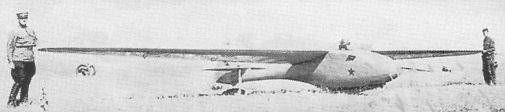
For the XI National Flying Competition held in Koktebel, Vladimir Verzilov developed two new gliders: the two-seater trailed “Staliniets-2bis”, built as a development of the “Staliniets-2” and the single-seater “Staliniets-4” (Russian: Верзилов “Сталинец-4”). Both were valued by the technical commission, receiving approval for the flights without objections.
The “Staliniets-4” glider was designed as a single-seater training and competition monoplane.
Structurally, it was a high-wing glider with variable chord cantilever wings and a trapezoidal shape in the plane. The wing, with a single spar, was constructed of wood with plywood covering and featured a P3-2 profile. The trailing edge featured long louvered ailerons covering 2/3 of the wingspan.
The tail was of the conventional type, with the horizontal planes located near the base of the empennage.
The landing gear consisted of a non-depreciated wooden ski with an extension located at the bottom of the keel.
The pilot was located in an open cockpit located in the bow. A notable feature was the use of a radio in the glider, which allowed communication with the ground.
Built at the VVS RKKA Naval Pilot School, this glider successfully participated in the XI National Competitions Gliding in Koktebel between 6 September and 6 October 1935. In the opinion of the pilot Iván M. Sujomlin, the glider was very obedient to the controls and stable in flight. The only defect noted was its one-piece wing construction, which caused problems during transport and maintenance actions.
With the pilot IM Sujomlin at the controls, this glider managed, between October 2 and 3, to stay in the air for 38 hours and 10 minutes, which meant a new record. The Stalinits-4 received a special award in the competition’s training glider category.
These were the last gliding competitions in which the duration of the flight was competed. In the new competitions, they moved the mountainous Crimea, to new sites such as Rostov and the Moscow airfields.
In 1937 the “Staliniets-4” glider was produced by various organizations in the country. Many competitors built developments of this model for participation in competitions. The XII national competitions, which took place between 10 and 28 of July 1937 at the airfield of the sports society “Spartak” near the village Tioply Stan (now a suburb of Moscow) participated with three copies under the name ” Staliniets-4bis “.
Staliniets-4
Wingspan: 14.00 m
Wing area: 11.30 m²
Aspect ratio: 17.3
Length: 6.15 m
Height: 1.30 m
Empty weight: 173 kg
Wing loading: 22.4 kg / m²
Glide ratio: 19.8
Surface of the horizontal planes: 1.57 m²
Rudder surface: 0.80 m²
Aileron surface: 1.35 m²
Accommodation: 1
Verzilov Staliniets-2bis
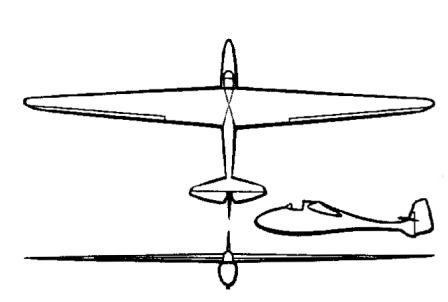
A development of the “Staliniets-2” built in 1935, the “Staliniets-2bis” (Russian: Верзилов “Сталинец-2бис”) glider was designed as a towed two-seater.
Structurally it was designed as a monoplane with a high wing in parasol, braced by uprights. The wing featured an R-II profile with a single spar structure and was built in two independent sections, which were fixed to the upper fuselage structure, featuring an upright on each side to ensure the necessary structural rigidity. The entire wing was covered by 1.5 – 2 mm thick plywood sheets and had a total weight of 158 kg.
The fuselage featured oval section and plywood overlay. Eighteen frames and four main spars were included in its structure.
The vibration problems presented by the previous “Staliniets-2” made it necessary to locate the tail planes somewhat lower in the empennage. The stabilizer was attached to the keel structure at two points and a bracing post.
The landing gear consisted of a rigid, trunk-shaped ski, to which a trolley was attached, which could be released after take-off from the second seat.
The two crew members sat in tandem seats. The second position was located just above the center of gravity of the glider, so the absence of its occupant did not bring problems of variation of the centering.
As a result of the modifications made, the new glider was 25 kg heavier than its predecessor.
For the XI National Competition gliding in Koktebel between 6 September and 6 October of 1935 both “Staliniets- 2” and the “Staliniets-4” were valued by the technical commission, receiving approval for the flights without objections.
During the XI National Sailing Competitions on the “Staliniets-2bis”, test pilot Valentin V. Licitsyn with passenger B. Dolya set a new world record for flight duration for a two-seater glider by staying in the air between 2 and October 3 for 38 hours and 40 minutes. Again the record was recognized only as a national one, because the USSR in those years was not a member of the FAI.
Staliniets-2bis
Wingspan: 20.10 m
Wing area: 25.00 m²
Aspect ratio: 16.2
Length: 8.22 m
Height: 1.60 m
Empty weight: 320 kg
Wing loading: 19.2 kg / m²
Ailerons area: 4.20 m²
Glide ratio: 21
Accommodation: 2

Verzilov Staliniets-2
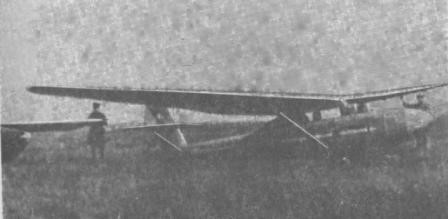
From a visit to the IX National Competition gliding, which took place in the town of Koktebel in Crimea between 12 August and 20 September of 1933, a group of students and instructors Pilot School Navales of the RKKA VVS named Stalin decided to develop self-built gliders to participate in these competitions. The gliders carried the name Staliniets (Сталинец), which can be translated as Staliniano, in relation to the name of the school.
With more desire than experience and using the facilities of the local carpentry they began to work.
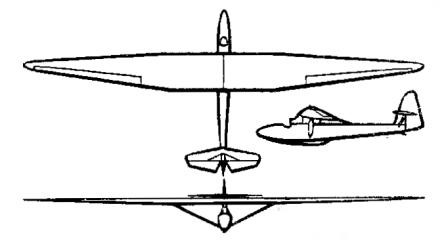
The “Staliniets-2” was designed as a two-seater competition glider.
Structurally it was designed as a monoplane with a high wing in parasol, braced by uprights. The wing featured an R-II profile with a single spar structure and was built in two independent sections, which were fixed to the upper fuselage structure, featuring an upright on each side to ensure the necessary structural rigidity. The central section of the wing was rectangular in shape, which became trapezoidal towards the ends. The entire wing was covered by 1.5 – 2 mm thick plywood sheets and had a total weight of 158 kg.
The fuselage featured oval section and plywood overlay. Eighteen frames and four main spars were included in its structure.
The tail planes were located high on the empennage. The stabilizer was attached to the keel structure at two points and a bracing post.
The landing gear consisted of a rigid, trunk-shaped ski, to which a trolley was attached, which could be released after take-off from the second seat.
The two crew members sat in tandem seats. The second position was located just above the center of gravity of the glider, so the absence of its occupant did not bring problems of variation of the centering.
The “Staliniets-2” (Russian: Верзилов “Сталинец-2”) was manufactured between June and September 1934 and this glider stood out for its good finish.
In the next competition, held also in Koktebel from 1 September to the 6 October of 1934 two gliders were presented: the “Staliniets-1” developed by the instructor flying school Pavel Yeyemeyev and two – seater “Staliniets -2 ”developed by Vladimir Verzilov.
The “Staliniets-2” glider successfully participated in the X National Sailing Competition, held in Koktebel.
Unlike the unsuccessful “Staliniets-1” of Yeremeyev, the “Staliniets-2” flown by instructor pilot Ivan M. Sujomlin established a new record in the competition extension flight to stay airborne 24 hours and 10 minutes between on October 18 and 19. Despite surpassing international results, this record was recognized only as national because the USSR was not a member of the FAI.
As a positive feature of the glider, it is worth highlighting its excellent longitudinal and transverse stability, as well as the excellent balance achieved by its builders.
Its disadvantages include the operation of the large unbalanced ailerons, which required a great effort o and some vibration in the tail, due to an ineffective location of the stabilizer.
Staliniets-2
Wingspan: 20.20 m
Wing area: 25.00 m²
Aspect ratio: 16.3
Length: 8.05 m
Height: 1.95 m
Empty weight: 295 kg
Wing loading: 18.2 kg / m²
Surface of the horizontal planes: 3.16 m²
Vertical plane surface: 1.72 m²
Ailerons surface: 3.68 m²
Accommodation: 2
Verzilov, Vladimir N.
It is known that in the 1920s Vladimir N. Verzilov (Russian: Владимир Н. Верзилов) began work on the development of gliders in Simferopol.
In the late 1920s he worked together with AN Sharapov on the construction of a pair of gliders that participated in competitions at Koktebel.
He transferred to the Yeisk Naval Pilot School in 1934, working there as an instructor until 1937. On 25 May 1936 VN Verzilov was awarded the Order of the Red Banner.
During his stay in Yeisk, Verzilov was responsible for the creation of four types of gliders of which three set national records. After dropping out of the Yeisk school, Verzilov worked as a test pilot.
Verzilov went on to establish several national records.
Verzilov gliders in Simferopol
”Piervieniets” – Competition (1927).
”Buyán” -Trainer (1928).
Verzilov gliders Yeisk
“Staliniets-2” – two-seater glider, record holder (1934).
“Staliniets-2bis” – two-seater glider, record holder (1935).
”Staliniets-4” – single-seater glider, record holder (1935).
“Staliniets-5” – long-range single-seater glider (1937).
Verville PT-10 / Training Plane
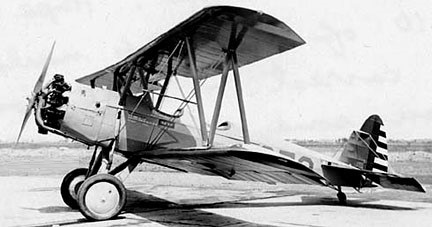
The 1931 PT-10 was an AT model foe Army Air Corp evaluation as YPT-10. Four were built as YPT-10 (31-519-522), first one was as “Training Plane” in prototypical stage (N479Y). The Training Plane first flew in February 1931.

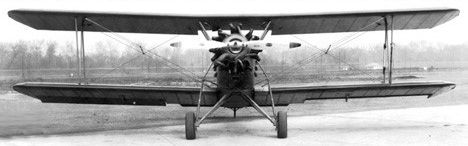

There was one conversion, 31-521, to a PT-10C. converted in 1931, it was powered by a Lycoming R-680.
One conversion to YPT-10D was completed in 1931, powered by a Kinner C-5.

PT-10
Engine: 200hp Lycoming R-680
Wingspan: 33’0″
Length: 25’0
Useful load: 642 lb
Max speed: 108 mph
Cruise: 80 mph
Stall: 52 mph
Seats: 2
Verville 1915 biplane
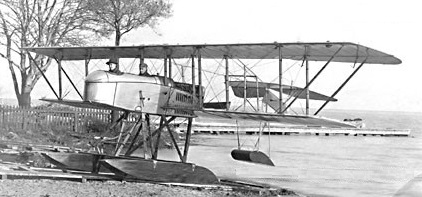
Verville’s first design, from 1915, was a two-place biplane, powered by an 80hp LeRhône pusher, possibly replaced by a Hall-Scott engine later.
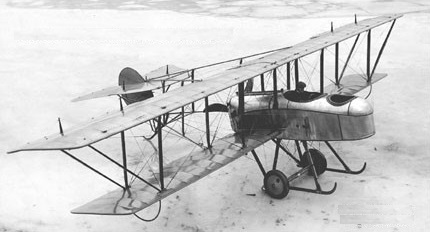
Verville 104 Air Coach
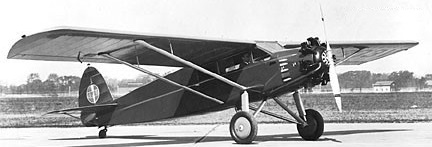
The 104 Air Coach (ATC 267) was built from 1928. With a semi-cantilever wing, the Air Coach was priced at $7,500. Two were built as just Air Coach NX506 c/n 2 and NX151E c/n 1.
Six or seven 104-C Air Coach were built in 1929 at $12,000, including; NC68W=NS11, NC88Y=NS3, NX/NC303H (165hp Wright J-6), X/NC303V, NC356V, NC477Y. ATC 2-306 was for NC477Y, powered by a 240hp Wright R-760 engine.
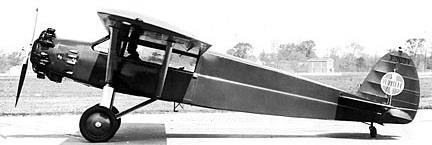
There was one 104-A Air Coach, converted from 104-C NC68W, in 1933. Registered NS11 (ATC 2-454).
In 1930 104-C NC70W was modified to a 104-P Air Coach (ATC 316) with a 225hp Packard DR-980 diesel.
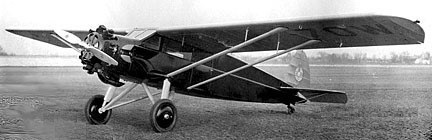
The 104-P Air Coach was priced at $11,000-12,000 but only the one was produced.
104-A Air Coach
Engine: 220hp Wright J-5
Seats: 4
104-C Air Coach
Engine: 110hp Warner Scarab
Wingspan: 40’0″
Length: 28’0″
Useful load: 875 lb
Max speed: 110 mph
Stall: 45 mph
Range: 600 mi
Seats: 4
104-C Air Coach
Engine: 225hp Wright J-6
Wingspan: 44’0″
Length: 28’9″
Useful load: 1234 lb
Max speed: 130 mph
Cruise speed:110 mph
Stall: 50 mph
Range: 650 mi
Seats: 4
104-P Air Coach
Engine: 225hp Packard DR-980 diesel
Length: 28’8″
Useful load: 1100 lb
Max speed: 130 mph
Cruise speed:110 mph
Stall: 50 mph
Range: 640 mi
Seats: 4

