Vintage Aircraft & Flying Assoc. Vimy [2]

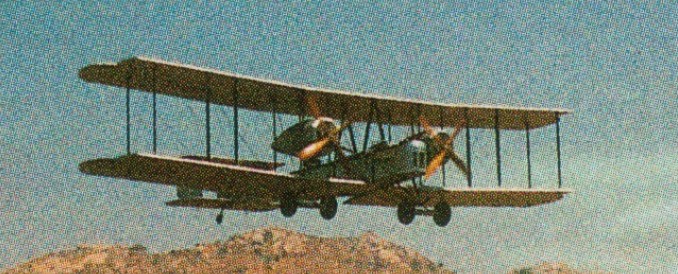
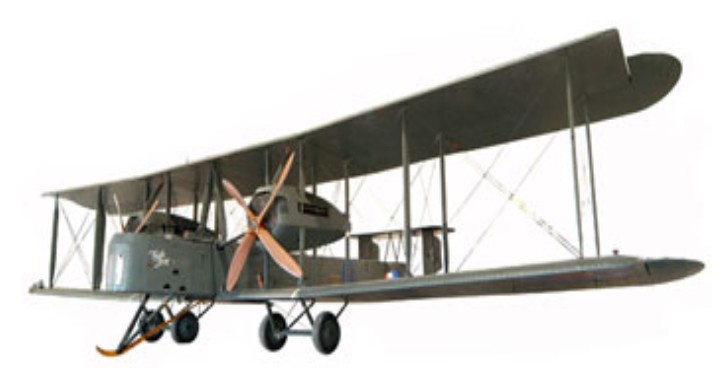
In 1992 Peter H.McMillan and Lang Kirby considered reproducing the Vickers Vimy. A set of almost complete drawings were found in 1993 and Bill Whitney, an Australian aeronautical engineer and designer was hired to do a stress analysis. Whitney also reproduced the great number of missing drawings and designed the numerous new parts that would be required.

The job of building the project was given to a Hollywood set builder, John LaNoue (who had never built an aircraft before). The wingspan was more than 70 ft. There were 112 flying wires, 150 sheets of aircraft plywood, 500 yards of Grade A cotton fabric, over a mile of hand frayed finishing tape, two 11 foot four blade wood propellers, 300 gallons of dope, 10,000 rib stiches, more than 700 feet of control cable, more than 1000 feet of 4130 aircraft tubing and 240 feet of 5/8 in bungee cord. There were 300 nose ribs to be fabricated, 330 feet of box spars to be built, 126 main wing ribs and hundreds of metal fittings.

The finished weight would exceed 12,000 lb. And all this had to be done by the 75th anniversary of the great air race of 1919 – 18 months later. LaNoue put together a team of dedicated experts who were committed to seeing the project through. The project was broken down to the smallest denominator, and a schedule developed.
The team started working 12 hour days five days a week but soon were working 12 hr seven days a week. The parts were built in two locations: Australia, and at the closed Hamilton AFB north of San Francisco.

Due to no Rolls Royce Eagles being available it was decided to go with automotive 454 Chevys. The GM motors would fit inside the cowling with their 4:1 reduction gears. The 454s flew the aircraft to Australia with only one mishap, but when BMW became a sponsor, the engines were changed to 5.4 litre BMW V-12 M-73s with 5:1 planetary reduction gears.
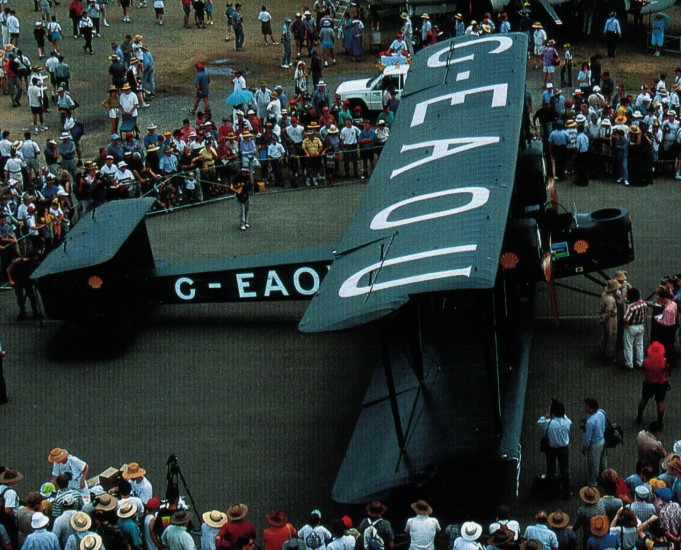
The project was completed in 15 months and 22,000 hours of labour, and flight testing was carried out at Hamilton on the old, closed runways.

The adverse yaw was so great due to the massive size, nothing happened quickly. The original Vimy had only one set of controls on the right side and no brakes or tailwheel. The reproduction is fitted with dual controls along with all the other modern conveniences, but it is still tough to fly.
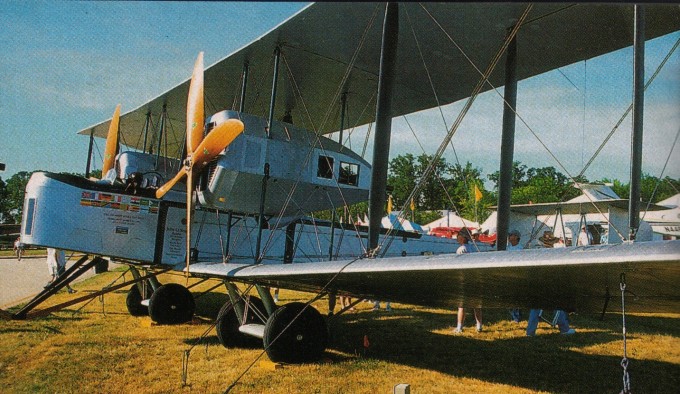
After the obligatory 25 hours of flight testing, the aircraft was disassembled, loaded into a C-5 Galaxy and delivered to Farnborough for the 1994 airshow.
Vintage Aircraft & Flying Assoc. Vimy [1]

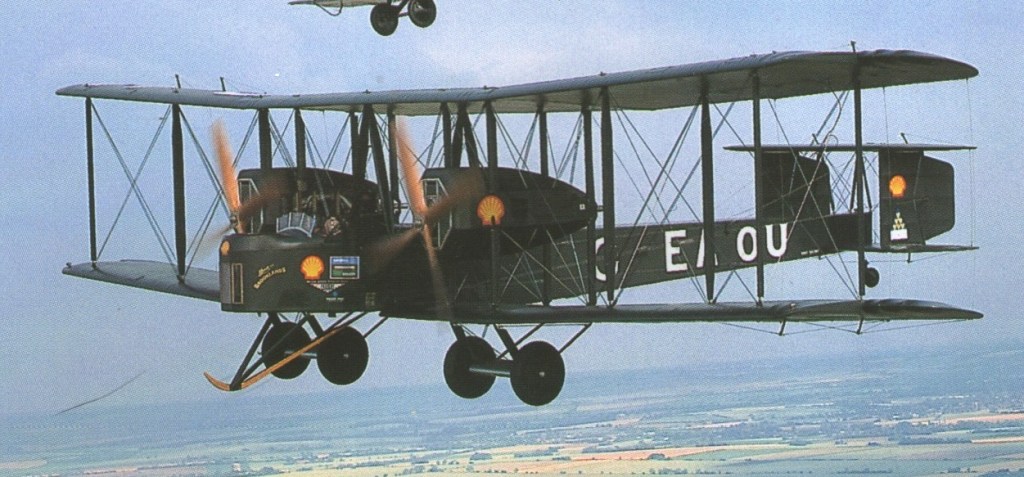
In May 1967 the Vintage Aircraft and Flying Association decided to build a Vimy replica to commemorate the 50th anniversary of the Alcock and Brown’s trans-Atlantic flight.
When told of the project Rolls-Royce began a world wide search for engines. Eventually they were successful and recovered three Eagle engines from Dutch canal barges two of which they stripped down and rebuilt; putting the first on bench test in August 1968.
The aircraft was completed on Friday 30 May 1969. The following days were filled with final inspections and checks and on Tuesday 3 June at 6.40pm the aircraft took off on its first flight.

The aircraft was completed on Friday 30 May 1969 at Weybridge with the original Rolls-Royce Eagle VIIIs. The following days were filled with final inspections and checks and on Tuesday 3 June at 6.40pm the aircraft took off on its first flight. It first flew at Wisley, un-marked, registered G-AWAU c/n VAFA.02 and pained as H651.

The aircraft went through an intensive flight test programme before receiving a Special Category Certificate of Airworthiness on 5 June. The next day the aircraft crossed the Channel to appear at the Paris Air Show. On 9 June it returned to the United Kingdom and two days later, after being repainted in service markings, flew to Ringway Airport, Manchester to become the centre of an Alcock and Brown exhibition.

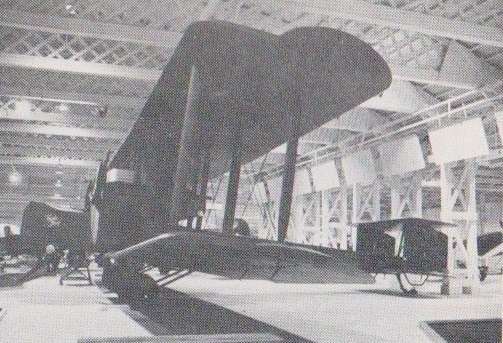
It was badly damaged by fire at Ringway on 18 July 1969 while on display. It was repaired and donated to the RAF Museum where it went on display at Hendon as F8614.

Villinger Skye / Airwave Skye

Skye I

The Skye was taken over by Airwave when the Villiger company closed.

A floater hang glider circa 1998 which could be flown supine or prone. The Skye was manufactured at the Seedwings Europe factory.

Wing area: 18.3 sq.m
Pilot weight: 70-125 kg
Wing span: 5.4 m
Nose Angle: 120 deg
Aspect ratio: 9.95
Price (1998) 6500 DM

Skye 193
Wing area: 18.3 m²
Wing span: 9.95 m
Aspect ratio: 5.4
Hang glider weight: 22 kg
Minimum pilot weight: 70 kg
Maximum pilot weight: 125 kg
Packed length: 6 m
Packed length short: 3.8 m
Nose angle: 120°

Villiers

France
Founded late 1924 at Meudon. Products included Type 2 AMC2 fighter, and two prototypes of Type 4 HBA2 twinfloat biplane for armed reconnaissance; Type 24 night-fighters for Aeronautique Maritime; last design was Type 26 twin-float cabin monoplane. Company closed down in 1930; factory taken over following year by Potez.