Back to Vultee Model 3
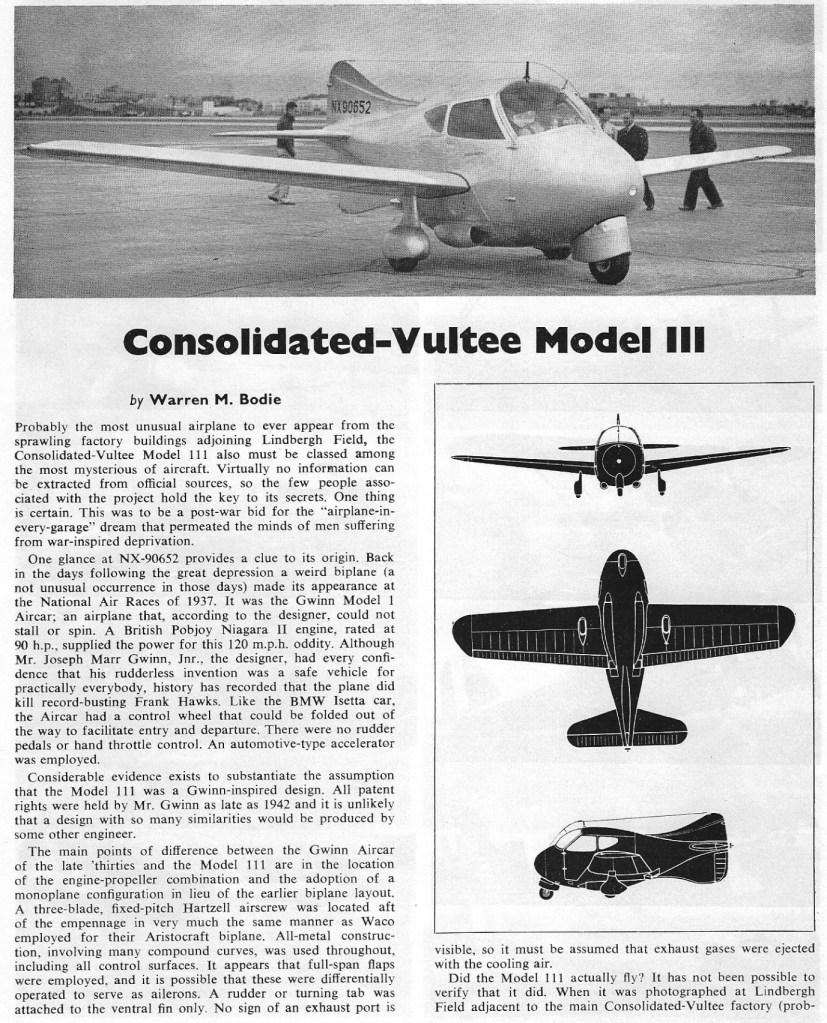

The 1941 Vultee-Stinson V-76 NX27772 was a modified Stinson 105 with a 185hp Lycoming O-435 engine. Designed by A P Fontaine, it was first flown on 28 June 1941, piloted by Al Schramm, it was equipped with full-span slots, which created a problem during testing with near-fatal results.
With modification to half-span slots and enlarged tail surfaces it became final prototype for the Stinson L-5.

The 1942 XBT-16 was BT-13A 41-9777 rebuilt with a plastic-impregnated plywood (Duramold) fuselage, tail section, and wing sections by Universal Products Corp, Bristol VA (aka Vidal Research Corp). A wartime experiment to replace vital aluminum with a less expensive material that didn’t prove too successful. It reportedly ended up heavier than the original metal-clad ship. Only one was built.
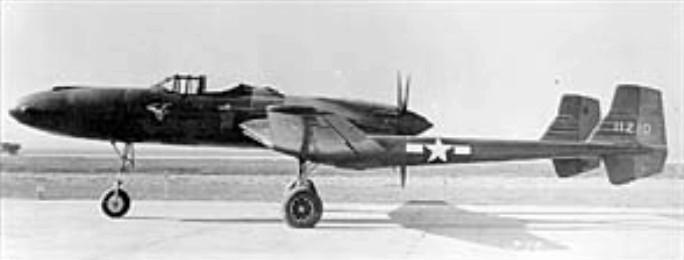
The XP-54, Vultee Model 70, was designed as a fast interceptor using the Pratt & Whitney X-1800-4AG engine. When the engine program was canceled, the aircraft was redesigned for the Lycoming XH-2470 and redesignated Vultee Model 84. With a pressurized cockpit, a pilot emergency ejection was downward, through a hole in the floor.
The first of two XP-54s built (S/N 41-1210) made its initial flight on 15 January 1943, piloted by Frank Davis, and flew 86 times before it was grounded by engine problems. The second aircraft (S/N 41-1211) flew only once, on 24 May 1944.
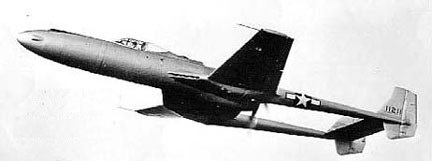
The XP-54 nose section had a very unusual design feature. It tilted slightly upwards when firing its 37mm cannon to increase the firing range while the .50-cal. machine guns were tilted down at the same time. All had compensating gunsights.
Both were eventually scrapped.
XP-54
Span: 53 ft. 10 in.
Length: 54 ft. 9 in.
Height: 13 ft. 0 in.
Weight: 15,262 lbs. empty/18,233 lbs. gross
Armament: Two 37mm cannon and two .50-cal. machine guns
Engine: Lycoming XH-2470 of 2,200 hp.
Maximum speed: 381 mph. at 28,500 ft.
Service ceiling: 37,000 ft.
Range: 500 miles

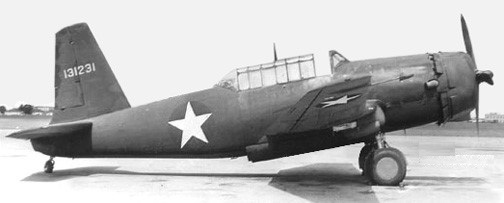
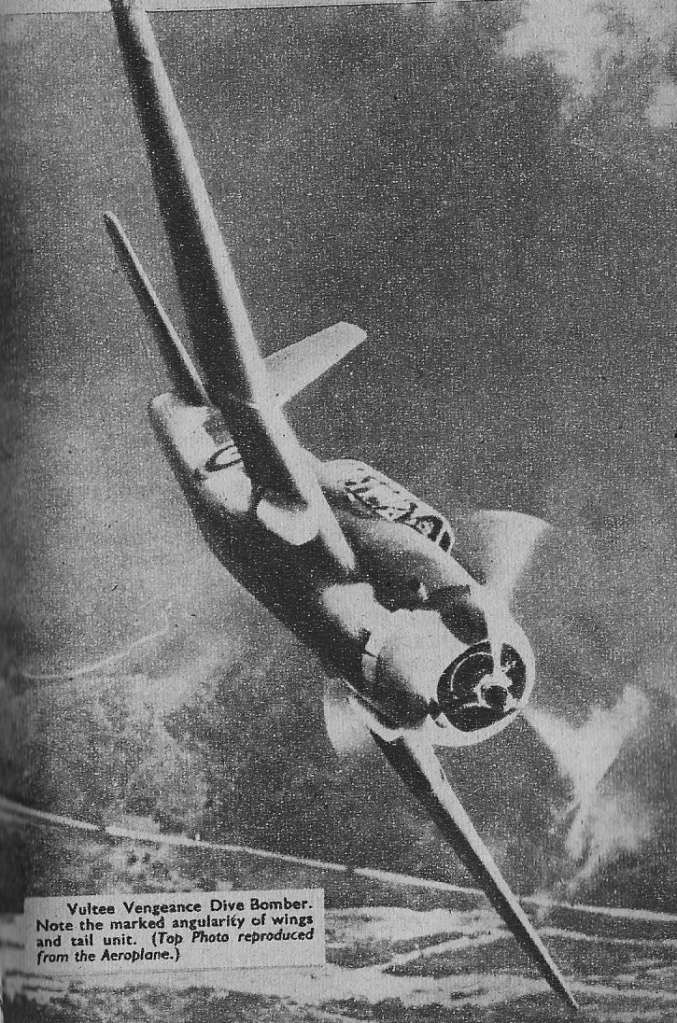
The Vultee A-31 Vengeance dive-bomber was designed led by Richard Palmer to meet French air force requirements.
The RA-31 (Model V-72) export model (as prototype V-85) first flew on 30 March 1941 piloted by Vance Breese. There was a second prototype with twin tails, but pilot Vance Breese refused to fly after finding dangerous tendencies during taxi tests, and it was quickly modified with a single tail. It first flew (as Vengeance I) on 30 November 1941, piloted by Moye Stephens.
400 went to the RAF as Vengeance I/IA, subcontracted to Northrop Corp for production during 1941-42, of which 99 went to the RAAF, plus 300 to the USAAF as RA-31 in a special Restricted classification (41-30848 – 41-31047, and 41-31048 – 41-31147), the last batch of 100 built by Northrop; 300 to RAF as Vengeance II, plus 243 to USAAF with type re-designation as model 85 in 1942; 100 as Vengeance III, becoming Army A-31C, with subsequent production as A-35.

The 1942 V-86 was a single place version of the A-31.
The XA-31A Model 85 of 1942 (42-35824) was a test-bed for the 3000hp P&W XR-4360 engine. It was re-designated XA-31B Model 86 for flight tests.
The A-31C of 1942 was t first production of the Vengeance III. One hundred were built; 41-30148 – 41-31147.
The XA-31C of 1942 was a test-bed for the 2200hp Wright R-3350 engine.
Five YA-31C were built in 1942 and went to Wright Field for testing of four-bladed props in the B-29 development program.
The A-35 Vengeance (Model 88) were A-31 for the USAAF, with similar data, but improved armament.

The 1942 A-35A were the second production of Vengeance III. Ninety-nine were built; 41-31148 – 42-31246.
781 A-35B of 1942 were built; 41-31247 – 41-31447, 42-94149 – 42-94548, and 42-101236 – 42-101465. Contradicting factory records show 831 A-35Bs built, with 562 going to the RAF and RAAF as Vengeance IV, and 29 to Brazil AF. (67 A-35A and -35B were supplied to the Free French, but it is unclear whether these were culled or a separate production.)

All models were powered by Wright R-2600 Cyclone engine.
V-72 A-31 Vengeance
Engine: 1600hp Wright GR-2600A
Wingspan: 48’0″
Length: 39’9″
Useful load: 3215 lb
Max speed: 275 mph
Cruise: 235 mph
Stall: 80 mph
Range: 500 mi
Ceiling: 22,300 ft
Seats: 2
A-35B / Vengeance IV
Engine: 1700hp R-2600
Wingspan: 48’0″
Length: 39’9″
Max speed: 279 mph
Cruise: 230 mph
Stall: 84 mph

The Vultee P-66, P-48, V-48/-61 Vanguard (Models 48, 61) incorporated design elements from the Hughes H-1 racer and detachable outer wing panels for storage.
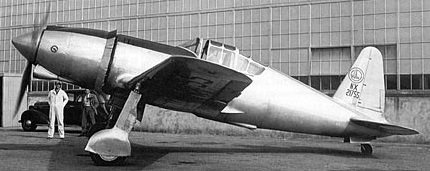
Designed by Dick Palmer as a company demonstrator, the V-48 NX21755 c/n 142 first flew on 9 September 1939, piloted by Vance Breese. The V-48 was powered by a P&W R-1830-S Twin Wasp with an extended propshaft in an elongated low-drag cowling. The original proposal included two rear-firing guns aimed with mirrors. The prototype, NX21755 c/n 142, was later re-designated V-61, then P-48X.
The 1940 P-48X was a redesign of the V-61 with a conventional R-1830-S1 engine because of cooling problems. First flown on 11 February 1940, piloted by Vance Breese, and it crash-landed on May 9 after colliding with a camera plane.

The 1940 V-48C was the V48-X rebuilt and repowered with a R-1830-S2 engine for export to Sweden’s Flygvapen as the J.10. First flown on 6 September 1940, it was re-registered NX19999 c/n 501, and followed by one production prototype, NX28300 c/n 502.

One-hundred and forty-four were built for Sweden (42-6832 to 42-6975), but diverted to the RCAF, who in turn released 129 of them after the outbreak of WW2 as Lend-Lease to China as P-66, and so marked with US insignia. Of the total about 50 were impressed for Army stateside assignment, and 12 transferred to 23 Fighter Group in China.
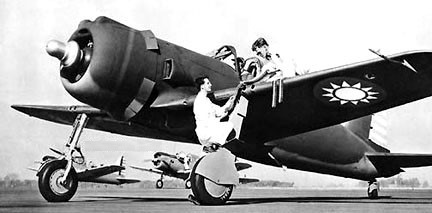
V-48
Engine: P&W R-1830-S Twin Wasp
Wingspan: 35’10”
Length: 28’5″
Useful load: 2165 lb
Speed: 340 mph
Range: 850 mi
Seats: 1
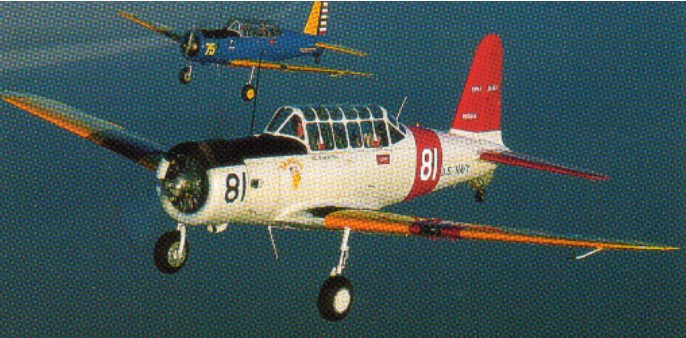
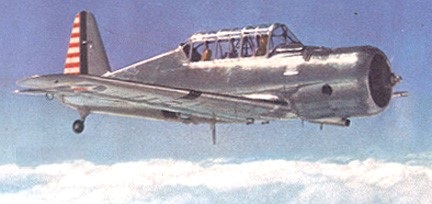
The BC-3 (Model 51 aka BC-51) Army basic combat trainer first flew on 24 March 1939 (piloted by Eddie Allen). The only one built, 39-720, was tested by the Army, who purchased the test model for upgrading as BC-3, one of the only three BC classifications (the other two were North Americans).

Following 1939 tests with the BC-3 variant with retractable landing gear and a 447-kW (600-hp) Pratt & Whitney R-1320-45 radial, the army opted for the lower-powered Model 54 with fixed landing gear. Designed by Richard Palmer, Walt Hite, and others, the initial contract called for 300 aircraft (40-810-1109).
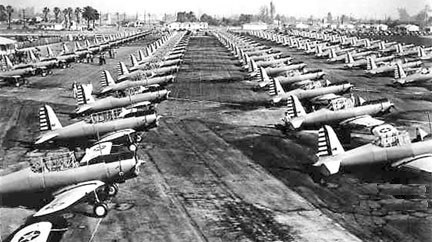
The 1939 V54 (Model 51D) was a retractable-gear export model demonstrator with a 600hp R-1340-S1 engine. The one prototype built, NX21753 c/n 140, first flew on 15 November 1939 piloted by Gil Clark), but crashed on 16 November 1939.

The 1940 V54-A NX21754 c/n 141 was a faired, fixed gear, 450hp R-985-AN-1 powered prototype of the BT-13. It first flew on 28 July 1940.

The BT-13s were followed by orders for no fewer than 6,407 BT-l3As and 1,125 BT-l3Bs with a 24- rather than 12-volt electrical system.
The 1940 BT-13A was powered by a 450hp R-985-AN-1 engine. Gear fairings were deleted in 1941. A total of 7,037 were built: 41-1211-1710, 41-9587-9979, 41-10410-11586, 41-21162-23161, 42-1164-1743, 42-42201-43257, and 42-88674-89573, plus 430 (41-09980-10409) to the USN and USCG as SNV-1, and 12 to the Peruvian AF.

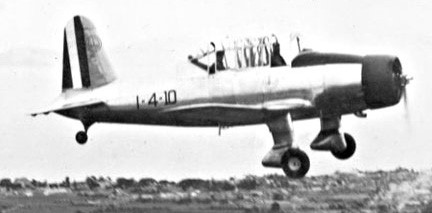
The 1941 BT-13B featured a 24v electrical system. 1,125 were built (42-89574-90698, and 44-31511-32160), with the last batch of 650 transferred to USN as SNV-2. Totals of all models include Lend-Lease exports to China, France, Haiti, Indonesia, Israel, the Philippines, and South American nations.
Demand far outstripped engine supplies, however, and in 1941 the USAAF ordered the BT-15 variant with the 336-kW (450-hp) Wright R-975-11 radial, and production of this model totalled 1,263. (41-9980-10409, 42-1744-2063, and 42-41258-42200)
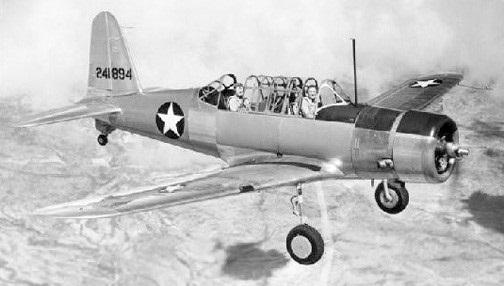
The US Navy procurement began with the 1940 US Navy SNV-1, the same as BT-13A. 1,125 (02983-03182, 05675-05874, and 12492-12991) (USN serials total 1,350, but is unexplained—perhaps includes a cancelled batch), with 2 (V222 and V223) to USCG, plus 450 (34135-34584) transferred from USAAF (44-31511-32160, et al) aircraft were retired soon after the war.

These were followed by 650 SNV-2s, equivalent to the BT-13B, in 1944. They were BT-13B transferred from the USAAF (44-31511-32010 became 52050-52549, and 32011-32160 became 44038-44187).

When production ceased in 1944, 11,537 had been built.
BC-3 / Model 51 / BC-51
Engine: P&W R-1340-S3H1G Wasp, 600hp
Wingspan: 42’0″
Length: 28’10”
Useful load: 920 lb
Speed: 180 mph
Range: 725 mi
Seats: 2
Undercarriage: retractable
V54 / Model 51D
Engine: P&W R-1340-S3H1G Wasp, 600hp
Undercarriage: retractable
BT-13 Valiant / Model 54
Engine: 450hp P&W R-985-25
Wingspan: 42’2″
Length: 28’10”
Useful load: 1121 lb
Max speed: 166 mph
Cruise: 140 mph
Range: 515 mi
Ceiling: 16,500′
Seats: 2
BT-13A Valiant / SNV-1
two-seat basic trainer
Powerplant: l x Pratt & Whitney R-984-AN-1, 336kW (450 hp)
Span: 12.80m (42ft)
Length: 8.79m (28ft 10 in)
Max TO weight: 2039 kg (4,496 lb)
Max speed: 180 mph at sea level
Operational range: 725 miles
Armament: none
BT-15 Valiant
Engine: Wright R-975-11, 336-kW (450-hp)