1997: 1121 Lewis Ave, Sarasota, FL 34237, USA.
2009: Windex AB, Lucernavägen 9, 593 50 Västervik, Sweden
LSA motor-glider builder
1997: 1121 Lewis Ave, Sarasota, FL 34237, USA.
2009: Windex AB, Lucernavägen 9, 593 50 Västervik, Sweden
LSA motor-glider builder
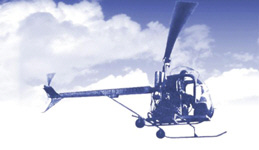
The Aeros is a Single Seat homebuilt helicopter. The plans manual offers pages of highly detailed construction prints, photos and assembly instructions to guide the builder.
This single-seat helicopter can be built in a well-equipped home shop. It features a bolt-together main frame and a standard helicopter control system: full collective with a twist-grip throttle, full cyclic and foot-operated tailrotor pedals. For low-cost and reliability, the drive train utiliizes a converted VW car engine and a primary belt drive that leads to a geared transmission with VW gears. The belt-driven tailrotor is high-mounted to minimize the rolling moment caused by tailrotor thrust. A number of weight-saving features have gone into the design Aeros, including a simple, but attractive monocoque tailboom. The Aeros is licensed as an Experimental Aircraft.
The Guidebook covers, with clear, illustrated explanations, how helicopters work, the various considerations that go into their design, main and tailrotor aerodynamics, control-system operation, and a glossary of terms. Then, fully illustrated with photos and detailed specifications, is a presentation of what is currently available to the helicopter hobbyist in the form of kits and plans. A comprehensive list includes sources of engines, metals, AN hardware, cables, controls, rotorblades, instruments, and the regulations you need to know.
The Aeros is capable of vertical take-offs and landings; hovering; forward, backward and sideward flight. In the event of engine failure, the Aeros can autorotate to a safe landing.
Length: 18 ft.
Height: 7 ft.
Width: 5 ft.
Main rotor dia: 22 ft.
Main rotor chord: 8 in.
Main rotor rpm: 450
Disc loading: 2.5 lb/sq ft
Tail rotor dia.: 40 in.
Tail rotor chord: 3.5 in.
Tail rotor rpm: 3200
Empty weight: 544 lbs.
Useful load: 356 lbs.
Speed (max): 85 mph
Range (max): 65 miles
Engine: Volkswagen
Horsepower: 95+
Power loading: 9 lbs/hp
Fuel capacity: 12 gal.
Fuel consumption: 4 gph
Altitude (max): 12000 ft
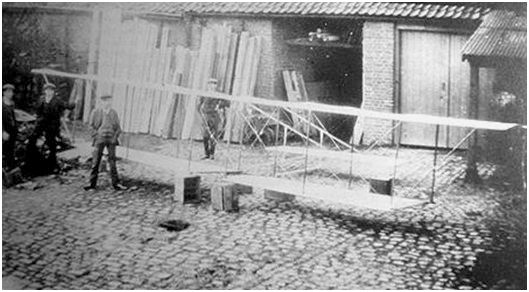
Sydney Camm, one of Britains most distinguished aircraft designers and father of the Hawker Hurricane, was born in 1893. From his schooldays he had shown a keen interest in aviation, founding the Windsor Model Aeroplane Club and constructing many successful model aircraft. Camm and his friends built a full sized Chanute-type glider 1912-1913 with plans to put an engine on it. It is seen with wing extensions that were added after the first experiments. It was used for almost a year, before being wrecked by a hurricane.
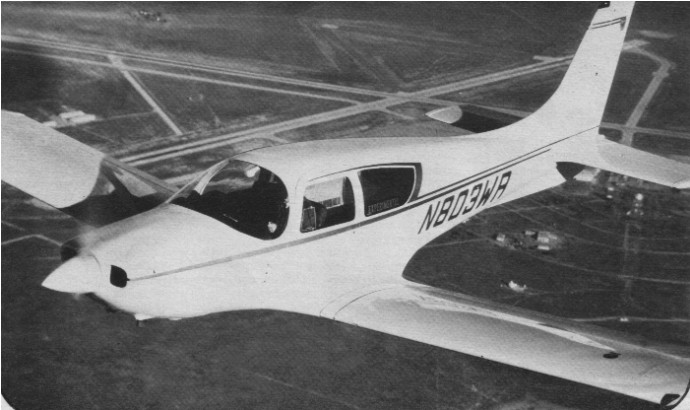
The Windecker Eagle single engine, low wing, four place airplane was built of fiberglass reinforced epoxy and introduced about 1967. The Eagle was fabricated of a resin called “Fibaloy” developed by Dr Leo Windecker, Midland, Texas. It was supposed to make the aeroplane extremely strong, light, easy to manufacture and, because of its rivetless, seamless loveliness, unsurpassedly fast. First flown in 1969, the prototype Eagle (aka X-7) N801WR was lost during spin tests; it wasn’t fast enough and it cost as much as its aluminum competitors.
The Windecler Eagle was certified in 1970 as the first production plastic composite aircraft. Because the FAA was unfamiliar with plastic aircraft t required the Eagle to meet 20 percent higher strength factors than comparable aircraft.
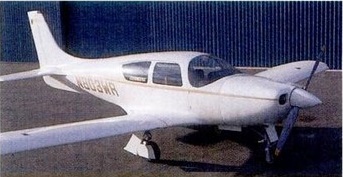
It was not a lack of prospective buyers that sank the Windecker; it was under-capitalization. The cost of getting the Windecker’s foam and fiberglass construction past the FAA is rumored to have been about $20 million; and, although the project started out with generous financing from a large backer, the financing simply stopped, probably because once a certain amount of money has gone down the drain, even an optimistic backer will take flight before sending down even more. Plagued by persistent financial difficulties, the manufacturer, Windecker Industries, was 15 months behind schedule when the first production Eagle emerged from the factory at Midland, Texas. Five airplanes later, the financial ogres halted the program. Production models were Eagle I (aka YE-7) priced at $36,000. Eight were built N801WR-804WR, and N4195G-4198G. NASM has Eagle N4197G s/n 6 at Silver Hill.
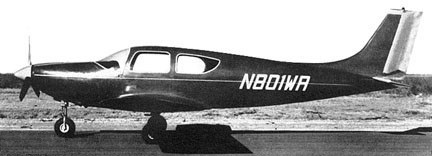
During the Have Blue era the all composite Windeck Eagle light aircraft was modified and tested by Lockheed for USAF for stealth potential as the YE-5A. A militarised Eagle I c/n 008 (delivered in 1973) as 73-01653, powered by a Continental IO-540G, but the problem of shielding the remaining metal parts (engine, hydraulics, undercarriage) remained, although the YE-5A did contain internal radar absorbent material (RAM) for this purpose.
Jerry Diet¬rick, a Florence, Kentucky mechanical en¬gineer, formed the Composite Aircraft Corporation to acquire the molds, tooling equipment and other assets in 1977 so he could form his own corporation to reopen the factory. Dietrick’s own Eagle, one of the six production aircraft made, un¬derwent detail modifications that would be in¬cluded in future models if the factory reopened.
Composite Aircraft Corp, of Florence, Ken¬tucky, had given details of its plans to produce three derivatives of the all plastics Windecker Eagle, the design and production rights for which were acquired after Windecker Indus¬tries Inc went bankrupt. The four seat high performance Eagle, of glassfibre and epoxy construction, had been certificated by Win¬decker and six examples were built; two of these owned by Jerry Dietrick, president of CAC. The planned developments are Eagle 1, with the same 285 hp Continental IO 520 C engine as the original model but an improved one piece tapered wing with winglets and a single spar in place of the three piece rectangular five spar wing; Eagle 2, combining this new wing with a 317 shp Allison 250 B17C turboprop and Eagle 3, with a new fuselage incorporating a six seat pressurised cabin and turboprop engine. One of the original Eagles was being fitted with an Allison turboprop to help development of the Eagle 2.
The remains of the first two airframes (N801WR and N802WR) are in outdoor storage at KRCK Rockdale HH Coffield Regional Airport, under the stewardship of the local EAA Chapter in 2022. They’re hoping to get these preserved at a museum in Oshkosh. Tail number remains visible on N801WR.
Eagle / Eagle I (A7SW)
Engine: Continental IO-520B, 285hp
Wingspan: 32’0″
Length: 28’5″
Max speed: 220 mph
Cruise speed: 212 mph
Stall: 63 mph
Range: 1100 mi
Ceiling: 18,000′
Seats: 4
Windecker Research Inc.
Windecker Industries
USA
Held license from Dow Chemicals for a reinforced plastic aircraft developed by Dr Leo Windecker, Midland, Texas. Flight tested 1967. First production Windecker AC-7 Eagle I, mainly Fibraloy reinforced plastic, flown 1969. Also produced single example of YE-5 for USAF.
In 1909 John H Wilson, of Middlesex PA., USA, built an open cockpit biplane with two chain-driven pusher props. It appears to be a Wright copy in essence, except for wings with one lateral rib, around which the surfaces are bowed in an airfoil shape.
The 1950 Sky Mouse N6840 midwing midget racer was built by James Wilson powered by an 85hp Continental C-85.
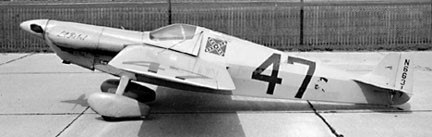
The 1948 Li’l Rebel N66317 midget racer was built by James Wilson from salvage of a Pack C racer. Powered by an 85hp Continental C-85, the single seater was piloted by M L LeFevers and Jimmy Wilson.
The 1959 Baby Cyclone N121W was a single place cabin midwing midget racer built by James Wilson. It was not raced until 1965 at Reno where it qualified ninth at 162 mph.
Los Angeles CA.
USA
Aircraft builder circa 1948-59

