Xiamen Ad Light Aircraft Co produced the AD-100 single/two-seat lightplane, a pusher-engined type of composites construction and with rear-mounted wings and canards.
Author: Terry
Xiamen Ad Light Aircraft Co
China
Produces the AD-100 single/two-seat lightplane and Nanjing University of Aeronautics and Astronautics FT-300 three-seat derivative, both pusher-engined types of composites construction and with rear-mounted wings and canards.
Xenon Gyroplanes Xenon / ABS Aerolight Xenon / Future Flight Xenon / Celier Xenon
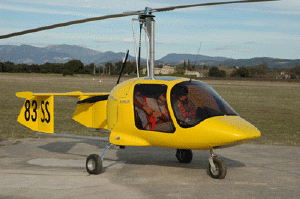
Xenon was designed by French aircraft designer Raphael Celier and was manufactured in Poland to the French Ultralight category standards.
Celier Aviation established its reputation with the two-seat side-by-side configuration Celier Xenon 2 series of autogyros. By 2011 over 100 of these were flying.
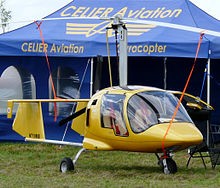
This high performance ultralight autogyro was available as a kit or ready to fly. Registered as an LSA.
Delivered fully factory built starting at $61,000 in 2009.
The composite structure is the airframe, providing lightness and incorporating a full roll cage to protect the occupants. The cabin is 10″ wider than a Cessna 172 and the two pilots are separated by a 10″ console and arm rest. Behind the seats is a very large luggage compartment. The Aircopter rotor blades are aluminum yet use titanium for strength and tip weighting for higher inertia. The DUC R propeller features a spoon blade with a wider tip and built in feathering. It is carbon forged under high pressure and a carbon fiber spinner is fitted.
The box tail section is directly in the propeller slipstream and is on a long lever arm for effectiveness with or without engine power. The 28″ high cabin is soundproofed, with interior carpeting and heated leather bucket seats, and the Xenon meets European noise standards.
The Xenon is available with a choice of 3 different engines. The standard model comes with a Rotax 912S Engine that delivers 100 horsepower. The 914 Model features a Rotax turbo that delivers 115 horsepower for up to 5 minutes after which the engine delivers a continuous 100 horsepower. The high altitude or extra climb ability model is the 912 RST version which has a Rotax 912 sporting a custom designed Mitsubishi turbo delivering 122 horsepower for take-off followed by a continuous 110 horsepower with full time turbo boost.
The doors are removable for flight, leaving a full wrap around optical windshield with overhead windows and foot well windows, allowing near unobstructed viewing. The instrument panel is shock mounted to be vibration free and includes full instrumentation for flight performance and engine monitoring. Flight instruments include: altimeter, airspeed indicator and vertical speed indicator. Rotor tach and fuel are separate gauges while graphic digital engine monitor uses colored LEDs to keep track of engine tach, CHT and EGT gauges, volt/amp meter, oil pressure and temperature, fuel flow, turbine temperature and manifold pressure. There is a 12 volt power plug for the portable GPS or MP3 player. Options include intercoms, VHF radio and transponder with altitude encoder.
The console arm rest puts the throttle and 280 rpm pre-rotator under one hand. Circuit breakers control the panel and landing lights and overhead heat vents are fitted.
Options vary depending on the model but your Xenon is available with propeller spinner, special metallic paint, cabin and blade covers, larger rotors, removable joystick, adjustable pedals, heated leather seats or a ballistic parachute.
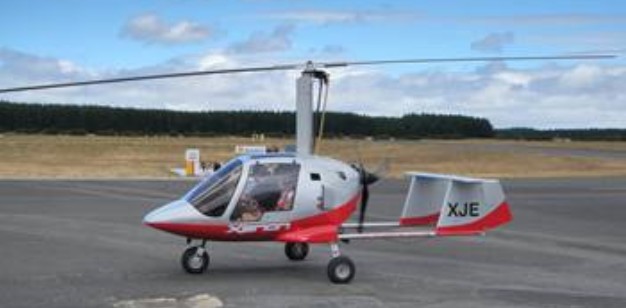
Engine: Rotax 912S, 100 hp
Propeller: 3 Blade DUC Windspoon 68.5 in
Max TO weight: 1,155 lbs.
Empty Weight: 583 lbs
Payload: 462 lbs
Rotor blades: Type 8H12 Aircopter Extruded Aluminum
Rotor Diameter: 27.55 ft
Dics Area: 596.1 sq. ft
Total Width: 86.6 in
Total Length: 192.9 in
Total Height: 110.23 in
Cabin Width: 49.2 in
Pre-rotator: Mechanical 280 RRPM
Wheel Diameter: 400×4
Vne: 108 kt / 124 mph / 200 kph
Minimum Speed: 19 mph
Cruise 75%: 75 mph
Max speed: 105 mph
Climb Rate: 600-1200 fpm
Glide Ratio: 3:1
Service Ceiling: 15,000 ft
Endurance: 4 hr + res
Take off Dist: 100-300 ft
Landing Dist: 15 ft
Fuel Capacity: 22 USG
Fuel Burn @ 65% pwr: 4.8 USGPH
Endurance: 4 hrs + res
Engine: Rotax 914, 115 hp
Empty Weight: 616 lbs
Propeller: 3 Blade DUC Windspoon 68.5 in
Max TO weight: 1,155 lbs.
Rotor blades: Type 8H12 Aircopter Extruded Aluminum
Payload: 484 lbs
Rotor Diameter: 27.55 ft
Dics Area: 596.1 sq. ft
Total Width: 86.6 in
Total Length: 192.9 in
Total Height: 110.23 in
Cabin Width: 49.2 in
Pre-rotator: Mechanical 280
Wheel Diameter: 400×4
Vne: 108 kt / 124 mph / 200 kph
Minimum Speed: 19 mph
Cruise 75%: 87 mph
Max speed: 115 mph
Climb Rate: 600-1200 fpm
Glide Ratio: 3:1
Service Ceiling: 15,000 ft
Endurance: 4 hr + res
Take off Dist: 100-300 ft
Landing Dist: 15 ft
Fuel Capacity: 22 USG
Fuel Burn @ 65% pwr: 4.8 USGPH
Endurance: 4 hrs + res
Engine: Rotax 912 RST, 122 hp
Empty Weight: 605 lbs
Propeller: 3 Blade DUC Windspoon 68.5 in
Max TO weight: 1,155 lbs.
Rotor blades: Type 8H12 Aircopter Extruded Aluminum
Payload: 550 lbs
Rotor Diameter: 27.55 ft
Dics Area: 596.1 sq. ft
Total Width: 86.6 in
Total Length: 192.9 in
Total Height: 110.23 in
Cabin Width: 49.2 in
Pre-rotator: Mechanical 280 RRPM
Wheel Diameter: 400×4
Vne: 108 kt / 124 mph / 200 kph
Minimum Speed: 19 mph
Cruise 75%: 99 mph
Max speed: 121 mph
Climb Rate: 600-1200 fpm
Glide Ratio: 3:1
Service Ceiling: 15,000 ft
Endurance: 4 hr + res
Take off Dist: 100-300 ft
Landing Dist: 15 ft
Fuel Capacity: 22 USG
Fuel Burn @ 65% pwr: 4.8 USGPH
Endurance: 4 hrs + res
Xenon Gyrocopter
Engine: Rotax 912RST (turbo)
Height: 2.8m
Fuselage width: 2.2m
Length: L4.9m
Empty weight: 294kg
Max take off weight: 544kgs
Payload: 240kgs
Fuel capacity: 87 litres
VNE: 113 knots
Cruise speed: 86 knots
Min speed: 16 knots
Rate of climb: 800-1200 fpm
Take off Distance: 35-100 meters
Landing distance: 0-5 metres
Range: 4hours plus
Seats: 2
Future Flight LLC / Xenon Gyroplanes
2009: Xenon Gyroplanes
Future Flight LLC
411 Walnut St. No. 3986, Green Cove Springs, FL 32043, USA
Xenoah C72C-C
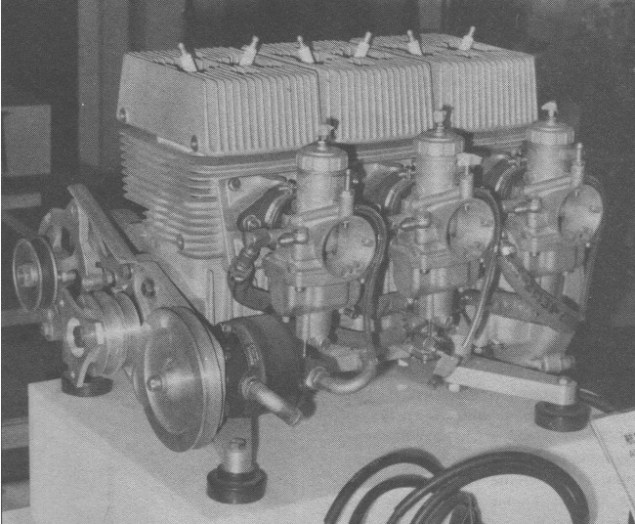
Affected by an Arabian oil embargo, like many other countries Japan has felt the squeeze in private flying. One result was Xenoah’s takeover by Komatsu, which decided to go ahead with the development program of the G72C-C engine, since there was a growing homebuilt market developing in Japan itself.
The Xenoah C72C-C is a two-cycle, three-cylinder, in-line, air-cooled powerplant with three carburetors; it burns 100/130 octane av gas. Of 44.34 CID and a compression ratio of 71, the engine measures 22.2 inches long, 17.4 inches wide and 15.35 inches high. It comes with dual ignition, oil injection, starter, and engine mount.
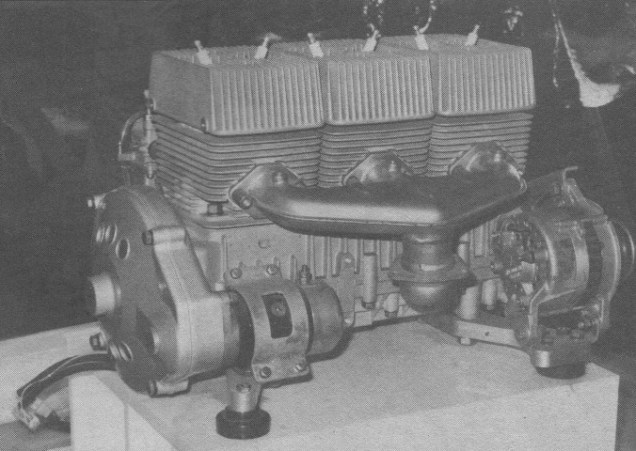
The G72C-C weighs 157 pounds and is rated at maximum continuous 54 hp at 6080 rpm SL. The cruise rpm of 6080 requires a reduction unit for the propeller.
The G72C-C aircraft engine has been certified by both the FAA and Japan’s JCAB for use in homebuilts.
Xenoah 150 Power Hawk

Xenoah 150 Japanese engine develops 150 lb thrust, is available to power ultralights, its 22 bp derated to 18 hp.
Xenoah
The Xenoah firm has been around since 1910 and early on manufactured various engines for lightplanes. Their airframe department built a plane for the Aeronautical Research Institute of Tokyo University in 1937, and with it they established a world record for nonstop closed-course max distance flight. After World War II Xenoah produced many piston engines for trainers and engine parts for Japan’s Self Defense Forces. They have been involved in overhauling piston engines for civil and military planes.
The Xenoah Company is now called Komatsu Xenoah, since the firm was taken over by Komatsu Co., Ltd., Japan’s leading manufacturer of bulldozers and other earthmoving equipment.
XCOR Aerospace EZ-Rocket

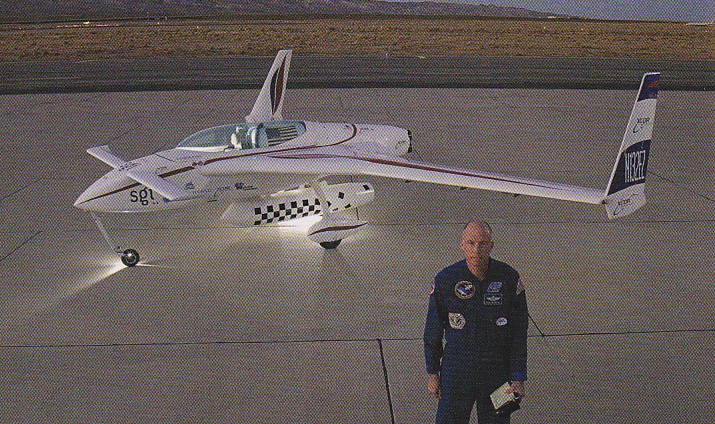
A rocket powered version of the Long-Ez flew twice at Mojave in 2002. Its twin rocket motors of 400 lb thrust each burned for less than three minutes after which it took seven minutes to glide to landing. It is fuelled by isopropyl alcohol and liquid oxygen. The engines can be shut-down and restarted in flight.
XC Aviation XCitor
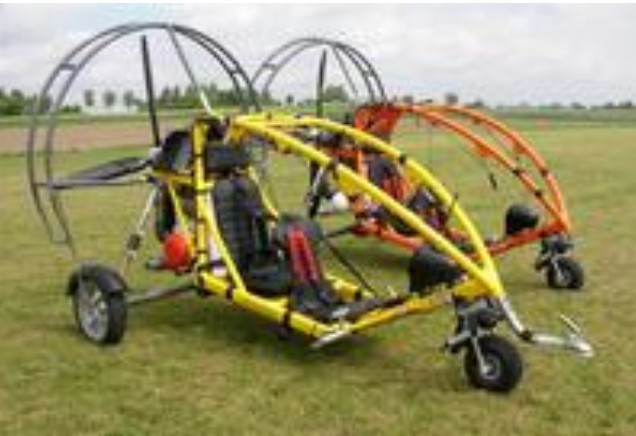
2009 Price: 28000 EURO
UL
Cruise: 61 kt / 70 mph / 113 kmh
MTOW Weight: 368 kg / 811 lbs
Climb Ratio: 3 ft/min /
Take-off distance (50ft obstacle): 80 ft / 24 m
Landing distance (50ft obstacle): 110 ft / 35 m
XC Aviation KR 010 Elf
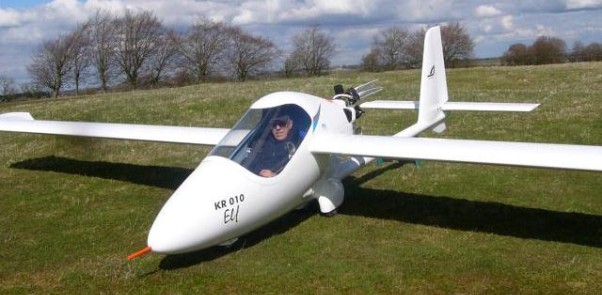
Jerzy Krawczyk, in addition to Ekolot’s Junior and Topaz, has several light aircraft, crop sprayer, and sailplane designs to his credit. In creating the self launching Elf sailplane, he employed composite sandwich and carbon structures to achieve the exceptional strength and durability required to pass UK BCAR Section ‘S’ airworthiness certification.
The Elf prototype used the JPX 330 engine which, unfortunately, was withdrawn from production in 2006 after over 20 years in the market. Fortunately, Compact Radial Engines in Canada has produced a very similar unit. This is 20% more powerful than the JPX and also employs a clutch which eliminates folding prop ‘chatter’ on start-up and allows the prop to fold whilst the engine is on idle. This engine has displayed instant re-start capability.
The Elf employs full span flapperons, and airbrakes, and has excellent rudder/stick co-ordination. The NN17-18 aerofoil possesses mild stall characteristics and overall, the handling conveys a strong sense of stability and security to the pilot.
Production aircraft will have the more powerful Compact Radial engine and a 126cms prop with a projected climb rate of 500 ft/min.
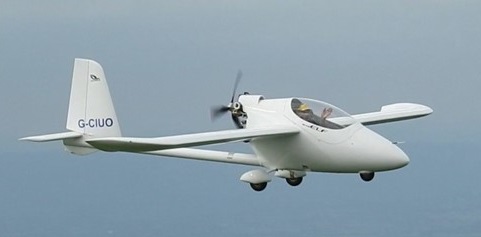
Engine off, the Elf with it’s 120 ft/min sink rate is capable of slowing down to exploit the slightest lift and core the smallest thermal. This is where the fun and skill challenge begins and where, if the pilot falls out of lift into sink, he can be confident of a quick engine restart and climb back to the area of lift.
Prototype
Engine: JPX 330, 24 hp
Prop dia: 116cms , folding
Weight: 145 kg (with BRS)
Gross Weight: 260 kg
Area: 10.8 sq/m
Span: 11.2 m
Length: 5.7m
Aerofoil: NN18-17
Fuel Capacity: 15 litres (3 hours + reserve)
Proof Load: +6 / -3
Max Pilot Height: 1.9m (6’3”)
Max Pilot Weight: 100kg (220lbs)
Cruise: 50 mph at 5,100rpm
Max Climb: 400ft/min at 30mph
Stall: 27mph
Best L/D: 26.4:1, 150ft/min at 45mph
Min Sink: 120ft/min at 39 mph
Airbrake: 300ft/min at 45mph (13:1)
Fuel burn: 4.5 litres/hour

