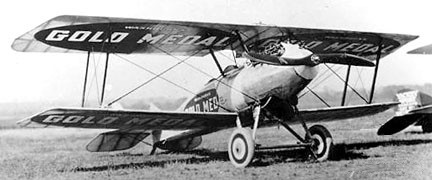
The 1924 Yackey A was a converted Thomas-Morse S-4C for exhibition pilot Charles “Speed” Holman.
Yackey A
Engine: Curtiss OX-5, 90hp
Seats: 2
The 1924 Yackey A was a converted Thomas-Morse S-4C for exhibition pilot Charles “Speed” Holman.
Yackey A
Engine: Curtiss OX-5, 90hp
Seats: 2
1924
(Wilfred Alonzo “Toney”) Yackey Aircraft Co
Roosevelt Rd at Desplaines River
Forest Park IL.
USA
1926
Yackey’s Checkerboard Flying Field
Maywood IL.
USA
Aircraft builder 1924-27.

The Y2Fly Seahawk is an American amphibious flying boat ultralight trike that was designed and produced by Y2Fly of Point Harbor, North Carolina.
The Seahawk features a cable-braced hang glider-style high wing, weight-shift controls, a two-seats-in-tandem, open cockpit, a trimaran hull and a single engine in pusher configuration.
The aircraft hull is made from fiberglass, with stainless steel fittings. The wing and its supporting structure are made from bolted-together aluminum tubing, with the single surface wing covered in Dacron sailcloth and supported by a single tube-type kingpost. The Seahawk uses an “A” frame control bar for weight-shift control. The hull was carefully designed to account for the inherent lack of pitch control that trikes have while on the water. It was designed to reduce porpoising and water spray being thrown into the crew seats and propeller. The hull also provides lift in flight and allows flight at reduced power and fuel consumption. The retractable landing gear is of tricycle configuration and is mechanically retracted by a lever located next to the pilot. The nosewheel retracts in front of the bow of the hull, while the main landing gear retracts beside the tri-hull. The standard powerplant supplied was the twin cylinder, two-stroke, liquid-cooled 64 hp (48 kW) Rotax 582 aircraft engine.
A clutch system is standard on the 582 Rotax using an E box. This allows pilots to safely taxi in the water, without having the prop pushing the craft along. Another feature is a full time water rudder located at the rear and center of the craft. The unit is equipped with all three wheels retractable, actuated by one manual lever.
The “trimaran float design” uses spray rails, and splash pans. “Dive planes” help bring the nose of the craft up in case of slight nose down landing, or taxing in rough water. The use of fiberglass and stainless steel components allow the Sea Hawk to be used in salt water.
The Sea Hawk uses a 16.8 meter, certified Wizard wing to give the best performance for take-off and cruise. With two on board the craft stalls at 30 mph and cruises along at 55 mph.
The empty weight of this amphibious trike without wing is 341-363 lbs. depending on what engine is chosen. The aircraft was supplied as a completed aircraft but production has ended.

The XtremeAir Sbach 342 is a German high performance two-seat aerobatic and touring monoplane designed by Philipp Steinbach with Albert Mylius and built by XtremeAir GmbH of Hecklingen.
The Sbach 342 (a marketing name for the XA42) is a composite structure low-wing monoplane with a fixed conventional landing gear with a tailwheel. It is powered by a 315 hp (235 kW) Lycoming AEIO-580-B1A piston engine driving a three-bladed propeller. It is the tandem version of the single-seater XA 41 (XtremeAir Sbach 300) which was designed by the same team in Speyer in 2004. The XA42 received a type certificate from the European Aviation Safety Agency in March 2011. On 5 November 2012 it received its type certification through the FAA.
At least 37 have been produced.

Engine: 1 × Lycoming AEIO-580-B1A, 245 kW (315 hp)
Length: 6.67 m (21 ft 11 in)
Wingspan: 7.5 m (24 ft 7 in)
Height: 2.54 m (8 ft 4 in)
Overall height, ground attitude: 2.3 m / 7.5 ft
Wing area: 11.25 sq.m (121 sq.ft)
Aspect ratio: 5
Stabilizer / Elevator span: 3.20 m / 10.5 ft
Stabilizer / Elevator area: 2.98 sq.m / 32.1 sq.ft
Empty weight: 610 kg / 1344 lb
Max. Take off weight Aerobatic: 850 kg / 1875 lbs
Max. Take off weight Utility: 999 kg / 2200 lbs
Wing loading Aerobatic: 75.5 kg/sq.m / 15.4 lb/sq.ft
Wing loading Utility: 84.4 kg/sq.m / 17.3 lb/sq.ft
Maximum speed @ 3000 ft: 416 km/h (256 mph)
Cruise 75%: 185 kts
Stall speed: 53 kts
Rate of climb: 3200 ft/min
Service ceiling: 4572 m (15000 ft)
Range @ 75% 205kts TAS @ 10,000ft: 800 nm
VA: 174 kts / 322 km/h
VC: 185 kts / 345 km/h
VNE: 225 kts / 416 km/h
Load Factor Aerobatic flight: +/-10G
Load Factor Utility: +4,4G / -2G
Roll rate: 450°/sec
Take off over 50 ft obstacle: 260 m / 853 ft
Landing over 50 ft obstacle: 400 m / 1312 ft
Seats: 2
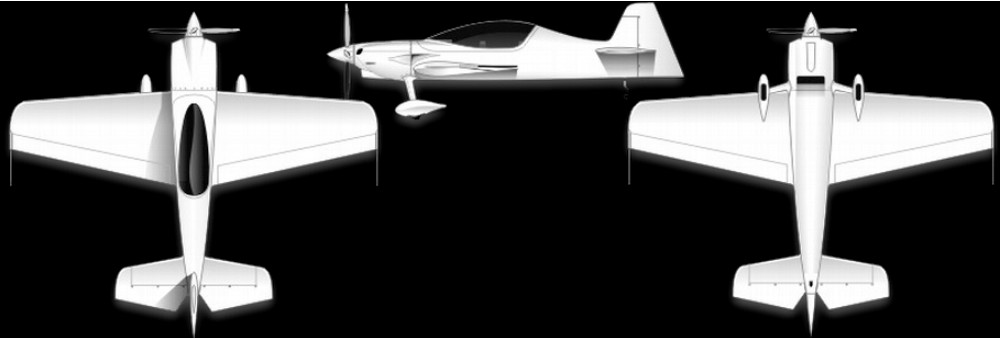

The XtremeAir Sbach 300 is a German aerobatic aircraft, designed by Philippe Steinbach and produced by XtremeAir, of Cochstedt. The aircraft was supplied in 2012 as a complete ready-to-fly-aircraft. The aircraft bears the company designation XA41, but is marketed under the name Sbach 300.
The Sbach 300 is an all-composite design, predominately constructed of carbon fibre. It features a cantilever low-wing, a single-seat enclosed cockpit under a bubble canopy, fixed conventional landing gear and a single engine in tractor configuration.
The aircraft’s wing mounts full-span ailerons with spades to lighten control forces, which give a roll rate of 450° per second. The standard engine employed is the 324 hp (242 kW) Lycoming IO-580 four-stroke powerplant.

The Sbach 300 was flown to a German national aerobatic championship in the unlimited class.
The 300 was later developed into a two-seat version, the XtremeAir Sbach 342, which was introduced in 2007.
XtremeAir XA-41 (Sbach 300)
Engine: 1 × Lycoming IO-580 B1A, 242 kW (324 hp)
Propeller: 3-bladed constant speed
Length: 6.30 m (20 ft 8 in)
Wingspan: 7.50 m (24 ft 7 in)
Height: 2.3 m (7 ft 7 in) in three-point attitude
Wing area: 11.25 sq.m (121.1 sq ft)
Aspect ratio: 5:1
Stabilizer / Elevator span: 3.20 m / 10.5 ft
Stabilizer / Elevator area: 2.98 sq.m / 32.1 sq.ft
Empty weight: 570 kg (1,257 lb)
Gross weight: 850 kg (1,874 lb) for aerobatics
Gross weight: 999 kg (2,200 lb) for non-aerobatic flight
Fuel capacity: 245 litres (54 imp gal; 65 US gal)
Maximum speed: 389 km/h; 242 mph (210 kt) @ 3000 ft
Cruising speed 75%: 345 km/h (214 mph; 186 kn)
Stall speed: 94 km/h (58 mph; 51 kt)
Never exceed speed: 417 km/h; 259 mph (225 kn)
VA: 174 kts / 322 km/h
VC: 185 kts / 345 km/h
Range 75% pwr: 1,482 km; 921 mi (800 nmi)
Load Factors Aerobatic: +/-10G
Load Factors Utility: +4,4G / -2G
Rate of climb: 3500 ft/min
Roll rate: 450°/second
Wing loading Aerobatic: 57,8 kg/sq.m / 11.8 lb/sq.ft
Wing loading Utility: 66,7 kg/sq.m / 13.7 lb/sq.ft
Take off over 50 ft obstacle: 230 m / 750 ft
Landing over 50 ft obstacle: 380 m / 1250 ft
Crew: one

Top L
Paraglider circa 1998.
Wing area: 28.1 sq.m
Certification: Afnor
Pilot weight: 70-100 kg
No. of cells: 68
Wing span: 13.2 m
Aspect ratio: 6.2
Min sink: 0.9 m/s
Max speed: 57 kph
Price (1998) 4940 SF
Top XL
Paraglider circa 1998.
Wing area: 32 sq.m
Certification: Afnor
Pilot weight: 85-125 kg
No. of cells: 68
Wing span: 14.1 m
Aspect ratio: 6.2
Min sink: 0.9 m/s
Max speed: 57 kph
Price (1998) 4990 SF

Inter 1.2 M
Paraglider circa 1998.
Wing area: 24.3 sq.m
Certification: Afnor
Pilot weight: 65-85 kg
No. of cells: 41
Wing span: 11.1 m
Aspect ratio: 4.7
Min sink: 1.1 m/s
Max speed: 46 kph
Price (1998) $ 3000
Inter 1.2 XL
Paraglider circa 1998.
Wing area: 30.5 sq.m
Certification: Afnor
Pilot weight: 100-130 kg
No. of cells: 41
Wing span: 12.7 m
Aspect ratio: 4.7
Min sink: 1.1 m/s
Max speed: 47 kph
Price (1998) $ 3200
Inter 1.2 L
Paraglider circa 1998.
Wing area: 27.6 sq.m
Certification: Afnor
Pilot weight: 80-104 kg
No. of cells: 41
Wing span: 11.9 m
Aspect ratio: 4.7
Min sink: 1.1 m/s
Max speed: 48 kph
Price (1998) $ 3100
Inter 1.2 XXL
Paraglider circa 1998.
Wing area: 34.4 sq.m
Certification: Afnor
Pilot weight: 115-159 kg
No. of cells: 41
Price (1998) $ 3300
Paraglider circa 1998.
Wing area: 42 sq.m
Pilot weight: 138-200 kg
No. of cells: 48
Wing span: 14.2 m
Aspect ratio: 5
Min sink: 1.2 m/s
Max speed: 46 kph
Price (1998) 4990 SF
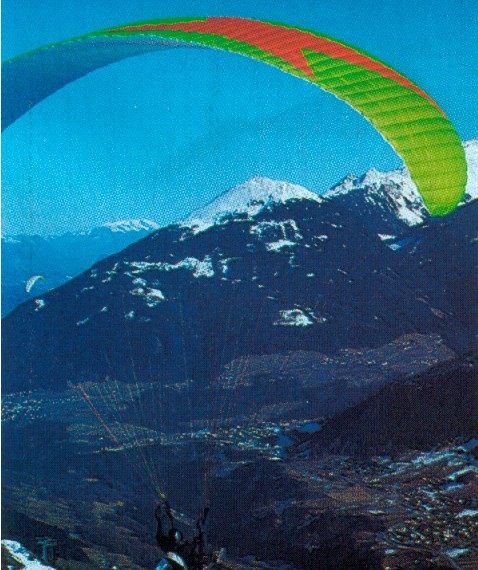
Paraglider circa 2005.
Form I L
Paraglider circa 1998.
Wing area: 27.5 sq.m
Certification: Afnor
Pilot weight: 60-90 kg
No. of cells: 56
Wing span: 12.2 m
Aspect ratio: 5.4
Min sink: 1 m/s
Max speed: 49 kph
Price (1998) 4750 SF
Form I M
Paraglider circa 1998.
Wing area: 25.3 sq.m
Certification: Afnor
Pilot weight: 45-70 kg
No. of cells: 56
Wing span: 11.7 m
Aspect ratio: 5.4
Min sink: 1 m/s
Max speed: 50 kph
Price (1998) 4650 SF
Form I XL
Paraglider circa 1998.
Wing area: 30 sq.m
Certification: Afnor
Pilot weight: 85-115 kg
No. of cells: 56
Wing span: 12.7 m
Aspect ratio: 5.4
Min sink: 1 m/s
Max speed: 49 kph
Price (1998) 4850 SF
Form 3
1998: Airbornerstr 6, CH-9302 Kronbuhl, Switzerland
Paraglider builder

