Cycle: 2 stroke
No cylinders: 2 opposed
Displacement: 340 cc
Cooling: Air
Weight: 8.4 kg
Max pwr: 30 hp at 7000 rpm
Price 1998: 1800 FS
Author: Terry
Flyman Ghostfighter
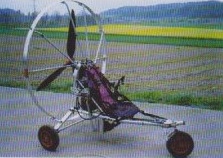
The Ghostfighter trike unit is intended for either paraplanes or flexwings. The Ghostfighter E has an electric motor and batteries. It can use a two-stroke 28 hp Zanzoterra or four-stroke 25 hp OVH engine. It can lift two light passengers.
Ghostfighter E
Empty weight: 120 kg
Engine: Electrique, 25 hp
Seats: 1
Price (1998): 12 800 FS
Flyman Company / H. Piller
1998:
Paganaweg 3
CH-3280 Murten
Switzerland
Trike builder
Flylight Airsports PeaBee
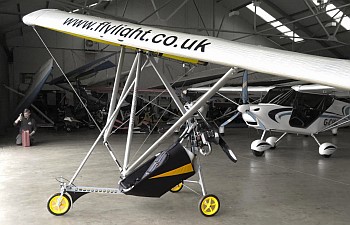
The idea of designer Ben Ashman was to build a high-performance sub-70kg microlight with comfort and build quality while retaining the performance.
The PeaBee is a roomy, well-padded seat with adjustable pedals, yet can carry carry camping gear, a change of clothes and enough fuel to actually go places. The trike unit can be folded in minutes to fit inside a car, and the machine is light enough to allow the pilot to switch the engine off and soar in good conditions. The trike unit was extensively tested with the Foxcub’s 13TL wing and then married to the lighter 13T wing – itself already test flown – when the production versions arrived at Flylight’s Sywell factory.
Using the 25hp Corsair M25Y engine and Helix prop, the PeaBee weighs in at 61kg empty, allowing enough fuel to be carried for three or four hours flying while remaining within the sub-70kg category.
Flylight PeaBee nanolightFlylight’s new PeaBee ‘nanolight’ trike made its maiden flight in September 2017. The list price was £8,300 + VAT in 2017.
Flylight Airsports Ltd
2017
Flylight Airsports Ltd
Sywell Aerodrome
Northants NN6 0BN
UK
Trike builder
Flylab Tucano Delta 3 VTW
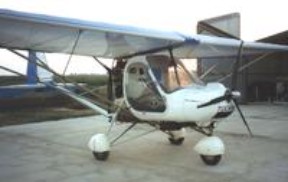
Twin Engine Ultralight, with tractor and pusher engines. The Tucano Delta3 VTW is directly derived from the twin-engined Tucano Delta3 TW, to which the same concepts that have led to the Tucano V have been coupled: cleaner aerodynamics, new cabin, new mudguards.
Tucano Delta3 VTW
Stall: 30 kt / 34 mph / 55 kmh
Cruise: 78 kt / 90 mph / 145 kmh
VNE: 92 kt / 106 mph / 170 kmh
Climb Ratio: 1600 ft/min / 8 m/s
Take-off distance (50ft obstacle): 200 ft / 60 m
Landing distance (50ft obstacle): 300 ft / 90 m
Flylab Tucano
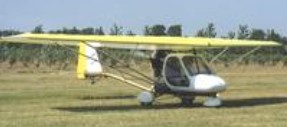
The Tucano is for sure the most sold and flown ultralight aircraft in Italy. Strong and reliable, it is suitable for beginners as much as for expert pilots, being also the most used ultralight in flight schools.
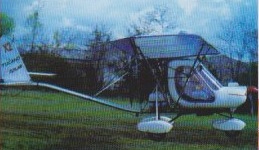
Tucano
Stall: 28 kt / 32 mph / 52 kmh
Cruise: 54 kt / 62 mph / 100 kmh
VNE: 81 kt / 93 mph / 150 kmh
Empty Weight: 220 kg / 485 lbs
MTOW Weight: 450 kg / 992 lbs
Climb Ratio: 800 ft/min / 4,5 m/s
Take-off distance (50ft obstacle): 230 ft / 70 m
Landing distance (50ft obstacle): 230 ft / 70 m
Engine: Rotax, 64 hp
Wing span: 10.17 m
Wing area: 16.97 sq.m
MAUW: 450 kg
Empty weight: 230 kg
Fuel capacity: 76 lt
Max speed: 150 kph
Cruise speed: 100 kph
Minimum speed: 52 kph
Climb rate: 4.5 m/s
Fuel consumption: 13 lt/hr
Certification: Vz
Seats: 2
Price (1998): 24 900 000 L
Flylab srl
1998:
Via Di Vittorio, 19
I-71010 Ischitella (Fg)
Italy
LSA builder
Flyitalia MD3 Rider
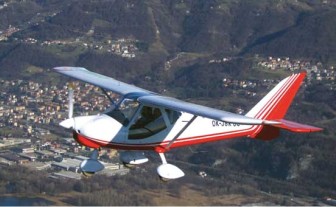
Flyitalia MD-3 has all-metal semi-monocoque airframe, primary glued and riveted from aluminum alloy sheets by blind rivets. This design enables longer life and easy maintenance without great skills.
Rider is the first own design of Flyitalia s.r.l., but not the first one from MD-3 creators.
Fuselage cockpit cage is welded from steel tubes. Its basic structure has firewall, engine mounting hinges and front wheel bracket in the front, doors and main gear hinges on its sides and instrument panel frame and seats brackets in the middle. Rear fuselage is riveted from aluminum alloy sheets with integral fin and tail hinges in the rear. Side canopy doors hinged on the front enable great view and easy access.
Composite engine cowling and rear part of the canopy fairing create natural aerodynamic shape without usual square corners. All metal wings with simple aerodynamically shaped strut and efficient MS(1)-0313 airfoil with-beam pressed ribs and integral fuel tanks 72 or 100 liters. Ailerons and large flaps with 15deg and 42deg deflection are hinged on rear help-beam. Large aerodynamically shaped wingtips increase wing efficiency.
Classic-type all-metal tail has symmetrical NACA 12% profile. Elevator has electrically controlled trim-tab as a standard.
Full dual control with classic joysticks and pedals for both pilots. Flap lever, trim lever and throttle are placed on the central column.
Elevator and ailerons are controlled by rods, rudder is controlled by wires in plastic tubes. Flaps are controlled by electric actuator placed in the cockpit ceiling.
Wings can be (optional) quickly folded to the tail and horizontal tail surfaces can be dismounted for transportation or storage.
Instrument panel with central engine instruments and drivers panel, full cockpit upholstery with adjustable seats.
Tricycle type landing gear, with steerable 13×4″ nose wheel, composite legs of main undercarriage and front wheel leg and fork welded from steel tubes.
14×4″ main wheels have hydraulic disc brakes, controlled by lever on the central column.
Standard version uses pushing throttle and choke, there is prepared twin throttle version and level throttle version with peculiar styling.
From first time of development the chosen interior can be our “trade mark” = sport car like, comfortable, ergonomical, safety.
Air diffuser from automobile industry, standard middle communication panel for radio, GPS map and FLYdat.
Negative swept wing brings greater outside view, to enjoy cross-country flying.
Base price 2008: US$99,995
Engine: Rotax 912 ULS, 100hp
Wing span: 8.50 m
Wing area: 9.50 sq.m
Length: 5.70 m
Height: 2.30 m
Gross weight: 1267.2 lb / 480 kg
Empty weight, std: 654 lb / 277 kg
MTOW: 450 kg
Useful load, std: 612 lb
Payload, full std. fuel (lbs.): 456
Useable fuel: 25 Usgals / 70 lt
Vne: 270 kph
Top speed: 240 kph
Cruise 75% pwr: 210 kph
Max cruise speed: 113 kt
Stall clean: 82 kph
Stall flaps: 62 kph
Best rate of climb, SL: 1200 fpm / 7m/sec
Max range: 1000 km
Takeoff distance: 396 ft
Landing distance: 578 ft
Max load factor: +4/-2G
Flying Planet Syrius
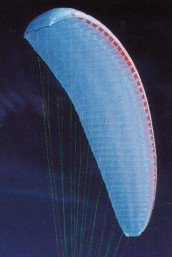
Paraglider circa 1998.
Syrius 23
Wing area: 25.45 sq.m
Certification: Afnor
Pilot weight: 65-80 kg
No. of cells: 45
Wing span: 11.25 m
Aspect ratio: 5
Max speed: 43 kph
Price (1998) 17,000 Fr
Syrius 25
Wing area: 27.8 sq.m
Certification: Afnor
Pilot weight: 75-95 kg
No. of cells: 45
Wing span: 11.8 m
Aspect ratio: 5
Max speed: 43 kph
Price (1998) 17,000 Fr
Syrius 28
Wing area: 30.1 sq.m
Certification: Afnor
Pilot weight: 90-115 kg
No. of cells: 45
Wing span: 12.25 m
Aspect ratio: 5
Max speed: 43 kph
Price (1998) 17,000 Fr

