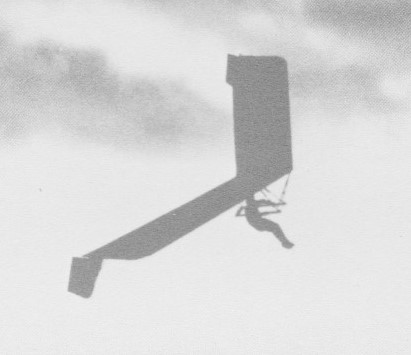
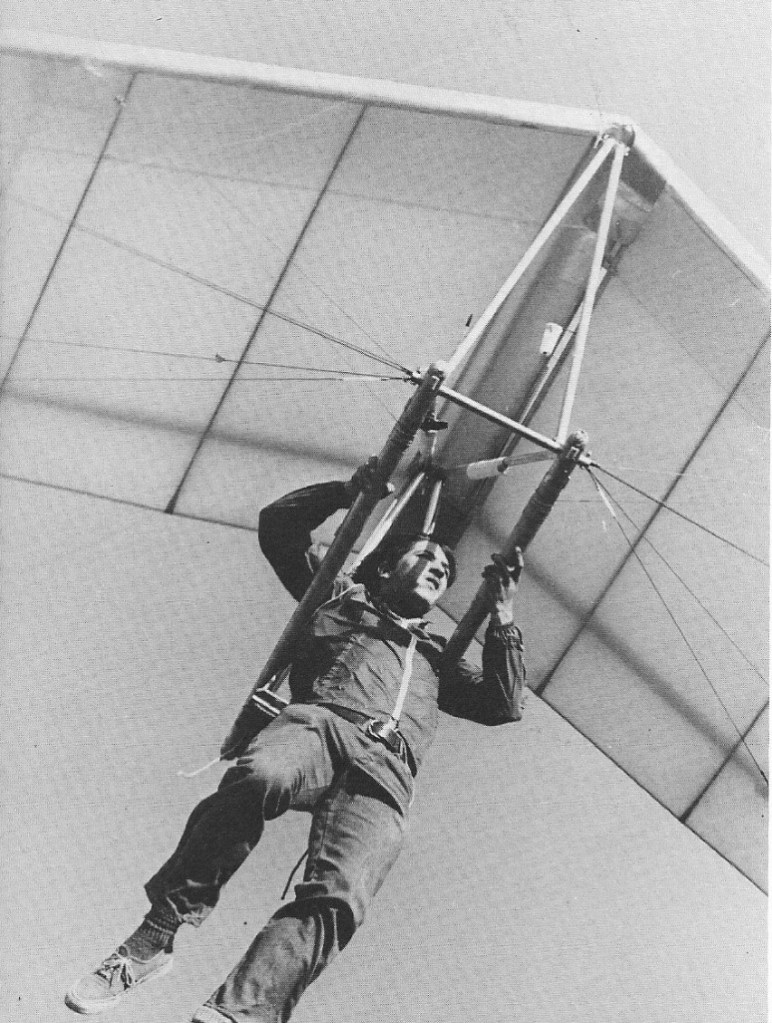
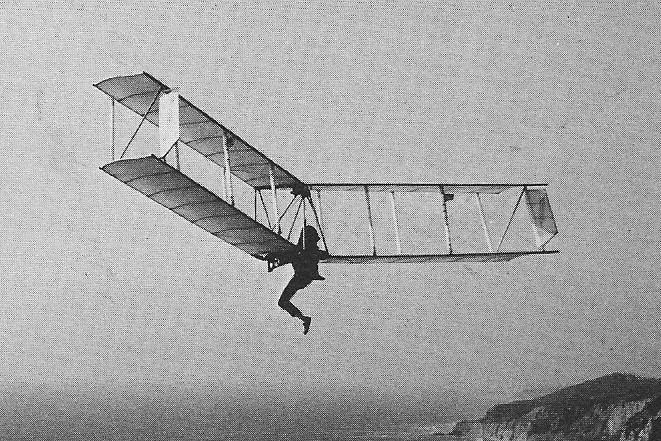
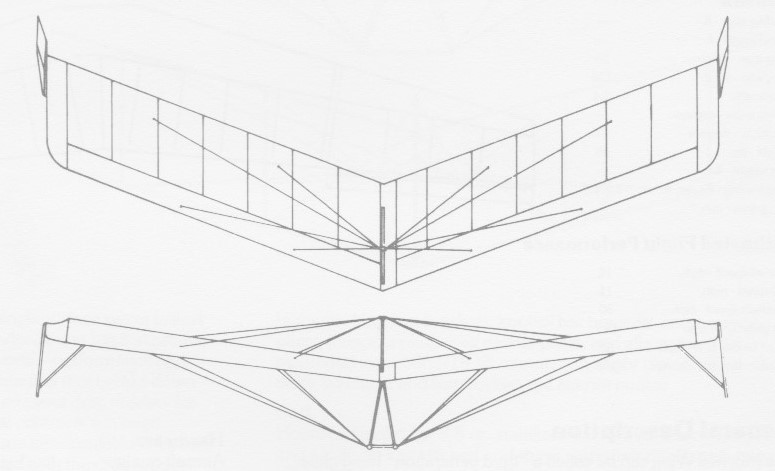
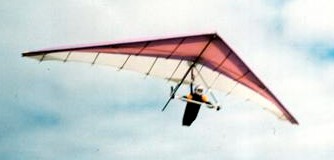
Developed by Taras Kiceniuuk, the Ikarus V swept wing monoplane hang glider utilised independently actuated wing tip rudders allowing continuous 60 degree banked turns and easy, controlled landings.
Tip rudders, individually worked by twist grips, provide lateral control. The pilot rides in a cage and can pull his feet up during flight to reduce drag. The glider disassembles along the centreline for car-top transportation.
The wing has a foam sheet leading edge with doped fabric covering, and is stressed for a maximum of 6.5G.
The airframe is made from 6061-T6 and 2024-T3 aluminium tubng. All exposed parts are bright dip gold anodised or cadium plates. Rigging is stainless steel 3/32in 7 x 7 aircraft quality, all vinyl coated.
A hardware is aircraft quality stainless steel, aluminium, and some 4130 chromoly steel. The wing covering is 1.7oz dacron, shrunk and doped. It was available in white only.
The pilot has a parallel hang tube/swing seat combination.
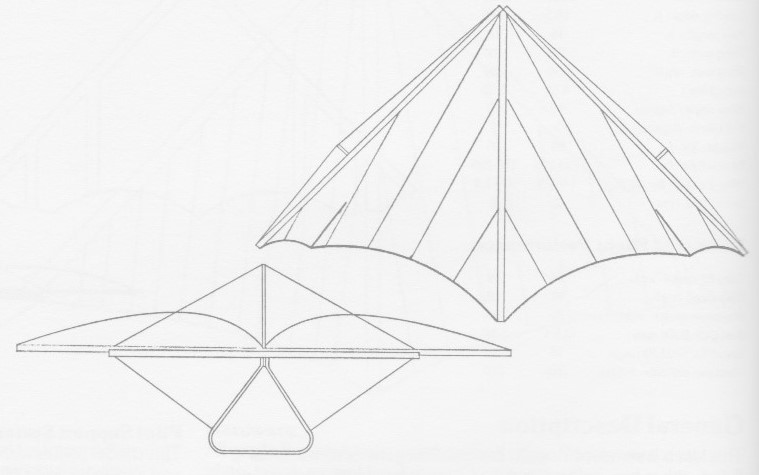
The Sierra II has an adjustable centre of gravity plate, skid late, adjustable wing stiffeners, 5ft control bar and a ‘shur-lok’ quick release spreader bar tha allows for speedy folding of the wing without tools.
The airframe is made from 6061-T6 1.5in x .058 aluminium tubing. All airframe parts are anodised in gold or black, fully sleeved and doweled.
The rigging is stainless steel 3/32in 7×7 aircraft qualiy, all vinyl coated. All harwre is aircraft quality stainless steel and aluminium.
The sal is 3.8oz Howe & Bainbridge stabilised dacron that wasin 11 colours. It has 8in reinforced wing pockets and a non-symetrically cut trailing edge. A prone harness was included.
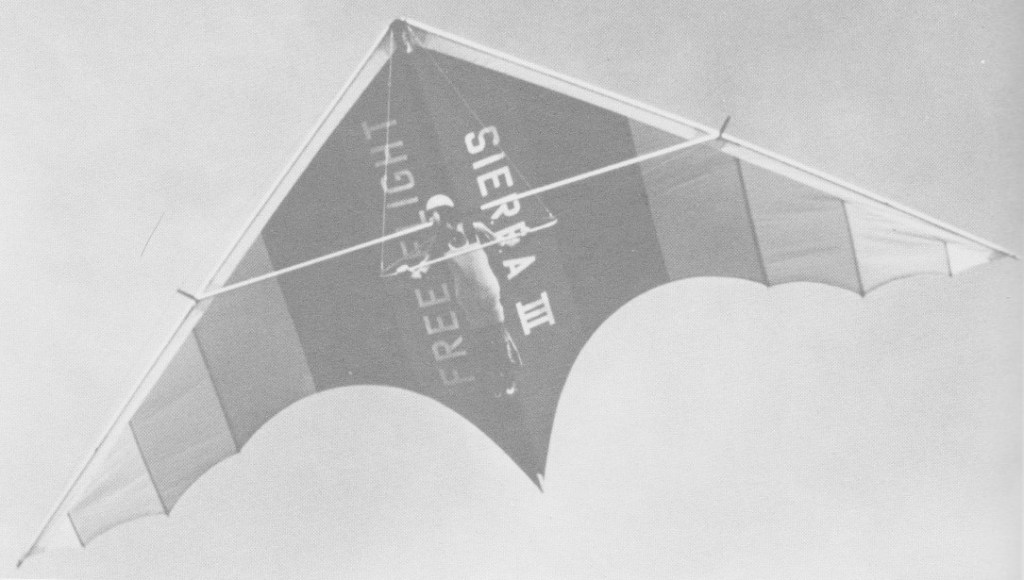
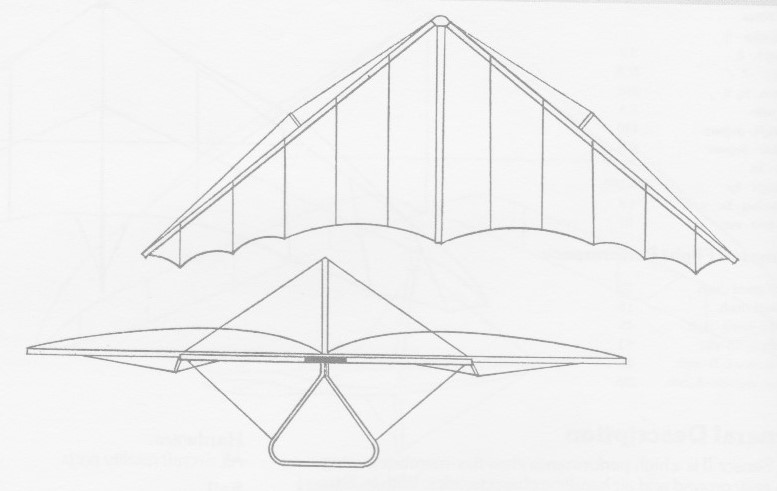
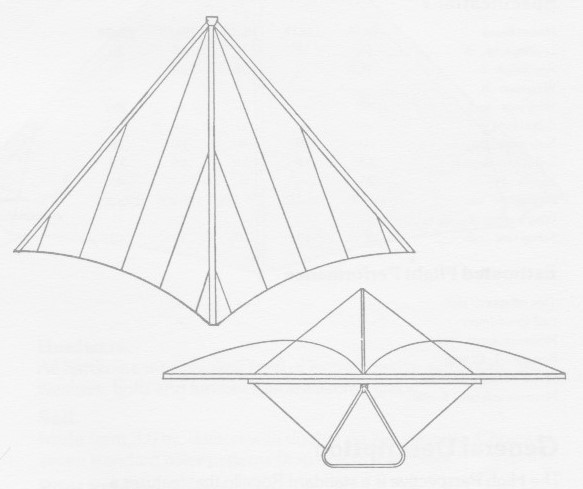
The Sierra III was a high performance glider with a deep scalloped centre section cambered keel. It was for advanced pilots only because of its very fast handling and long glide ratio. This model has an adjustable centre gravity plate, skid plate, 5 ft control bar, and a “shur-lok” quick release spreader bar that allows for speedy folding of the wings without tools.
Sierra III
The Sierra III airframe is made from 6051-T6 1.5in x .058 aluminium tubing. All airframe parts are anodised in gold or black, fully sleeved and doweled. Rigging is stainless steel 3/32 in 7 x 7 aircraft quality, all vinyl coated, and the hardware is all aircraft quality stainless steel and aluminium parts.
The sail is made from 3.8oz Howe and Bainbridge stabilisd dacron in a choice of 11 colours. He sail has tapered leading edge pockets, triple flared wing tips to increase the tip chord, and three tapered tubular fibreglass batten per side. A prone harness was included.
Sierra II 19×17 Leading edge: 19 ft Keel length: 17.5 ft Wing span: 26.9 ft Wing area: 185 sq,ft Aspect ratio: 3.9 Nose angle: 90˚ Sail billow: 3.5˚ Weight: 40 lb Pilot weight: 105-150 lb off speed: 12 mph Stall speed: 14 mph Max speed: 50 mph Best glide ratio (L/D): 6-1 Best L/D speed: 26 mph Min sink: 300 fpm
Sierra II 20×18 Leading edge: 20 ft Keel length: 18.5 ft Wing span: 28.2 ft Wing area: 208 sq,ft Aspect ratio: 3.9 Nose angle: 90˚ Sail billow: 3.5˚ Weight: 45 lb Pilot weight: 130-80 lb off speed: 12 mph Stall speed: 14 mph Max speed: 50 mph Best glide ratio (L/D): 6-1 Best L/D speed: 26 mph Min sink: 300 fpm
Sierra II 21×19 Leading edge: 21 ft Keel length: 19.5 ft Wing span: 29.8 ft Wing area: 230 sq,ft Aspect ratio: 3.9 Nose angle: 90˚ Sail billow: 3.5˚ Weight: 48 lb Pilot weight: 180-240 lb Takeoff speed: 12 mph Stall speed: 14 mph Max speed: 50 mph Best glide ratio (L/D): 6-1 Best L/D speed: 26 mph Min sink: 300 fpm
Sierra III Leading edge: 20 ft Keel length: 12 ft Wing span: 32 ft Wing area: 187 sq,ft Aspect ratio: 5.8 Nose angle: 105˚ Sail billow: 1.5˚ Weight: 45 lb Pilot weight: 110-210 lb Takeoff speed: 15 mph Stall speed: 15 mph Max speed: 45 mph Best glide ratio (L/D): 7-1 Best L/D speed: 28 mph
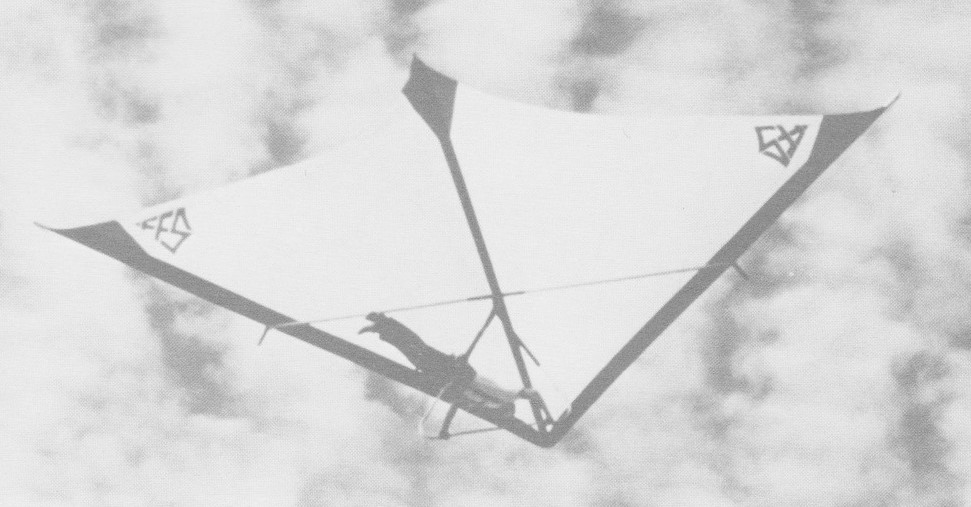
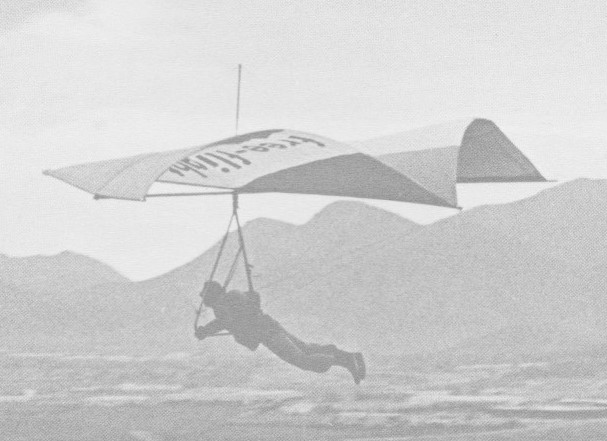
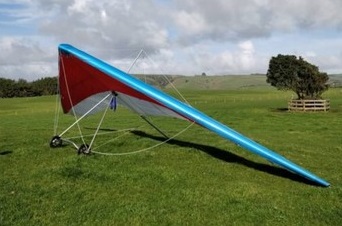
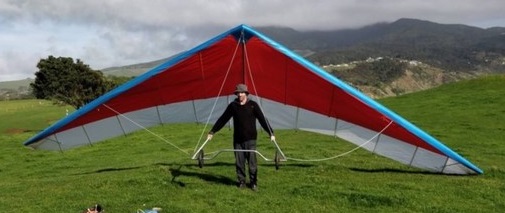
The computer designed Free Flight Standard beginners’ hang glider incorporates a deep scollop 3.8 oz Howe & Bainbridge stabilised dacron sail in a choice of 11 colours.
A prone harness was included. Controls were available in 40in, 48in, and 60in widths. Each rigging wire had a tang, and a storage cover was included.
The airframe is made from 6061-T6 1.5in x .058 aluminium tube and all airframe parts are anodised in gold or black. Fully sleeved and doweled. Stainless steel cables are 3/32in 7×7 aircraft quality.
15 x 15 Leading edge: 15 ft Keel length: 15 ft Wing area: 143 sq,ft Aspect ratio: 2.6 Nose angle: 80˚ Sail billow: 3.5˚ Weight: 35 lb Pilot weight: 90-130 lb Takeoff speed: 14 mph Stall speed: 15 mph Max speed: 40 mph Best glide ratio (L/D): 4.1 Best L/D speed: 25 mph Min sink: 400 fpm
16 x 16 Leading edge: 16 ft Keel length: 16 ft Wing area: 157 sq,ft Aspect ratio: 2.6 Nose angle: 80˚ Sail billow: 3.5˚ Weight: 37 lb Pilot weight: 120-160 lb Takeoff speed: 14 mph Stall speed: 15 mph Max speed: 40 mph Best glide ratio (L/D): 4.1 Best L/D speed: 25 mph Min sink: 400 fpm
17 x 17 Leading edge: 17 ft Keel length: 17 ft Wing area: 179 sq,ft Aspect ratio: 2.6 Nose angle: 80˚ Sail billow: 3.5˚ Weight: 38 lb Pilot weight: 140-170 lb Takeoff speed: 14 mph Stall speed: 15 mph Max speed: 40 mph Best glide ratio (L/D): 4.1 Best L/D speed: 25 mph Min sink: 400 fpm
18 x 18 Leading edge: 18 ft Keel length: 18 ft Wing area: 202 sq,ft Aspect ratio: 2.6 Nose angle: 80˚ Sail billow: 3.5˚ Weight: 39 lb Pilot weight: 150-200 lb Takeoff speed: 14 mph Stall speed: 15 mph Max speed: 40 mph Best glide ratio (L/D): 4.1 Best L/D speed: 25 mph Min sink: 400 fpm
19 x 19 Leading edge: 19 ft Keel length: 19 ft Wing area: 227 sq,ft Aspect ratio: 2.6 Nose angle: 80˚ Sail billow: 3.5˚ Weight: 40 lb Pilot weight: 190-220 lb Takeoff speed: 14 mph Stall speed: 15 mph Max speed: 40 mph Best glide ratio (L/D): 4.1 Best L/D speed: 25 mph Min sink: 400 fpm
20 x 20 Leading edge: 20 ft Keel length: 20 ft Wing area: 260 sq,ft Aspect ratio: 2.6 Nose angle: 80˚ Sail billow: 3.5˚ Weight: 42 lb Pilot weight: 220+ lb Takeoff speed: 14 mph Stall speed: 15 mph Max speed: 40 mph Best glide ratio (L/D): 4.1 Best L/D speed: 25 mph Min sink: 400 fpm
The Windrider hang glider kit was a standard rogallo that features: double zig zag stitched all white sail, 48in wide control bar with replaceable downtubes, 6061 T6 1.5in x 0.058in aluminum airframe, deep scalloped sail, completely pre fin¬ished rigging and airframe tubes, prone flight harness, and a clear concise set of plans that allows assembly in 1 hour.
I have flown a couple of pigs already, first was a local made Kiwi flyer. I actually learned to fly on it, it was tail heavy and had a terrible tendency to pop the nose. NO I know what you are thinking, it wasn’t my technique, it was that glider. Mr. Green
The Free Flight K1 ZK-JFW was originally a “K 1” hang-glider but has been converted to a Trike powered by a Rotax 447 with a Bing carburettor and a three-blade adjustable propeller. It also has a ballistic parachute mounted above the wing for emergency use. Its first flight was at Murawai Beach, New Zealand, by Karl Hoffman.