Fulmar HP-16 Héron

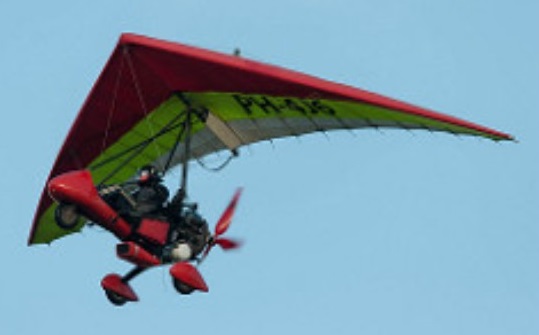
Single seat single engined high wing mono¬plane with two axis control. Wing has unswept leading and trailing edges, and constant chord; cruciform tail. Pitch control by eleva¬tor on tail; yaw control by fin mounted rudder; control inputs through stick for pitch/yaw/roll. Wing braced from below by struts; single surface. Undercarriage has three wheels in tricycle formation; no suspension on any wheels. Push right go left nosewheel steering indepen¬dent from yaw control. Optional brake on nosewheel. Aluminium tube framework, without pod. Engine mounted below wing driving pusher propeller.
The MP 16 Heron was designed by Pierangelo Mez¬zapesa, the driving force behind Fulmar. The prototype made its first flight on the 1 February 1983, and became available from April 1983 with two engine options: Sachs 330cc (see per¬formance characteristics below) or Hirth F 263R of 383 cc, which develops at 3900 rpm, an equivalent power (23 hp) to the Sachs. Despite the solidity of its tubular structure, the MP 16 Heron is foldable for transport on a road trailer, its space requirement then being 16.5 x 5.9 x 5.9 ft (5 x 1.74 x 1.75 m). A side by¬side two seater version is at the design stage.

Length overall 16.5 ft, 5.00 m.
Height overall 6.7ft, 2.00m.
Wing span 32.1ft, 10.0m.
Constant chord 4.7ft, 1.40m.
Dihedral 5 deg.
Sweepback 0 deg.
Tailplane span 8.2 ft, 2.50 m.
Total wing area 151 sq.ft, 14.0 sq.m.
Fin area 5.4 sq.ft, 0.50 sq.m.
Rudder area 14.0 sq.ft, 1.30 sq.m.
Tailplane area 13.5 sq.ft, 1.25 sq.m.
Total elevator area 9.2 sq.ft, 0.85 sq.m.
Wing aspect ratio 7.1/1.
Wheel track 5.9ft, 1.75m.
Nosewheel dia¬meter overall 12 inch, 30cm.
Main wheels diameter overall 16 inch, 40cm.
Engine: Sachs SA 340 engine.
Max power 22hp at 5250rpm.
Propeller diameter and pitch 41 x 18 inch, 1.05 x 0.46 m.
No reduction.
Max static thrust 155 lb, 70 kg.
Power per unit area 0.15hp/sq.ft, 1.6hp/sq.m.
Fuel capacity 2.6 US gal, 2.2 Imp gal, 10.0 litre in main tank; 5.3 US ga1, 4.4 Imp gal, 20.0 litre in reserve.
Empty weight 1991b, 90kg.
Max take off weight 419 lb, 190kg.
Payload 220 lb, 100kg.
Max wing loading 2.78 lb/sq.ft, 13.6 kg/sq.m.
Max power loading 19.1 lb/hp, 8.63 kg/hp.
Load factors design; +6.0, 3.0 ultimate.
Max level speed 44 mph, 70 kph.
Never exceed speed 50 mph, 80kph.
Max cruising speed 37mph, 60kph.
Economic cruising speed 34mph, 55kph.
Stalling speed 20 mph, 32 kph.
Max climb rate at sea level 300 ft/min, 1.5 m/s.
Min sink rate 400 ft/min at 31 mph, 2.0 m/s at 50 kph.
Best glide ratio with power off 7/1 at 34 mph, 55kph.
Take off distance 115 ft, 35 m.
Land¬ing distance 66 ft, 20 m.
Service ceiling 6560 ft, 2000 m.
Range at average cruising speed 50 mile, 80km.
Fulmar Ultralight Diffusion / Delta Fulmar

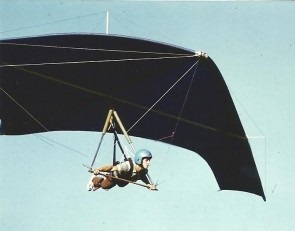
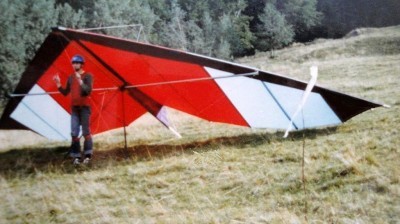
Fulmar first saw the light of day in 1978 and was one of the first manufacturers in Europe to motorise a hang glider, their Fulmar I, of 183 sq.ft (17.0 sq.m) area, using a Soarmaster American supplied engine. The company was incorpo¬rated into SPRL in July 1981, at which time Fulmar Ultralight Diffusion not only made single seater and two seater trikes using Robin 244, 333 and 432cc engines under wings of their own design and manufacture, but also built Weedhoppers on behalf of the European dealer Media Systems. 50 machines were built in this way.
1983: Fulmar Ultralight Diffusion, rue des Palais 285A, B 1000 Bruxelles, Belgium; tel (02) 216.79.30. Designer: Pierangelo Mezzapesa.

Ful Graffiti

Graffiti MA 30

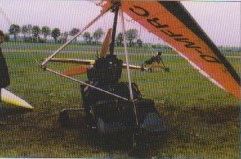
The Graffiti trike is made in the Ukraine by Aeros. The wing is the same as Aeros trikes, but the trike is not identical.

MA 30 Graffiti

The aircraft was supplied as a complete ready-to-fly-aircraft.

Graffiti MA 30
Empty weight: 185 kg
Wing span: 10.2 m
Wing area: 14.8 sq.m
Fuel capacity: 30 / 40 / 50 lt
Certification: Vz
Engine: Rotax 582E, 65 hp
MAUW: 450 kg
Seats: 2
Max speed: 130 kph
Cruise speed: 85-105 kph
Minimum speed: 45 kph
Climb rate: 6 m/s
Fuel consumption: 7.8 lt/hr
Price (1998): 27 600 DM

Ful Maverick

The Maverick is one of the few side-by-side trikes.

Empty weight: 176 kg
Wing span: 10.15 m
Wing area: 15.2 sq.m
Fuel capacity: 30-40 lt
Certification: Vz
Engine: Rotax 582E, 65 hp
MAUW: 450 kg
Seats: 2
Max speed: 118 kph
Cruise speed: 80-95 kph
Minimum speed: 40 kph
Climb rate: 5 m/s
Fuel consumption: 8.5 lt/hr
Price (1998): 29 900 DM

Fukunaga Tenryu 3

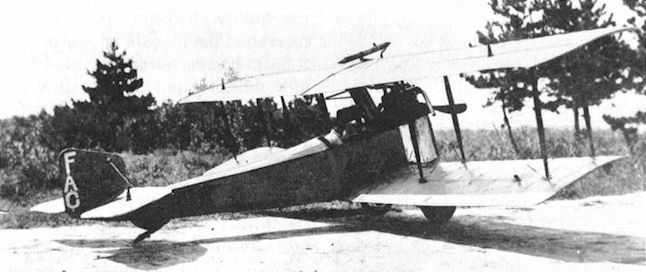
To help Fukunaga establish a flying school of his own, ltoh released the Emi 2 Aeroplane to him and took it to Osaka. Using numerous fields in trying to find a suitable place for his flying school, the aeroplane was frequently damaged and repaired. Eventually Fukunaga settled on the dry river bed of Tenryu River in Kakezuka-cho, Iwata-gun, Shizuoka Prefecture, near his family’s place of origin, where he established in November 1919 what was at first the Fukunaga Aeroplane Research Studio. Because of the many repairs and modifications, his aeroplane was so unlike the original Emi 2 Aeroplane that he renamed it the Tenryu 3 Aeroplane, a name he applied in retrospect to the two previous aircraft and continued to use, numerically sequenced, to those that followed.

The Tenryu 3 was used to provide flying training for his younger brothers, Shiro and Goro, followed by other students who were merely allowed to taxi the aeroplane since the 1911 Gregoire Gyp engine was all but worn out and difficult to adjust.

Engine: 45hp Gregoire Gyp
Propeller: two-bladed wooden
Span, upper: 9.75m (32ft)
Span, lower: 7.92m (26ft)
Wing area: 20.8sq m (223.896sq ft)
Length: 5.93m (19ft 5 1/2in)
Maximum speed: 48kt (55mph)

Fuji FA-300 / Rockwell Commander 700

Rockwell Commander 700

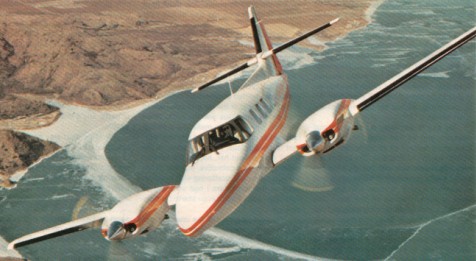
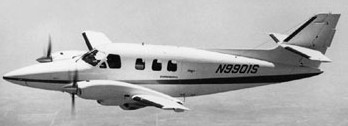
Fuji heavy industries and Rockwell International joined forces to manufacture a seven passenger pressurized twin that will be called in the US the Rockwell Commander 700.
But in order to compete directly in the American marketplace, Fuji needed a dealership organization that could both sell and service the airplane.
Rockwell’s problem was their Aero Commander basic design of 30 years had run out of growth potential.
The resulting agreement: Fuji builds the airframe, wings and tail assembly in Japan, then ships them to Rockwell’s Oklahoma plant, where they are assembled and fitted with engines, landing gear, interiors and other American-made components, which make up approximately 80 percent of the complete airplane. The design is certificated in both countries; Fuji will market the airplane in Australia and Asia, while Rockwell, through its dealer network, will sell the Commander 700 in America and Europe.
The first of five flying prototypes of the Fuji FA 300/Rockwell Commander 700 made its maiden flight at Utsonomiya on 13 November 1975 and the first flight in the U.S. was in late February 1976.
Three air¬planes were involved in U.S. certification, and two in a companion pro¬gram in Japan. The Rockwell Commander 700 was certified by Japan in 1975. It features two 340 hp turbocharged Lycomings. First deliveries of the 700 were scheduled for February 1977.
The 700 is a pressurized piston twin powered by two Lycoming TIO 540s that put out 340 horsepower at 2,500 rpm and have a TBO of 1,800 hours; they’re geared and turbocharged and are much the same engines Piper uses in the Navajo Chieftain. Their cooling is updraft, with air exiting out the upper rear of each nacelle through a single mo¬tor driven cowl flap that opens inward. Each wing carries 624 pounds of fuel in a single tank that supplies gas directly to its respective engine. The remainder of the fuel system is comprised of two shutoff valves, a single cross flow valve for emergency situations and two boost pumps. Pressurization was 5.5 psi, for a 5,000 foot cabin at 20,000 feet. The cabin is large 360 cubic feet including 53 cubic feet for baggage in the pressurized area.
On the first flight, a cruising speed of about 200 knots was attained at 10,000 feet. Preliminary figures indicate a top speed of 240 knots at 20,000 feet. Total fuel capacity will be 190 gallons, for an en¬durance of about five hours.
The airframes will be fabricated in Japan and shipped to Rockwell’s Bethany, Oklahoma plant. Engines, systems, accessories, avionics and interiors will be installed there as the airplane is assembled. Eighty percent of the total aircraft will be of U.S. manufacture.
Development of the airplane started in the mid 1960s, with Rockwell entering the picture in the early 1970s. The specifications were refined, discussed and negotiated, and an agreement as to the final design for the 700 was reached in June 1974.
The airfoil section was designed by Fuji and combines with an efficient flap system to produce a relatively low stalling speed in spite of a relatively high wing loading. The 700 has 200 square feet of wing area and the projected gross weight is 6,800 pounds.
An extensive wind tunnel program was conducted on the design. Engine cooling drag has been minimized, and extensive use of metal bonding has resulted in smooth surfaces.

Rockwell and Fuji Jet Industries terminated their agreement on the Commander 700 in December 1979.

Aerostar Aircraft Corp acquired the design and production rights to Aero Commander.

Rockwell Commander 700
Engines: Lycoming TIO 540 R2AD, 340 hp at sea level.
TBO: 1,800 hrs.
Props: three blade, constant speed, 81 in diameter.
Length: 38 ft. 2 in.
Height: 13 ft. 4 in.
Wingspan: 42 ft. 5in.
Wing area: 200 sq.ft.
Wing loading: 33.8 lb/sq.ft.
Power loading: 9.9 lb/hp.
Seats: 6.
Empty weight: 4,740 lbs.
Useful load: 2,010 lbs.
Payload with full fuel: 762 lbs.
Gross weight: 6,750 lbs.
Usable fuel capacity: 208 USG/1,248 lbs.
Maximum landing weight: 6,600 lbs.
Maximum rate of climb: 1,633 fpm.
Single engine rate of climb: 273 fpm.
Single engine climb gradient at 101 kts. (Vyse): 256 ft/nm.
Service ceiling: 32,000 ft.
Certificated ceiling: 25,000 ft.
Single engine service ceiling: 12,000 ft.
Maximum speed: 221 kts.
Max cruise, 75 % power at 24,000 ft: 218 kts.
Econ cruise, 65 % power at 16,000 ft: 190 kts.
Duration at max cruise: 5.9 hrs.
Duration at econ cruise: 6.8 hrs.
Stalling speed, clean: 85 kts.
Stalling speed, full flaps: 67 kts.
Pressurization differential: 5.5 psi.
10,000 ft. cabin at: 26,000 ft.
Max SL cabin alt: 12,500 feet.

Aerostar 700
Engines: two 350hp Lycoming TI0-540-U2A
Wingspan: 36’8″
Length: 34’10”
Useful load: 1715 lb
Max speed: 328 mph
Cruise: 282 mph
Stall: 84 mph
Range: 1151 mi
Ceiling: 30,000′.
Seats: 4-6

Aerostar Super 700
Engines: 2 x modified Lycoming I0-540-SIA5
Seats: 4-6

Fuji FA-200 Aero Subaru

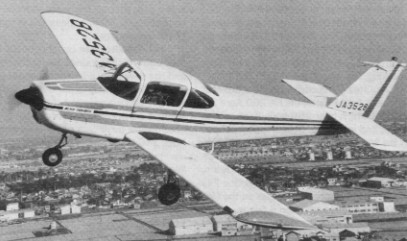
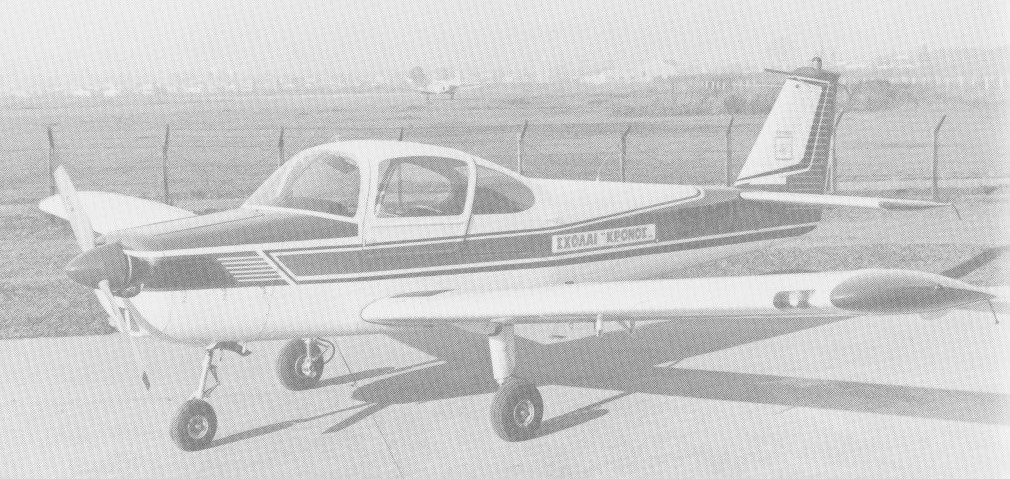
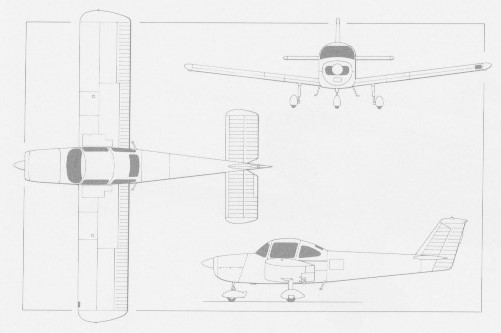
Fuji Heavy Industries builds a two seat aerobatic light trainer, the FA 200 Aero Subaru, of which over 250 have been sold in Japan and in Europe. Expensive to produce because of its heavy reliance on handwork and imported hardware, and rather homely in appearance, the Fuji has not been as great a success, but it has not been a failure.

FA-200-160

The FA-200-160 is a basic version with a Lycoming O-320-D2A engine and certified as a two-seater (aerobatic category) and three-seater (utility) or four-seater.

The FA-200-180 was a developed version certificated as a two-seater (aerobatic category) and four-seater (utility and normal categories).

The FA-203S was an experimental STOL verion with leading-edge slats and full-span trailing-edge flaperons. Only one was built.

FA-200-180
Engine: Lycoming IO-380-B1B, 180 hp
Wingspan: 30 ft 11 in / 9.42 m
Length: 26 ft 2.25 in / 7.98 m
Empty weight: 1433 lb / 650 kg
MTOW NormCat, 4 seat: 2535 lb / 1150 kg
Max cruise 75% 5000 ft/1535m: 110 kt / 127 mph / 204 kph
ROC SL: 760 fpm / 232 m/min
Service ceiling: 13,700 ft / 4175 m
Range max fuel: 534 nm / 615 mi / 970 km
Seats: 4
Baggage capacity: 44 lb / 25 kg (shelf), 176 lb / 80 kg (compartment)
Cabin length: 5 ft 8.5 in / 1.74 m
Cabin width: 3 ft 4.5 in / 1.03 m

FA-200-160