
The first of the Granville brothers’ Gee Bee racers, of 1930.
Engine: Menasco, 125 hp.
Top speed: 159 mph.
The first of the Granville brothers’ Gee Bee racers, of 1930.
Engine: Menasco, 125 hp.
Top speed: 159 mph.
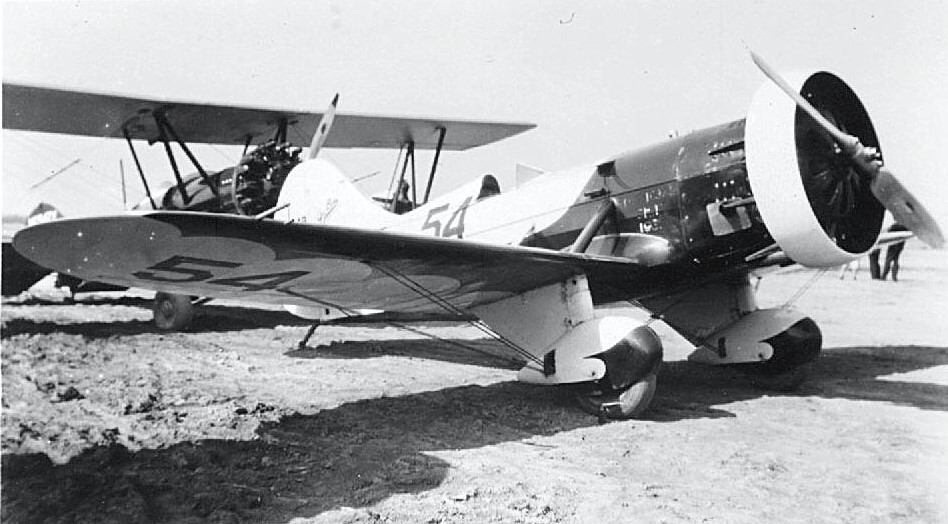
Chief engineer Bob Hall’s “Gee Bee” (for Granville Brothers) racers had dominated the 1931 Nationals. In the Thompson, Hall took a Model Y Senior Sportster to fourth and Lowell Bayles flew a Wasp Jr.-powered Model Z Super Sportster to victory.
2 seat
2 built
X11049 Wasp C engine
X715Y Lycoming
1 seat
8 built
Cirrus 110 hp, 2 built
Menasco C-4, 125 hp 2 built
Warner Scarab, 110 hp 4 built
2 place biplane
Engine: Kinner 12-5, 118 hp
9 built
Based at Springfield, Massachusetts, Granville became known for the 1930-1933 series of Gee Bee racers, first of which came second in the 1930 All-America Air Derby round the U.S.A. In September 1932 Gee Bee R-1 Super Sportster set new world landplane speed record of 294.417mph (473.820kmh).
Liquidated fall of 1933
After liquidation the workforce built the QED for the 1934 England to Australia race, and the ‘Time Flies’ a racer for Frank Hawks.
Company succeeded by Granville, Miller, and de Lackner in 1934. Built Granville R6H Cyclone-engined monoplane for England-Australia race, but aircraft only reached Bucharest.
Skylander was a Desmond Norman’s last project. Intended for rough field work in remote areas, the rights for this twin PT6A turboprop have been bought by GECI of France for further development.
Skylander (provisional)
Engines: Two 1100shp Pratt & Whitney Canada PT6A 65B turboprops.
Span, 71 ft (21.6m).
Length, 47ft 2in (14.38m).
Height, 20ft 1 in (6.lm).
Max take off weight, 18,5001b (8.4 tonnes).
Max payload, 7,2751b (3.3 tonnes)
Cruise speed, 230kt (426km/h).
Range, 1,207nm (2,235km).
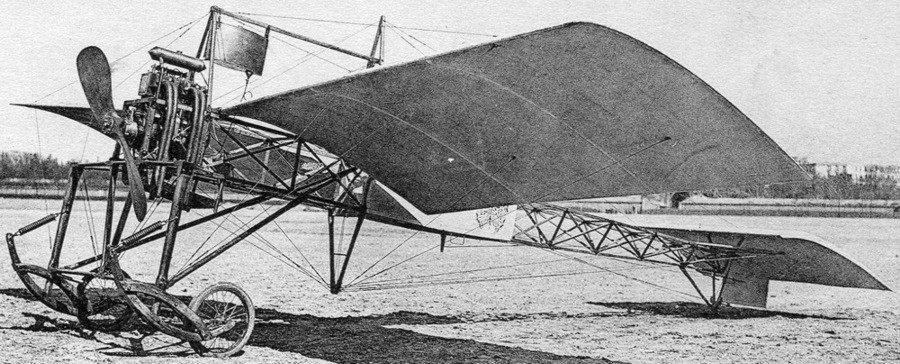
Built in France by Guyot, Bœswillwald et Stahl (G.B.S.), three of these Blériot-like planes with triangular cross-section were entered in the 1910 Tours meeting, but never showed up. Powered by a 40 hp Labor engine.
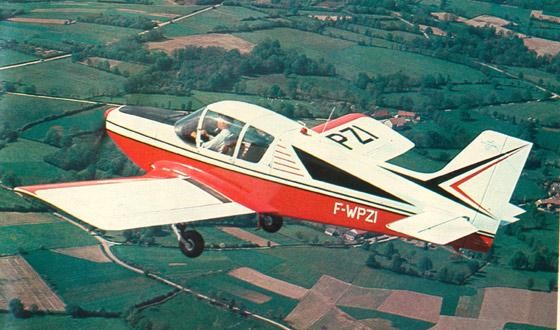
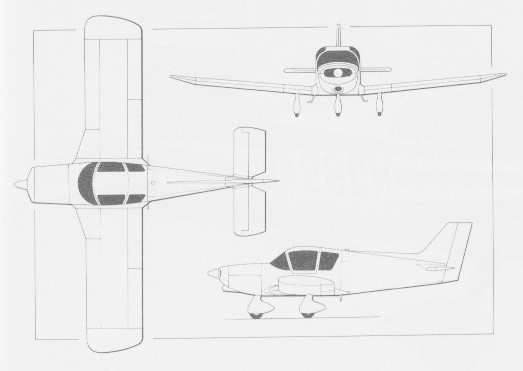
The company produced a 2/3-seat light aircraft, the GV 103L, which first flew on 1 May 1969. Subsequently built a second example with the intention of finding a sponsor for production of the type.
The GV 10-20 was an aerobatic two-seat version with 115 hp Lycoming engine.
The GV 10-31 was a four-seat version.
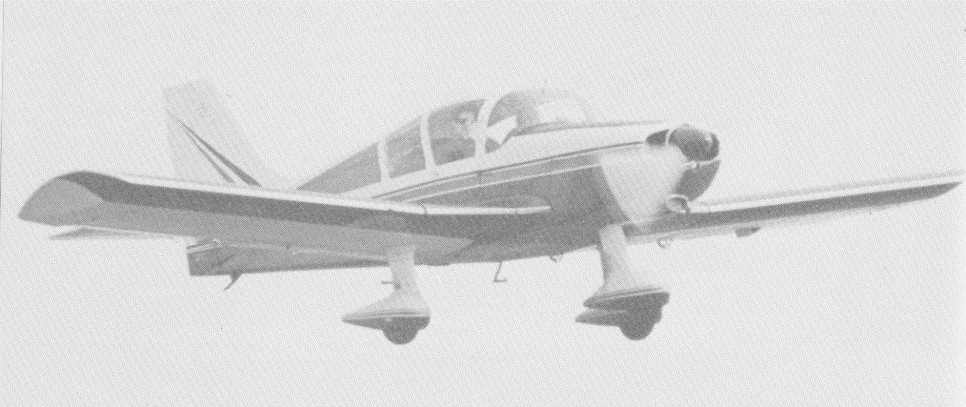
GV 10-31
Engine: Lycoming O-320, 150 hp
Wingspan: 28 ft 8.5 in / 8.75 m
Length: 21 ft 7.75 in / 6.60 m
Empty weight: 1212 lb / 550 kg
MTOW: 2182 lb / 990 kg
Max cruise 75%: 122 kt / 140 mph / 225 kph
ROC SL: 787 fpm / 240 m/min
Service ceiling: 14,760 ft / 4500 m
Range: 594 nm / 683 mi / 1100 km
Seats: 4
Max rear seat load: 340 lb / 154 kg
Baggage: 22 lb / 10 kg
France
Known mainly as light aircraft maintenance company. Gazuit was formerly a designer with Morane-Saulnier, and Valladeau had been a subcontractor for some Wassmer aircraft. The company produced a 2/3-seat light aircraft, the GV 103L, which first flew on May 1,1969. Subsequently built a second example with the intention of finding a sponsor for production of the type, but this did not materialize.
During a general conversation, Harold E. “Hal” Lemont told Gazda of his work with Igor Sikorsky; Gazda asked if Lemont would like to design and build a helicopter for him. They
agreed that Lemont would lay out a design for a two-pJace helicopter, and thus the Gazda Model 100 was begun.
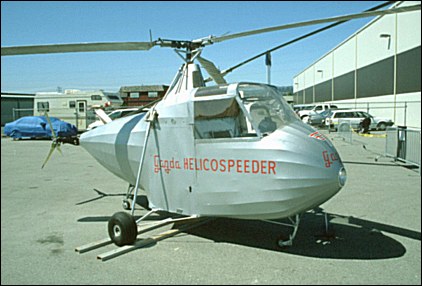
The Gazda Model 100 Helicospeeder NX69154 was designed and developed in 1943, 1944, and 1945 by Antoine Gazda of Wakefield, Rhode Island. It was a single motor and torque aircraft with unique concepts which had the following features:
A swing tail for forward flight was designed to permit flight as a gyrodyne (V. Isaoco, J. Bennett) at higher than manual helicopter speeds with the rotor axis vertical.
To control blade inplane motion to prevent ground resonance a rotor azimuthal blade positioning system was included.
A wheel/stick installation was used so that positioning of the aircraft was achieved by one appropriate motion of the pilot control.
An internal swash plate below the main rotor gearbox actuated push rods going up to the rotor head which controlled blade collective and cyclic pitch as a low drag solution.
Belt drives were used between its engine, the cooling fan, and the main rotor gearbox. A drive shaft from the gearbox to the swinging tail rotor was also included with a torseinal damper as part of this shaft.
An all-aluminum single-seat helicopter, it was powered by a Continental A-75 engine.
Two assistants for detail designs were hired from previously known engineers who had attended RISC – Mr. S. Fitzpatrick in 1944 who was later replaced by Mr. H. Sadler in 1945.
The Helicospeeder was manufactured by Helicopter Engineering & Construction Co. and designed in accordance with general practice at that time. The fuselage was welded steel aircraft tubing. Main rotor blades were steel tubular spars, wooden leading edge wire cable training edge and airplane fabric covering. Cast aluminum gear cases and industrial/automotive gears, bearings, belts, and pulleys were used. The wheels came from a Piper Cub. Considering the limited pool of knowledge and experience in helicopter design, and Mr. Lemont’s earlier background with the Sikorsky VS-300, it is natural that there would be considerable similarity between these two machines.
Its Cierva-type rotor hub, with hydraulic-interconnect links between blades, made ground resonance impossible.
Initially, attempts were made to use a jet of air from the tail to counter torque. However, due to difficulties, a tail rotor was used that could be turned 90 degrees by the pilot, and thus serve as a push propeller for added thrust.
The Model 100 was constructed in the Rhode Island area during World War II, incorporating some surplus aircraft items. Powered by a 75 hp (56 kW) Continental A-75 engine, it was specified to carry one person and publicity releases claimed an ultimate goal of a 300 mph (483 km/h) maximum airspeed. Flight testing was done by Mr. Gazda himself, whose limited experience at the controls of a rotorcraft may have been detrimental to success of these tests. The designer/constructor carried out test flights and a more modest actual speed of 100 mph (161 km/h) was reached.
Production examples were expected to sell for 5,000 U.S. dollars, but no firm sales were made. As Gazda came to understand the difficulty in learning to fly the aircraft, plus the cost of further development, he decided to discontinue further work on this aircraft, and only one example of the initial version was completed.
The Helicospeeder was sold at auction after Mr. Gazda passed away, and was purchased by HAl Past-Chairman Vincent Colicci, who eventually sold it to Dr. Voss. After some years at AgRotors in Pennsylvania, Stanley Hiller took it on loan for his aviation museum in San Carlos, California, and had it restored to its original condition (it would appear that the Model 100 was also placed on public display at some point in time in the Owls Head Transportation Museum at Knox County Regional Airport—located two miles south of Rockland, Maine.)
Helicospeeder
Engine: 1 x Gazda, 130hp
Rotor diameter: 7.62m
Length: 5.79m
Height: 2.54m
Gross weight: 544kg
Cruising speed: 224km/h

