GAL 41 Monospar of 1939 was first British aircraft with pressurized cabin.
Author: Terry
General Aircraft GAL.38
In 1937 the British Admiralty issued a requirement for a novel type of aircraft to shadow enemy fleets, especially by night. The Air Ministry issued Specification S.22/37 calling for an aircraft compatible with aircraft carriers which would provide comfortable accommodation for a pilot, observer and radio operator, outstanding all round view and the ability to cruise at 40 knots for 11 hours. Two prototypes were built, the Airspeed A.S.39 (serial N1323) and the General Aircraft G.A.L.38 (P1758). These flew after the out break of the Second World War. Both were high wing aircraft with extensive slats, flaps and drooping ailerons all in the slipstream of four 130 hp Pobjoy Niagara V radials driving fixed pitch propellers. The G.A. aircraft was all wood, but the Airspeed Fleet Shadower, had a metal fuselage; the former had a nose¬ wheel and tall single fin, while the Airspeed had a tail wheel and three small fins. Each seated the observer in a panoramic nose, the pilot high and behind and the radio operator further aft. Both aircraft met the requirement but the Admiralty changed their minds about the desirability of such an air¬ craft and scrapped this programme in 1940.
Span: 17.02m (55ft 10in)
Length: 11 m (36 ft 1 in)
Gross weight: 3897 kg (8590 lb)
Maximum speed: 185 km/h (115 mph).
General Aircraft Ltd
General Aircraft Ltd, Feltharn, UK.
Established 1931 at Croydon Airport. Chief designer was Swiss H. J. Stieger. Acquired world rights from Monospar Company for its system of construction for aircraft up to 1,360kg laden weight. First type was ST-3 three-seat enclosed cabin monoplane with two 45 hp Salmson radial engines. Later built series of light twins; GAL 41 Monospar of 1939 was first British aircraft with pressurized cabin. Single-engined pre-Second World War Cygnet monoplane was first light all-metal stressed-skin civil aircraft in U.K.; also an experimental open-cockpit version, the Owlet. Took over premises of British Aircraft Manufacturing Company in 1938. Built Hotspur training gliders and later Hamilcar assault gliders during Second World War. Postwar work included conversion of Mosquitoes as target tugs and design of GAL- 60 Universal Freighter, built as the Beverley after General Aircraft merged with Blackburn in January 1949.
The Monospar company was established in 1926 and was later absorbed by the General Aircraft Company.
General Aircraft Ltd
During 1948, discussions between General Aircraft Ltd and the Humberside firm of Blackburns led to a merger of the two companies under the joint name of Blackburn & General Aircraft Ltd. The new company was formed on 1 January 1949 and it was proposed that all work in progress at the various factories be completed as originally planned.
General Aircraft Genairco
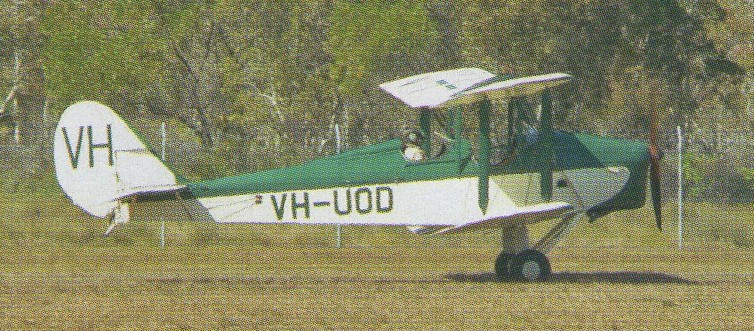
The first Genairco flew on December 20, 1929, and bore a marked similarity to the D.H.60, although it had a two-place front cockpit. The seventh and eighth aircraft produced were modified into cabin biplanes, resembling the D. H, 83 Fox Moth. The Depression and availability of D.H. types put General Aircraft out of business by early 1933.
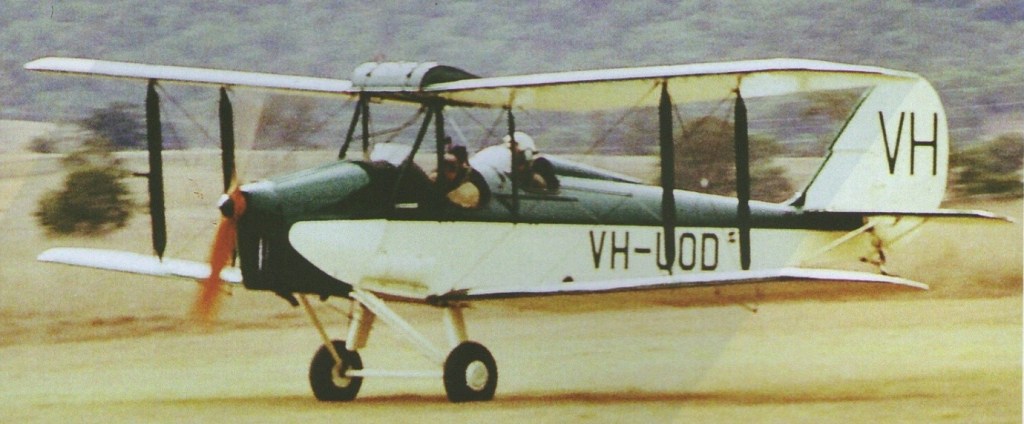
General Aircraft built about 12 Genaircos from late 1929 in ‘cabin’ and ‘open’ forms. A three-seater, two passengers are side-by-side in the front and pilot behind.
General Aircraft Co Ltd
General Aircraft Company Ltd. formed in 1929 at Sydney/Mascot Aerodrome. Built large factory, initially carried out overhauls, but by 1930 had designed a three-seat biplane, the Genairco, powered by Cirrus Hermes engine. Subsequently produced a four-seat version. Company thought to be inactive by about 1934.
General Airbourne Transport Co / Bowlus MC-1 / XCG-16
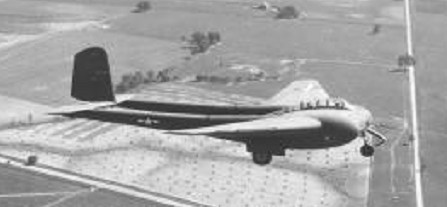
William Hawley Bowlus, a sailplane and glider manufacturer, designed a flying wing glider, the MC-1 in February 1942. Its design was a departure from single fuselage designs and incorporated a twin boom design. The MC-1 was an all-wood twin boom military transport glider of 91ft 10in span, featuring an aerofoil-sectioned lifting fuselage between the booms in which either cargo or troops could be carried in two 16ft x 7ft compartments. The load could be four tons of cargo or 48 armed troops. The front of the wing opened upwards and downwards like a pair of jaws, the bottom doors doubling as a loading ramp. A mock-up of the troop accommodation shows that the compartment tapered towards the trailing edge, allowing little headroom for those unfortunates at the back. The crew of two sat in tandem beneath a continuous canopy atop the centre section.
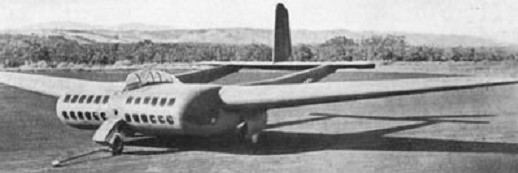
A single fin and rudder was mounted on the tailplane between the booms. The tricycle landing gear was retractable, and flaps were fitted to the outer wing panels and the fuselage centre section. The MC-1 was constructed mainly of plywood, although all flying surfaces and flaps were fabric-covered.
Early test flights of a full scale model proved disastrous when unsecured weighted bags shifted causing it to become unbalanced and killing the pilot and several passengers.
Hawley’s General Airbourne Transport Company received a contract in November 1943 to build the glider. The first glider was delivered six months late at three times the cost in the summer of 1943.
The MC-1 was test flown by the company and Richard duPont was the instigator of a demonstration for the military on September 11, 1943 from March Field.
The pilot of the glider was Col P. E. Gable, deputy director of the Army Air Corps assault glider program. The copilot was Howard Morrison, a long time associate of Bowlus and a test pilot.
Several VIPs set off on the flight. They included Richard Dupont, special assistant to Gen Arnold; Col Ernest Gabel, another glider specialist on the staff of the Chief of Staff of the Air Force, and C. C. Chandler, thrice soaring champion. In order to bring the glider up to more-or-less full load, bags of sand and lead shot were loaded aboard but apparently were in securely lashed some reports say they were not lashed to the glider at all. The glider was towed off from March Field by a Lockheed C-60. During turbulence the bags shifted aft and set up a porpoising moment. The tow release did not release at first pull but released on the third porpoise of the MC-1. It released from the glider. The glider entered a flat spin from which it failed to recover. Three managed to take to their parachutes but the other occupants, including Dupont, perished. Only one survived the jump.
One report says that Gable had less than 6 hours total time on gliders and allowed the XCG-16 to fly into the wake of the C-60, causing the glidcr to pitch violently and breaking the cable. The ballast shifted aft, and the glider entered the flat spin.
Despite this tragic occurrence the company persevered with a further XCG-16, albeit six months late and costing three times the estimate. It was tested at Clinton Army Air Field and at Orlando, Florida. This is probably the aircraft tested by GAT test pilot Paul E. Tuntland and Northrop test pilot J. Meyers together with army officers from the glider branch at Dayton Ohio. Total flying time for the tests was 34 hours, including 50 landings made under Service operating conditions.
Once the factory flight tests on the XCG-16 were completed, glider pilots at CCAAF flew the XCG-16 on over 70 flights in October of 1944 before the glider was rejected.
In his pilot’s test report summary, Tuntland had this to say about the handling of the XCG-16: “In my opinion the XCG-16 has excellent handling qualities. During the flight tests I had the impression of flying a large sail plane. It is laterally stable in that it has a tendency to over-bank in steep spirals. I always had good lateral control at the slower airspeeds and higher angles of attack. Longitudinal control was normal with high elevator forces noted at increased airspeeds. “Directional control was good throughout the normal speed range. There was sufficient vertical area in the tail group to maintain good directional control throughout the approach and landing roll, even in moderate crosswinds. There was no tendency to yaw before or during the landing roll except in a crosswind, where normal correction was satisfactory. The subject aircraft is very maneuverable, being capable of rolling from one vertical turn to another in a minimum of time. On one occasion I was able to soar the aircraft in moderate lift conditions. Stalling characteristics are excellent. The first stall warning is indicated about 15 m.p.h. above actual stalling speed. This aircraft made normal landings at between 40 and 75 m.p.h. with the average about 48 m.p.h. A minimum of longitudinal trimming control was necessary in a c.g. shift from 24 per cent MAC to 36 per cent MAC. Normal landings were made with the flaps retracted at approximately 70 m.p.h.
“The copilot’s lateral vision is rather poor from the rear cockpit. The pilot’s front cockpit vision is excellent forward, and good towards the sides.
“The ground cushioning effect is very noticeable and is a desirable feature of the type, assisting soft ground contact from a rough approach.
“Any glider of either tricycle or conventional landing gear that has sufficient vertical tail surfaces for directional stability will tend to turn into the wind during crosswind landings at high or low angles of attack. In this respect the XCG-16 glider has absolutely no objectionable qualities compared to any other aircraft with which I have had experience. The tendency to turn could be readily corrected by the action of the rudder and of the brakes at slow speeds.”
The report is dated October 31, 1944. Despite the favorable flying qualities of the XCG-16 there were a number of operational snags; rather too many, as it turned out. These included: inadequate protection in the event of a crash; insufficient exits for crew in the event of an emergency; unsatisfactory loading ramps; poor location of flight equipment, and critical lateral loading. After tests by the AAF Board at Clinton Army Air Field and at Orlando, the contract for the XCG-16 was cancelled on November 30, 1944.
Span: 91 ft 10 in.
Length: 48 ft 4 in
Height: 18 ft 4 in.
Aspect ratio:7.4:1
All up weight: 19,580 lb.
Empty weight: 9,500 lb
Cargo: 10,080 lb.
Max speed: 220 mph
Stall speed flaps down: 58 mph
Stall speed flaps up: 62 mph
General Airbourne Transport Co / Bowlus Proof of Concept
Around 1942 Bowlus began work on a twin boom flying-wing glider for military transport work. In order to test his design he began work on a half-scale proof-of-concept flying model, forming the Airborne Transport Company in Los Angeles, California for the purpose.
Construction of the test model was carried out in his tiny shop, a former dry cleaning shop where there was just sufficient room to build the two-seat open-cockpit prototype. On completion, the glider was flown at Muroc Dry Lake, now the sight of Edwards AFB. The glider flew well and Bowlus and partner Albert Criz set about designing, building and marketing the full-size glider, the XCG-16.
General Airbourne Transport Co / Bowlus XCG-7 / XCG-8
Early in 1942 Bowlus was awarded a contract by the USAAF for two troop gliders – the eight-place XCG-7 and the 15-place XCG-8. The smaller glider was structurally unsound and failed official tests. The larger XCG-8 was really too large for Bowlus to handle and Douglas Aircraft came to the rescue. But this glider, too, failed to come up to scratch structurally; and both projects came to nothing.
General Aeronautique
France
Formed in February 1930 by a number of the most important French aircraft manufacturers, and one engine manufacturer, as a result of a concentration and rationalization of policy proposed by the French Air Minister. Companies were Lorraine-Hanriot, Chantiers Aero-Maritimes de la Seine, Nieuport-Delage, Societe Aerienne Bordelaise, Societe d’Emboutissage et de Constructions Aeronautiques, Latham, and Societe Lorraine.
General Aeronautic 1916 12-cyl
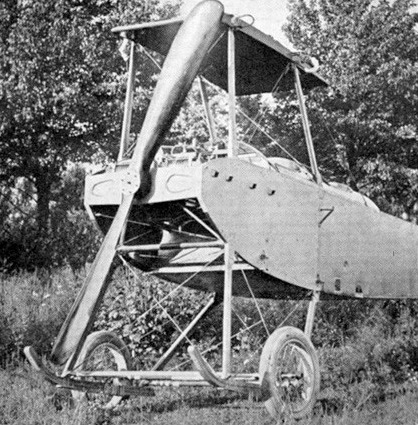
In 1916 General Aeronautic Co produced a 12-cyl “semi air-cooled” aero engine.

