General Electric J73

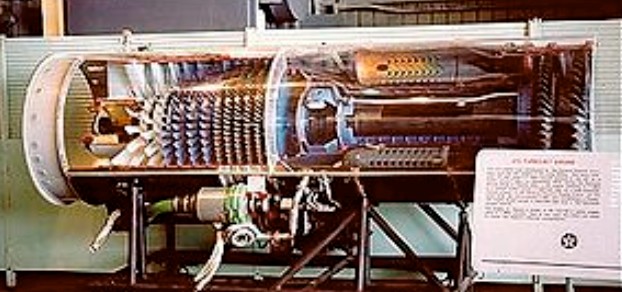
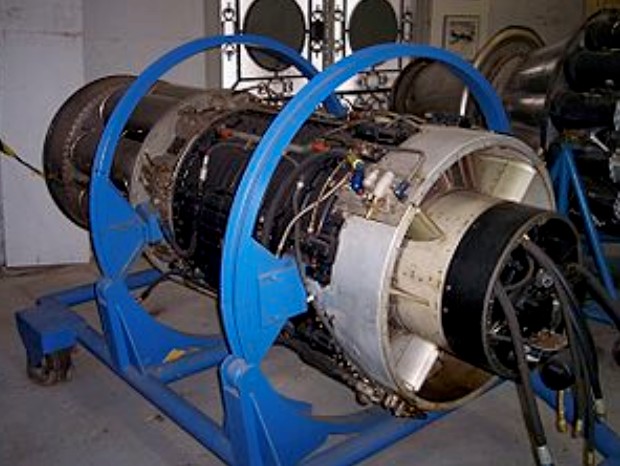
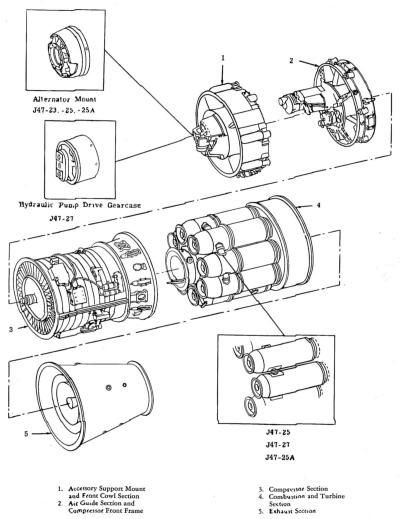
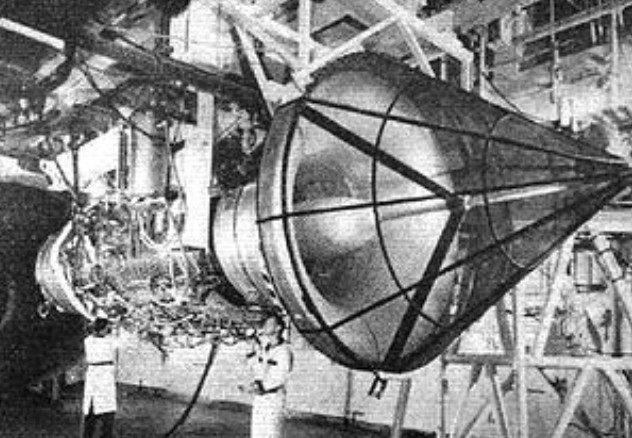
The General Electric J73 turbojet was developed by General Electric from the earlier J47 engine. Its original USAF designation was J47-21, but the innovative features (variable inlet guide vanes, and single-shell combustor case) led to its redesignation as J73. A total of 870 were built at a unit cost of US$145,000.

Applications:
YF-84J Thunderstreak
F-86H Sabre

Specifications:

J73-GE-5
Type: Turbojet
Length: 200 in (5 m)
Diameter: 39.5 in (1 m)
Dry weight: 3,650 lb (1,656 kg)
Compressor: 12 stage, axial flow, variable inlet guide vanes
Combustors: 10 cannular combustion chambers
Turbine: 2 stage
Maximum thrust: 9,500 lbf (42 kN) dry, 12,500 lbf (55.6 kN) with afterburner
Overall pressure ratio: 7.5:1
Specific fuel consumption: 0.9 lb/hr/lbf (dry power)
Thrust-to-weight ratio: 3.4 lbf/lb

General Electric J47 / TG-190 / X-39

General Electric J47

The General Electric J47 turbojet (GE company designation TG-190) was developed by General Electric from the earlier J35 engine, and first flew in May 1948. First run on 21 June 1947, the J47 was the first axial-flow turbojet approved for commercial use in the United States. It was used in many types of aircraft and 36,500 were manufactured before production ceased in 1956. It saw continued service in the US military until 1978.

Overhaul life for the J47 ranged from 15 hours (in 1948) to a theoretical 1,200 hours (625 achievable in practice) in 1956. For example, the J47-GE-23 was rated to run 225 hours between overhauls. As installed on the F-86F, it experienced one in-flight shutdown every 33,000 hours in 1955 and 1956.

Variants:
J47-GE-1 – 4,850 pounds-force (22 kN) thrust
J47-GE-17B – 5,425 pounds-force (24 kN) thrust
J47-GE-19 – 5,200 pounds-force (23 kN)
J47-GE-23 – 5,800 pounds-force (26 kN), (6,500 pounds-force (29 kN) with water injection)
J47-GE-25 – 7,200 pounds-force (32 kN) thrust
J47-GE-27 – 5,200 pounds-force (23 kN), 5,970 pounds-force (27 kN) thrust
J47-GE-33 – 5,550 pounds-force (25 kN) thrust

Applications:
Boeing B-47 Stratojet
KB-50J Superfortress
KC-97L Stratotanker
Chase XC-123A
Convair B-36
Convair NB-36
Curtiss XF-87 Blackhawk
Martin XB-51
North American B-45 Tornado
North American F-86 Sabre
North American F-86D Sabre
North American FJ-2 Fury
Republic XF-91 Thunderceptor

Ground-based vehicles that used the engine include:
Spirit of America
M-497 Black Beetle jet-powered locomotive

The nuclear-powered X39
In the 1950s, interest in the development of nuclear-powered aircraft led GE to experiment with two nuclear-powered gas turbine designs, one based on the J47, and another new and much larger engine called the X211.

The design based on the J47 became the X39 program. This system consisted of two modified J47 engines which, instead of combusting jet fuel, received their heated, compressed air from a heat exchanger that was part of the Heat Transfer Reactor Experiment (HTRE) reactor. The X-39 was successfully operated in conjunction with three different reactors, the HTRE-1, HTRE-2 and HTRE-3. Had the program not been cancelled, these engines would have been used to power the proposed Convair X-6.

Specifications:

J47-GE-23
Type: turbojet
Length: 144 inches (3.7 m)
Diameter: 39.5 inches (1.00 m)
Dry weight: 2,707 pounds (1,228 kg)
Compressor: 12-stage axial compressor
Turbine: Single-stage axial
Maximum thrust:
5,800 pounds-force (26 kN) at 7950 rpm
6,500 pounds-force (29 kN) with water injection
Specific fuel consumption: 0.98 lb/hr/lb

J47-GE25

General Electric GE4

General Electric GE4/J5

The General Electric GE4 turbojet engine was designed in the late 1960s as the powerplant for the Boeing 2707 supersonic transport. The GE4 was a nine-stage, single-shaft, axial-flow turbojet based largely on the General Electric YJ93 which powered the North American XB-70 bomber. The GE4 was the most powerful engine of its era, producing 50,000 lbf (220 kN) dry, and 65,000 lbf (290 kN) with afterburner. The Boeing 2707 was cancelled in 1971, putting an end to further work on the GE4. First run in 1967, only three were built.

Specifications
GE4/J5P
Type: Turbojet
Length: 27ft 4 in (833.1cm)
Diameter: 5ft 11 in (180.3cm)
Dry weight: 11,300 lb (5,100 kg)
Compressor: Nine-stage axial
Combustors: Annular straight-through-flow
Turbine: Two-stage axial
Fuel type: Special high-temperature JP-6 Fuel
Maximum thrust: 50,000 lbf (220 kN) (63,200 lbf (281 kN) with afterburning)
Overall pressure ratio: 12.5:1
Turbine inlet temperature: 2,200 ºF (1,204 ºC)
Thrust-to-weight ratio: 6.02
Compressor inlet diameter: 60.6 in (1,539 mm)
Exhaust nozzle diameter: 74.2 in (1,880 mm)
Core airflow: 620 lb (280 kg) per second
Noise:
Takeoff: 104 dB
Sideline: 117 dB
Approach: 107 dB

General Electric TF39 / CTF39

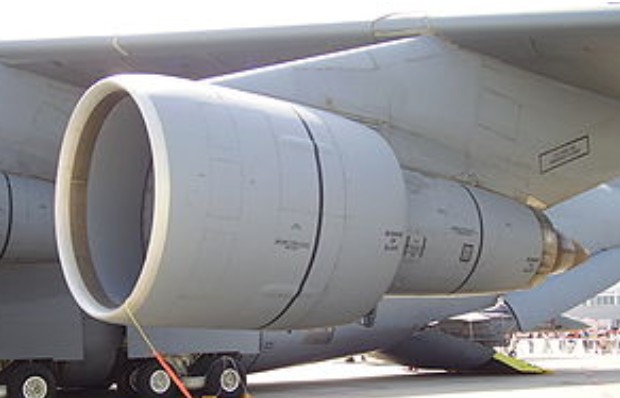
A TF39 on a C-5 Galaxy

The General Electric TF39 is a high-bypass turbofan engine. Developed to power the Lockheed C-5 Galaxy and first run in 1964, it was the first high-power, high-bypass jet engine available. The TF39 was developed into the CF6 series of engines, and formed the basis of the General Electric LM2500 marine and industrial gas turbine.

The United States Air Force opened the “CX-X Program” in 1964, intending to produce a next-generation strategic airlifter. Of the several airframe and engine proposals returned for consideration, Lockheed’s aircraft and General Electric’s engine were selected for the new design in 1965.
The high-bypass turbofan was a huge leap in engine performance, offering a thrust of 43,000 pounds, while improving fuel efficiency by about 25%. The TF39 had an 8-to-1 bypass ratio, 25-to-1 compressor pressure ratio, a 2,500 °F (1,370 °C) turbine temperature made possible by advanced forced-air cooling. The first engine went for testing in 1965. Between 1968 and 1971, 463 TF39-1 and -1A engines were produced and delivered to power the C-5A fleet.

The TF39 is rated from 41,000 to 43,000 lbf (191 to 205 kN) of thrust. It employed a great deal of then-new technological features such as:
1½ stage fan blades (unique to TF39).
8:1 bypass ratio.
Variable stator vanes.
Turbines equipped with advanced cooling.
Fuel efficiency better than any engines available at the time.
Cascade-type thrust reversers.

Mechanically, the TF39 is rather unusual for a high bypass ratio turbofan; the single stage is snubbered (‘Snubbers’ are protuberances that stick-out at right angles to the fan aerofoil somewhere between mid-span and blade tip). The snubbers on adjacent fan blades butt-up against each other, in a peripheral sense and improve the vibration characteristics of the blade to the fan rotor which has a set of inlet guide vanes for the outer bypass section and the core booster stage located in front of the fan rotor, rather than behind. This unique design is clearly seen from the front.

The only application was the Lockheed C-5A/B/C Galaxy.

Specifications:

TF39-1C
Type: Turbofan
Length: 312 in (792 cm)
Diameter: 97 in (246 cm)
Dry weight: 8000 lb (3630 kg)
Compressor: Axial, 1 stage fan, 5 stage low pressure compressor, 16 stage high pressure compressor
Combustors: Annular
Turbine: Axial, 2 stage high pressure turbine, 6 stage low pressure turbine.
Maximum thrust: 43,300 lbf (193 kN)
Overall pressure ratio: 25:1
Specific fuel consumption: 0.313 lb/lbf-hr
Thrust-to-weight ratio: 5.4:1

General Electric CJ805 / TF35

A CJ805-3A turbojet installed on a Convair 880 airliner

The General Electric CJ805 is a jet engine which was developed by GE Aviation in the late 1950s. A simplified civilian version of the J79 featuring an axial compressor, it was developed in two versions. The basic CJ805-3 was a turbojet and powered the Convair 880, while CJ805-23 (military designation TF35), a turbofan derivative, powered the Convair 990 airliners.

Variants and applications:

CJ805-3
Convair 880

CJ805-3A
Convair 880-22 : Revised variable inlet guide vane and stator control.

CJ805-3B
Convair 880-22M : Increased thrust.

CJ805-23
Flight testing in a Douglas RB-66: Aft-fan variant with a direct drive fan attached to a free-running LP turbine.

CJ805-23A

CJ805-23B
Convair 990

CJ805-23C
Intended for the proposed Sud Aviation Caravelle 10A
Only a single Sud Aviation Caravelle intended as a prototype for the US market, was equipped with the CJ805.

Specifications:

CJ805-3B
Type: Single-spool turbojet
Length: 188.9 in (4,798 mm) with thrust reverser/suppressor
Diameter: 31.6 in (803 mm)
Dry weight: 3,213 lb (1,457 kg) with thrust reverser/suppressor
Compressor: 17-stage axial flow
Combustors: can-annular
Turbine: 2× gas generator power stages + 1× free running turbine with fan blades on the periphery
Fuel type: Aviation kerosene
Oil system: pressure spray/splash
Maximum thrust: 11,650 lb (5.28 kN) for take-off
Overall pressure ratio: 13:1
Specific fuel consumption: 0.75 lb/lb·hr (76.45 kg/kN·hr) at max. continuous rating
Thrust-to-weight ratio: 3.626 lbf/lb (0.356 kN/kg)

General Electric CJ610

The General Electric CJ610 is a non-afterburning turbojet engine derived from the military J85, and is used on a number of civilian business jets. First run in the 1960s, the model has logged over 16.5 million hours of operation. Civilian versions have powered business jets such as the Learjet 23 and the Hamburger Flugzeugbau HFB-320 Hansa Jet.

A development, the CF700 added a rear-mounted fan mounted directly on the free-running low-pressure turbine.

Applications:
Aero Commander 1121 Jet Commander
HFB-320 Hansa Jet
Learjet 23
Learjet 24
Learjet 25
Learjet 28
Learjet 29

Specifications:
CJ610
Type: Turbojet
Length: 45.4 to 51.1 inches (1.15 – 1.30 m) (depending on accessory equipment installed)
Diameter: 17.7 inches (0.45 m)
Dry weight: 396 – 421 pounds (180 – 191 kg)(depending on accessory equipment installed)
Compressor: 8-stage axial flow
Turbine: 2-stage
Maximum thrust: 2,850 – 3,100 lbf (12.7 – 13.8 kN) at sea level
Specific fuel consumption: 0.96 – 0.97 lb/(lbf·h) ( 27 g/kN·s )

General Electric CFE738

The CFE738 is a small turbofan engine aimed at the business/commuter jet market manufactured by the CFE Company, and is used on the Dassault Falcon 2000.

The success of the GE27/GLC38 gas generator development of the 1980s led to the formation of the CFE Company by GE and the Garrett Engine Division of Allied Signal (later Honeywell) in 1987.

The CFE738 consists of a single stage fan, driven by a 3-stage low-pressure (LP) turbine, supercharging a 5-stage high-pressure (HP) axial/centrifugal compressor driven by a 2-stage HP turbine. The engine has an overall pressure ratio of 35:1, which is extremely high for an engine with a centrifugal compressor. Other cycle parameters are a bypass ratio 5.3 and airflow of 240 lb/s. The take-off thrust is 5,600 lbf, flat-rated to ISA+15C.

Applications:
Dassault Falcon 2000

Specifications:
Type: Turbofan
Length: 68.3 in
Diameter: 35.50 in (Fan)
Dry weight: 1,214 lb (Basic) Dry Weight: 1,325 lb
Compressor: Fan/Compressor Stages: 1/5+1C
Turbine: High-Pressure Turbine/Low-Pressure Turbine Stages: 2/3
Maximum thrust: Max. Thrust (Sea Level Static): 5,918 lbf, Cruise Net Thrust (Mach 0.8, 40000 ft, ISA): 1310 lbf
Overall pressure ratio: ~30:1, Bypass Ratio: 5.3
Specific fuel consumption: (Sea Level Static): 0.369 lb/hr/lbf, (Mach 0.8, 40000 ft, ISA): 0.645 lb/hr/lbf

General Electric CF700 / TF37

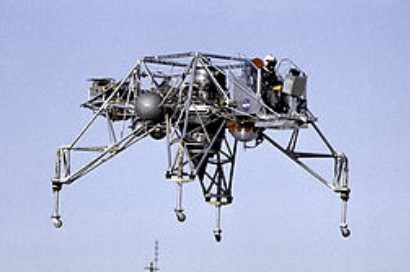
Lunar Landing Research Vehicle (LLRV) with its CF700 in the center of the vehicle

The General Electric CF700 (military designation TF37) is a turbofan development of the CJ610. The CF700 has an uncommon rear-mounted fan connected directly to the low-pressure turbine blade for improved fuel economy.

Applications:
Dassault Falcon 20
North American Sabreliner Series 75A and 80
Lunar Landing Research Vehicle/Lunar Landing Training Vehicle

Specifications:

CF700
Type: Single spool turbofan
Length: 75.5 in (1,918 mm)
Diameter: 33 in (838 mm))
Dry weight: 735 lb (333.4 kg) with optional thrust reverser
Compressor: 8 stage high pressure compressor + 1 stage fan directly driven by the free LP turbine
Turbine: 2 stage high pressure turbine, 1 stage low pressure turbine
Fuel type: Aviation kerosene
Maximum thrust: 4,200 lbf (18.68 kN)
Bypass ratio: 2.0:1
Specific fuel consumption: 0.67 lb/lbf-hr (68.3 kg/kN-hr) at maximum cruising speed
Thrust-to-weight ratio: 6.6:1

General Electric CF34

The General Electric CF34 is a civilian turbofan developed by GE Aircraft Engines from its TF34 military engine. First run in the 1960s, the original engines comprise a single stage fan, driven by a 4-stage LP turbine, supercharging a 14-stage HP compressor, driven by a 2-stage HP turbine, with an annular combustor. Later higher thrust versions of the CF34 feature an advanced technology core, with only 10 HP compressor stages. Later variants, the -10A and -10E, were derived from the CFM56 engine family, and have a radically different HP spool, comprising a 9 stage compressor driven by a single stage turbine. The LP spool has 3 core booster stages behind the fan. Static thrust is 18,500 lbf for the -10E variant.

Applications:

CF34-1
Bombardier CL-601-1A
Bombardier CL-601-1A/ER

CF34-3A
Bombardier CL-601-3A

CF34-3A1
Bombardier CRJ100 ER/LR

CF34-3A2

CF34-3B
Bombardier CL-604
Bombardier CL-605

CF34-3B1
Bombardier CRJ200 ER/LR
Bombardier CRJ440 ER/LR

CF34-8C1
Bombardier CRJ700 (Series 701)

CF34-8C5
Bombardier CRJ700 (Series 705)
Bombardier CRJ900
Bombardier CRJ900 NextGen

CF34-8C5A1
Bombardier CRJ1000 NextGen

CF34-8C5B1
Bombardier CRJ700 NextGen

CF34-8E
Embraer E-170
Embraer E-175

CF34-10A
Comac ARJ21

CF34-10E
Embraer E-190
Embraer E-195

Specifications:

CF34-3
Length: 103 in (2.6 m)
Diameter: 49 in (1.2 m)
Dry weight: 1,625 lb (737 kg) – 1,670 lb (760 kg)
Compressor: 1 fan / 14 HP stages
Turbine: 4 LP stages / 2 HP stages
Thrust at sea level: 9,220 lbf (41.0 kN)
Power-to-weight ratio: 5.6:1
Overall pressure ratio at max. power: 21:1
Bypass ratio: 6.2:1

CF34-8
Length: 121.2 in (3.08 m) – 128 in (3.3 m)
Diameter: 52 in (1.3 m) – 53.4 in (1.36 m)
Dry weight: 2,408 lb (1,092 kg) – 2,600 lb (1,200 kg)
Compressor: 1 fan / 10 HP stages
Turbine: 4 LP stages / 2 HP stages
Thrust at sea level: 13,790 lbf (61.3 kN) – 14,510 lbf (64.5 kN)
Power-to-weight ratio: 5.3:1
Overall pressure ratio at max. power: 28:1 – 28.5:1
Bypass ratio: 5:1

CF34-10
Length: 90 in (2.3 m) – 145.5 in (3.70 m)
Diameter: 57 in (1.4 m)
Dry weight: 3,700 lb (1,700 kg)
Compressor: 1 fan + 3 LP stages / 9 HP stages
Turbine: 4 LP stages / 1 HP stage
Thrust at sea level: 18,285 lbf (81.34 kN) – 20,000 lbf (89 kN)
Power-to-weight ratio: 5.2:1
Overall pressure ratio at max. power: 29:1
Bypass ratio: 5:1