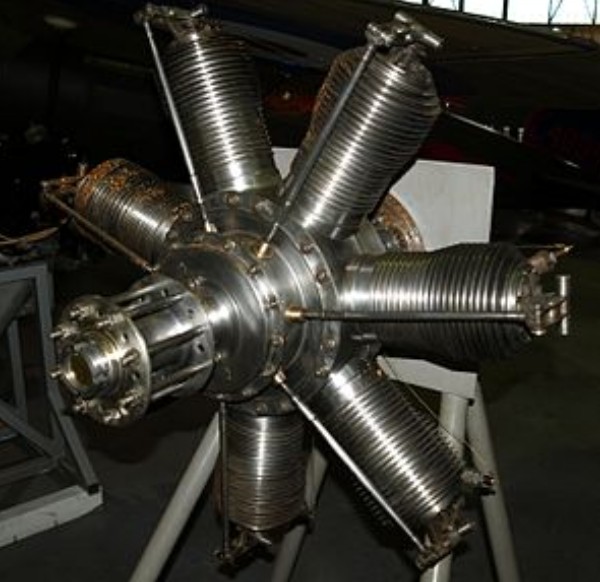
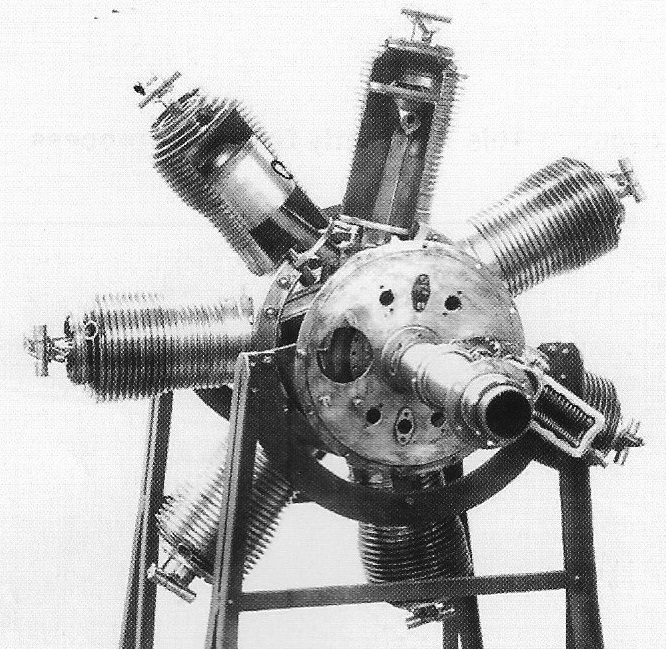
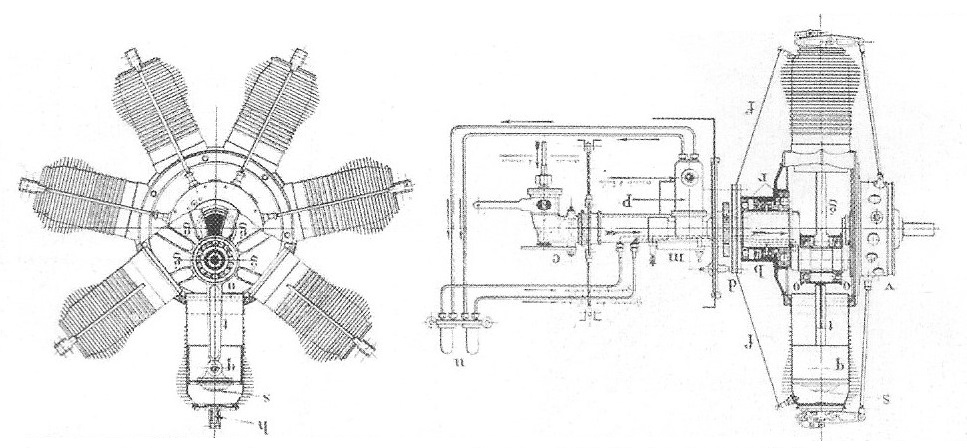
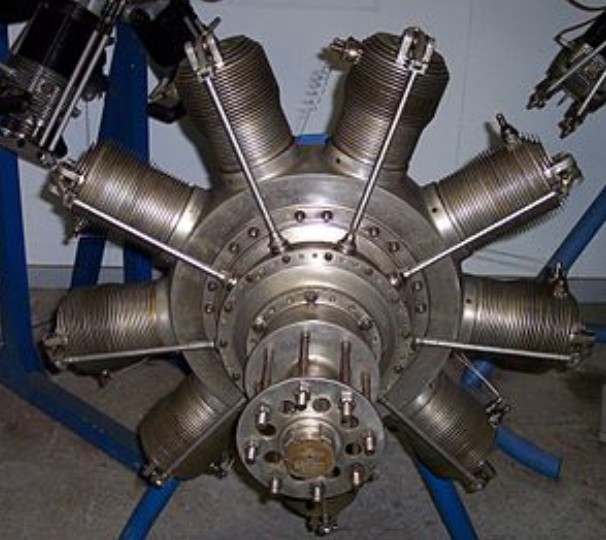
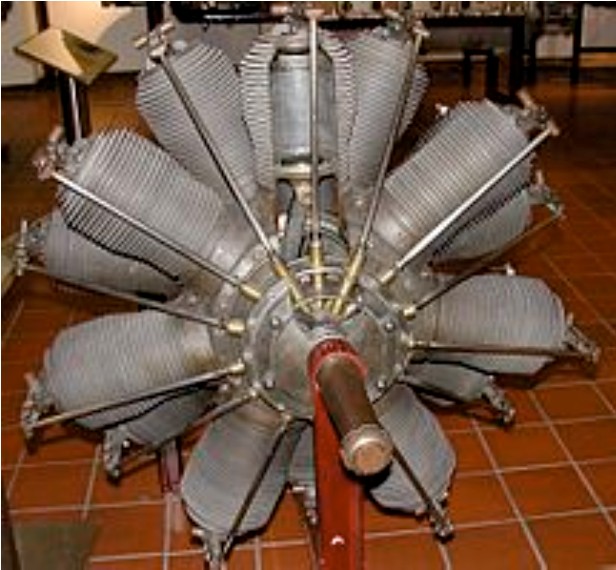
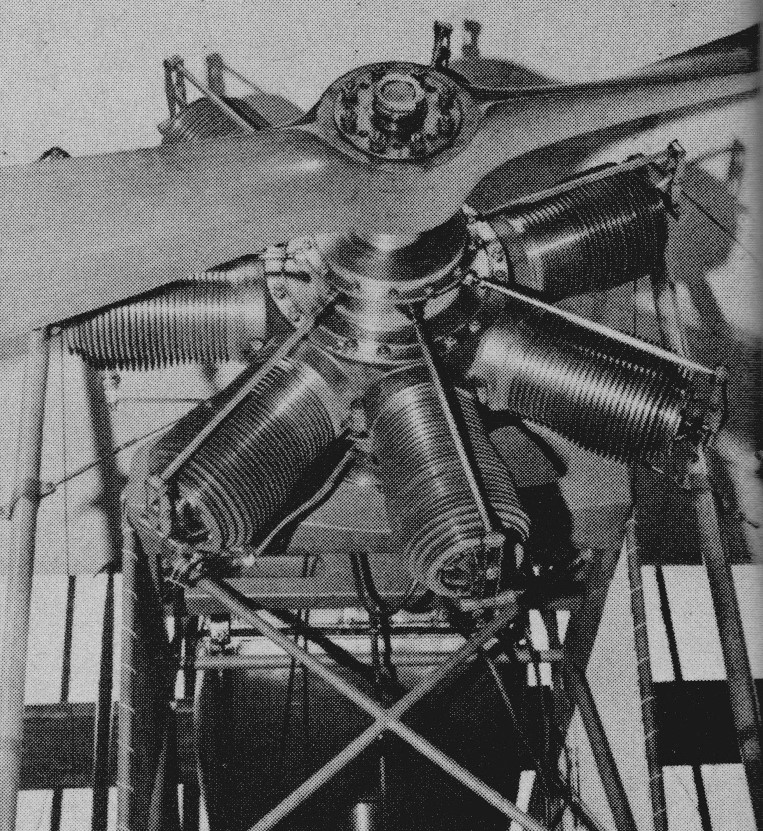
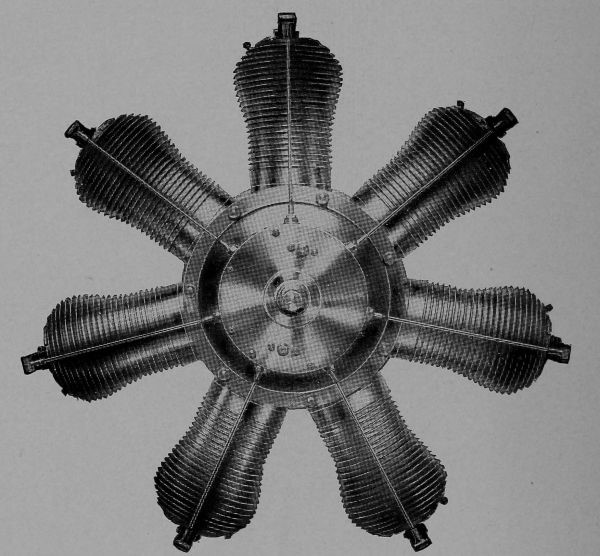
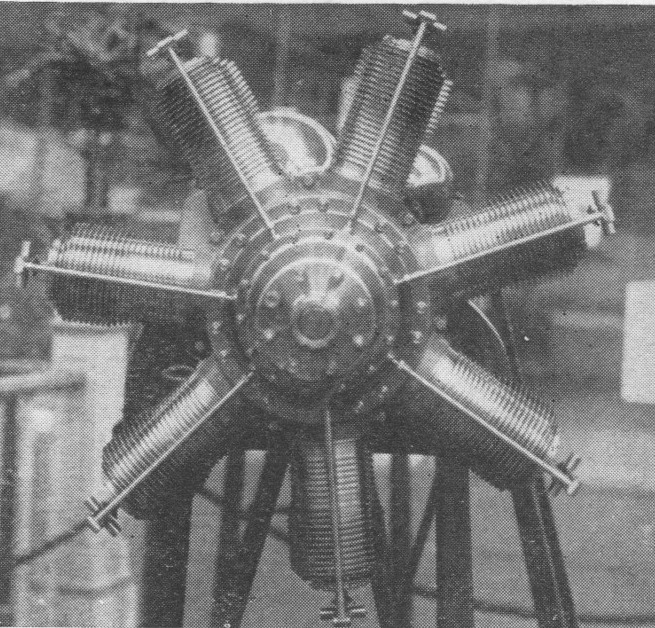
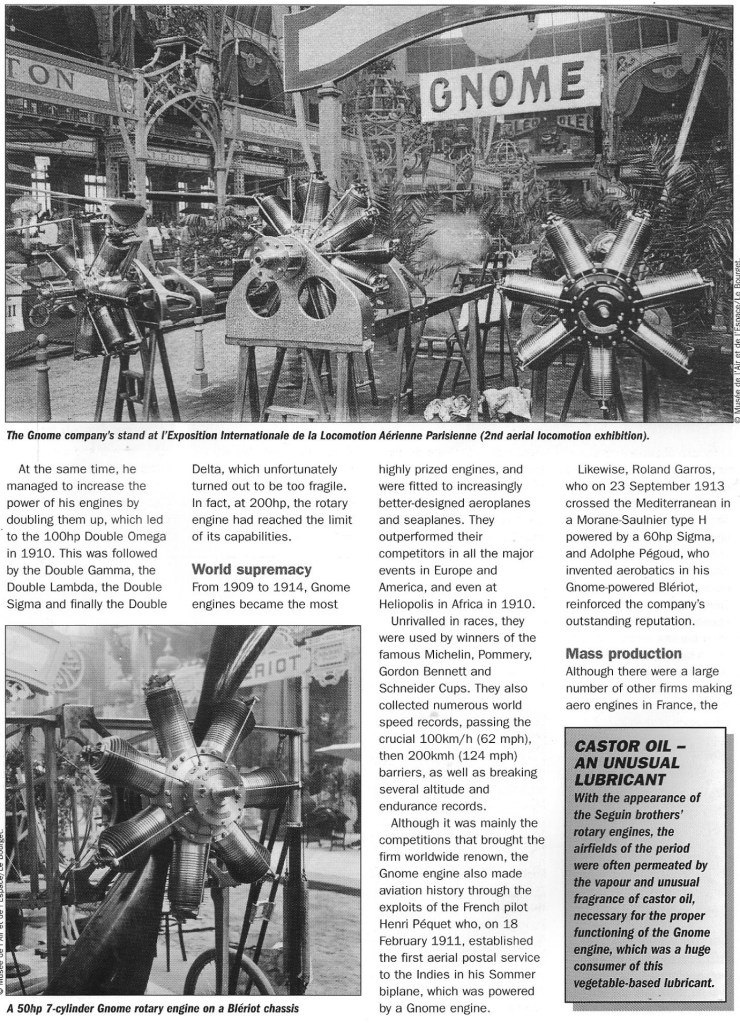
The Gnome 7 Omega (commonly called the Gnome 50 hp) is a French seven-cylinder, air-cooled aero engine. It was shown at the Paris Aero Salon held in December 1908 and was first flown in 1909. The unit cost in 1909 was £520.
It was the world’s first rotary engine produced in quantity, and its introduction revolutionized the aviation industry and it was used by many early aircraft. 4,000 had been produced until 1914 (more later). It produced 50 horsepower (37 kW) from its capacity of 8 litres (488 cubic inches).
Gnome 50 hp
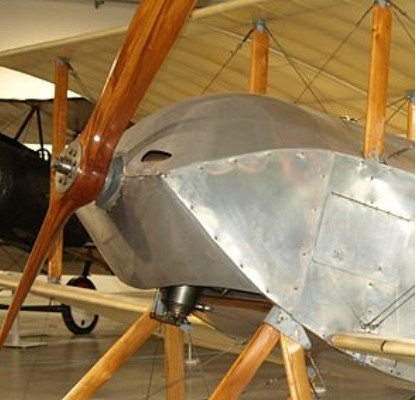
A Gnome Omega engine powers the 1912 Blackburn Monoplane, owned and operated by the Shuttleworth Collection, the oldest known airworthy British-designed aeroplane worldwide.
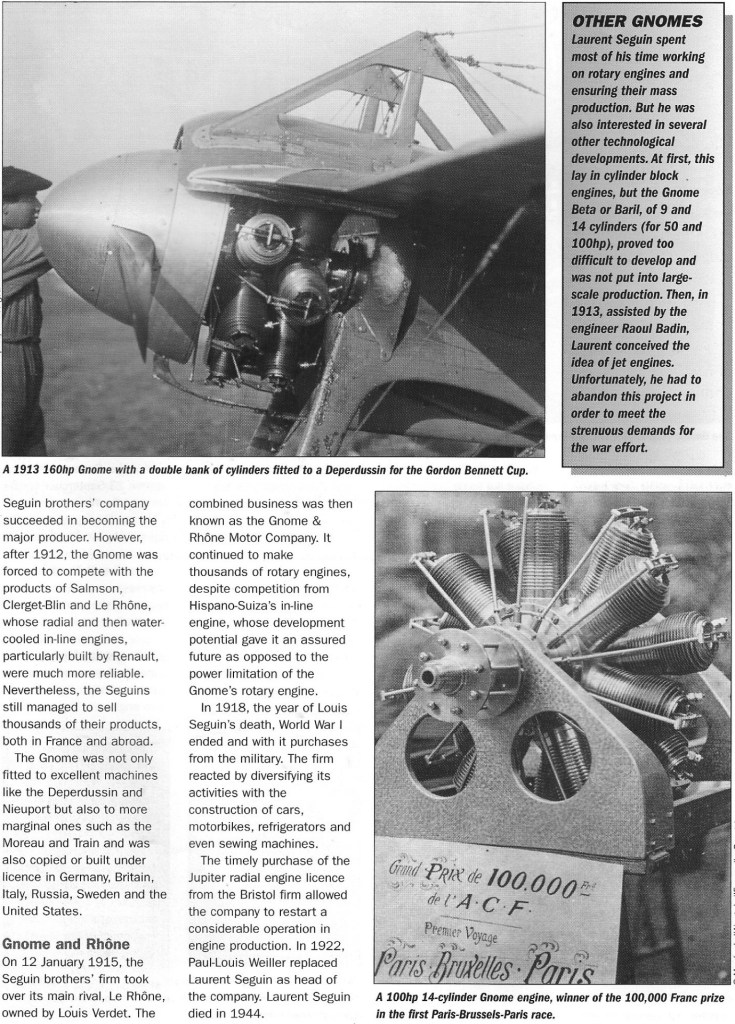
A two-row version of the same engine was also produced, known as the Gnome 14 Omega-Omega or Gnome 100 hp. The prototype Omega engine still exists, and is on display at the United States’ National Air and Space Museum.
Variants Gnome 7 Omega Single-row 7-cyl. original version; 50 hp (37 kW). Gnome 14 Omega-Omega Two-row, 14-cylinder version using Omega cylinders; 100 hp (75 kW).
Applications:
Gnome 7 Omega
Avro Type 500 Blackburn Mercury Blackburn Monoplane Blériot XI Bristol Boxkite Bristol Racing Biplane Bristol Monoplane Bristol-Prier P.1 Bristol-Coanda School Monoplane Bristol-Coanda T.B.8 Burga Monoplane Fabre Hydravion Henry Farman Type Militaire Grahame-White School Biplane Koolhoven Heidevogel Nieuport Monoplane Paulhan Biplane Pemberton-Billing P.B.9 Royal Aircraft Factory B.E.3 Royal Aircraft Factory B.E.4 Royal Aircraft Factory F.E.2 Short S.27 Short Tandem Twin Short S.37 Tractor Monoplane Short Triple Twin Short S.47 Triple Tractor Short S.62 Sopwith Bee Sopwith Sparrow Valkyrie Type B Vickers No.6 Monoplane Vickers No.7 Monoplane Vickers Boxkite School Biplane
Gnome 14 Omega-Omega
Bristol Gordon England G.E.2 Coventry Ordnance Works Biplane 10 Nieuport Monoplane Short S.41 Tractor Biplane Short S.57 Seaplane Short S.64 Folder Seaplane Short S.74 Admiralty Seaplane
Specifications:
7 Omega Type: 7-cylinder, single-row, rotary engine Bore: 110 mm (4.3 in) Stroke: 120 mm (4.7 in) Displacement: 8 L (488.5 cu in) Length: 79 cm (31 in) Diameter: 84 cm (33 in) Dry weight: 75 kg (165 lb) Valvetrain: pressure-driven inlet valves were located on the pistons Oil system: Total loss, castor oil Cooling system: Air-cooled Reduction gear: Direct drive, right-hand tractor, left-hand pusher Power output: 37 kW (50 hp) at 1,200 rpm
The Monosoupape (French for single-valve), was a rotary engine design first introduced in 1913 by Gnome Engine Company (since 1915 called Gnome et Rhône). It used an arrangement of internal transfer ports and a single pushrod-operated exhaust valve to replace a large number of moving parts found on more conventional rotary engines, and made the Monosoupape engines some of the most reliable of the era. British aircraft designer Thomas Sopwith described the Monosoupape as “one of the greatest single advances in aviation”.
Produced under license in Britain the engine was built in large numbers in both seven and nine-cylinder versions, the latter being produced with two different displacements.
Contrary to the Le Rhône designs, earlier Gnome engines like the Gnome Omega, Lambda and Delta used a unique arrangement of valves in order to avoid needing pushrods and other complex devices that operated during the inlet phase of the combustion cycle on more conventional engines. Instead, a single exhaust valve on the cylinder head was operated by a pushrod that opened the valve when the pressure dropped at the end of the power stroke. A pressure-operated inlet valve, which was balanced by a counterweight to equalize the centrifugal forces, was placed in the centre of the piston crown, where it opened to allow the fuel–air charge to enter from the engine’s central crankcase.
Although ingenious, the system had several drawbacks: the cylinder heads had to be removed both in order to perform maintenance of the intake valve, which could easily become jammed, and in order to adjust the timing and pressures correctly for the rod-less operation; and the Gnomes exhibited even poorer fuel economy than other rotaries because the inlet valves opened at times that were not efficient.
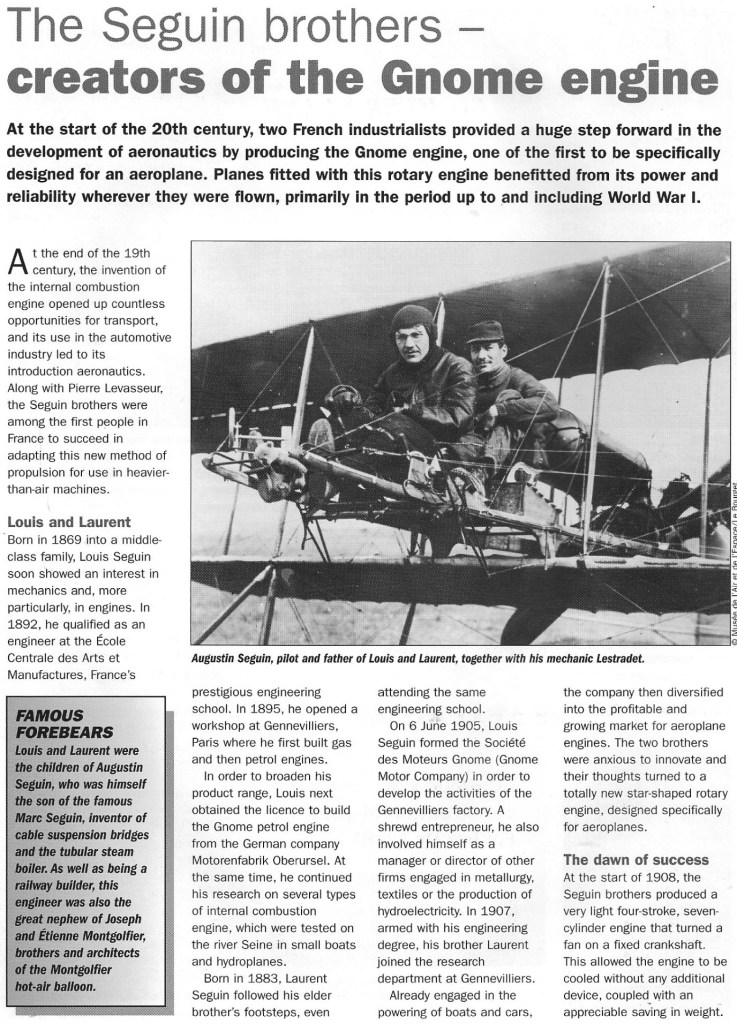
In 1913, Louis Seguin and his brother Laurent (engineers who founded the Société Des Moteurs Gnome [the Gnome motor company] in 1905) introduced the new Monosoupape series, which eliminated the inlet valve, replacing it with piston-controlled transfer ports similar to those found in a two-stroke engine. Beginning with the power stroke, the four-stroke engine operated normally until the piston was just about to reach the bottom of its stroke (bottom dead center, or BDC), when the exhaust valve was opened “early”. This let the still-hot burnt combustion gases “pop” out of the engine while the piston was still moving down, relieving exhaust pressure and preventing exhaust gases from entering the crankcase. After a small additional amount of travel, the piston uncovered 36 small ports around the base of the cylinder, leading to the crankcase which held additional fuel–air mixture (the charge). No transfer took place at this point since there was no pressure differential; the cylinder was still open to the air and thus at ambient pressure. The overhead valve exhausted directly into the slipstream since there was no exhaust manifold in order to save weight.
During the exhaust stroke, total scavenging occurred as the air moving past the cylinder exterior lowered the pressure inside due to the direct exposure of the exhaust port to the slipstream. The piston continued its exhaust stroke until top dead center (TDC) was reached, but the valve did not close. The piston began to move down on its intake stroke with the valve still open, pulling fresh (presumably un-filtered) air into the cylinder. It remained open until it was two-thirds of the way down, at which point the valve closed and the remainder of the intake stroke greatly reduced the air pressure. When the piston uncovered the transfer ports again, the low pressure in the cylinder drew in the balance of the charge.
The charge was an overly rich mixture of air, which was acquired through the hollow crankshaft, and fuel that was continuously injected by a fuel nozzle on the end of a fuel line, entering the crankcase through the hollow crankshaft. The nozzle was in the proximity of, and aimed at, the inside base of the cylinder where the transfer ports were located. The fuel nozzle was stationary with the crankshaft, and the cylinders rotated into position in turn. The compression stroke was conventional.
The spark plug was installed horizontally into the rear of the cylinder at the top but had no connecting high-voltage wire. An internal-tooth ring gear mounted on the engine drove a stationary magneto mounted on the firewall, whose high-voltage output terminal was in close proximity to the spark plug terminals as they passed by. This arrangement eliminated the need for points, distributor, high-voltage wiring and capacitors found in conventional mechanically timed ignition systems. This ring gear also drove the oil pump, which supplied oil to all bearings, and through hollow pushrods to the rockers and valves and also drove an air pump which pressurized the fuel tank. The later Gnome 9N engines had dual ignition systems for safety, with twin spark plugs per cylinder which were electrically wired, with the wires routed onto the crankcase and a central pair of magnetos driven by the spinning engine crankcase.
The Monosoupape had no carburetor or throttle, and since most of its air supply was taken in through the exhaust valve, it could not be controlled by adjusting the air supply to the crankcase like other rotaries. Monosoupapes therefore had a single petrol regulating control used for a limited degree of speed regulation. In early examples, engine speed could be controlled by varying the opening time and extent of the exhaust valves using levers acting on the valve tappet rollers, but this was later abandoned due to causing burning of the valves. Instead, a blip switch was used, which cut out the ignition when pressed. This was used sparingly to avoid damaging the engine, since it was only safe to be used when the fuel supply was also cut. Some later Monosoupapes were fitted with a selector switch which allowed the pilot to cut out three or six cylinders instead of all nine when hitting the blip switch, so that each cylinder fired only once per three engine revolutions but the engine remained in perfect balance.
The lubrication system, as with all rotary engines, was a total-loss type in which castor oil was injected into the fuel–air mix with a small pump. Castor oil was used because it could not be easily dissolved into the fuel, and because it possessed lubrication qualities superior to mineral oils of the day. Over two gallons of castor oil were sprayed into the air during each hour of engine operation. This explains why most rotaries were fitted with a roughly 270º perimeter “horseshoe”-shape ring cowl, with the lowermost quarter of the cowl omitted to be open at the bottom. The cowl directed the spray of castor oil, along with sparks from the exhaust, away from the flammable aircraft structure. Unburnt castor oil from the engine tended to be hurled into the pilot’s face, often having a laxative effect on the pilot if ingested.
Because the entire engine rotated, it had to be precisely balanced, requiring precision machining of all parts. As a result, Monosoupapes were extremely expensive to build, the 100 horsepower (75 kW) models costing $4,000 in 1916. However, they weighed slightly less than the earlier two-valve engines and also used less lubricating oil.
Variants:
Gnome Monosoupape 7 Type A (1916) Seven-cylinder rotary engine, 80 hp (60 kW). Bore and stroke: 110 x 150 mm (4.3 x 5.9 in). Gnome Monosoupape 9 Type B-2 (1916) Nine-cylinder rotary engine, 100 hp (75 kW). Bore and stroke: 110 x 150 mm (4.3 x 5.9 in). 2,188 units produced under license in Britain. Gnome Monosoupape 9 Type N (1917) Nine-cylinder rotary engine, larger diameter crankcase than the B-2, 150 or 160 hp (112 or 119 kW). Bore and stroke: 115 x 170 mm (4.5 x 6.7 in).
The Gnome-Rhône 7K Titan Major was a seven-cylinder 370 hp (270 kW) air-cooled radial engine, that started life as an enlarged Gnome-Rhône 5K with two extra cylinders. The Gnome-Rhône 5K was itself a licensed version of the Bristol Titan. The 7K is very comparable to the Bristol Neptune seven-cylinder engine since they used the same technology. The 7K was followed by the larger and more powerful nine-cylinder 550 hp (405 kW) Gnome-Rhône 9K Mistral. Gnome-Rhône later responded to the need for a more powerful engine by developing the 7K into a two-row version that became the Gnome-Rhône14K Mistral Major.
The CNIAR IAR 7K was a licence-built Gnome-Rhône 7Ksd, 420 hp aircooled 7-cyl radial.
Applications: Bernard 160 Breda Ba.25 Breguet 393T Breguet 414 FBA 291 FBA 294 Lioré et Olivier LeO H-199 Lioré et Olivier LeO 203 Lioré et Olivier LeO H-242 Morane-Saulnier MS.235 Potez 33/3 Rogožarski PVT Rogožarski R-100 SET 7 SPCA 80 SPCA 90 Wibault 280 Wibault 362
The Gnome 7 Lambda was a French designed, seven-cylinder, air-cooled rotary aero engine that was produced under license in Britain and Germany. Powering several World War I era aircraft types it was claimed to produce 80 horsepower (60 kW) from its capacity of 12 litres (720 cubic inches) although recorded figures are lower.
Gnome 7 Lambda
Just under 1,000 units were produced in Britain, the majority (967) by the Daimler Company of Coventry. A 14-cylinder variant was known as the Gnome 14 Lambda-Lambda.
In Germany Motorenfabrik Oberursel license-built the seven-cylinder engine as the Oberursel U.0 and later copied the 14-cylinder design and designated it as the Oberursel U.III.
Gnome 7 Lambda
Variants: Gnome 7 Lambda Seven-cylinder, single-row rotary engine. Gnome 7 Lambda (long stroke) Increased stroke of 145 mm (5.7 in) to raise the compression ratio to 3.87:1, and total displacement to 12.26 litres. Gnome 14 Lambda-Lambda 14-cylinder, two-row rotary engine using Lambda cylinders. 160 hp (120 kW). Motorenfabrik Oberursel U.0 German production of the Gnome 7 Lambda – had a 124mm cylinder bore and 140mm piston stroke for a total displacement of 11.52 litres, external diameter of 1.020 meters.
Applications:
Gnome 7 Lambda Avro 504 Blackburn Type I Blériot Parasol Blériot XI Bristol Boxkite Bristol Gordon England G.E.3 Bristol-Coanda Monoplanes Bristol Coanda T.B.8 Bristol Coanda P.B.8 Bristol Scout Caudron G.III Deperdussin Type B Dunne D.8 Henry Farman F.20 Grahame-White G.W.15 L & P 4 Lowe Marlburian Nieuport IVG Nieuport 10 Radley-England Waterplane Royal Aircraft Factory B.E.3 Royal Aircraft Factory B.E.4 Royal Aircraft Factory B.E.8 Royal Aircraft Factory B.S.1 Royal Aircraft Factory S.E.2 Royal Aircraft Factory S.E.2 Royal Aircraft Factory S.E.4 Short S.37 Short S.38 Short S.41 Short S.60 Short S.70 Sopwith Gordon Bennett Racer Sopwith Pup Sopwith Sociable Sopwith Tabloid Sopwith Three-Seater Vickers No.8 Monoplane
Gnome 14 Lambda-Lambda Avro 510 Royal Aircraft Factory S.E.4 Deperdussin Monocoque Short S.63 Short S.64 Short S.70 Short S.74 Short S.80 Short S.81 Short S.82
Specifications:
Gnome 7 Lambda Type: 7-cylinder, single-row, rotary engine Bore: 124 mm (4.9 in) Stroke: 140 mm (5.5 in) Displacement: 11.8 L (721.2 cu in) Length: 112 cm (44 in) Diameter: 93 cm (36.6 in) Dry weight: 96 kg (212 lb) Valvetrain: Automatic centre-piston inlet valve, overhead exhaust valve (one each per cylinder) Cooling system: Air-cooled Reduction gear: Direct drive, right-hand tractor, left-hand pusher Power output: 50.3 kW (67.5 hp) at 1,250 rpm (maximum power) Compression ratio: 3.75:1
The Gnome 7 Gamma was a French designed, seven-cylinder, air-cooled rotary aero engine. Powering several pre-World War I era aircraft types it produced 70 horsepower (52 kW) from its capacity of 12 litres (680 cubic inches).
March 1909
A 14-cylinder variant was known as the Gnome 14 Gamma-Gamma.
Gnome 14 Gamma-Gamma 14-cylinder, two-row rotary engine using Gamma cylinders. 140 hp (104 kW).
Applications:
Gnome 7 Gamma Blériot XXI Bristol Biplane Type T Bristol Prier-Dickson Henry Farman Biplane Grahame-White Passenger Biplane VIIc Handley Page H.P.3 Morane-Borel seaplane Nieuport Monoplane Paulhan Biplane Royal Aircraft Factory B.E.3 Royal Aircraft Factory B.E.4 Short School Biplane Short S.32 Short S.36 Short S.38 Short S.45 Sopwith Three-Seater Vickers No.6 Monoplane Vickers No.8 Monoplane
Gnome 14 Gamma-Gamma Royal Aircraft Factory B.E.7 Short S.41
Specifications: Gnome 7 Gamma Type: 7-cylinder, single-row, rotary engine Bore: 120 mm (4.7 in) Stroke: 130 mm (5.1 in) Displacement: 11.14 L (679.84 cu in) Length: 112.7 cm (44.4 in) Diameter: 86.9 cm (34.2 in) Valvetrain: Automatic centre-piston inlet valve, overhead exhaust valve (one each per cylinder) Cooling system: Air-cooled Reduction gear: Direct drive, right-hand tractor, left-hand pusher Power output: 52.2 kW (70 hp) at 1,200 rpm
Société des Moteurs Gnôme was founded in 1905 by Louis Seguin. In 1915, this firm merged with the Société des Moteurs Le Rhône, founded three years earlier by Louis Verdet, to form Gnôme & Rhône. While Gnôme had continued to produce rotary engines in the 50 to 100 horsepower range, Rhône had refined its fixed-cylinder engines to produce 200 horsepower. However, both these lines of engines were being outclassed in terms of reliability, economy, or power by several contemporary engine manufacturers.
Nevertheless, the two merged companies were quite successful commercially, thanks to licensed production in Great Britain, Russia, the United States, Sweden, Germany, and Japan, as well as joint ventures in Italy and elsewhere.
A number of factors hit Gnôme & Rhône (G&R) hard after the war. A huge tax burden was levied based on the firm’s previous international success. At the same time, a mass of war surplus engines glutted the market.
Unlike its other domestic rivals, Gnôme & Rhône lacked experience in areas apart from aero engines, a market now glutted by thousands of surplus motors. A variety of schemes, from making sewing machines to engines for farm tractors or cars, all failed. In constant francs, the company’s sales in 1921 were almost half those of 1913, though the factories were five times larger, notes one scholar in the journal Entreprise et Histoire. In that year, the already legendary company reduced its employment from 6500 workers to 1200.
Production of motorcycles under the Gnôme & Rhône was one area that produced quite satisfactory results in the marketplace; in fact these machines gained a devoted following. In 1922 the English firm Bristol licensed to G&R the right to produce its powerful air-cooled radial engines producing up to 450 horsepower, as well as the freedom to sell them anywhere in the world except for the United States and the territories of the British Empire. With the support of its banks, G&R was able to retool its workshops to build engines, including the new Jupiter introduced in 1923. At the time, G&R had also taken a significant holding in a French-Romanian airline, which helped establish its engines in Eastern Europe.
Between 1924 and 1928, sales increased more than sixfold. At the same time, the air, sea, and land branches of the French military were deciding their outdated equipment was in need of replacement, hence, another blossoming market at home. Expanding commercial fleets produced still more demand. The radial Jupiter engines earned a reputation for being simple to run and easy to fix, even if in-line and V-8 engines made by Hispano-Suiza and Lorraine-Dietrich were more powerful. A novel program, instituted in 1924, allowed for the lease of the engines for a given number of flight-hours, which relieved designers and manufacturers some of the financial strain associated with bringing out new models of aircraft. The popular Jupiter engine was subsequently licensed for production in several European countries as well as the Soviet Union and Japan.
G&R introduced its K family of engines in 1928. In terms of power, this series culminated in the 750 horsepower 14K licensed to a Soviet factory for eventual use in Antonov transports. G&R’s designers evolved L, M, and N families of engines by 1939; one of the latter achieved 1150 horsepower.
Air power played a determining role World War II, and G&R engines had a significant part to play. The Soviet Union’s Molotov factory was producing 300 licensed G&R engines a month in 1940 for use in biplanes and Sukhoi fighters. In Japan, Mitsui illegally copied the 850 h.p. 14K engine, producing the “Suizei” powerplant found in the Mitsubishi Zeroes that attacked Pearl Harbor. During the Nazi occupation of France, G&R became a subsidiary of BMW. Emmanuel Chadeau writes in Entreprises et Histoire that G&R thereby influenced 16 manufacturers in 14 countries during the war; this off-shore production nearly equalled G&R’s own output of 8,000 motors a year, together accounting for a quarter of the worldwide market.
The high share price that G&R commanded prevented it from being nationalized before the war. However, this did come to pass after the Liberation. SNECMA, la Société nationale d’étude et de construction de moteurs d’aviation, was thus created on May 29, 1945. The company was an amalgamation of diverse design bureaus and workshops; it inherited a work force of 10,000 mostly part-time employees. Along with G&R, Snecma was given some of the factories of the Société des moteurs et automobiles Lorraine, formerly Lorraine-Dietrich, which had been nationalized as la Société nationale des moteurs and had been relegated to making parts for tanks. Some of Snecma’s other facilities had been devoted to the production of German Junkers engines by the thousands during the Nazi occupation. G&R also owned a factory of the Aéroplanes Voisin firm, which had gone bankrupt in 1938.
Cycle: 4 stroke No cylinders: Vee 2 Bore: 97 mm Stroke: 76 mm Compression: 8.5 Displacement: 1122 cc Cooling: air / oil Ignition: electronic Reduction: Poly-V belt 2.3/1 Weight: 57 kg Max pwr: 70 hp at 5800 rpm Max torque: 131 Nm at 4200 rpm Price 1998: 89 000 000 L