The 1909 Goupy II biplane, designed by Ambroise Goupy in France, powered by a REP or Anzani engine, was built at the Bleriot factory.
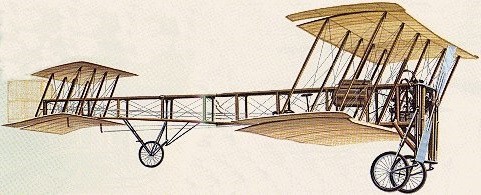
Span: 20′
Length: 23′
Weight gross: 630 lb
Wing area: 26 sq.m
The 1909 Goupy II biplane, designed by Ambroise Goupy in France, powered by a REP or Anzani engine, was built at the Bleriot factory.
Span: 20′
Length: 23′
Weight gross: 630 lb
Wing area: 26 sq.m
The three-passenger Goupy biplane, type 1914-B, resembled in general construction other machines of this firm. The cell is composed of two staggered planes of unequal length: chord 1.6 m. top plane 19.75 m. long, lower one 10.35 m. long.
The cell is rigid and lateral balance is obtained by powerful conjoined ailerons. The fuselage is of quadrangular section. The monoplane tail is slightly lifting and approximately rectangular, terminated by a flap 3.1 by .7 m. serving as an elevator.
The quadrangular rudder, above the tail, is partly balanced and in front of it is a small vertical fin. The 100 hp Gnome supported between two bearings turns a 2.8 m. propeller, the axis being 1.8 m. above the ground. The chassis is of the usual type, skids and wheels: the wheels are far enough forward to prevent “capotage.” The skids, however, do not seem sufficient to protect the propeller in a bad landing on rough ground.

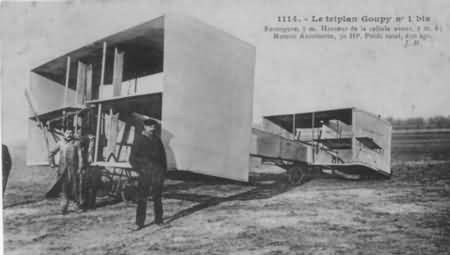
The Goupy I triplane was designed by Goupy, built by Voisin, in France 1909.
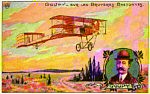
Span: 23′
Weight: 1430 lb
France
Company engaged largely in experimental work but built a few biplanes of its own design from around 1913.
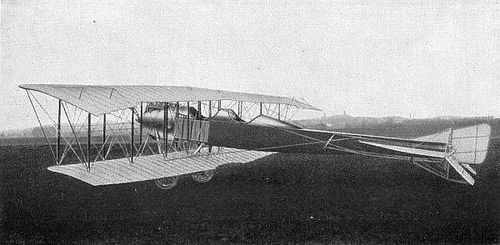
Bruno Büchner designed the 1913, 120 hp Argus powered, 20 m span Schuldoppeldecker biplane built by Gothaer Waggonfabrik.
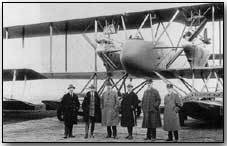
The Gotha WD.27 (for Wasser Doppeldecker – “Water Biplane”) was a patrol seaplanes developed in Germany during World War I. It was a conventional four-engine seaplane with engines grouped in tractor-pusher pairs on the lower wings. Contemporary records show three German Navy serial numbers allocated to the type, but firm evidence of only one of these being built.
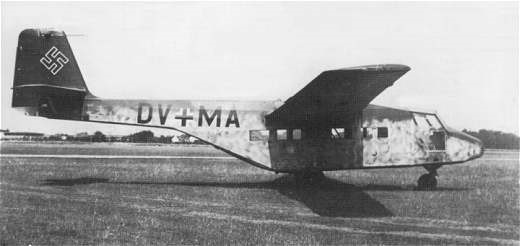
The Gotha Ka 430 was a military transport glider, first built in 1944. The glider was designed by Albert Kalkert. Twelve had been produced by the end of World War II, but none of them was used operationally.
The glider could carry twelve men, and tests were being conducted towards the end of the war to see if it could carry a cargo of 1,400 kg (3,100 lb). A single 13 mm (.51 in) MG 131 machine gun was fitted for self defence.
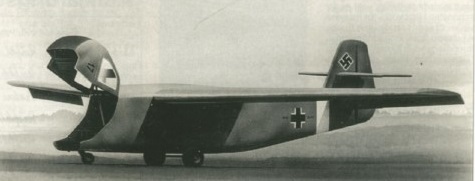
The Gotha Go 345 was a prototype German Military transport glider of the Second World War. A single example was tested in 1944.
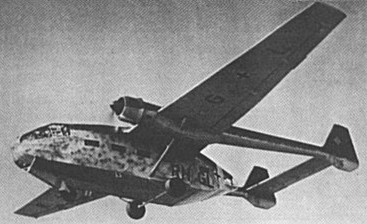
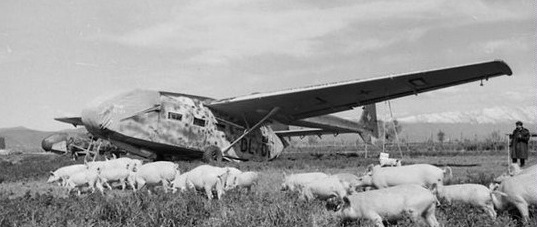
After the fall of France the French Gnome-Rhone 14M radial engine became available to the Germans in large numbers, and the Go 242 was modified to serve as the Go 244 twin-engined transport, each of the twin booms being extended forward of the leading edge of the wing to mount one of these engines. At the same time fixed tricycle landing gear was installed.
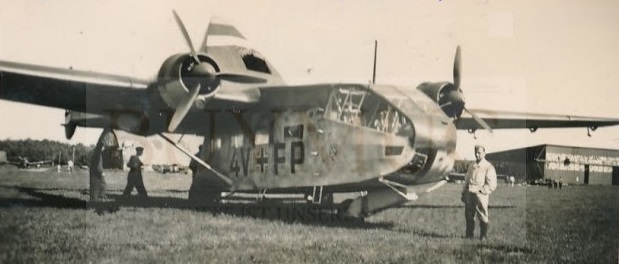
A total of 133 conversions was made from the five Go 242B variants and these were designated correspondingly Go 244B-1 to B-5. First deliveries were made in March 1942 to the Greek-based KGrzbV 104 and to KGrzbV 106 in Crete, but they proved to be relatively easy targets for Allied fighter aircraft and had been withdrawn by November 1942. Some Go 244s had 492kW BMW 132Z or captured Russian Shvetsov M-25As each of 559kW.
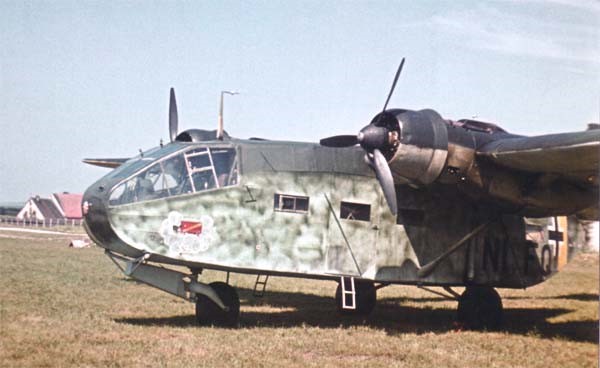
Go-244B-2
Engine: 2 x Gnome-Rhone 14M, 522kW
Max take-off weight: 7800 kg / 17196 lb
Empty weight: 5100 kg / 11244 lb
Wingspan: 24.5 m / 80 ft 5 in
Length: 15.80 m / 51 ft 10 in
Height: 4.70 m / 15 ft 5 in
Wing area: 64.4 sq.m / 693.20 sq ft
Max. speed: 290 km/h / 180 mph
Ceiling: 7500 m / 24600 ft
Range: 600 km / 373 miles
Armament: 4 x 7.9mm machine-guns
Back to Gotha Go 242