Little information has survived about this single-engined 1916 machine with a counter rotating construction of two four-bladed propellers. One was ordered as A8964 but later cancelled.
It could be that the designation Grahame-White M.1 originates from the contract (card) which may be held in the UK archives.
Pictured fully built, it was destined never to fly.
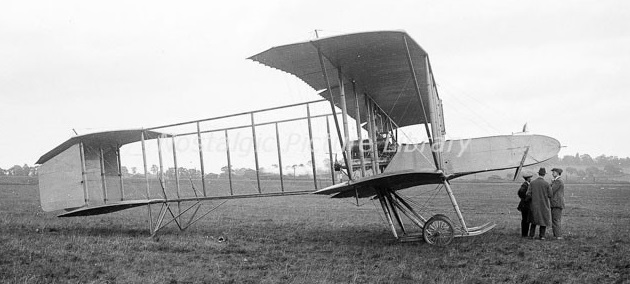
The Grahame-White Type XV (sometimes called “Bi-Rudder ‘Bus” or “Box-Kite” of 1915 was directly derived from the Type XII.
The aircraft itself was a pod-and-boom configuration biplane with three-bay un-staggered wings. In early models, two seats were fitted on the leading edge of the lower wing for the instructor and the trainee pilot; in later models, space was provided for them in tandem in an open-topped nacelle, with the engine mounted pusher-fashion behind them. The empennage was carried on four parallel beams extending two each from the top and bottom wings, and consisted of twin rudders and a horizontal stabiliser and elevator that were carried on the top two beams. Early production aircraft had wings of equal span, but later examples had long extensions fitted to increase the span of the upper wing. The landing gear comprised two separate, wing-mounted, ‘two-wheel plus skid’ assemblies and a tail-skid.
This military trainer biplane was built in quantity for the RNAS (as the Admiralty “Type 1600”) and later the RFC, for a total of 135 aircraft. It was known as the Admiralty Type 1600, since the first aircraft of the type purchased for the Royal Naval Air Service was given that serial number, and contemporary practice was to assign type numbers based on the serial number of the first example in service.
First flying in 1913, there were notable differences between the early and late examples produced, but they retained the same designation. They were made in a variety of forms from 1912 – 17, undergoing a gradual evolution, losing the front elevator and having a cockpit nacelle, aileron balance cables, top wing extensions and dual controls fitted. The Type XV can also be found as the “G.W.15” in some sources.
60hp Le Rhone, 70 & 80hp Gnome and 60hp Green engines were among those used to power the huge variation of types built under the general umbrella name of GW XV.
The Type XV was extensively used as a trainer by both the RNAS and RFC, with 135 machines being purchased for this purpose. In November 1913, one RFC Type XV was employed in the first British trials of firing a machine gun (a Lewis gun) from an aircraft at targets on the ground. Despite the number of aircraft produced, little documentation on the type has survived.
The XV trainers were the type used by No. 65 Squadron RFC, and 48 Reserve Sqn at Waddington from November 1916 to June 1917, as they were established for 18 machines, and A1700 was definitely on their charge. Along with Farman Shorthorns they were the first aircraft based here.
The Type XV was also operated by the Australian Flying Corps at Central Flying School, Point Cook, Victoria, Australia.
GW XV, c.1916
Three Type XVs survived the First World War to become civil aircraft, being some of the first aircraft to bear British aircraft registrations once civil flying was permitted in 1919.
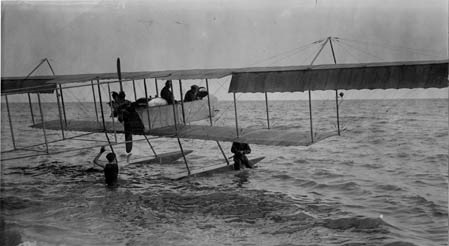
Designed by J. D. North, the Type XIII Circuit Seaplane, originally known as the Circuit Seaplane, of 1914 was a twin-float two-seater tractor seaplane initially built to be flown by Claude Grahame-White in the Daily Mail’s 1914 “Circuit of Britain” air race that was cancelled due to the outbreak of World War I.
It was a conventional single-bay biplane with staggered wings of equal span braced by N-struts. The forward fuselage featured a highly streamlined aluminium engine cowling, with the rest of the construction being wood and fabric. The landing gear consisted of twin pontoons, with a small third pontoon carried beneath the tail.
First flown in 1914, the Type XIII was later converted into a landplane and marketed as the “Type 13 Scout” but no orders materialized.
Engine: 1 × Gnome Monosoupape, 100 hp (75 kW) Wingspan: 27 ft 10 in (8.48 m) Wing area: 290 ft2 (26.9 m2) Length: 27 ft 3 in (8.31 m) Empty weight: 1,040 lb (470 kg) Gross weight: 1,800 lb (820 kg) Maximum speed: 85 mph (136 km/h) Endurance: 5 hr 30 min Crew: One pilot Capacity: 1 passenger
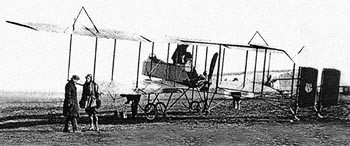
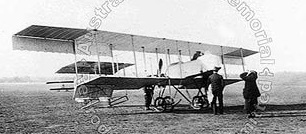
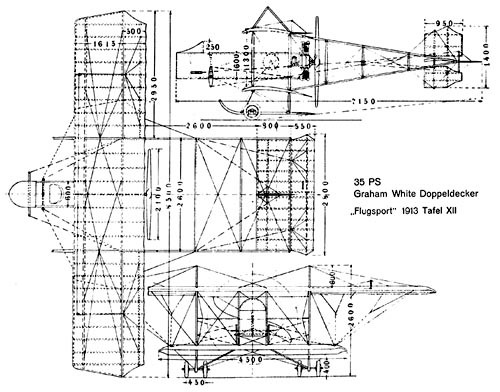
The Grahame-White Type XII “Bi-Rudder ‘Bus” of 1913 was sometimes dubbed the “School ‘Bus”.
This boxkite-type aircraft participated in numerous races before the war and led to the military Type XV. The designation “Type XII” is assumed to be right for this aircraft because the Type XV has been described as “derived from the Type XII”.
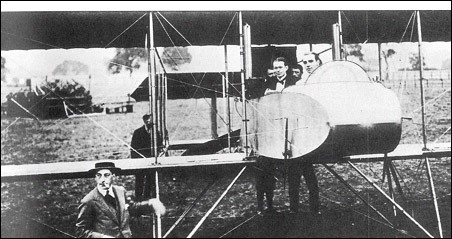
The Grahame-White Type XI (also known as the “Naval and Military Biplane”) was an early aircraft built in the United Kingdom and marketed as being particularly well-suited to military applications. Designed by J. D. North, it was a two-bay biplane of pod-and-boom configuration with un-staggered wings of slightly unequal span. The pilot and an observer sat in tandem, open cockpits in a streamlined nacelle, with the 100 hp Gnome engine mounted pusher-fashion behind them. Unusually for an aircraft of this period, the propeller was not driven directly by the engine, but rather, via a sprocket and chain system that geared it down in the ratio of 14/23. The undercarriage was of the fixed, tailskid type but was designed to be easily exchanged for pontoons. Construction throughout was fabric-covered wood, with the exception of a neat aluminium cowling for the engine and transmission.
A sample was exhibited at the Olympia Aero Show in 1914. It remained in prototype form.
Engine: 1 × Gnome Monosoupape 9 Type B-2, 100 hp (75 kW) Wingspan: 37 ft 0 in (11.28 m) Length: 26 ft 6 in (8.08 m) Empty weight: 1,000 lb (455 kg) Maximum speed: 80 mph (130 km/h) Endurance: 5 hours Crew: Two, pilot and observer
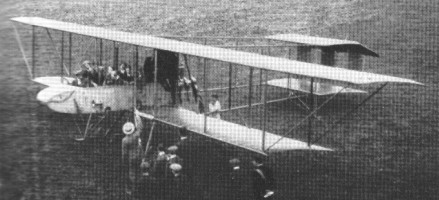
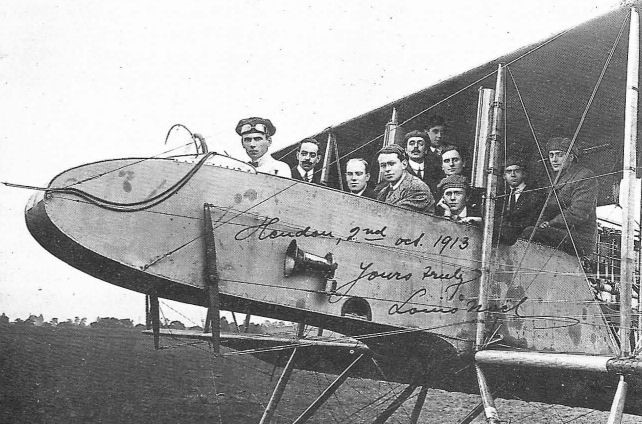
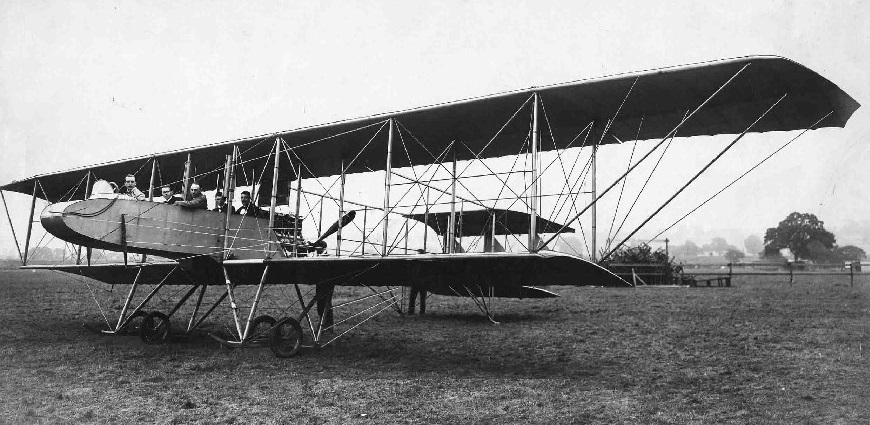
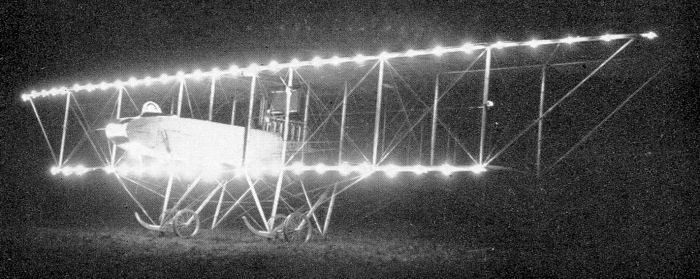
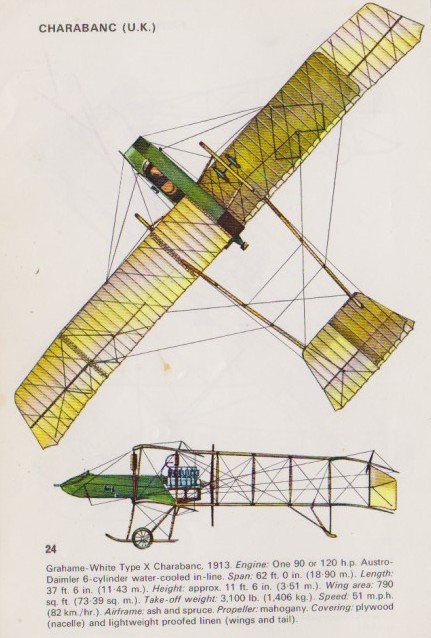
The Charabanc was built by the Grahame-White company to meet the demand for passenger-carrying flights, which could not be satisfied by the existing two-seat designs. Designed by J. D. North, it was an unequal-span pusher biplane with ailerons on both upper and lower wings and a biplane tail unit with three rudders mounted on booms. An elongated nacelle mounted on the lower wing housed the pilot in the front and four passengers in two rows of two seats behind. The wing spars, tail booms and outer interplane struts were of hollow section spruce, and the nacelle and inner struts were of ash.
It first flew in 1913 powered by a 120 hp (89 kW) Austro-Daimler engine, and in this form was flown by Louis Noel with seven passengers aboard to set a British world record on 22 September 1913: on 2 October, he set a world record in carrying nine passengers, staying aloft for nearly twenty minutes, obtaining a Royal Aero Club certificate for the record.
Hendon c 1913
To meet the entry requirements for the 1913 Michelin Cup, which required an all-British aircraft, the engine was replaced by a British-built 100 hp (75 kW) Green E.6 engine. The Charabanc went on to win the cup, covering a distance of over 300 miles on 9 November 1913 piloted by R.H. Carr.
Fitted with 100 hp Green 6 cyl engine, Grahame-White is here seen in the pilot’s seat. 1912
The first parachute descent from an aircraft in Great Britain was made by W. Newell from the aircraft at Hendon on 9 May 1914.
It was also equipped with lights for night flying.
Only one was built, and the Type X Charabanc was sold in March 1916 to the Japanese Naval Authorities.
Engine: 1 × Green E.6, 100 hp (75 kW) Wingspan upper: 62 ft 6 in (19.05 m) Wingspan lower: 43’8″ Wing area: 790 ft2 (73.39 m2) Length: 37 ft 6 in (11.43 m) Empty weight: 2000 lb (907 kg) Gross weight: 3100 lb (1406 kg) Maximum speed: 51 mph (82 km/h) Cruise speed: 45 mph (72 km/h) Crew: 1
The Grahame-White Type IX of 1912 was a single seat tractor monoplane designed by W Rowland Ding. Gnome engine.
A conventional braced single-seat tractor monoplane with monocoque fuselage, warping wings and twin skid undercarriage, it was test-flown by Desoutter and found underpowered. It was re-engined but found unsatisfactory and never heard of anymore.
Engine: Anzani, 35 hp / Gnome, 50 hp Wingspan: 9.75 m Wing area: 19.32 sq.m Length: 6.40 m Height: 2.74 m Endurance: 3 hr 3 min / 4 hr Maximum speed: 89 kph / 105) kph Cruising speed: 80 km/h Seats: 1
Built in 1913, Type VIII Tractor Hydro-Biplane was a tractor biplane seaplane of unequal span, designed by J. D. North, and meant for private owners. Power was Anzani or Gnome.
Only one was built; it was later modified as a landplane and acquired by the Royal Flying Corps, but was soon struck off-charge.
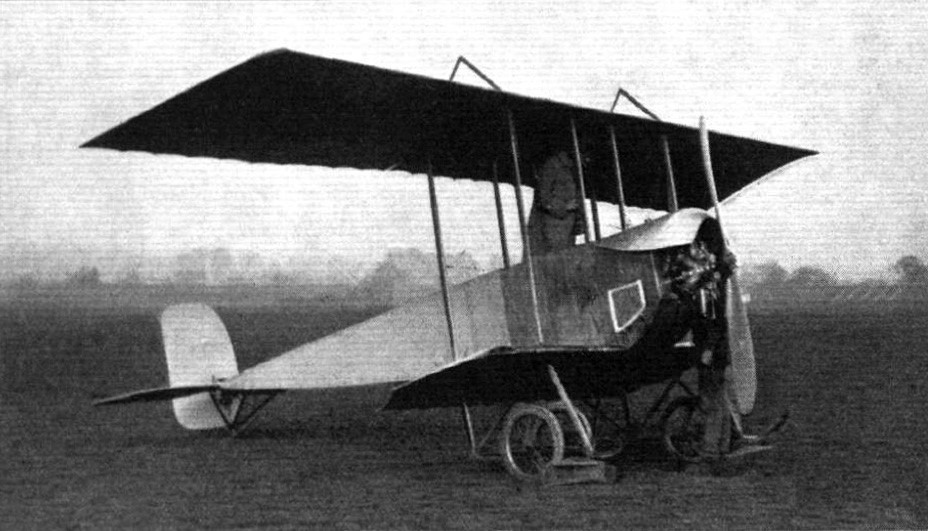
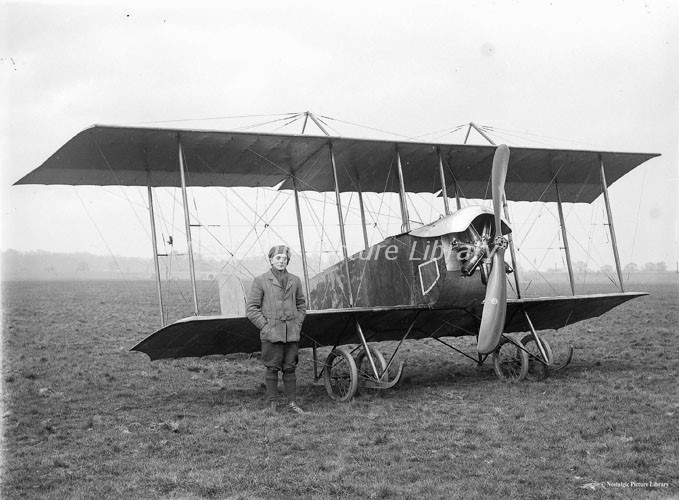
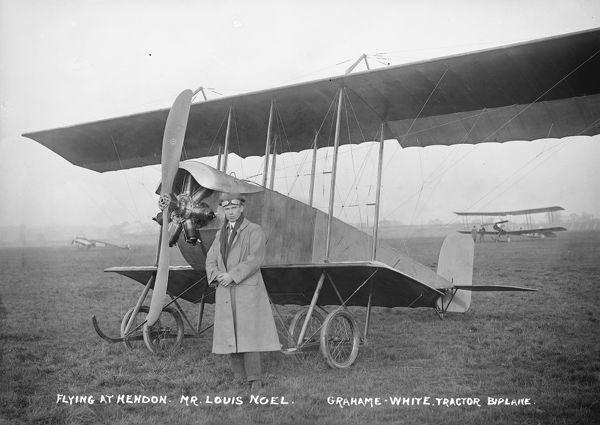
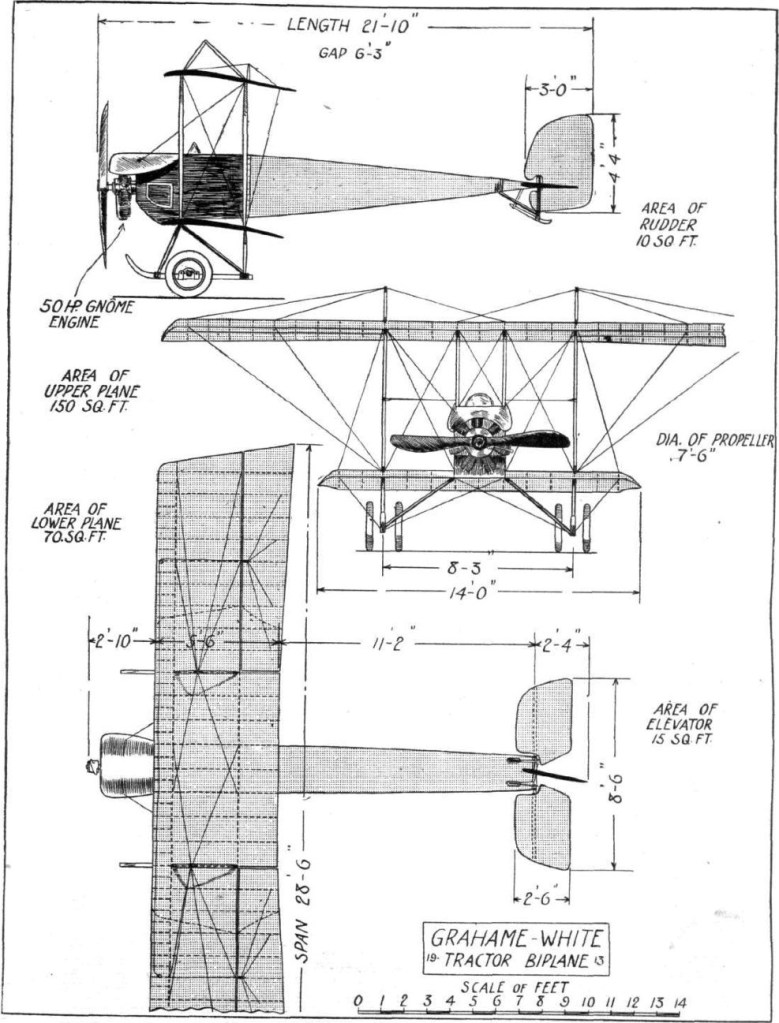
The 50-h.p. Grahame-White tractor biplane, “Lizzie” at Hendon, London, UK.
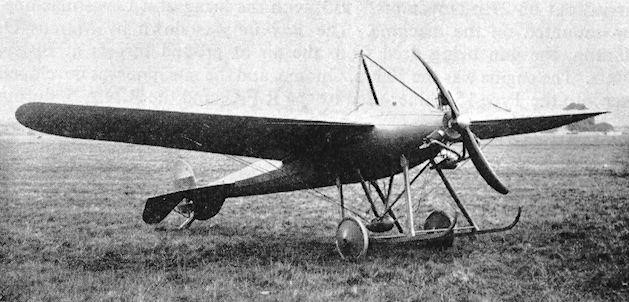
The Grahame-White Lizzie was a 1913 Sesqiplane tractor aircraft mating the wings of a Popular built on a Morane-Saulnier fuselage. Also known as the Tea-tray
R Carr at Hendon c 1913
Recognized by its very short lower wings, but a modified version appeared in 1914 with two bay wings, giving it a more “conventional” look.
Louis Noel flying at Hendon and his Graham White tractor biplane 18 June 1921
A new, hopeful aviator purchased a veteran plane, a 50-h.p. Grahame-White tractor biplane that carried the moniker, “Lizzie”, at Hendon, near London. The year was 1914, and his intention was to teach himself to fly. His name was Mr. Charles Walter Graham, the son of Mr. C. K. Graham of 9, Kitson Road, Barnes, Southwest London, England. Soon Mr. Charles W. Graham was out on the field taxiing around to get familiar with the handling of the biplane, no doubt intending to remain on the ground. “Lizzie”, however, had other ideas, as related in the November 27, 1914, issue of Flight, the newsletter of England’s Royal Aero Club: It appears that a certain enthusiast has bought “Lizzie” with the object of teaching himself to fly, and that last Saturday was to be the dress rehearsal. Starting off from the corner at the top of the ex-half-crown enclosure, a very neat straight roll was accomplished in the direction of No. 4 pylon, with the tail well up. After some prancing about on the bad ground out by No. 4, “Lizzie” was persuaded to turn back in to the wind, and before anybody had realised what was happening, she shot up in the air at an angle of about 450, the pilot switching on and off all the while. By some kind whim of fate, which the newspaper correspondents would probably have described as superhuman efforts, “Lizzie” just managed to avoid a tail slide, and proceeded on a comparatively even keel towards No. 1 pylon, whisking her tail from side to side in the friskiest of ways. The pilot evidently considered this the moment appropriate for coming down, a performance which he seemed likely to accomplish in quite good style, for he descended in a pretty good glide switching on and off, but unfortunately he spoilt it at the last moment by not flattening out sufficiently and by keeping his engine running all out after touching the ground. The result was that “Lizzie” took matters into her own hands and did a loop the wrong way round, finishing on her back, whilst the pilot was seen to drop out of his seat on to the top plane. He was up again in a second, however, waving his hands to show the anxious onlookers that he was none the worse for his “spill.” As a fact, the only damage done was a broken propeller and a bent shaft. It is to be hoped that “Lizzie” will soon be out of hospital again, since her owner is evidently made of the right stuff, and should, with a little patience, turn out a good pilot. Most initiates would certainly have made a worse job of it than he did. On Christmas Day in 1914, Flight carried yet one more mention of “Lizzie” and Mr. C. W. Graham, who was attending a flight school at that point, having abandoned the idea of teaching himself: At the Hall school several new machines will be put into commission shortly, among others a two-seater biplane that will have dual controls. This firm has been repairing “Lizzie,” after her little spill recently, and she is now almost ready to take the air again, and looks as well as ever. While awaiting her return from “hospital,” “Lizzie’s” owner is getting a little preliminary experience on the dual-control two-seater Caudron biplane of the Ruffy school, so as to get used to the handling before taking “Lizzie” out again.