The 1911 Gray monoplane was designed and built by W. E and E. L. Gray in the UK. Material cost were £50.
Span: 32′
Length: 21’6″
Weight all up: 800 lb
Speed: 35-40 mph
The Gray BT-1 built in 1928 was a four place open cockpit biplane. The one built was registered as N2850 but also seen as N2851 c/n 1, which was “a temporary ID issued erroneously,” according to a NASM abstract, and which was cancelled in 1929 and replaced by the lower number.
Engine: Hisso I, 150 hp
Wingspan: 37’0″
Length: 18’6″
Seats: 4
(Earl T) Gray & (Birney) Taliaferro
1815 N Van Ness
Los Angeles
California
USA
Circa 1928 built the BT-1 airplane
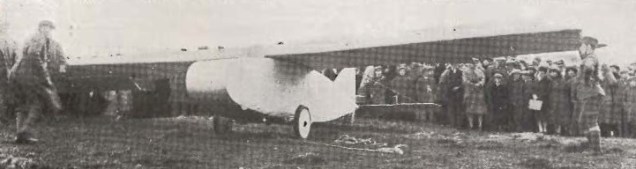
In August 1922 the Daily Mail newspaper offered a £1,000 prize for the longest duration flight by an unpowered, heavier than air aircraft. The competition was to be organized by the Royal Aero Club, who chose the site (Itford Hill, on the Sussex South Downs near Lewes) and the date (16–21 October). This gave competitors six weeks to design, build and transport their entries. Thirteen arrived in time and one of these was the aircraft nicknamed Brokker, competition number 31.
Built by Sqn. Ldr. Alec Gray and F/O W. J. Buchanan, the Brokker was, as its name suggested, a fusion of a Bristol and a Fokker aircraft. Specifically, the upper wing of a Fokker D.VII married to the engineless fuselage of a Bristol Fighter.
The Brokker was a glider which got its name from the fact that it was constructed from the wings of a Fokker D.VII and the fuselage (less engine) of a Bristol F.2B Fighter. It was put together from two of the cheap and unwanted airframes left at the end of World War I; the wings and fuselage each cost 5/- (25 p), with 8/6 (42.5 p) chiefly for dope and plywood, a total of 18/6 or 92.5 p.
The Fokker D.VII wing had advantages over most other World War I fighters as it was one of the few to use a thick airfoil. The merits of these only emerged towards the end of the war, and then only in Germany: structurally, they could be internally braced and more importantly they produced lower drag and higher lift, particularly at high angles of attack, than the usual thin wings.
On the Brokker, the D.VII wing was simply clamped to the top of the rectangular cross section Bristol fuselage, forming a high wing cantilever monoplane. Since there was no propeller to need ground clearance, the Fighter’s tall undercarriage was replaced with a pair of wheels mounted outside the lower longerons. The now empty nose of the Bristol was enclosed with a new, single curvature fairing.
It first flew on 21 October 1922 at Itford Hill, on the South Downs near Lewes, East Sussex.
The Brokker arrived late at the Iford meeting and was not flown until the final day. Its first launch was not successful but the next resulted in a flight of over 90 mins ended only by darkness, the third longest flight of the week. The relative steadiness of the heavy Brokker in the strong winds of the last day, compared with all other competitors with their low wing loadings, was noted. Gray received the Royal Aero Club prize of £50 third longest flight.
After the competition Gray took it to Salisbury Plain where he was to conduct tests for the Air Ministry on the suitability of gliders in pilot training programmes.
The aircraft was lost in a fatal glider accident on 28 August 1923. The pilot, Neville Charles Waltho, was thrown out of the cockpit when the Brokker stalled on a hillside near Pewsey.
According to a contemporary report in Flight dated September 6 1923:
“LAST week the first fatal glider accident in England occurred when Flight-Lieut. Neville Charles Waltho was piloting a monoplane glider at Milton Hill, near Pewsey, Wilts. It appears that Waltho had been gliding for several minutes and was about to land, when the machine went into a dive.
The pilot was thrown out and killed instantly. The machine used was, we believe, the ” Brokker,” flown by Squadron Leader Gray at Itford last year.”
It was the first fatal glider accident in England since Percy Pilcher’s death in 1899.
Wingspan: 29 ft 4 in (8.93 m)
Gross weight: 500 lb (227 kg) approx
Seats: 1
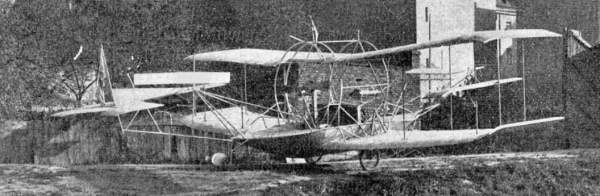
The Amphibien-Flugboot was designed and built by Fritz Grawert in 1910. The engine, a special three-chamber design of Grawert’s (patent issued in 1910), drove two propellers (pusher and tractor). The wings were made of aluminium with silk covering and could be detached from the boat fuselage. Grawert died in 1916.
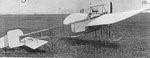
The 1911 Grapperon monoplane designed and built by Grapperon in France.
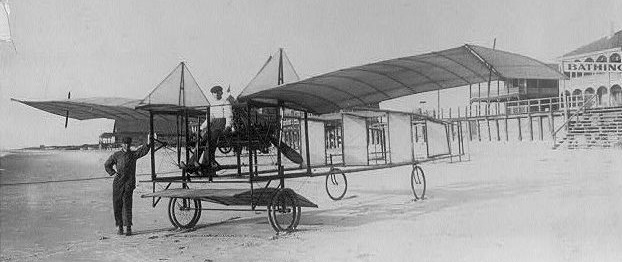
Rudolph R. Grant, who later became Chairman of the Technical Board of the Aeronautic Society of America and Charles Oliver Morse of Norfolk, VA, were busy to develop a mechanism for automatic directional and lateral stability in aeroplanes, an interesting device with air pressure spring-loaded wings and counter-wise adjusted incidence of the small lower wing. The Virginia I monoplane was their first, built in the summer of 1910. It proved to be a stable flyer, that in spring 1911 was tested as a hydroplane in the Willoughby Bay, just North of Norfolk. It might have been the first motor aeroplane built in Virginia.
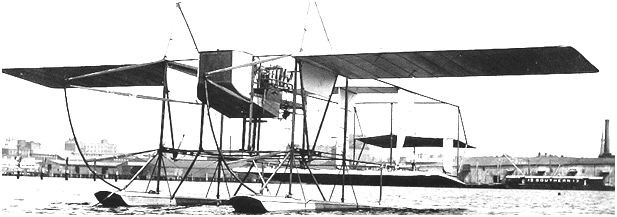
Built in the USA, R. R. Grant’s Aerostable hydroplane of 1913 featured a device whereby the angle of incidence could be changed while in flight. The operator turned a small wheel when changing or adjusting for the proper angle. The wing framework was built of white ash and steel tubing covered with Goodrich alumina cloth. The floats were of the catamaran type, each two ft wide by 21 ft long. Each pontoon was divided into five watertight compartments.
Engine: Emerson two-cycle, 100 hp
Wingspan: 42 ft
Length: 41 ft
Weight: 1600 lb
Mr R.H. Grant is known to have built and flown a single-seat, similar to a BAC Drone, powered by a 390cc A.B.C. engine from his English Electric Wren G-EBNV, post-era. It was flown from Dumfries Gliding Club field, UK.
It is possible Mr Grant also built some aircraft pre-war.
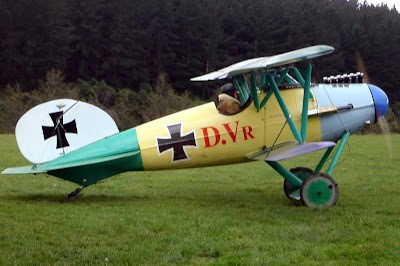
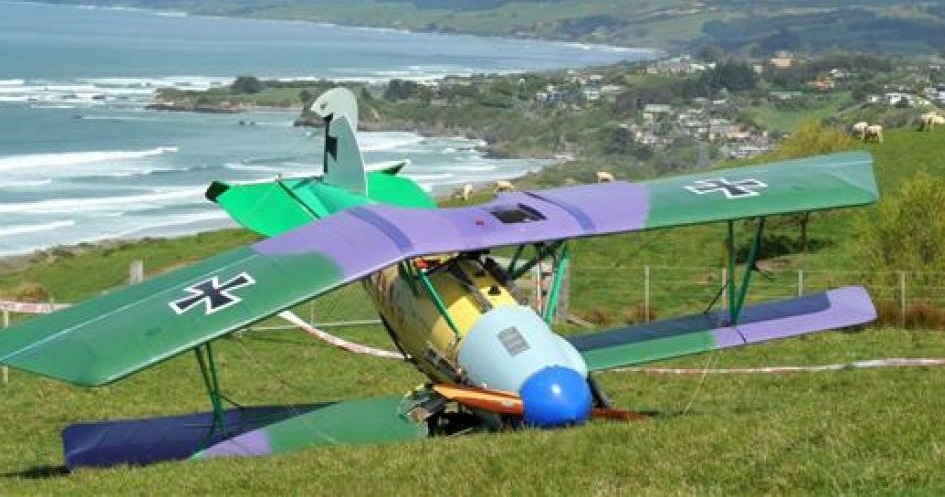
Tom Grant designed and built his 3/4 scale Albatross D V replica from his own plans over about 14 years, which included a building time of around three and a half years.
The fuselage was built up from white pine carvel planking (a boat building technique), with a lightweight fibreglass finish. The wings are of standard spruce spars and ribs with fabric covering. The engine is a 4 cylinder Toyota 480E from a Corolla.
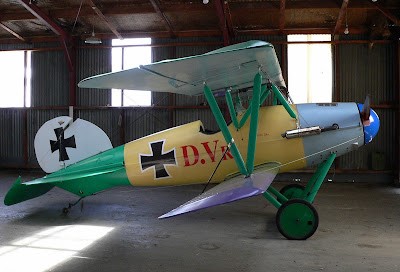
ZK-DVR (c/n TG01) was registered to Tom Grant of Dunedin on 8 November 2007. Tom says that it flies just like it is supposed to, and he had flown around 50 hours.
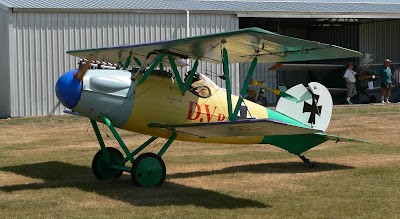
On 26 October 2015 it was reported;
Witnesses to the emergency landing of a replica World War 1 fighter heard the plane coughing before a loud ”boom” gave way to silence as it descended on to a ridge high above Ocean View on Saturday.
Police lauded the quick-thinking pilot for his ”perfect” emergency landing of the three-quarter Albatros D.Va replica on farmland above Brighton Rd about 10.50am.
The pilot, Tom Grant (87), was fine despite the plane hitting a fence on a ridge about 100m above Brighton Rd during the emergency landing, his wife, Jeanette, said.
”It was a controlled landing. He just caught the top of the wire as he came in,” she said.
”He got a tiny bump on his nose … but he’s fine.”
It appeared the landing buckled the plane’s wheels and damaged the right wing and undercarriage.
The plane, which Mr Grant built, was salvageable and would be ”next winter’s project”, Mrs Grant said.