Grigorovich M-2 / M-3 / M-4 / Shchetinin M-2

Despite the poor results obtained with the M-1 flying boat, the Russian fleet command was predisposed towards an effective national flying boat model. On June 28, 1914 , the Naval General Staff (MGSh) wrote:
“The General Staff… to get out of the position, considers it very advisable to start the indigenous construction of hydroplanes and establishes the following conclusions:
1 – Because the hydroplane designed and built at the SS Schetinin and K Society is available, allowing the factory to carry out the tests at the Puerto del Emperador Alexander III aviation station, but on the condition that the pilot be from the factory. In case of success of the tests the flying boat will be acquired for the needs of the Baltic Sea aviation.
‘ In the event that the hydroplane shows good results, the Naval General Staff considers requesting several of these boats after the problems presented have been solved.”

On the other hand, with the war approaching, the Navy leadership, the 2nd rank captain BP Dudorov requested the MGSh without delay to buy from the PRTV and the RBVZ (Russian Baltic Wagon Factory) all the hydrofoils, finished or not, that could be ready in a short period of time.

These factors encouraged Schetinin to redirect the fundamental activity of PRTV towards the development of navalized models. DP Grigorovich was working on a development of the M-1 model, so on July 29, 1914 a contract would be signed for the production of four new improved examples.

The changes introduced were so significant that the resulting aircraft earned the right to be defined as a new model, which came to light as the M-2 (Morskoi (Naval) – 2), Russian: Григорович М-2.

The contract established the delivery of the first copy for the 7th, the second for the 12th, the third for the 17th and the last for August 23, 1914. Each flying boat was valued at 8,000 rubles and instructions were given to collect four Gnôme engines between 80 and 100 hp in Moscow.

The acceptance conditions established the reach of a height of 500 meters in 12 minutes with the 100 hp engine and 15 minutes with the 80 hp, carrying a load of 75 kg above the weight of the crew and the necessary fuel for three flight hours.

The M-2 was a propeller-driven biplane flying boat, generally similar to that of the M-1 and originally the same engine, but its overall dimensions were increased. The hull grew in width in order to accommodate both crew members side by side. The bow also changed its shape from flat to tapered with a concave bottom in the front, while a new three-sided tail section featured new, much higher mounts, to which the considerably larger area stabilizer was attached.

The wingspan of the upper wing was considerably greater than that of the lower wing, but unlike the M-1 the diagonal supports at the wingtips were not used. The biplane box maintained its location on supports above the fuselage and had only large-area ailerons on the upper plane. The lower wings were installed 1m above the hull on the engine support frame.

The triangular section rear fuselage was raised from the water, tail was equipped with a skid, often referred to as the “shovel”.

According to Shavrov the M-2 to M-4 were used to test some novelties such as the variable incidence stabilizers in flight (for this purpose they had an elevator in the lower part of the leading edge) and in the M-4 a ski – paddle with rubber buffer hinged under the tail to improve launch.

The types of wood used were generally similar to those used during the construction of the M-1.

The construction of the model in the Schetinin factory introduced a constructive novelty: for the first time in Russia, the hull was formed inverted, with the keel up. The first M-2 was delivered to the naval experimental station located in the Grebni port of Petrograd only on August 18, 1914, because before that date the hangar was not found ready for its conservation.

The tests of the prototype with the 80 hp Gnôme engine plant began in August 1914. Unfortunately, the prototype was destroyed on the 31st of that month causing the death of its pilot PV Evsyukov. It is noteworthy that VB Shavrov defines this engine as an 80 hp Clerget, which makes this statement appear in multiple articles and sites that reference this source.

The construction of the other examples was stopped until the investigations were completed. The causes of the accident were never established, but no problems related to structural weaknesses or linked to the construction of the model were found, so it was agreed to continue production.

On October 8 at the Schetinin factory, 4 Gnôme Monosoupape engines of 100 hp were received (The engine of the damaged unit was delivered to the RBVZ) and on November 28, 1914 the first of the new units with this power plant and modifications in the selection of the airfoil was received at the Third Naval Station in Revel (Tallinn). Only 12 days later a second copy would arrive. The test flights were developed until December 22 by the pilot of the factory Ya. I. Siedov-Sierov and the fleet pilot Lieutenant II Kulniev, resulting in numerous remarks and proposals for improvements.

On December 20 three FBA (Franco-British-Aviation) flying boats of the six contracted to France on September 12, 1914 arrived at the Third Station. Both because of their construction and because of their performance, they were quite superior to the M-2, which is why the representatives of the Navy took a negative position towards the Schetinin – Grigorovich model. By the end of the year none of them had been able to present themselves to the acceptance tests.

During the winter the company’s mechanic and pilot made the changes so that by the spring of 1915 flights could be resumed. At that time, a series of improved components arrived from the factory and were installed in the second prototype. General tests continued until April 1915, resulting in a climb time of 15 minutes to a height of 1,300 meters.

The third flying boat М-2 code Sch-3 in the fleet register, with Lieutenant VA Litvinov, head of the Kilkond naval station in the cabin.

In general, they received a positive assessment, so on April 25, 1915 they entered service with the Baltic Fleet aviation with the registrations Sch-2 and Sch-3. These served in the Third Revel Station, basically in training missions, until they were discharged in the winter of 1915-1916 (in the month of November according to Maslov). After that date the engines were removed and for some time were kept in Revel. Due to the fact that these examples underwent changes in the wing profile and hull lines during the tests, their name was changed to M-3 (according to Maslov the name M-3 only corresponded to the second of these, since the first kept as M-2 (Sch-2)).

In the summer of 1914 in the Black Sea the situation was calm and by the month of September the Naval Aviation only had six military planes. The situation would change radically in October, when Turkey declared war on Russia. The new situation made it necessary to take urgent measures.
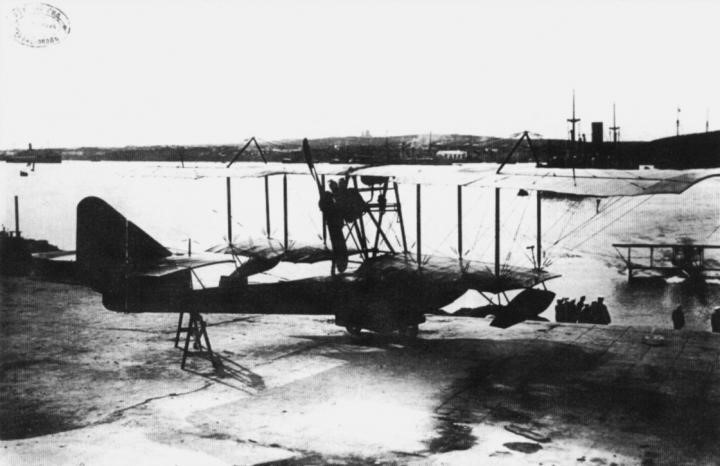
M-4 number 29, belonging to the Black Sea fleet

From a request of the Black Sea pilots and after several talks held by the head of the Russian aviation, Grand Prince Alexander Mikhailovich Romanov, the commander of the Baltic Fleet NO von Essen; the head of the MGSh AI Rusini and the head of the Aeronautical Department of the MGSh AA Tuchkov, the remaining two copies of the contract of four were sent to Sevastopol on March 10, 1915. This measure was aimed at strengthening the capacity of the air forces for the operations to be carried out in the Bosphorus area.

Ten days after the arrival, a PRTV brigade would arrive under engineer AN Sidielnikov and also made up of pilot Ya. I. Siedov-Sierov, two mechanics and two assemblers. On March 24 the flying boats were transferred to the assembly site and on the 31st the commission from the port of Sevastopol arrived to carry out the tests.

They had to make a flight of 25 minutes and another of 13 minutes in which they should reach the contracted height in 7.5 minutes. The planes received the numberings “29” and “30” and were to complement a varied group of seaplanes that made up the Black Sea Fleet aviation. These M-2s would later be referenced in documents as M-2/M-4 or simply M-4.

M-4 number 29

On April 8, 1915, military pilots began familiarization flights and after a series of acceptance tests, the two were accepted by the Fleet, eventually being used in military actions. On April 12, 1915, number 29, armed with a Maxim machine gun in an installation designed by Kryltsov, was lowered into the water from the cruiser “Emperor Nikolai I” in the Bosphorus region. Crewed by A. Ye. Zhukov and SN Korsakov the flying boat managed to carry out an attack on a Turkish gunboat of the type “Burak Reis”, dropping a bomb that exploded about 70 meters from the stern. This was considered the first military action of a flying boat in Russia and could have ended as a major catastrophe: a hose rupture forced the crew to make a landing a considerable distance from the base, but they managed to reach it by sailing.

Reports on the use of the Schetinin / Grigorovich flying boats in the Black Sea theater were promising, but the Aviation Committee had some doubts about the structural resistance of the model, especially since “30” began to present problems with the hull cladding slats, which came off even after normal landings. As a result, on May 15, a document was issued to the factory in which it recommended reducing the angle of attack of the stabilization floats, reinforcing their fixation and modifying the hull in order to add a rudder that would improve operation in the water. PRTV received the considerations but there was little that could be done because the production had culminated with the delivery of the four copies.

The flying boat “30” was decommissioned in October 1915. In the case of “29”, no evidence has been found to define its operating time.

The factory numbers of the delivered were 196 and 197 (the numbers of the others are unknown), The Baltic Sea Fleet of M-3s were Sch-2 and SCh-3. The Black Sea Fleet of M-4s were naval register ”29”, factory number 196, and naval register ”30”, factory number 197.

M-2 prototype
Powerplant: 1 x 80 hp Gnôme
Upper plane wingspan: 13.68 m
Wing area: 33.5 m²
Length: 8.0m
Normal takeoff weight: 870 kg
Wing loading: 26 kg/ m²
Power Load: 10.9kg/hp
Speed at sea level: 115km/h
Cruising speed: 76km/h
Ascent time to 1000 m: 7 min
Ceiling: 4000m
Practical range: 320 km
Endurance: 3.5 hours
Accommodation: 2 side by side

1913 M-3
Span: 44’10”
Length: 26’3″
Loaded Weight: 1918 lb

M-4
Powerplant: 1 x 100 hp Gnome Monosoupape
Wingspan: 13.62m
Wing area: 37.90 m²
Length: 8.00m
Normal takeoff weight: 870 kg
Wing loading: 26 kg/m²
Power load: 8.7kg/hp
Top speed: 100km/h
Cruising speed: 76km/h
Practical range: 320 km
Accommodation: 2 side by side
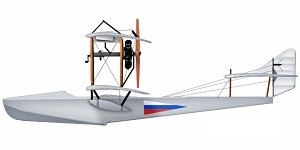
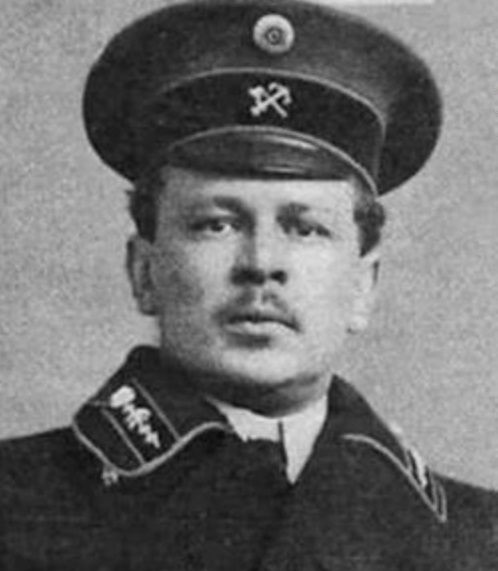
Grigorovich M-2

Grigorovich, Dmitry Pavlovich / Grigorovič

Dmitry Pavlovich Grigorovich was born on February 6 (January 25, old style) in 1883 in Kiev. His father, Pavel Dmitrievich, a great-nephew of the famous Russian writer Dmitry Vasilievich Grigorovich, first served in a sugar factory, later – in the quartermaster of the military department. Mother, Yadviga Konstantinovna, was the daughter of a rural doctor. The parents sent their son to the Kiev real school. Quite a lot of lessons were devoted to practical training in workshops and laboratories.

Graduates of a real school had the right to enrol in polytechnic institutes and, after graduating from a real school in 1902, Dmitry Grigorovich chose for his further education the mechanical department of the Kiev Polytechnic Institute of Emperor Alexander II.

Dmitry Grigorovich actively participated in the Aeronautical Circle KPI, founded in 1905. It was supervised by Nikolai Borisovich Delone, a student of Nikolai Yegorovich Zhukovsky, a professor of mechanics. Members of the circle listened to N.Delone’s lectures on the basics of aeronautics and were actively engaged in the design and manufacture of their own aircraft.

Before the end of the KPI, Dmitry went to the Belgian city of Liege, where he attended two semesters at one of the institutes, studying aerodynamics and engine theory. “Since 1909,” wrote N. Suknevich, the wife of Dmitry Pavlovich, “when Dmitry graduated from the Kiev Polytechnic Institute, we were both passionate about aviation. Our room was littered with mechanical parts, engine components, various parts. Not far from the Polytechnic Institute on the Kurenevsky airfield, he removes the shed and adapts it to the hangar. Next hangar another polytechnic – Igor Sikorsky. Dmitry made the first lightweight sports biplane G-1 with the Anzani engine with a capacity of 25 horsepower from bamboo, which he tested on January 10, 1910. “

The next work of D. Grigorovich was an airplane built according to the design of the French Bleriot XI aircraft, also with the Anzani engine, but with its own control system and chassis design. It was built by Grigorovich together with the Kiev motor sport amateur Ilnitsky. Financial assistance Ilnitsky was enough to complete work on a new airplane and demonstrate it at the Kiev exhibition of aeronautics. The aircraft attracted the general attention of aviation specialists and amateurs. The magazine “Automobile and aeronautics” called it the best design of the exhibition.

Fedor Tereshchenko, a descendant of a wealthy merchant family, became interested in the development of Dmitry Grigorovich. Tereshchenko also studied at the Kiev Polytechnic Institute and in his estate in the village of Chervonoye, Berdichevsky district, he equipped an aircraft workshop and airfield. Fyodor Tereshchenko proposed to Grigorovich to cooperate. Soon two of their sport airplanes appeared – the G-2 and the G-3. The designer and the main performer of all the works was Dmitry Grigorovich, the patron of the arts was Fyodor Tereshchenko.

In 1911 Dmitry Grigorovich went to St. Petersburg and got a job as a journalist in the science journal “Bulletin of the ballooning”. It was in 1911 that the famous work of Konstantin Tsiolkovsky’s Study of World Spaces with Jet Instruments was published in this journal.

Grigorovich flew one of his planes from Kiev to St. Petersburg and carried out several successful flights there at the Commandant airfield. They were witnessed by Sergei Schetinin, the founder of the first in the Russian Empire aircraft building plant called “The First Russian Aeronautical Partnership of the SS Shchetinin and Co.”. Over time, Schetinin invited Grigorovich to the position of manager and technical director of the plant.

Grigorovich proposed to create new aircraft designs, which at that time were very necessary for the military industry of the empire.

The head of the naval aviation of the Baltic Fleet requested repair the Donne-Levek military seaplane damaged in training flights. At Schetinin Grigorovich, together with the head of the drawing bureau Sedelnikov, suggested repairing the plane and at the same time making its drawings and setting up production at the factory.

During this work, the idea was born to create a hydroplane, but with the introduction of fundamental changes in its design as compared with Donne-Leveque. Grigorovich proposed to install the aircraft not on the float, necessary for take-off and landing on water, but to design a “flying boat”. The new design, called M-1 (“Sea-first”).

In parallel with the work at the plant of S. Shchetinin, on June 1, 1917, Grigorovich founded his own research aircraft building plant called “DP Grigorovich”.

On June 1, 1917 Grigorovich ended his working relationship with SS Schetinin. His personal relations by that time had been damaged and Schetinin, who had grown considerably rich from the war, considered that he no longer needed his engineer. Quite quickly Grigorovich received bank loans with low interest rates that allowed him to lease some facilities to organize an experimental factory and an empty building belonging to the Ismailovski regiment, at 12 Rota, Building 26. As an aid to be able to make the loan payment, the new facility received an order for the construction of 40 M-5 flying boats (later M-20), which was signed on July 28, 1917 with deliveries scheduled for the period between September 1, 1917 and January 1, 1918. The price of each unit was set at 16,000 rubles. In parallel Grigorovich received requests for the development of several experimental models.

At this enterprise, Dmitry Pavlovich designs, tests and prepares several more machine designs for serial production. These were flying boats M-18, M-19, M-20 and M-21.

The revolutionary events of 1917-1918 interrupted Dmitry Grigorovich’s quick pace in the aircraft industry. In March 1918, his plant was nationalized and redeveloped to produce agricultural equipment. According to some reports, in those days he received an invitation to go abroad, but remained in his homeland. The enterprise of S. Shchetinin was also reorganized into the State Aviation Plant “Red Pilot”.

Trying to survive and save his loved ones, D. Grigorovich began to work in the Main Committee of the United Aviation Plants (Golovkoavia) – the leading body of aircraft engineering. However, he did not work there for long: during the famine in Petrograd, Grigorovich and his family moved to Kiev, then to Odessa, then went to Taganrog. In Taganrog, he worked at an aviation factory, whose main profile was the repair of aircraft and engines. On the initiative of Grigorovich, outside of all sorts of orders and plans, the MK-1 sea float fighter (Rybka) was built there. Dmitry Pavlovich took direct participation in its design and production. Soon the order for “Rybka” was transferred to the plant “Red Pilot”, and Grigorovich was able to return to Petrograd.

In addition to introducing the new aircraft into production, Grigorovich completed work on the GASN sea torpedo bomber, which had been half forgotten in the factory yard since 1917. The hydroplane was repaired, some changes were made to its structure, and in the summer of 1920 test flights began.

In connection with the receipt of an order for the design of a new naval reconnaissance aircraft in mid-1922, Grigorovich moved to Moscow, where he was appointed Technical Director and Head of the Design Bureau of the State Aviation Plant No. 1 (GAZ 1), the former Dux Aircraft Factory. In this position, Grigorovich replaced another well-known aviation specialist, Nikolai Polikarpov, who was transferred to the Golovkoavia design department.

The company built a new Soviet R-1 reconnaissance aircraft for a 400 hp engine. The aircraft was designed on the basis of the captured English DH-9. Grigorovich accelerated the revival of production and ensured the operational solution of dozens of large and small tasks. On June 29, 1923, after the successful tests of the Air Force, the first two R-1 aircraft were handed over. And after a while, the plant produced 38 such machines every month.

In addition, the design team of the company worked hard on another order – the creation of a domestic fighter. It became a biplane I-2 with an M-5 engine, developed under Grigorovich and put into service in early 1925.

At the beginning of 1925 Grigorovich was again transferred to the Krasny Pilot plant (later – State Aviation Plant No. 23), where Aviatrest created the country’s first Department of Marine Research Aeronautical Engineering.

Under the leadership of Grigorovich, a number of projects and research samples of naval reconnaissance aircraft were prepared: MRL-1 (“Marine reconnaissance with Liberty engine”), its subsequent modifications – MR-2, MP-3, training aircraft MUR-1, MU -2 (“Marine Training with the engine” Ron “and” Marine Training “); ROM-1, ROM-2, ROM-2bis (“Scout of the open sea”), two-float, two-tail naval destroyer under two MM-1 tandem engines (“Marine minononset”), MT-1 (“Sea torpedo carrier”).

Unfortunately, due to some design flaws, incomplete compliance with customer requirements, and sometimes because of overt intrigues in the aviation industry, most of these machines did not reach mass production.

The chain of certain failures coincided in time with the start of the campaign launched against the old specialists. Special commissions “on the elimination of sabotage” were created at each defensive enterprise.

The first lawsuits against the “bourgeois experts” were the Shakhty affair and the Industrial Party affair. On September 1, 1928, they reached Grigorovich. He was arrested in his office, accused of sabotage and sent to Butyrka prison. Following him, he was arrested by his comrades – A. Sedelnikov, E. Maioranov, V. Corvin-Kerber, who worked with him in the “First Russian Aeronautical Partnership of S.S. Shchetinin and K”. Soon, a wave of arrests of aviation specialists swept through other defense industry enterprises.

In the spring of 1928, the USSR government adopted the “Plan for the construction of armed forces for the future five-year plan”. The leadership of the OGPU decided to use the imprisoned specialists in their direct specialties. The Deputy Chairman of the OGPU, Heinrich Yagoda, defended this idea, and was entrusted with the task of overseeing the first prison design bureau.

They established a design bureau in December 1929 directly in the Butyrskaya prison,. Dmitry Grigorovich was appointed Chief Designer of the Special Design Bureau, Nikolai Polikarpov, who was arrested on charges of participating in a counter-revolutionary organization, was appointed his deputy. Prisoners who were enrolled in the OKB were improved in conditions of detention — they increased their nutritional standards, more often they were taken to the bathhouse and were allowed to see their relatives. Immediately after the formation of the design bureau, he was visited by the Deputy Chief of the Air Force, Y. Alksnis, and set the task: by the spring of 1930, to design a fighter, the characteristics of which would be no worse than those of the best foreign aircraft.

Over time, the group of Grigorovich was transferred to aviation plant Menzhinsky (GAZ number 39), located near the Central airport. In his memoirs, Alexander Yakovlev, wrote: “They lived and worked in the mysterious” Seventh Hangar “, adapted to the internal prison.” The guards divided this hangar into two parts: in one there was a living area, in the other – working premises.

In just three months, the prisoners, designers and engineers have developed a model of the future fighter. They spent even less time on the construction of his research sample – a month, and on April 29, 1930, it was first tested in the air.

The success of the I-5 fighter inspired the leadership of the OGPU to expand the network of Special Design Bureaus, and the OKB D. Grigorovich received the orderto develop a whole range of combat aircraft.

Soon the staff of the OKB Grigorovich was expanded to 300 people at the expense of freelance specialists, and under the new name of the Central Design Bureau (Central Design Bureau) it was introduced into the technical department of the OGPU Economic Department. The mode of detention of prisoners of the Central Clinical Hospital was relaxed. And on July 10, 1931, Dmitry Grigorovich received freedom. In those days, Pravda newspaper published the Resolution of the USSR Central Executive Committee: “… Amnesty … Grigorovich Dmitry Pavlovich, Chief Designer for Research Aircraft Building, who repented of his previous actions and hard work, proved in practice his repentance. To award him with a diploma of the CEC of the USSR and a cash premium of 10,000 rubles.”

After his release, Dmitry Grigorovich remained to work in his Central Design Bureau. At that time, there were carried out searches and research of the best schemes of light and heavy attack aircraft, developed cannon fighter monoplanes I-Z and PI (factory code DG-52), armed with recoilless cannons and machine guns, which were produced in large series.

Dmitry Pavlovich combined his work with the Central Clinical Hospital with teaching and research at the Moscow Aviation Institute, where he headed the Department of Aircraft Design and Design.

In the spring of 1938, Grigorovich was given a new position – the head of the newly organized design bureau in Novosibirsk. But he could not go to Siberia – he became seriously ill and on July 26 of the same year, at the age of 56, died of blood cancer. He was buried at the Novodevichy cemetery in Moscow.

The result of D. Grigorovich’s life was 80 types of designed airplanes, of which almost four dozen were placed in production.

Gribovski G-31

When the production of the Gribovski G-11 was restarted in 1943 at the Ryazan Factory, Gribovski began the development of an improved version based on the experience accumulated during combat operations.

The project of this new moto-glider would receive the name G-31 (Russian: Грибовский Г-31) from the OKB and by April 1944 it was ready for discussion.

The G-31 also featured a high wing monoplane structure, but in this model with bracing to the fuselage by uprights. The wing design with R-II profile was maintained. The centroplane had a rectangular shape and the wing consoles were fixed to it with inflection on the leading edge and the straight trailing edge. Wing mechanization included ailerons and flaps, located in the wing soffit and intended to improve landing characteristics.

Another difference that was obvious to the naked eye was the new semi-monocoque fuselage with an oval cross section.

In the nose there was a two-seater cabin with double control and side-by-side seating. The entire nose could be opened to one side in order to allow the loading of large packages or equipment in the cargo hold.

At the request of the Landing Troops (VDV), the possibility of using one or two M-11 engines was maintained.

Despite the fact that the G-31 project was considerably more refined than that of the G-29 and was approved by the NKAP committee of experts during its presentation, it was decided not to proceed with its production. A little earlier, SA Moscaliov had presented a similar project that led to the SAM-28 glider and its development had already been approved.

Gribovski G-30 / G-11M

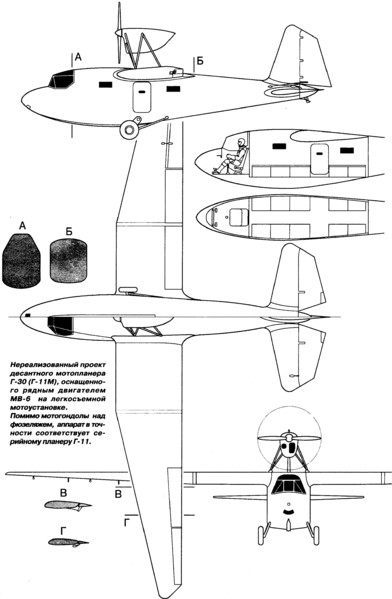
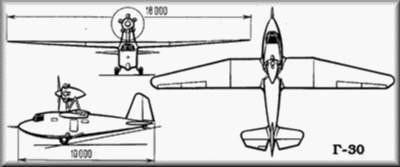
In 1942 Gribovski began development of a motorized version of the G-29 glider with a 100 hp M-11 engine. Two possible variants of the powerplant installation were analyzed: on the nose of the glider or on a pylon on the centroplane. After analyzing the advantages and disadvantages, the second option was finally decided, considering that it could be executed with minimal changes in the production chain.

The moto-glider was named G-11M (G-30 in consecutive Gribovski models) Russian: Грибовский Г-11M (Г-30).

One example was modified in the summer of 1942 at Factory No.471, but it is not clear whether it was ever tested. Maslov states that it was successfully tested in 1942, but other sources such as Shavrov state that it was never tested without explaining reasons. In any case, the need to increase motive power was valued, so the wing installation of two M-11 or MV-6 engines was recommended. In this way the G-30 became a transport airplane.

The decision to produce the model was affected by the cancellation of serial production of the G-11 glider in 1942 itself. On the other hand, the need for a small twin-engine transport aircraft had already been covered by the Scherbakov Sche-2. The VVS did not approve production, so development was abandoned. Other competitors such as the Polikarpov MP or the Moscaliov SAM-22 would have the same fate.

G-30 (G-11M)
Engine: M-11 100 hp
Wingspan: 18.0 m
Wing area: 30.0 m²
Length: 9.71 m
Empty weight: 1500 kg
Loaded weight: 2400 kg
Fuel + oil load: 70 kg
Payload: 830 kg
Wing loading: 80 kg / m²
Power load: 24kg / hp
Surface of the horizontal planes: 5.64 m²
Vertical plane surface: 2.7 m²
Spoiler area: 3.1 m²

Gribovski G-29 / Gr-29

With the beginning of the war the OKB-28 received a new task of creating a landing glider capable of transporting 11 people. The order to begin development of the glider was announced by the NKAP leadership on July 7, 1941. That day, the deputy commissioner for the experimental construction of the NKAP, AS Yakovlev asked Gribovski how long it would take to project the glider. Gribovski, without much thought, replied that two months. Considering the response little serious, Yakovlev asked him to put this commitment in writing and signed.

The first plans for the construction of the G-29 (Russian: Грибовский Г-29) were delivered to the production workshops on July 11 and by August 2 the glider was practically finished. On September 1, with a few days remaining for the two months, the new model, named by the OKB G-29 (Gr-29), was ready for the first flight.

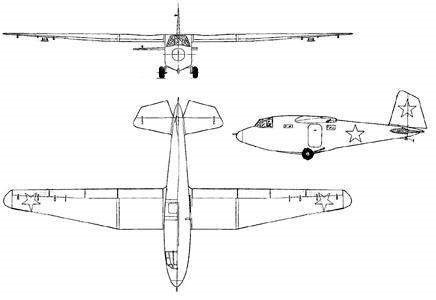
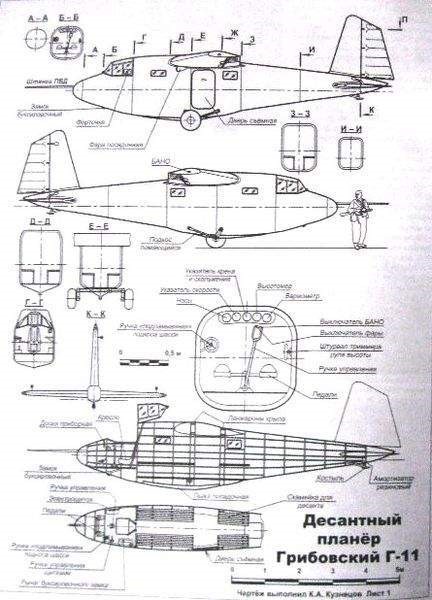
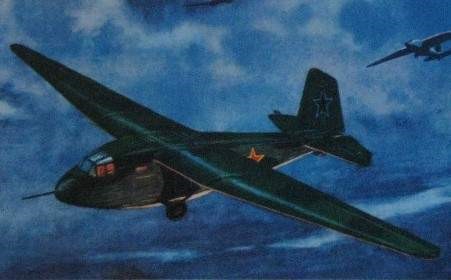
The G-28, also known as the Gr-29, was designed as a landing glider with a monoplane structure with a high cantilever wing and entirely made of wood.

The wing had a box-shaped double spar structure, made of wood. The wing profile used was the R-II. The centroplane had a rectangular shape and the wing consoles were fixed to it with inflection on the leading edge and the straight trailing edge. Wing mechanization included ailerons and flaps, located in the wing soffit and intended to improve landing characteristics. In the upper and lower part of the fuselage there were emergency hatches measuring 0.51×0.46 meters, which could also be used for the defense of the glider.

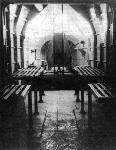
The fuselage was box-shaped with a rectangular cross section. The entire construction had been conceived paying great attention to the simplicity of production and the necessary structural strength. In the central area of the fuselage, there were two master frames to which the centroplane was attached. The cargo cabin, 3.24 meters long and 1.36-1.25 meters wide, featured 1.2 x 0.7 m cargo doors on both sides, as well as two small rectangular windows, which could be opened for operation. shot from them. Wooden benches were placed on both sides of the walls to accommodate the landing troops.

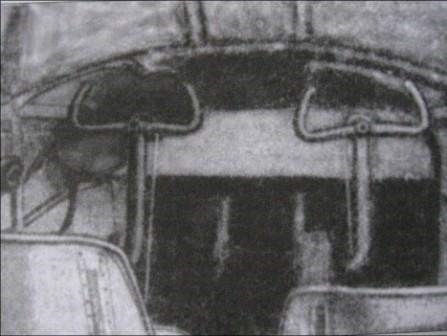
G-11 landing glider transport cabin interior

The tail was of the conventional monoplane type with large surface rudders.
The landing gear was a fixed combination type, with 600 x 250mm wheels used during takeoff and a ski on the underside of the fuselage for landings. A crank on the left side of the cockpit allowed the main landers to be retracted for landing. The use of skis significantly decreased the landing roll.

In the nose area there was a single-seater cockpit for the pilot with the steering organs and covered by a transparent lantern that opened up and back, pivoting on a hinge. The cabin equipment was quite austere (a clock, a speedometer, a barometer, an angle indicator and an altimeter).

The first test flight was on 1 of September of 1941 performed by VL Rastorguyev. The good results obtained resulted in the approval of the serial construction of the model in two factories on September 18: number 471 in Shumerlya city and 494 in Kozlovka village.

At the end of September, the military acceptance tests were carried out, which showed totally acceptable results. As a conclusion, a request was made to slightly advance the wings to achieve the necessary centering of the plane once it had been abandoned by the paratroopers.

The tests also showed that with the glider empty and the flaps extended, the tail creaked. This was eliminated by introducing perforations in the flaps.

G-11 glider with flaps extended

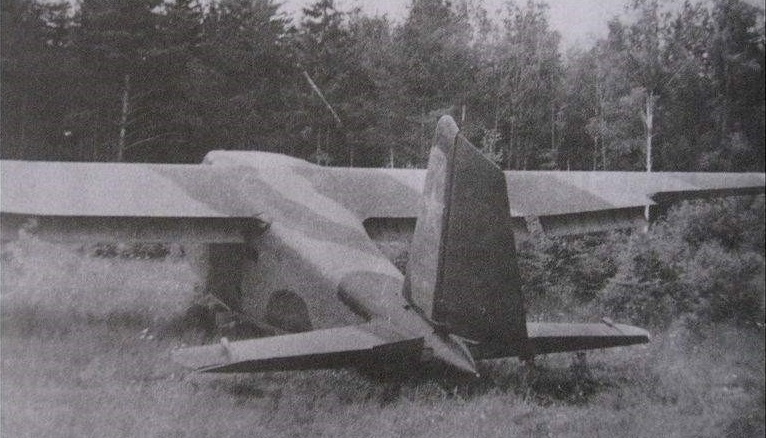
The 28 as September as 1941, as soon as they finished the tests, Gribovski traveled to the Factory No.471 and his deputy, Landyshev the Factory No.494. Already on October 18, the first base prototype for production arrived in Shumerlya together with a group of specialists from the OKB-28. By the end of the year, Factory No.471 had finished 10 copies, which soon entered service with the Landing Troops (VDV), receiving the name G-11 (in view of the number of places).

The production of the G-11 was maintained until June 1942, when it was concluded that the military was not prepared for the execution of large landing operations with gliders. The lack of prepared crews in tow and glider pilots was being felt. The absence of conditions for the conservation of these airplanes caused them to be affected by weather conditions, which affected their resistance and reliability.

As a result of this situation the production of the G-11 glider was stopped in 1942 . The OKB-28 collective was reassigned as technical personnel to Factory No.471, which at that time received the mission to start producing the Yakovlev Yak-6. Gribovski was placed at the disposal of the Commissariat for the Aeronautical Industry (NKAP).

In the year of closure of production, Factory No.471 had produced 127 copies (to which must be added the 10 produced in 1941 and the prototype), while Factory 494 delivered 170 copies. Thus, the total number of units produced in this first stage reached 308 copies.

At the end of 1943, the logistical supply needs for guerrilla and combat groups caused the restart of production. This time the Ryazan aviation factory was chosen as the production base. Vladislav Gribovski would be appointed chief builder.

The first G-11 produced in Ryazan was tested in March 1944 by the glider test pilot Lieutenant Chubukov, who even performed spins, inverted flight and barrel roll.

During production various modifications were made. Starting from the standard number 21 on the left side, an increased door 1.4 meters wide with two-leaf opening was introduced. The cargo door located on the right side, present in previous versions, was eliminated. The number of copies produced at this stage, which would last until 1948, is unknown. It is estimated that the total number produced was between 500 and 600 copies.

By the final stage of the war, the VVS leadership had internalized the importance of the gliders in the actions of rapid troop transfer, carrying out surprise attacks on enemy positions, supporting offensive missions and supplying logistics to units. The experiences during the war had not been good, so it was necessary at high speed to start working on the preparation of glider crews and the development of preparation exercises in this type of operations.

Dual control cockpit

As of October 1944, the manufacture of landing gliders equipped with dual flight control, a landing ski suspension system and structural reinforcements would begin in Ryazan. This version would be renamed G-11U.

Production of the G-11U version was closed in mid- 1945, but a little less than a year later it would be resumed, remaining until 1948.

In 1942 Gribovski proposed to develop on the basis of the G-11 a motor glider with an M-11 engine, which would eventually be produced in prototype form under the company name G-30, although it was also known as G-11M.

The landing actions carried out in the USSR during the war were scarce and in some cases catastrophic. The main use of gliders was restricted to specific supply operations, fundamentally to guerrilla groups and the transport of small sabotage units, which operated in the enemy rear.

Perhaps the most brilliant performance of the landing gliders took place in 1943 when they were used in supplying the Belarusian guerrillas in the Minsk region. The gliders were prepared to transport fuel, weapons and ammunition, including those for cannons.

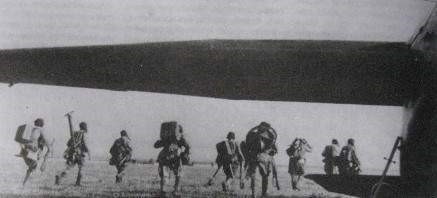
Landing troops board the G-11

The glider launch operation over Belarus was kept a great secret, so for the Germans it was totally unexpected. This operation was directed by the headquarters of the Air Landing Troops (VBV) and its development was personally followed by Stalin.

It was planned to be executed at night. Ilyushin DB-3F and Lisunov Li-2 towed Moscaliov and Gribovski gliders in pairs, releasing about 50 to 60 km from the target. The guerrillas had prepared surfaces for the landing and at the agreed time they lit bonfires as signalling. This operation was successful and allowed the Belarusian partisans to achieve significant successes against the fascist groups.

A G-11 glider prepares to be towed by an Ilyushin Il-4.

The aeronautical designers OK Antonov, AS Moscaliov and VK Gribovski received the 2nd rank “Guerrilla of the Great Patriotic War” medal for their contributions to the partisans, which was one of the few exceptions for the delivery of this medal to personnel from the deep rear.

The G-11 gliders were also used on a small scale during the crossing of the Dnieper, carrying guns and mortars from one shore to the other. Another notable action was the creation of a supply bridge between Moscow and Stalingrad in November 1942 to carry deicing fluids for Soviet tanks, which were preparing for the offensive.

Versions:

G-29 (G-11)
Original version as a transport glider from 1941 with capacity for 11 people and a rectangular section fuselage. Built 308 copies in factories 471 in Shumerlya city and 494 in Kozlovka village.

G-11U
1944 training version with dual controls, structural reinforcements and changes to the landing gear. The quantity produced is unknown.

G-30 (G-11M)
Motorized version of the G-29 with M-11 powerplant. A prototype was built in 1942. With the closure of production in 1942 the development would be abandoned.

Specifications
G-11
Wingspan: 18.00 m
Wing area: 30.00 m²
Length: 9.71m
Height: 2.7 m
Empty weight: 1250 kg
Maximum takeoff weight: 2400 kg
Wing loading: 83 kg / m²
Payload: 10 equipped soldiers or 1200 kg
Surface of the horizontal planes: 5.64 m²
Vertical plane surface: 2.7 m²
Spoiler area: 3.1 m²
Maximum towed speed: 370 km / h
Maximum planing speed: 146 km / h
Glide ratio: 16
Accommodation: 1

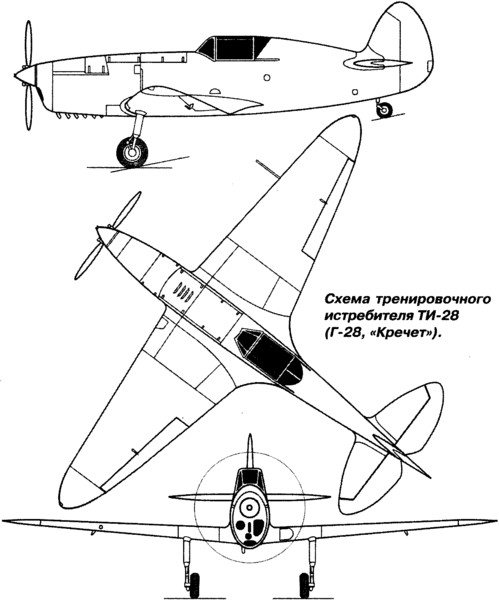
Gribovski G-28 Krechet / TI-28

Initially, in December 1939, a new Construction Bureau was created as a subsidiary of Factory No.301. This new organization was based on a garage under construction belonging to the “Mosvoyentorg” located in the Pavshino village, belonging to the Moscow suburbs.

In this period under the direction of Gribovski, several conceptual projects of training aircraft would be developed, among which a fighter trainer called G-28 and nicknamed “Krechet” (Gyrfalcon) (Russian: Грибовский Г-27 Кречет) stood out.

In order to ensure its development, the order was issued on March 10, 1940 to create the Experimental Construction Bureau No.28 (OKB-28), subordinate to the NKAP structure and under the leadership of VK Gribovski. At the VVS controls the plane would be registered as TI-28, an acronym for Trenerovochni Istrebitiel or Fighter Trainer.

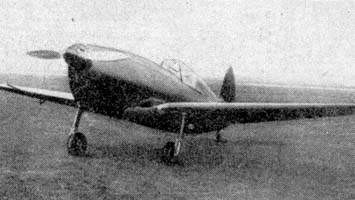
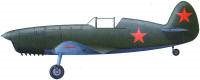
The G-28 was designed as a low-wing cantilever aircraft with a trapezoidal shape in the plane and rounded ends. The construction was developed mostly with wood. The entire structure of the wings and the fuselage was built with this material. Only the stabilizers and flight control surfaces featured a fabric-covered duralumin frame.

The wings featured a double-spar structure with an RAF-34 airfoil. Aerodynamically balanced spoilers were located on the trailing edge.

The fuselage featured a semi-monocoque structure with plywood skins and ended in a conventional-type tail unit. The empennage was built as an integral part of the structure of the fuselage tail section. The elevators and rudders had weight balance and aerodynamic compensation.

In order to simplify the construction of the model it was decided to use a fixed landing gear of conventional type. The main landing gear was attached directly to the forward wing spar and the tailwheel was located at the rear of the fuselage.

In the nose there was an inverted six-cylinder in-line MV-6 engine (a copy of the French Renault Bengali 6 engine manufactured in the USSR under license) of 220 hp. The propeller had two blades and constant pitch. The tunnel-type radiator was located at the bottom of the engine.

The pilot’s cabin was enclosed and rearward in the fuselage. The transparent top cover featured rear opening. As a fighter trainer, the TI-28’s instrument panel featured a fairly complete set of equipment, allowing it to perform day and night flights.

For training in the use of weapons, the TI-28 received a 7.62 mm ShKAS synchronized machine gun with 400 rounds, a photo machine gun and a PAK-1 type collimator. Under the wings were located some supports capable of carrying bombs of 10, 25 and 40 kg.

The TI-28 trainer was built in the spring of 1940. The first flight took place on May 22 of that year with the pilot of LII V. Gravrílov.

In less than a month the TI-28 passed the entire test flight program. In addition to Gavrilov, the TI-28 was air-tested by well-known Soviet NII VVS test pilots such as MM Gromov, AB Yumashiev, and PM Stefanovski, who gave the aircraft an excellent rating. Unfortunately, the beginning of the Great Patriotic War prevented the completion of the tests in Moscow, so in 1941, when the NII VVS was evacuated, the TI-28 prototype flew to Sverdlovsk. Its fate thereafter is unknown.

In order to improve the aircraft’s characteristics, the military recommended replacing the power plant with the improved 240 hp MV-6A and repeating the tests. It was felt that the landing run of 280 meters could be shortened and by installing a slightly more powerful engine some gain in speed could be obtained.

The construction of a second example had begun. During the evacuation, Gribovski decided to keep it, with the aim of continuing its development when the situation allowed. These ideas also did not happen. With the beginning of the war the needs for fighter training aircraft would be covered from the conversion to two-seaters of single-seater models in production.

Г-28
Powerplant: 1 x 220 hp MV-6
Wingspan: 9.00m
Wing area: 11.60 m²
Length: 7.66m
Height: 2.80m
Empty weight: 897 kg
Normal takeoff weight: 1157 kg
Wing loading: 100kg/m²
Power load: 4.8kg/hp
Fuel + oil capacity: 122+15kg
Maximum speed at sea level: 275 km/h
Top speed at 1600m: 303km/h
Cruising speed: 226km/h
Landing speed: 90.5km/h
Practical range: 500 km
Practical ceiling: 6600 m
Take-off run: 280m
Armament: One 7.62mm ShKAS synchronized machine gun, one photo-machine gun
Bombload: 40kg
Accommodation: 1

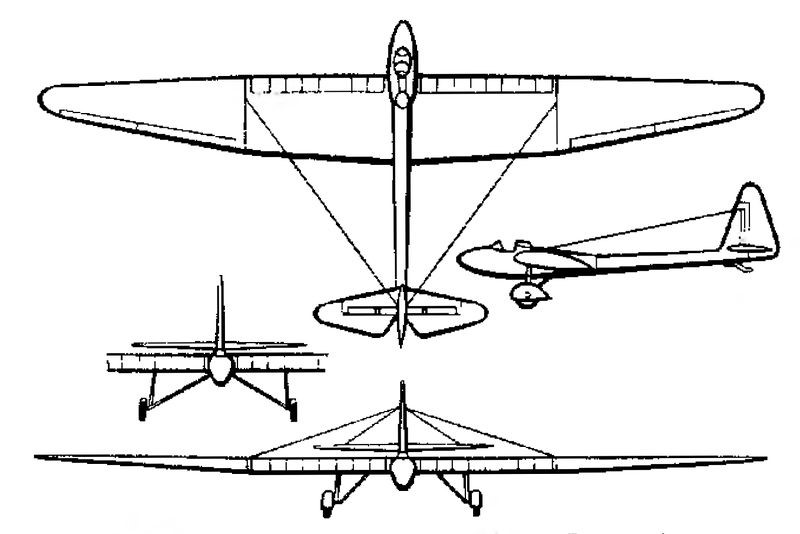
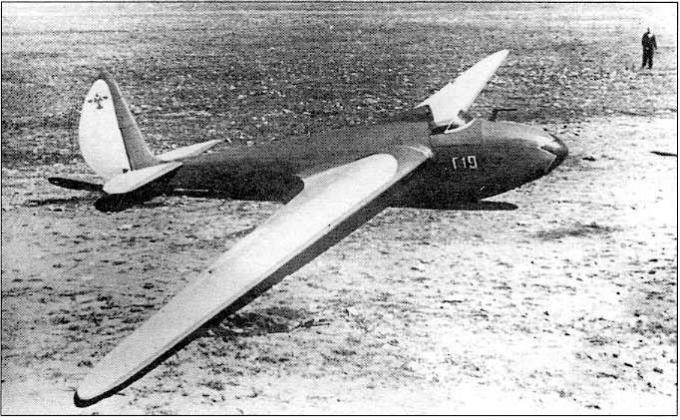
Gribovski G-19

The G-19 (Russian: Грибовский Г-19) glider was designed as a development of the record – breaking G-17 single – seater and was generally similar to it. It would be the last glider designed by Gribovski, who would from there on design and construct light aircraft.

The Gribovski G-19 was designed as a single-seat cantilever mid-wing glider, specially prepared for aero-tow.

The double spar wing, presented in the front part of the wing was covered with 1 mm plywood sheets, up to the position of the second spar. The rest of the wing and ailerons were covered with fabric. The wing design used the TsAGI R-II profile proposed by the engineer PP Krasilschikov. Unlike the previous G-17, in addition to the louvered ailerons, it featured flaps to improve operations during landing. As with the G-18, great attention was paid to improving the attachment of the wings to the fuselage.

The trimmed tail unit featured cantilever planes and monoplane configuration. The leading edge of the empennage and horizontal planes also featured plywood overlay. The rudders were covered in fabric.

The fuselage featured a monocoque structure with a plywood coating. At its bottom there was a landing gear in the form of a ski with suspension.

The pilot was located in an open cockpit located in front of the wing leading edge, protected by a windshield. At the rear of the cockpit, the fuselage deepened to form a headrest.

The G-19 glider was designed and built by the Moscow Building Bureau (MKB) of OSOVIAJIM in 1935. This glider entered the XI National Gliding Competitions.

G-19
Wingspan: 16.00 m
Wing area: 14.40 m²
Length: 6.15 m
Height: 1.70 m
Empty weight: 142 kg
Wing loading: 15.4 kg / m²
Surface of the horizontal planes: 1.60 m²
Empennage surface: 0.85 m²
Ailerons surface: 1.50 m²
Glide ratio: 24.3
Accommodation: 1

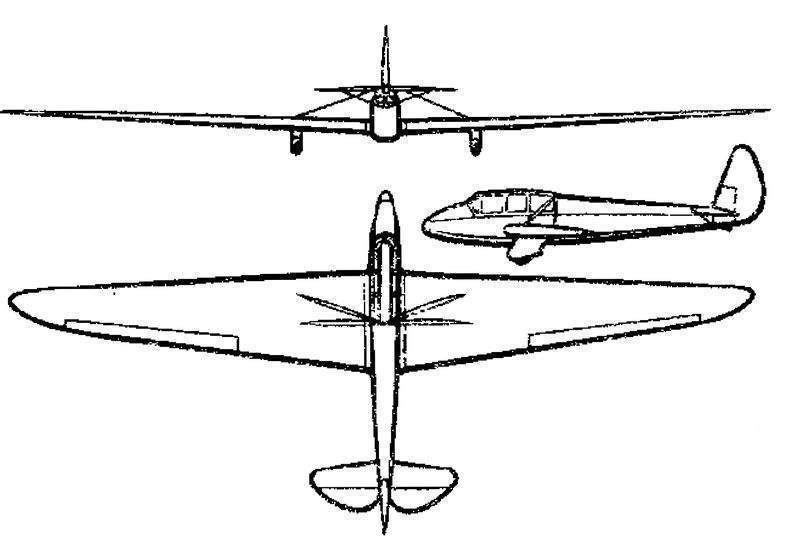
Gribovski G-18

In parallel with the G-17 single – seater glider, Gribovski would develop a tandem two-seater version designed as a development of the G-14. This model was projected in the Moscow Construction Bureau (MKB) of OSOVIAJIM in 1935, receiving the name G-18 (Russian: Грибовский Г-18).

The Gribovski G-18 repeats the structure of the G-14, appearing as a low-wing monoplane braced to the sides of the fuselage by struts. The large wing had a straight leading edge and an inverted trailing edge and was designed with an R-II wing profile. In order to improve aerodynamics, the joint with the fuselage was modified. The trailing edge of the wing featured large louvered ailerons measuring 2 square meters in area.

The landing gear maintained the composition of the previous G-14 with two simple wheels in pants and fixed to the wing soffit. The wide span between the two wheels allowed the necessary stability during aero-tow training.

The wide fuselage, covered with plywood, could be used to transport loads and luggage in the towed mode, so the structure was reinforced.

The cockpits, located in tandem, had a dual control system and were covered by transparent windows.

The G-18 glider was built in OSOVIAJIM’s own MKB workshops. By 1935 Gribovski managed to organize a small productive workshop in a neighbouring basement to the one occupied by the MKB. The entire staff of this workshop consisted of eight men. They practically did not have machine tools, so most of the metal parts had to be hired from other workshops. Another major problem arose when removing the finished parts from the basement. It was necessary to increase the size of a window.

Despite these conditions during 1935 this workshop would build the G-18, G-19 gliders and the G-20 light sport aircraft.

The G-18 glider was sent to participate in the XI National Gliding Competitions, being destroyed during its first flight in September 1935. The pilot IL Kartashiev managed to get out of the accident alive.

G-18
Wingspan: 15.60 m
Wing area: 19.00 m²
Length: 7.1 m
Height: 1.50 m
Ailerons surface: 2.00 m²
Empty weight: 210 kg
Wing loading: 19.5 kg / m²
Glide ratio: 19
Accommodation: 2

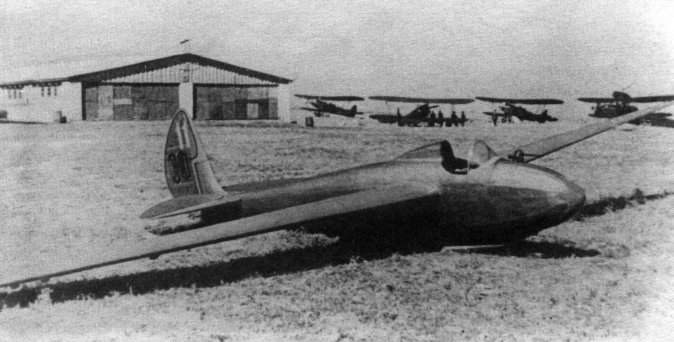
Gribovski G-17

With a view to participating in the XI National Sailing Competitions, Gribovski decided to build a single-seater glider capable of flying long distances taking advantage of thermal currents.

The Gribovski G-17 (Russian: Грибовский Г-17) was designed as a single-seat cantilever mid-wing glider, specially prepared for aero-tow.

The double spar wing, presented in its front part of the wing was covered with 1 mm plywood sheets, up to the position of the second spar. The rest of the wing and ailerons were covered with fabric. The wing design used the TsAGI R-II profile proposed by the engineer PP Krasilschikov. The slotted ailerons occupied 46% of the wingspan.

The tail unit featured cantilever planes and monoplane configuration. The leading edge of the empennage and horizontal planes also featured plywood overlay. The rudders were covered in fabric.

The fuselage featured a monocoque structure with plywood coating. At its bottom there was a landing gear in the form of a ski with amortization.

The pilot was located in an open cockpit located in front of the wing leading edge, protected by a windshield. At the rear of the cockpit, the fuselage deepened to form a headrest.

The G-17 glider was projected at the Moscow Construction Bureau (MKB) of the Union of Defense and Aviation Assistance Societies-Chemical Construction of the USSR, but at that time it still lacked productive capacity, so the construction of the only example built was made at the Frunze factory (ZIF) in 1934 – 1935. This was the reason for the three interlocking ZIF letters that were painted on the rudder. Completed in 1935 it was ready in time to participate in the XI National Sailing Competitions, in the fall of that year, where it would compete with the number 11 in its empennage.

G-17
Wingspan: 15.60 m
Wing area: 13.60 m²
Length: 6.15 m
Height: 1.30 m
Surface of the horizontal planes: 1.60 m²
Empennage surface: 0.85 m²
Aileron surface: 1.50 m²
Empty weight: 126 kg
Wing loading: 15.2 kg / m²
Glide ratio: 23
Accommodation: 1