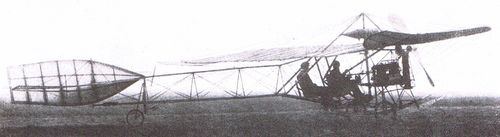
1910/11 two-seater monoplane of Dipl.-Ing. Karl Grohmann, with a high-positioned “Zanonia” wing and a fully open fuselage. It was powered by a 50 hp Argus engine, which drove the tractor screw via a chain. Immediately on its first flight the machine flew 300 meters. Later Grohmann built a single seat development of the 1911 machine. Sometimes the two-seater is identified as the Grohmann I and the single-seater as the Grohmann II, but this is probably a spurious coding introduced years after the event.
In 1910/11 Dipl.-Ing. Karl Grohmann built the Grohmann Eindecker single and two seat aircraft. Karl Grohmann later worked at Albatros (Johannisthal) where he was involved in the design of, among others, the Doppeltaube. During the War he was Chefkonstrukteur (chief-designer) of the Ostdeutsche Albatros-Werke (OAW) in Schneidemühl (Posen).
Groen Brothers Aviation, Inc. (GBA) has developed a plan that can rapidly bring the gyrodyne into the modern age. Implementing this plan would enable the design, development, production and delivery of safe, fast, vertical takeoff and landing, long range high payload rotorcraft. These aircraft will have the ability to hover and will be economical, reliable and easy to maintain. This can be accomplished using a tiny fraction of the cost and time that would normally be necessary. Gyrodyne components and flight control systems can be incorporated into certain existing production high wing airplanes with only small modification to the airframe. The time and cost savings benefits of using an existing production airplane are possible because neither the airframe nor most of its systems will need to be designed, engineered, developed, structural loads measured, analyzed, tested, redesigned and engineered, tested again and then prepared for production. And, since the technology is simple, engineering risks are low. Groen Brothers Aviation has also developed proprietary mission adaptive rotor blade technology. This technology allows GBA’s rotor systems to be optimized for hover flight and then during transition from hover to forward flight it can change to be optimized for high speed. Load sharing between the rotor and the aircraft’s fixed wing adds to the high speed capability of GBA’s gyrodyne aircraft designs. Using an airplane that is already in production also means that the production plan, materials management system and massive supplier chain, quality assurance system, tooling, and production line are already in place and do not need to be designed, developed and paid for again, nor will there be a production learning curve to overcome. The only components that will need this development are the tip-jets (which have no moving parts), rotorblades, rotor head, mast and flight control system. Since the airframe is suspended from the rotor exactly from where it is suspended from its wing, in flight loads to the airframe should be virtually unchanged. This concept was successfully tested by Groen Brothers Aviation through modifying a Cessna Skymaster airplane. It’s two piston engines were removed. The forward engine was replaced with a Rolls-Royce model 250 gas turbine engine, and the aft engine was replaced with a large clam-shell cargo door. The wings were clipped and the existing twin boom tail was inverted to give rotor clearance. The rotor system from one of GBA’s Hawk 4 Gyroplanes was directly connected to the high wing attach points that were already carrying the Skymaster’s fuselage. This conversion, using minimal assets, took less than one year from first conception to first flight. This aircraft demonstrated its exceptional stability and ease of flight, characteristic of a well designed gyroplane. A technology demonstrator development of the Hawk 4 was announced in late 2000 as Hawk 6G with an expected first flight (prototype N9112A) in January 2001. The first flight was eventually made on 22 September 2001. Based around Cessna 337 fuselage with a single 335kW Rolls-Royce 250-B17F2 turboprop in the nose for propulsion, driving a FC9684C-6RX three-blade propeller, and a Rolls-Royce 250-C18 above the fuselage for rotation. The craft was fitted with an inverted Cessna 337 tailplanes and shortened wing with spoilers and two-blade rotor system from the Hawk 4. External fuel tanks are mounted at wingtips, and are modified Piper PA-24 Comanche wingtip units. Fuel capacity 416 litres. Estimated cruising speed was 209 to 241km/h, and a useful load of 907kg. Price was US$950.000 in 2003.
The Hawk 5 (five place) Gyroplane brings to aviation a unique aircraft with many utilitarian qualities. The Hawk’s performance and exceptional versatility also offer a safe and affordable alternative to helicopters and airplanes in many applications. The aircraft’s simple, robust, design translates into lower operating costs than any comparable turbine powered helicopter. The wide operating speed range, from 46 – 162 mph, of this highly maneuverable gyroplane also ensures the Hawk 5 a new niche in the aviation marketplace. The Hawk 5 design, intended for series production following certification, incorporates modifications gained from GBA’s experience with its Hawk 4 (four place) prototype. These include a weight reduction program and an extended cabin that will permit an additional passenger. Most notably are: higher capacity; vertical take-off and landing; a marked increase in useful load, range and endurance; and higher maximum and cruise speeds. Easy to fly and always in autorotation, the Hawk 5 offers uncompromising safety in the realm of flight.
Engine Rolls-Royce 250 C20S (420shp) gas turbine Rotor Blade 42 ft. – 2 blade system Fuselage Length 24 ft. Height 13.5 ft. Fuel Capacity 100 gal. Max. Gross Weight 3,500 lbs. Useful Load 1,525 lbs. Rate of Climb (ft./min.) 1,500 Max. Speed (VNE) 162 mph (140 kts) Cruise Speed 140 mph (122 kts) Service Ceiling 16,000 ft. Range at Cruise 508 miles (no reserve) Endurance 5 hours (no reserve) Seats 5
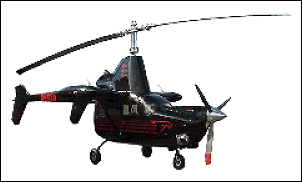
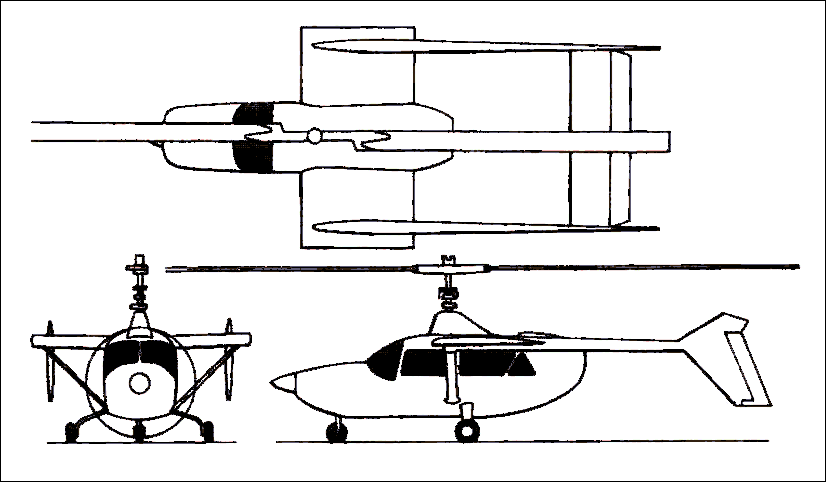
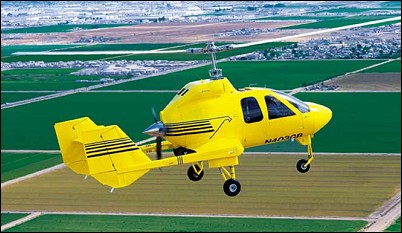
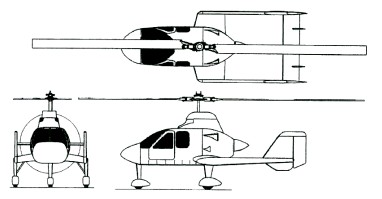
Design changes to H2X and later Hawk III in October 1998 resulted in Hawk 4. Initial aircraft (N402GB) first flew 29 September 1999, powered by a Continental piston engine, and made first vertical take-off on 9 December 1999; had flown 120 hours in 200 sorties by early April 2000. In September 2000 company switched certification effort to turbine-powered Hawk 4T (N403GB), which was renamed Hawk 4 at this time following abandonment of piston-engined version; the following October Groen changed its focus to seek government contracts for Hawk 4, slowing certification process for both piston- and turbine-powered versions until it sees market upturn. GBA analysises and optimises gyroplane rotor blade airfoil performance resulting in a family of natural laminar-flow airfoils for the rotor blades of the Hawk 4 and successor gyroplanes. The airfoil design optimizes the lift/drag relationship for the Hawk rotor system. Initial Hawk models will use aluminum rotor blades with GBA’s proprietary airfoil design, and subsequent models are anticipated to use composite blades with an enhanced GBA proprietary airfoil design that will permit increased operating speeds. The aircraft features twin tailbooms supported by stub-wings which also house main landing gear, and twin stabilisers and rudders with fixed horizontal tail surface mounted between the vertical tails. A two-blade, semi-rigid aluminium teetering rotor with swashplate has a rotor speed of 270rpm. The collective pitch-controlled rotor head allows vertical take-off (zero ground roll) and enhanced flight performance. Rotor brake is standard. Actuation by pushrods. Patented dual-control stack cyclic flight controls. The structure had a steel mast and engine mounts; stressed skin aluminium semi-monocoque fuselage, tail unit, hub structure and propeller; composites nose, engine cowling and wingtips; acrylic windscreen and doors; glass fibre nosecone and engine cowling. The undercarriage is fixed tricycle type with mainwheel tyres 6.00×6; nosewheel 5.00×5, Cleveland hydraulic brakes, and twin safety wheels at rear of tailbooms. Hawk 4 piston-powered version has air-cooled, six-cylinder Teledyne Continental TSIO-550 rated at 261kW at 2.700rpm; prototype had four-blade MTV propeller but production models will have Hartzell three-blade constant-speed propeller. Engine provides power to rotor for prerotation to provide for short and vertical take-off capability; power to rotor system never engaged during flight. Fuel capacity is 284 litres in a single tank at the rear of the fuselage and a refuelling point at the top of the fuselage. Oil capacity 11.4 litres. The pilot and up to three passengers are in an enclosed cabin in two pairs of seats. The rear seats folding to provide baggage space. The electrical system is 28V DC.
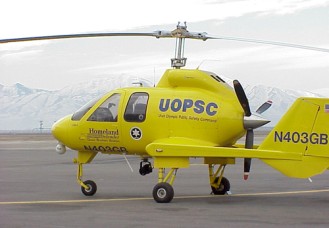
The production prototype for Hawk series was powered by a 134kW Textron Lycoming O-360-A4M flat-four. The company has a flight test facility at Buckeye, Arizona, where, on 12 July 2000, the prototype Jet Hawk 4T / Hawk 4 made its initial flight. This turbine-engine version is powered by a Rolls-Royce Model 250 420shp turboprop engine driving a three-blade constant-speed propeller, first flown (N403GB) on 12 July 2000. Other changes include addition of underfins and taller landing gear. Two further prototypes under construction. The Hawk 4T is sold fully assembled with a Rolls-Royce Model 250 B17C gas turbine for $749,000 in 2001. By May 2003, deposits on 148 aircraft had been taken, via 12 dealerships at around US$749.000 (2003). Fractional ownership programme announced July 2001 but later dropped. The Hawk 4 was an integral part of security during the 2002 Winter Olympic and Paralympic Games. On 28 December 2001, Groen announced contract with Utah Olympic Public Safety Command for lease of Hawk 4, beginning 20 January 2002, for security patrols at Salt Lake International Airport, equipped with video downlink system, Spectrolab SX-5 searchlight and additional radios. The Hawk 4, during its operational period for the Utah Olympic Public Safety Command (UOPSC), was available 24-7, completed 67 missions and accumulated 75 hours of maintenance free flight time.
Hawk H4 Engine: Rolls-Royce 250, 420shp Rotor diameter: 12.80m Fuselage length: 7.31m Overall height: 4.11m Empty weight: 835kg Max. take-off weight: 1587kg Useful load: 960 lb Fuel capacity: 75 USgal Max. speed: 238km/h Cruising speed at 75% power: 212km/h Max. rate of climb at sea level: 457m/min Service seiling: 4875m Take-off run: 8m Range with max fuel at 75% power: 584km
flew several prototype test gyroplanes of increasing size and sophistication during the 1990s. Based on proof-of-concept Hawk One (N4379X) first flown 26 September 1992; design started April 1996 and prototype two-seat H2X (N4412X) first flew 4 February 1997. The H2X was later converted to three-seat Hawk III standard. The Hawk III multipurpose cabin gyroplane was capable of vertical (jump) take-off. First deliveries had been due June 1998, but design changes to H2X and later Hawk III in October 1998 resulted in Hawk 4.
Hawk H2X Engine: one 335kW Geschwinder V-8 aluminium liquid-cooled engine, derated to 261kW at 2.500rpm Propeller: Hartzell three-blade constant-speed.
GBA was founded in 1986 by David Groen and his brother, Jay Groen. GBA’s Corporate Headquarters are located in Salt Lake City, Utah, USA, with its manufacturing facility on the same site. GBA also operates a flight test and R&D facility in Buckeye, Arizona, near Phoenix. Since its inception, GBA has been involved in an extensive research program in the design, engineering, development, testing and marketing of gyroplane and gyrodyne aircraft. Groen Brothers Aviation, Inc. (GBA) is engaged in the business of designing and developing new high performance gyroplanes and gyrodynes using advanced technology and modern aerospace design methods. The Groen brothers realized that the collective pitch controlled rotor system developed for helicopters could be applied to a gyroplane. This innovation would substantially improve a gyroplane’s ability to achieve vertical takeoff and landing, as well as dramatically improve performance in both high speed flight and safe low and slow flight. GBA has three U.S. Patents and several International Patents relating to the variable pitch rotor system they developed. With such improvements the gyroplane could become a safe, economical and versatile aircraft with appeal to a broad range of markets. Based on this insight, the Groens decided in 1986 to enter the market and to design their first gyroplane. Following the successful flight of a proof-of-concept aircraft in 1987, the Groens designed, manufactured and flew several prototype test gyroplanes of increasing size and sophistication during the 1990s. Each of these gyroplanes were typically ultra-short take-off and landing (USTOL) aircraft that demonstrated that gyroplanes could be significantly easier to fly and maintain than a helicopter, would have significantly less maintenance down time and therefore much higher mission readiness, and would be safer than either airplanes or helicopters. By 1999 Groen Brothers Aviation had designed and manufactured their first piston-engine version of the four-seat Hawk 4 Gyroplane. In July 2001, Groen announced plans to move to a new 18.580sq.m facility at Phoenix, Arizona. The plant was intended to become operational by end 2002 and have the capacity to produce four aircraft per day, however this has lapsed. In August 2001 the company concluded a joint venture with Al-Obayya Corporation to produce and market gyroplanes in Saudi Arabia. However, economic downturn of late 2001 resulted in 85 of 130-strong workforce being laid off. Earlier plans for Chinese assembly also appear to have lapsed. In February, 2003, Groen Brothers Aviation formed American Autogyro, to produce gyroplanes for the “kit-built” market.
The 1995 Grob G-850 Strato 2C high-altitude and long-duration atmospheric/ stratospheric/ climatic research aircraft with a unique compound propulsion system using two turbocharged piston engines and two gas generators, was first flown March 1995. Featuring an extremely long span wing of composite construction, one aircraft was built in the 1990s, but was abandoned despite setting a world altitude record for piston engined aircraft on its last flight.
Engines: 2 x 300kW Teledyne Continental TSIOL-555 piston Max take-off weight: 13350 kg / 29432 lb Empty weight: 6650 kg / 14661 lb Wingspan: 56,50 m / 184 ft 9 in Length: 23,97 m / 75 ft 6 in Height: 7,76 m / 23 ft 12 in Wing area: 145.00 sq.m /1560.77 sq ft Cruise speed: 520 km/h / 323 mph Ceiling: 26000 m / 85300 ft Range: 18100 km / 11247 miles
The Grob/E-Systems/AlliedSignal Egrett was a surveillance aircraft developed in Germany in the 1980s by an international partnership. It was intended to fill a joint Luftwaffe-USAF requirement for a high-altitude, long-duration surveillance platform for treaty verification and environmental monitoring.
Germany’s Grob Aircraft, teamed up with E-Systems and Garrett AiResearch, both in the United States. The name EGRETT comes from a combination of the three companies’ names.
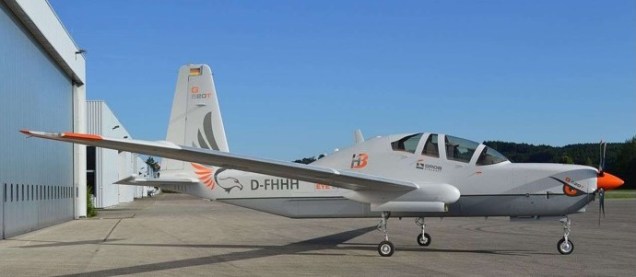
Grob G 520 EGRETT II
According to the publicly available accounts, the official purpose of the program, which the U.S. Air Force reportedly nicknamed Senior Guardian, was to provide a cheaper alternative to the U-2 Dragon Lady spy plane for both treaty verification and environmental monitoring purposes. In the 1980s, the United States and the Soviet Union were negotiating the terms of what would become the Intermediate-Range Nuclear Forces Treaty (INF) and the Treaty on Conventional Armed Forces in Europe (CFE). INF entered force in 1988, while CFE did not go into effect until 1990. Both required robust verification methods.
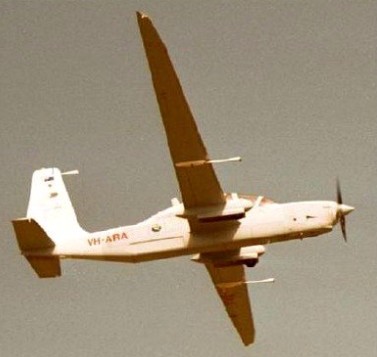
The turboprop-powered G-520 Egrett and Strato 1 high-altitude and long-duration research platforms are capable of carrying different electronic payloads in 12 separate compartments (first flown June 1987 in G-500 Egrett form.
Grob and the rest of the team ultimately built total of five aircraft in various versions, starting with the prototype D 450 EGRETT, followed two more D 500 EGRETT II aircraft.
The contractors then modified the D 500s into the final G 520 configuration before building a third of these pre-production planes. Finally, Grob produced a two-seat G 520T trainer version.
A two-seat Grob 520T
The German manufacturer claims its G 520NG variants has the “lowest operational cost in class.”
The aircraft with its composite airframe was able to carry more than 2,000 pounds of sensors and equipment in any of 12 separate, modular bays, five of which lined the bottom of the fuselage. There was enough room there for turreted day- and night-vision cameras, as well as synthetic aperture radars and other gear.
The G 520 could fly this equipment to an altitude of 50,000 feet. The aircraft has a very narrow cord wing with a span of just more than 108 feet. Depending on the exact load out and flight profile, the plane reportedly could have a range of more than 1,500 miles or loiter over a particular area for up to eight hours.
In the end, the existing prototypes filtered out onto the open market through the original partners. In 1995, Raytheon bought E-Systems, ultimately renaming it as their Intelligence, Information and Services division. The company’s flight test outfit continued flying at least one EGRETT II for some time afterward, providing support to NASA’s Airborne Science Program. According to the Federal Aviation Administration, this aircraft, N520DM, apparently passed to Bear Defense circa 2012.
The D 450 EGRETT aircraft is also still in the U.S. civil registry, listed as N520EG, and property of a company called Gentran Corporation. This Omaha, Nebraska-based “trucking company” has one employee, according to publicly available records. Spotters caught this all-white aircraft in California in 2012 and it does not appear to match the one flying in Indiana earlier in July 2017.
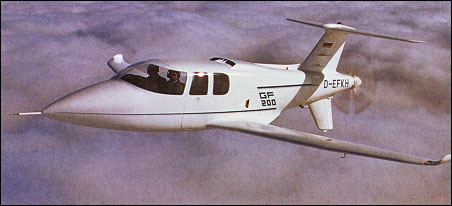
The GF 200 pusher piston-engined and pressurised 4/5-seat lightplane was first flown in November 1991.
Engine: 1 x 233kW Teledyne Continental TSIOL550 turbocharged flat-six Take-off weight: 1600 kg / 3527 lb Wingspan: 11.00 m / 36 ft 1 in Length: 8.70 m / 28 ft 7 in Height: 3.42 m / 11 ft 3 in Cruise speed: 370 km/h / 230 mph Ceiling: 7625 m / 25000 ft Range: 1850 km / 1150 miles Crew: 2 Passengers: 4