Gross

The German government ordered Major von Gross, the officer commanding the army balloon establishment outside Berlin, to commence the design of a large semi-rigid to match French efforts. Work began in 1906 under conditions of the greatest secrecy, and was to result in the construction of a series of airships distinguished by an envelope of elipsoidal form with a triangular-section, articulated tubular steel keel.

The structure evenly distributed the shear and compressive stresses that resulted from the weight of the cars and other loads, whilst allowing the envelope to retain its shape to the best aerodynamic advantage. The Gross airships were shown to be sturdy and well-engineered craft, the development of which benefited from the availability of almost unlimited resources provided by the German government.
Gruppo Costruzioni Aeronautiche GCA.3 Eta Beta

The Gruppo Costruzioni Aeronautiche GCA.3 Eta Beta is virtually a tandem two-seat scaled-up version of the earlier GCA.2 Dumbo, retaining the V-tail assembly. The Eta Beta appeared in 1952, and was designed for both training and touring roles.

The fuselage is an all-wood stressed-skin structure and the wing is an all-wood monospar structure with a stressed plywood skin. Cantilever spring steel main undercarriage legs are fitted, and the enclosed cabin is provided with dual controls and HF radio.

Engine: 60 hp C.N.A, D4S
Wingspan: 27 ft 10,5 in
Length: 20 ft 4 in
Empty weight: 710 lb
Loaded weight: 1151 lb
Max speed: 124 mph at SL
Cruise: 106 mpg
ROC: 984 fpm
Range: 404 mi

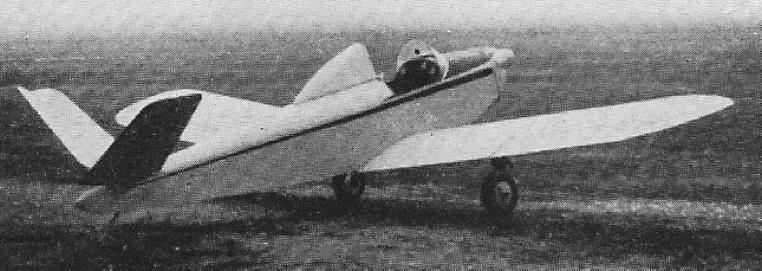
Gruppo Costruzioni Aeronautiche GCA.2 Dumbo

The second machine from Gruppo Costruzioni Aeronautiche of Milan, the GCA.2 Dumbo was designed by Emilio Bianchi and Giovanni.

First flown in 1951, only one prototype was built.

The Dumbo is a single-seat light monoplane with a butterfly tail assembly. All-wood construction with plywood and fabric covering. The power is a 23 hp Ambrosini P.25.

Engine: 23 hp Ambrosini P.25
Wingspan: 24 ft 3 in
Wing area: 85.249 sq.ft
Length: 16 ft 5 in
Height: 5 ft 7 in
Empty weight: 264 lb
Loaded weight: 484 lb
Max speed: 93 mph
Cruise: 75.5 mph
Time to 3280 ft: 6 min 30 sec
Ceiling: 12,120 ft
Range: 300 mi

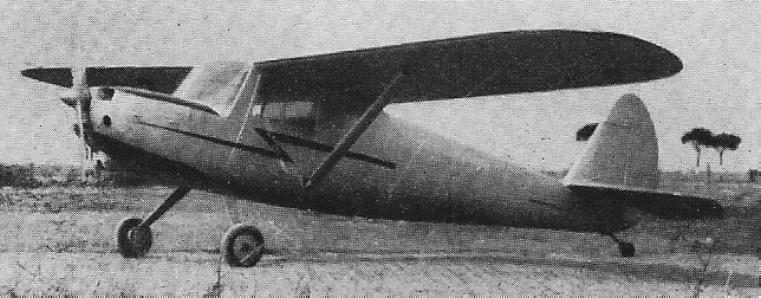
Gruppo Costruzioni Aeronautiche GCA.1 Pedro

Designed by Emilio Bianchi and built in 1953 by the Gruppo Costruzioni Aeronautiche, the GCA.1 Pedro is a side-ny-side two-seat cabin monoplane powered by a 60 hp C.N.A. D4 air-cooled engine.

The Pedro is of all-wood construction with plywood covering. Dual controls are fitted.

Engine: 60 hp C.N.A. D4
Wing span: 32 ft 1.5 in
Wing area: 140 sq.ft
Height: 6 ft 2.5 in
Empty weight: 748 lb
Loaded weight: 1276 lb
Max speed: 106 mph
Cruise: 93 mph
Time to 3280 ft: 6 min 30 sec
Service ceiling: 14,100 ft
Absolute ceiling: 17,550 ft
Cruise range: 342 mi

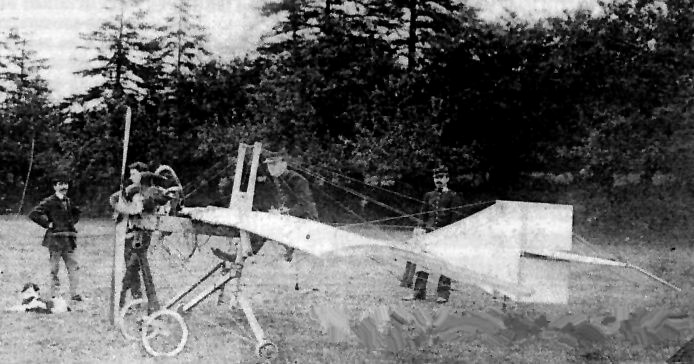
Groos Quand même

The second design of French military officer Alfred Groos. Produced in 1909, a small monoplane which was named “Quand même” [“Nevertheless”].

It was tested on 30 July 1909 as it flew about 100 meter with a speed of 55 km/hr at a height of ca. 2 meter. When it came down one part of the wing was damaged and the propeller broken. The monoplane had a four-wheel undercarriage (2 bigger in front and 2 small ones behind) and a very simple “fuselage” – about one piece of wood – and was powered by a 25 hp Anzani.