Halford H1 / de Havilland Goblin / Allis-Chalmers J36

de Havilland Goblin

An offshoot of the Whittle design was the Frank Halford designed Halford H1. It was more powerful at around 2,300 lbs thrust but also larger and heavier. Design of the engine was carried out by Frank Halford at his London consulting firm starting in April 1941. It was based on the basic design pioneered by Frank Whittle, using a centrifugal compressor providing compressed air to sixteen individual flame cans with a straight through flow from the inlet at the front to the jet pipe, from which the exhaust powered a single-stage axial turbine. Compared to Whittle designs, the H-1 was “cleaned up” in that it used a single-sided compressor with the inlet at the front, and a “straight through” layout with the flame cans exhausting straight onto the turbine. Whittle’s designs used a “reverse flow” layout that piped the hot air back to the middle of the engine, in order to “fold” it and reduce its length. Halford’s changes made his engine somewhat simpler than Whittle’s designs, notably allowing one of the main bearings to be removed. Nevertheless it was a fairly compact design, even without the Whittle-style “folding”.
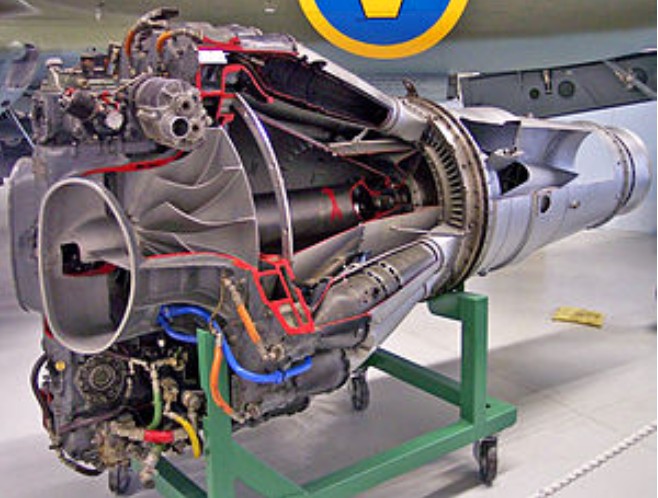
The H-1 first ran on 13 April 1942, and quickly matured to produce its full design thrust within two months. It first flew on 5 March 1943 in the Gloster Meteor DG206, and on 26 September in the de Havilland Vampire. The Goblin was the second British jet engine to fly, and the first to pass type tests and receive a “Gas Turbine” class type rating. It was around this time that de Havilland purchased Halford’s company and set him up as the chairman of the de Havilland Engine Company, with the engine name changing from H-1 to “Goblin”, while the new H-2 design became the “Ghost” – de Havilland jet and rocket engines were all named after spectral apparitions.

In July 1943, one of the two H-1s then available (actually the spare engine intended as a backup for the one installed in the Vampire prototype) was sent to the United States, where it was selected to become the primary engine of the Lockheed P-80 Shooting Star. This engine was fitted to the prototype which first flew on 9 January 1944. The engine was later accidentally destroyed in ground testing, and was replaced by the only remaining H-1 from the prototype Vampire. Allis-Chalmers was selected to produce the engine in the US as the J36, but ran into lengthy delays. Instead, the Allison J33, developed by a General Electric as the I-40 (their greatly improved 4,000 lbf (18 kN) version of the J31, itself based on Whittle’s W.1), was selected for the production P-80A.

“One example of the Allis-Chalmers licensed de Havilland Halford H-1 jet engine prototype was near Wichita Kansas in 2012. Ernst Nutsch had an Allis-Chalmers private museum in Washington Kansas. He had bought the jet engine at an auction in Iowa circa 1998. The condition was fair to good and it was on a repair stand. The Serial plate had Allis-Chalmers name on it as license from de Havilland, model of H-1, plus if I remember correctly it had a US Navy contract number.
The museum was sold off and Ernst passed away in 2010 however at the time the engine was not sold. The family still had it five years ago (in 2012).”
Alan Jones

Variants:

H.1/Goblin I
Developed about 2,300 lbf (10.2 kN) thrust (nominal thrust for prototype) and 2,700 lbf (12.0 kN) for production models.

Goblin II
3,100 lbf (13.8 kN)

Goblin 3
3,350 lbf (14.9 kN)

Goblin 35
3,500 lbf (15.6 kN)

Goblin 4
3,750 lbf (16.7 kN)

Allis-Chalmers J36
Licence production in the United States by Allis-Chalmers.

Aircraft applications:

de Havilland Vampire
de Havilland Swallow
Curtiss XF15C-1
Fiat G.80
Gloster Meteor
Lockheed XP-80
Saab 21R

Alternative applications:

Bluebird K4

Specifications :

D.H Goblin II D.Gn 27
Type: Turbojet
Length: 107 in (2,718 mm)
Diameter: 50 in (1,270 mm)
Dry weight: 1,550 lb (703 kg)
Compressor: Single sided, centrifugal flow
Combustors: 16 chambers
Turbine: Single stage axial flow
Fuel type: Kerosene (R.D.E. / F / KER)
Oil system: metered pressure spray at 50 psi (344.7 kPa) dry sump, 40 S.U. secs (13 cs) (Intavia 620) grade oil
Maximum thrust: 3,000 lbf (13.34 kN) at 10,200 rpm at sea level
Overall pressure ratio: 3.3:1
Turbine inlet temperature: 1,472 °F (800 °C)
Fuel consumption: 3,720 lb/hr (465 imp.gal/hr), (1,687 kg/hr) or (2,114 l/hr)
Specific fuel consumption: 1.18 lb/lbf/hr (120.285 kg/kW/hr)
Thrust-to-weight ratio: 1.9 lbf/lb (0.0186 kN/kg)
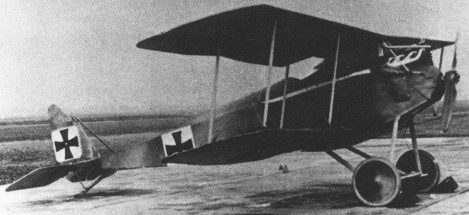
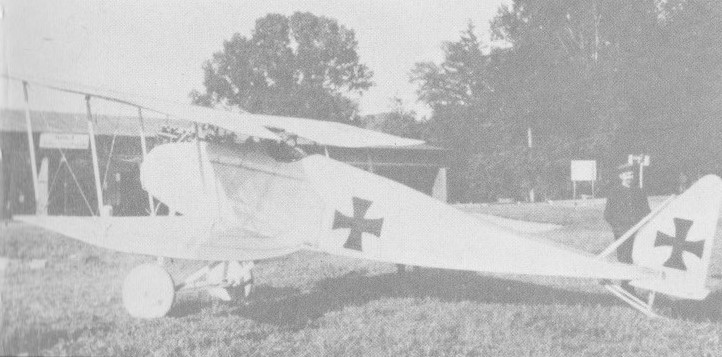
Halberstadt D Srs

D.II

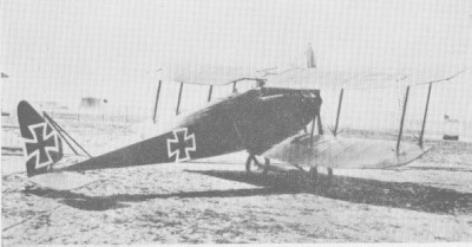
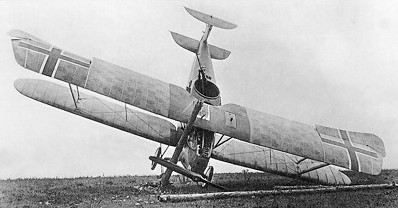
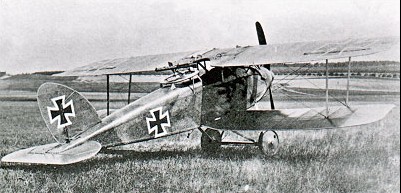
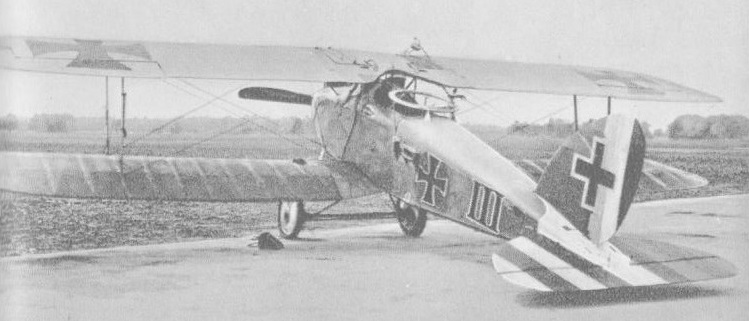
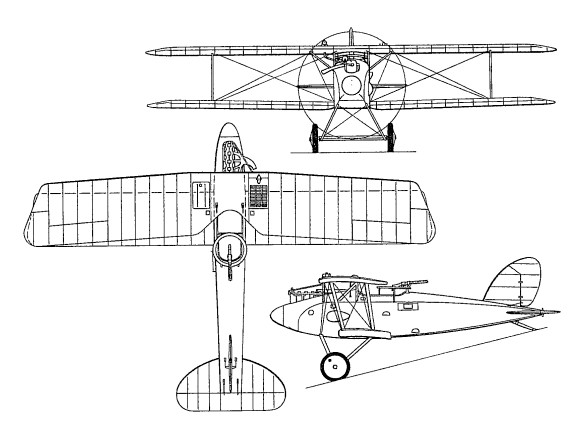
The Halberstadt D-series of single-seat fighters was developed from the unarmed B II reconnaissance two-seater, inheriting that type’s considerable structural strength. The D I appeared late in 1915 with a single interrupted gun and a powerplant comprising one 75-kW (100-hp) Mercedes D.l inline engine.

Halberstadt D Srs Article

A two-bay biplane, the wings were of two-spar construction with fabric covering. The wooden fuselage, with plywood covering forward and fabric covering aft. There were no fixed tail surfaces. The ailerons, elevators and rudder were all fabric covered steel tube structures. Ailerons were on the top wing only.

D.II

The production model, of which few were built, was the D II with the more powerful Mercedes DII engine and a wing radiator in place of the original nose-mounted unit. About 100 were in service in January 1917.

The D.II was not easy to fly on account of the absence of any fixed or tailplane surfaces resulting in extremely sensitive controls.

D.II

These served for a few months from June 1916 before being supplanted by the D III, which differed mainly in its larger horn-balanced ailerons and as powerplant one 89-kW (120-hp) Argus Ash inline.

A few D IVs were produced for Turkey with twin guns and the 112-kW (150-hp) Benz Bz.III, entering service in 1917 as a single seat fighter. The DV of 1917 was a refined type with a more streamlined plywood-covered fuselage and the As.II engine.

Replica D.VI:
Swanson Halberstadt D.VI

Halberstadt D.I
Engine: l x Mercedes D.I, 75kW(100hp).

Halberstadt D.II
Engine: l x Mercedes D.II, 89kW(120hp).
Span: 8.8m (28 ft 10.5 in).
Length: 7.3m (23 ft 11.5 in).
Height: 8 ft 9 in
Empty weight: 1237 lb
Max T/O weight: 730kg (1,6l0lb).
Fuel capacity: 18.5 Imp.Gal
Max speed: 93 mph.
Operational endurance: 2 hr.
Armament: 1 x 7.92-mm (0.312-in) Spandau LMG 08/15 mg.

Halberstadt D.III
Engine: l x Argus Ash, 89kW(120hp).
Span upper: 28 ft 8 in
Span lower: 25 ft 8 in
Wing area: 256 sq.ft
Length: 23 ft 10 in
Height: 7 ft 9 in
Max speed: 90 mph at SL
Armament: 1-2 Maxim mg
Crew: 1

Halberstadt D.IV
Engine: l x Benz Bz.III, 112kW(150hp).
Armament: 2 x mg.

Halberstadt D.V
Engine: l x Argus Ash As.II.

Halberstadt CL.II

The Halberstadt CL.II was produced in 1917 as a new class of light escort fighter to protest reconnaissance aircraft however its potential as a ground attack fighter was quickly realised. The CL.II was first used to hurl small bombs and hand grenades at advancing British troops in September 1917. They played a major role in the successful German counter attack during the Battle of Cambrai on 30 November 1917.

The crew of two sat in a single elongated cockpit. Their machine guns were supplemented by trays of grenades.

A single-bay biplane, the wings had two spars, with fabric covering, and plywood covered wooden fuselage. Conventional tail surfaces, with wooden fin and tailplane and steel-tube control surfaces, all fabric covered, were fitted. Ailerons of fabric-covered steel-tube construction were on the top wing only.

Engine: 1 x 119kW/160 hp Mercedes D.III water-cooled inline
Wingspan: 10.77 m / 35 ft 4 in
Length: 7.30 m / 23 ft 11 in
Height: 2.75 m / 9 ft 0 in
Empty weight: 1755 lb
Max take-off weight: 1133 kg / 2498 lb
Fuel capacity: 35 Imp.Gal
Max. speed: 165 km/h / 103 mph at SL
Ceiling: 5100 m / 16750 ft
Endurance: 3 HR
Armament: 3 x 7.92mm machine-guns, 5 x 10kg bombs
Seats: 2.

Halberstadt Flugzeuwerke

Deutsche Bristol-Werke was founded at Halberstadt in 1912 to manufacture products of the British & Colonial Aeroplane Company, but severed connection with the parent company in 1914. Subsequently it developed and built its own designs under the name of Halberstadter Flugzeugwerke.
Halberstadt’s first aircraft, the C.I reconnaissance biplane, first flew in May 1916, and together with more powerful C.III and C.V developments, was produced in large numbers in the First World War. The CL class two-seat escort fighters were particularly successful in ground-strafing roles during the campaigns of autumn 1917. Halberstadt’s D-class single-seater scouts were strong and maneuverable, but inferior to Allied fighters in speed. A number of D.ll and D.lll scouts were built by Hannoversche Waggonfabrik AG. The Halberstadt D.V, the company’s final scout design, appeared in early 1917.

Haines H-3 Mystery Ship / Special / Firefly

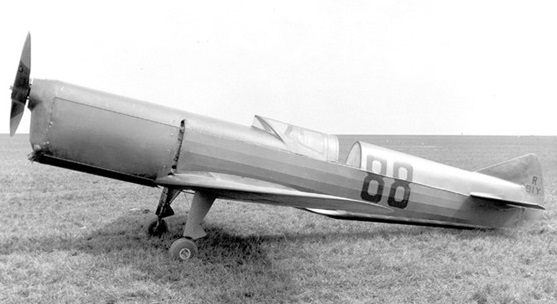
The Haines H-3 Mystery Ship (sometimes called the Special or Firefly) was designed and flown by Frank Haines in the 1937 Greve Trophy Races. The race was ten laps of a ten-mile course, with a $15,000 purse. The Haines H-3 was sixth and dead last.

Haines was killed in the H-3 on 3 December of 1937 in Miami as the race began. At virtually the same moment (but not a related incident) Rudy Kling, the 1937 Thompson Trophy winner lost control of his ship and was also killed. It was thought they were both caught by the same wake turbulence or downdraft. According to newspaper articles, both aircraft were set on fire at the end of the day to get rid of the wreckage.