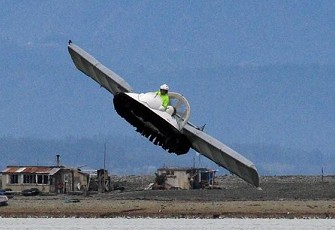
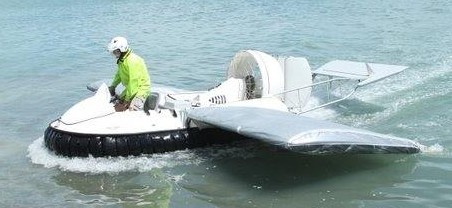
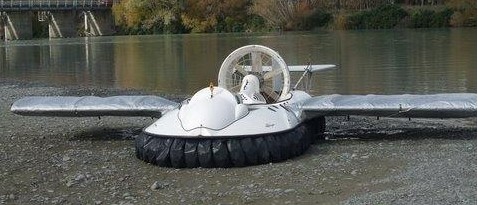
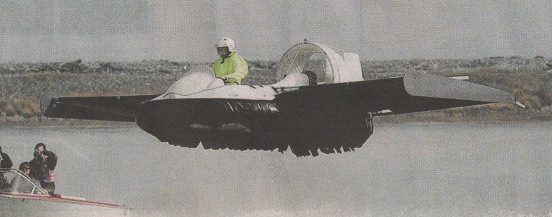
Rudy Heeman of Nelson, New Zealand, spent three years building and designing the hovercraft that can travel on water land and air.
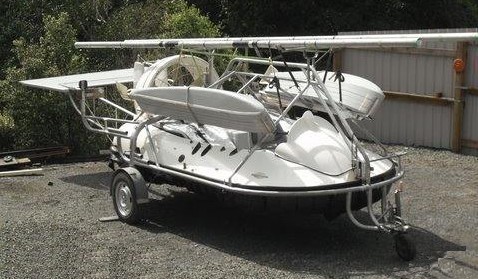
The craft has alloy wing spars, with foam cored ribs and fabric skins. The tail unclips but stays on for trailer transport.
He wanted to develop the flying hovercraft design, but had to sell a prototype to raise enough cash to do so.
It was listed on a ‘Trademe’ website expiring on 13 March 2010 with a reserve of NZ$20,000.
Mr Heeman, a mechanic, has been making hovercraft in his spare time for more than 13 years but was his first attempt at a flying version. He had spent 75 hours flying his completed bovercraft.
With a modified 1.8 litre Subaru car engine and a range of more than 225 kilometres, the hovercraft cruises at 90 kph when flying, and has a smooth ride above the waves.
This machine is a W.I.G [wing in ground effect] in the form of a hovercraft. This machine, which is classed as a boat and comes under MSA rules, can operate as a hovercraft or, when the wings and tail put on, flying machine that can travel above the water or land. The engine is an EA81 subaru, modified with turbo, intercooler blow thru webber carb.
The construction of the hovercraft began in 2003 and conversion to WIGE began in 2007. The first flight was towards the end of 2007.
The wingtips have water skis on them so it doesn’t dig in.
The final wing shape was the third design. Skirt retraction is electric. The thrust diverter works electrically by pushing green or red buttons on the handlebars. The green button gives a 30% increase in thrust instantly by diverting lift sir to add to thrust once airborne.
Has alloy wing spars, foam cored ribs and fabric skins. The tail unclips if not required but stays on when transported. Has a retractable finger skirt, open cockpit, aerofoil wings, and thrust diverter.
The first test flight was 2007.
The WIGE was auctioned on the New Zealand Trademe website during 27 February – 13 March 2010. It was listed as designed and built by Rudy Heeman. Powered by a 100 hp inboard motor, it could operate as a hovercraft or, with the wings and tail put on, as a wing in ground effect flying machine. Built in 2003, the engine had run for 150 hours. With the 1.8 lt engine it could reach over115 kph, and a range of over 225 km cruising at 90 kph, using 30 lt of 96 octane fuel/hr.
The machine does not require any licence but must obey boat rules when on or above the water. The sale was for the machine only and did not include copyrights, intellectual properties, moulds etc.
In flying mode t could carry 160 kg (or three people as a hovercraft).
At that time it had flown over 75 hours with the Subaru EA81 engine, modified with turbo, and intercooler blowthru Webber carb.
Engine: 100 hp at 5000 rpm +7 lb boost, approx. 400 lb thrust.
The T/O distance is approximately 80m and, while it has flown in 25 kph winds, a max of 15 kph is recommended.
It was sold by Trademe auction for $27,500.
Engine: Subaru EA81, 100 hp 100HP at 5000rpm with 7 pounds boost
Wingspan: 7m
Length with tail: approx 6.3m
Length: 4 m (13 ft)
Approx weight: 320 kg + 50 kg wing and tail
Fuel capacity: 75 lt
TO speed: 70 kph