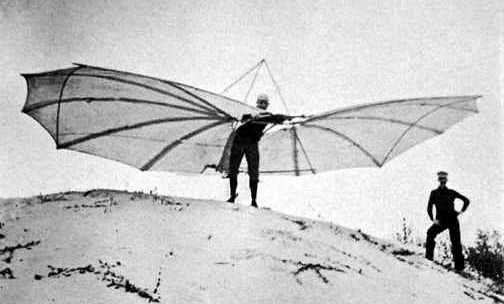
Herring Lilienthal monoplane

Herring preparatory to making a glide

In December, 1895, Mr. Chanute secured the services of Mr. A. M. Herring, a civil and mechanical engineer, who had for some years been making experiments in Aviation, this being the recent name given to attempts to imitate the birds.

Chanute selected the sand dunes along the southern shore of Lake Michigan as the perfect place to test his creations. The area was close to Chicago. The little train station at Miller, Indiana served as an entry point into Dune country. The area offered a number of other important advantages, including steady winds, dunes from which a glider could be launched in any direction, an abundance of sand for soft landings, and, Chanute hoped, relative isolation.

Chanute and his four assistants pitched their tents on a spot within the present city limits of Gary, Indiana, on June 22, 1896. Augustus Herring, the most experienced member of the group, had brought a glider based on the standard Lilienthal monoplane design. William Avery, a Chicago carpenter, had constructed a multi-wing glider designed by Chanute, while William Butusov would attempt to launch his own glider, the Albatross, down a wooden ramp. Dr. James Ricketts, a Chicago physician with “a slack practice and a taste for aeronautics,” would cook for the group and provide emergency medical service as required. Chanute’s dogs, Rags and Tatters, rounded out the party.
Herring and Avery did most of the flying.

Herring rebuilt a machine, previously tested by him in New York, somewhat similar to that of Lilienthal, so that the known should be tested before passing to the unknown. With these two machines Mr. Chanute and Mr. Herring, and two assistants (Mr. Avery and Mr. Butusov), went in June, 1896, to the desert sand dunes at the south end of Lake Michigan, north of Miller Station, about thirty miles from Chicago. The Lilienthal-like machine was the first tested.

The machine spread 168 square feet of sustaining surface, was equipped with a double rudder, and weighed thirty-six pounds. With this about 100 glides were made, the longest being 116 feet. It proved from the outset an awkward machine to handle. Lilienthal, whose skill had been developed by four or five years of practice, obtained valuable and safe results with it, but it was otherwise with novices. Its operation involved a struggle with the wind before it could be brought under control, and this continued after the flight had begun.

Gliding a short height over the ground was practiced to avoid untoward accidents, for the winds experimented in, of 12 to 17 miles per hour, constantly varied the position of the center of pressure so far and so rapidly through their fluctuations, that the operator had to shift his position as actively as a tight-rope dancer, but to greater distances, to avoid being overturned. The body had to be moved at times some 15 or 18 inches, and not infrequently in landing the apparatus was broken. This involved less personal risk than might be supposed because the radiating ribs curve downward, so that they first come into contact with the ground when an awkward landing is made, and save the operator from harm.

The Lilienthal glider proved to be a disappointment. At last, after having been broken and mended a number of times, was finally discarded altogether. After abandoning this first form of machine, the experimenters in the sand dunes next tested the machine built after the fashion of the ladder kite which had proven so steady in the air.
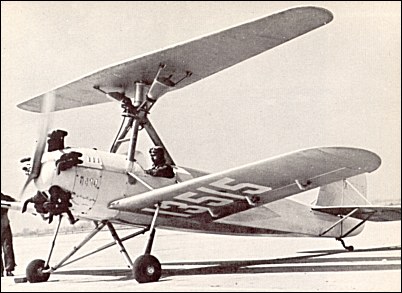
Herrick Convertoplane

The Convertoplane, cross between an airplane and a rotorplane, was developed in the United States in the 1930s by the Gerard P. Herrick, aided by Ralph H. McClarren of Philadelphia’s Franklin Institute. Basically, the design was a biplane with an upper wing that could function either as a lifting surface or as a two-bladed teetering rotor.
Flown by test pilot George Townsend in 1937, the aircraft demonstrated successful conversions in flight from a biplane to a rotorplane. Herrick was striving for an aircraft that could achieve speed as an airplane while possessing ability to convert to rotating-wing configuration for landing and take-off in tight areas.

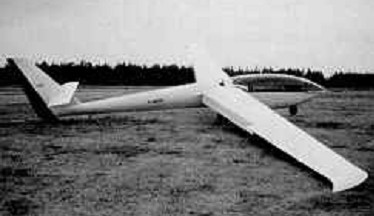
Hermanspann Chinook

Chinook S

The Chinook S, designed by Fred Hermanspann and Art Penz, first flew in 1996, as an improved version of the original Chinook of 1993. Approach control is by full deflection trailing edge flaps. Both the flaps and main wheel are hydraulically actuated. The sailplane has been used to study the effect of rain on airfoils, and dynamics at the stall.

Wing span: 17.37m / 57ft
Wing area: 13.29sq.m / 143sq.ft
Empty Weight: 286kg / 630lb
Payload: 190kg / 420lb
Gross Weight: 476kg / 1050lb
Wing Load: 35.82kg/sq.m / 7.34lb/sq.ft
Water Ballast: 0
L/DMax: 40 98 kph / 53 kt / 61 mph
MinSink: 0.73 m/s / 2.17 fps / 1.42 kt
Aspect ratio: 22.7
Airfoil: Wortmann FX67-K-170/17
Structure: aluminum, GFRP front fuselage
Seats: 2
No. Built: 1

Hergt Monoplane

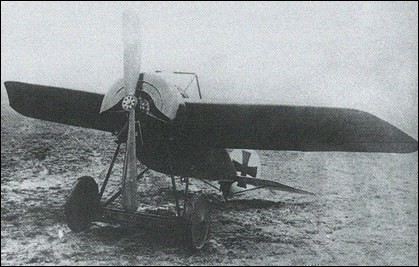
The Hergt Monoplane was designed and built at F.E.A. 1 Altenburg as a private venture by F. D. Hergt during 1918 and flown by Mario Scherff.

The prototype had room for one pilot, and ply-skinned wings and fuselage.

Engine: Gnome 80 h.p.
Wingspan: 6.0 m. (19 ft. 8 1/4 in.)
Length: 5.2 m. (17 ft. 0 3/4 in.)
Speed: 125 km.hr. (78 m.p.h.)
Armament: none

Herdler 1911 Hochdecker

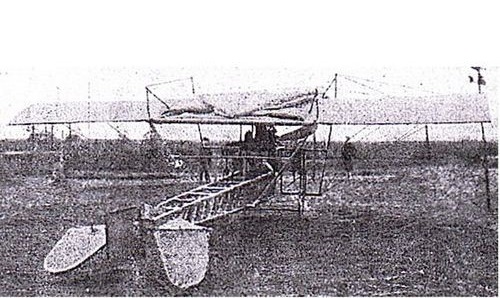
The 1911 Herdler Hochdecker high-wing eindecker designed by Carl Herdler, had an “Absturzsicherung auf dem Flügel (ein sammengefalteter Luftsack) der bei Gefahr gespreizt werden konnte” – a security device, where the idea was to blow up the bag with air, to remain longer in the air whereas to lessen the force of impact in the event of a crash on the ground. The “air bag” may have also been somewhat based on the parachute.

The machine made short hops in 1911.

Henson & Stringfellow Aerial Steam Carriage

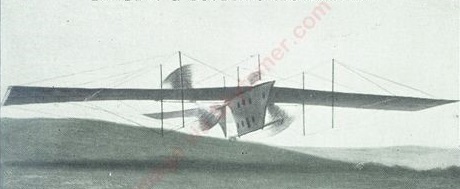
In 1843 William Samuel Henson patented about a proposed “Aerial Steam Carriage”. It seems more like a practical flying machine than anything hitherto suggested. Lacemaking industry engineer Henson, based in Somerset, has had a number of bright aviation ideas. This remarkable flying machine would be a monoplane, with two pusher propellers to be driven by a light steam engine of 25 to 30 hp. Henson actually ordered this engine from colleague John Stringfellow. Even if the Aerial Steam Carriage never flies, its impact has already been tremendous. Pictures of it appeared in magazines and newspapers, and is much talk about.

Also in 1843 William Samuel Henson and John Stringfellow filed articles of incorporation for the world’s first air transport company, the Aerial Transit Company.

Hensley 1909 biplane

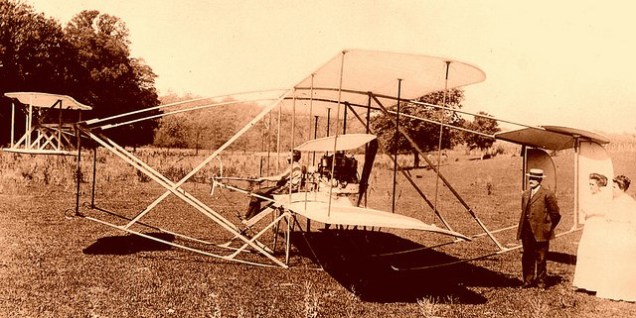
This somewhat Wright-like machine was constructed in Anderson, Indiana, USA, by Charles H. Hensley, a 40-year-old man who enjoyed building and flying box kites, and Levi Calvin Lambert, who was a 33-year-old plant manager and a member of the family that owned the Lambert Gas and Gasoline Engine Co., also of Anderson, which probably provided the engine. A grandson of Hensley stated that the plane flew around in a circle, for how long or at what height is unknown. He was told the plane was dismantled after its only flight.