One example only of the Hollandair HA-001 Libel (Dragonfly) single-seat agricultural aircraft was built in 1957.
Author: Terry
Hollandair TB
Netherlands
Formed as an aeronautical trading concern in 1956 specialising in the overhaul of aircraft and engines. One example only of the Hollandair HA-001 Libel (Dragonfly) single-seat agricultural aircraft was built in 1957.
Holdsworth 1931 Sailplane
The Holdsworth Sailplane was a single seater designed and built in 1931 by H.Holdsworth, the ground engineer of the Bradford & County Gliding Club.
Of conventional wooden construction, it was designed to have a high wing loading.
Only one was built and no CofA is recorded.
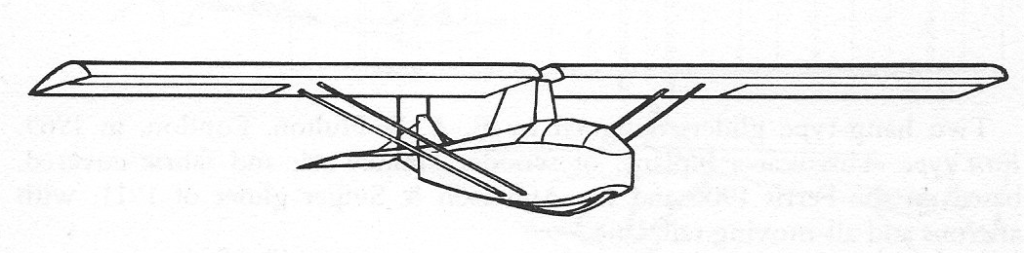
Holcomb Perigee
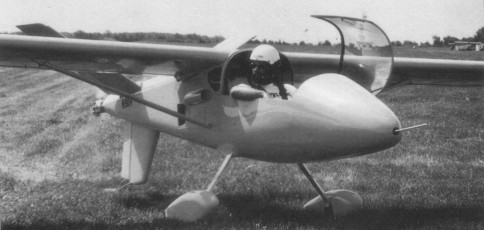
Due to other events, notably the Bullet 2100 project and Molt’s declining health, the Micro-IMP was not developed further. Jerry Holcomb went on however to develop, build and fly a refinement of the Micro-IMP design which he named the “Perigee”.
The Perigee, which was designed by Jerry Holcomb of Perigee Associates and initially called the Ultra Imp, first flew in April 1987 and is based on the TPG form of construction pioneered on the Aerocar Micro-Imp. This is a version of the same company’s Mini-Imp, which clearly provided the conceptual starting point for the Perigee.
The TPG (Taylor Paper Glass) form of construction was developed by Moulton B. Taylor, president and general manager of Aerocar, which was created in 1948 to develop Mr Taylor’s extraordinary flying car concept. TPG is a paper core (with metal inlays to accommodate compression loads) covered in glassfibre in a matrix of polyester resin and covered with ripstop Dacron fabric. The Mini-Imp and Micro-Imp both have retractable tricycle landing gear, but the Perigee uses fixed tailwheel landing gear with cantilever main legs ending in elegant speed fairing round the wheels. The need to accommodate a tailwheel led to an alteration of the Y-shape tail unit by comparison with the Aerocar types: in the Perigee it is turned through 1800 so that the vertical surface is at the bottom with the tailwheel attached to its lower edge.
The streamlined fuselaqe is of composite construction with spruce longerons, TPG bulkheads, cockpit floor, tailcone and side skins, a glassfibre nose and some aluminium alloy components. The braced high-set wing has an aluminium alloy/TPG main spar, a spruce/TPG rear spar, wood main ribs, TPG nose ribs, a glassfibre leading edge and fabric covering aft of the main spar. The full-span flaperons are of aluminium alloy sheet over polystyrene foam. The three tail surfaces are similar to the wing in basic construction, but have no wood in them. Propulsion is the task of a twin-blade pusher propeller behind the tail unit, and this is driven by an extension shaft running aft from the engine located behind the cockpit.
Fixed-gear, strut-based monoplane with Y tail, pusher engine. Wings fold for towing on highway. Optional retractable gear, cantilever wing. Powerplant: Cuyuna 430 drives controllable pusher prop. Landing gear: Fixed taildragger.
Information packages were sold but plans and kits never materialized.
Type: sport lightplane
Seats: one.
Powerplant: one 35-hp (26-kW) Cuyuna 430
Maximum speed 120 mph (193 km/h)
Initial climb rate 700 ft (213 m) per minute
Service ceiling 12,500 ft (3810 m)
Range 200 miles (322 km)
Empty weight 380 lb (172 kg)
Maximum take-off 720 lb (326 kg)
Wingspan 28 ft (8.53 m)
Length 15 ft 8 in (4.78 m)
Height 5 ft 2 in (1.57 m)
Wing area 81 sq.ft (7.53 sq.m).
Aspect Ratio 10:1.
Stall speed 40 mph.
Vmax 140 mph.
Takeoff run 300 ft. Landing roll 300 ft.
Fuel capacity 8+ USG.
Holcomb
1983: Jerry Holcomb, 1010 N.E. 122nd St., Vancouver WA 98664, USA.
LSA builder
Hohl H1 / H2 / H3 / H4 / H5 / Eindecker
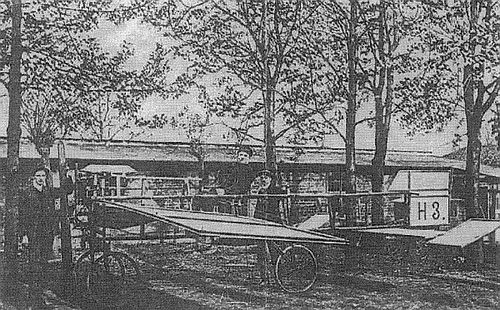
Electrician Hans Hohl was not a successful aviator and little is recorded of his designs. None of his machines is known to have flown; the main criticism of Hohl always given to his non-existent airfoil. Even in 1912, when the army allowed the use the Exerzierplatz at Halle-Beesen – 10 or so miles from Merseburg, south of Berlin – the last-known of his monoplanes, “Hohl-5”, failed to make a sustained test flight.
Holbrook 1910 Aeroplane
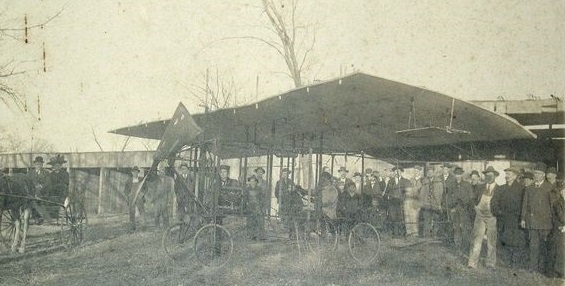
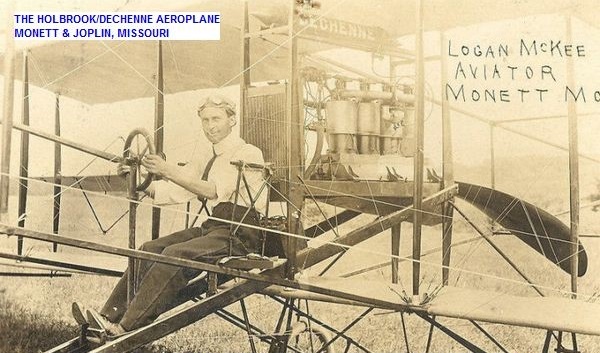
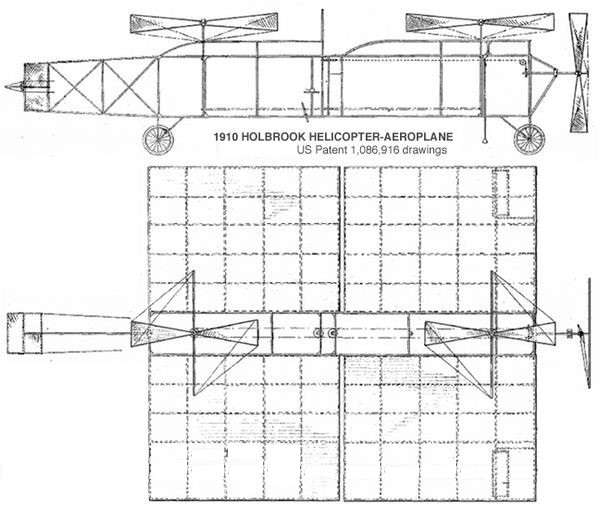
High-wing monoplane designed by Arthur Erritt Holbrook and built by the Holbrook Helicopter Aeroplane Co. in Joplin, Missouri. At around the time of the founding of his company, Holbrook also filed (January 19, 1910) to patent an Aeroplane; rather a tandem wing monoplane fitted with both tractor propeller and vertical rotors – hence the name of the firm. Four years later, on February 10, 1914, Holbrook was finally granted US Patent 1,086,916 for his invention. It is reasonable to assume that this photographed machine, with shafts protruding above the wing, was a “first draft” to be augmented to a form visible in the patent of Holbrook, where two rotary propellers are visible. After its appearance in 1910, Holbrook’s aeroplane was never heard from again.
Holbrook Aero Supply
Joplin MO.
USA
Built two models of inline 4-cylinder water cooled aero engine in 1910; a 35hp and a 50hp.
Höhenflug HFL
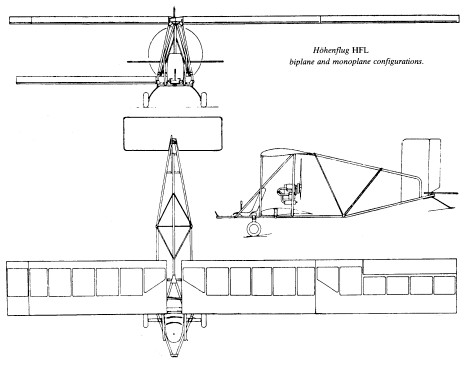
Single seat single engined high wing monoplane or biplane with conventional three axis control. Wing has unswept leading and trailing edges, and constant chord; conventional tail. Pitch control by fully flying tail; yaw control by fin mounted rudder; roll control by ailerons; control inputs through stick for pitch/roll and pedals for yaw. Cantilever wing; wing profile Worthmann FX63 137; double-surface. Undercarriage has two wheels side-by side with tailskid; suspension on both wheels. No ground steering. No brakes. Aluminium tube framework, without pod. Engine driving pusher propeller. Wings made from carbon fibre and unidirectional glass fibre.
This single seater is unusual in that it can be used either as a monoplane or a biplane. Its wing is in effect made up of four half wings, of which two form a high wing attached to the top of the tubular framework. The remaining two wings can either be joined to those of the top wing in a monoplane configuration or fitted to the bottom of the framework to make a biplane. These two ‘wandering’ wings are fitted with ailerons. As the four wing elements are of equal span, chord and area and the framework is wider at the bottom than the top, the biplane thus produced has a lower wing of greater span than the top. To avoid such aerodynamic nonsense, Hohenflug adds two wing tip sections to the upper wing to give it a slightly greater span than the bottom. In either configuration the wings are of cantilever construction with neither rigging wires nor interplane struts.
This Hohenflug bird was announced as due to make its first flights during summer 1983 and no information on its marketing strategy has so far been received. It is also not yet known which motor will be used, but the calculations have been based on a power range of 20 28 hp. The engine is fitted behind the pilot above the lower wing and drives a three blade pusher propeller.
Monoplane
Length overall 16.4 ft, 5.00 m.
Height overall 5.9ft, 1.80m.
Wing span 38.7 ft, 11.80m.
Chord at root 3.6 ft, 1.10m.
Sweepback 0 deg.
Total wing area 140sq.ft, 13sq.m.
Wing aspect ratio 10.74.
Wheel track 3.9 ft, 1.20 m.
Engine: 28hp.
Propeller diameter 45 inch, 1.13 m (three blade).
Power per unit area 0.20 hp/sq.ft
Fuel capacity 5.3 US gal, 4.4 Imp gal, 20.0 litre.
Empty weight 199 lb, 90kg.
Max take off weight 442 lb, 200kg.
Payload 243 lb, 110 kg.
Max wing loading 3.15 lb/sq.ft, 15.4 kg/sq.m.
Max power loading 15.8 lb/hp, 7.1 kg/hp.
Load factors; +4.9, 2.5 ultimate.
Never exceed speed 81 mph, 130 kph.
Max cruising speed 50 mph, 80kph.
Stalling speed 27mph, 43kph.
Max climb rate at sea level 400ft/min, 2.0m/s.
Range at average cruising speed 124 mile, 200 km.
Biplane
Length overall 16.4 ft, 5.00 m.
Height overall 5.9ft, 1.80m.
Wing span 22.6 ft, 6.90m.
Chord at root 3.6ft, 1.10m.
Sweepback 0 degs.
Total wing area 151 sq.ft, 14 sq.m.
Wing aspect ratio 6.311 top wing.
Wheel track 3.9 ft, 1.20 m.
Engine: 28hp.
Propeller diameter 45 inch, 1. 13 m (three blade).
Power per unit area 0.19 hp/sq.ft,
Fuel capacity 5.3 US gal, 4.4 Imp gal, 20.0 litre.
Empty weight 203 lb, 92kg.
Max take off weight 442lb, 200kg.
Payload 239 lb, 108 kg.
Max wing loading 2.92 lb/sq.ft, 14.3 kg/sq.m.
Max power loading 15.8 lb/hp, 7.1 kg/hp.
Load factors; +4.9, 2.5 ultimate.
Never exceed speed 81 mph, 130 kph.
Max cruising speed 50 mph, 80kph.
Stalling speed 27mph, 43kph.
Max climb rate at sea level 400ft/min, 2.0m/s.
Range at average cruising speed 124 mile, 200 km.
Höhenflug
1983: Hohenflug Leichtflugzeugbau, Matzstrasse 22, D 1000 Berlin 30, West Germany.
LSA builder

