Back to Supermarine Spitfire
Back to Messerschmitt Me 109
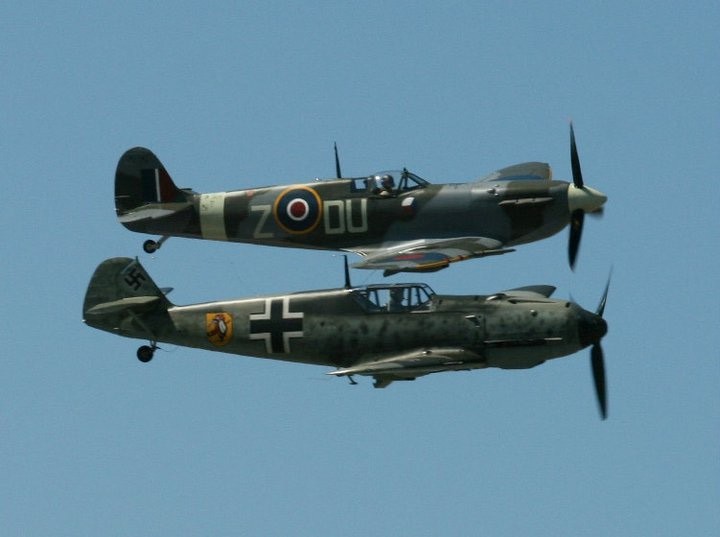
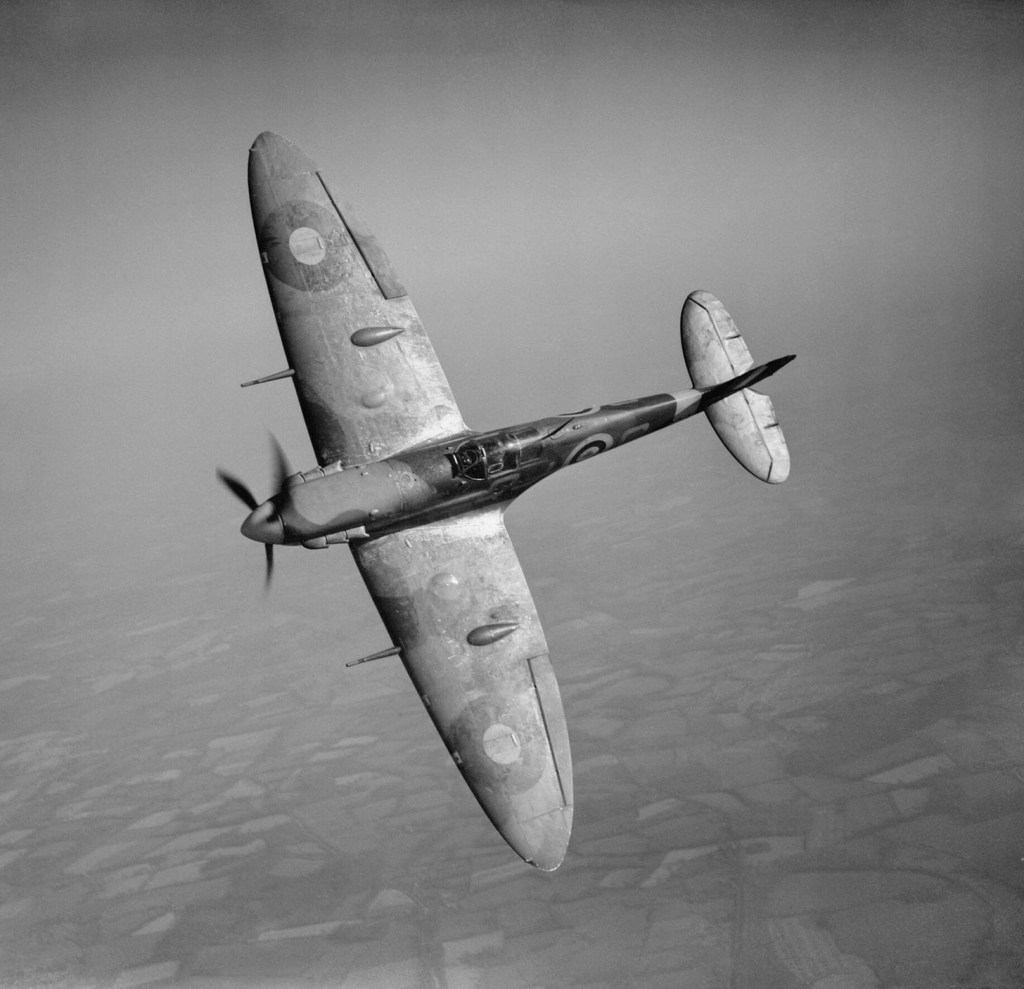
A comparison of the Spitfire and the Bf 109 in the early years of World War II
How did the British Supermarine Spitfire and the German Messerschmitt Bf 109 compare?
Fighter-versus-fighter comparison in the period between 1939 and 1941, when the Spitfire 1A/B and Spitfire V; the Bf 109E and F fought each other.
KINEMATIC PERFORMANCE
“…the Me 109F has a slightly superior performance to the Spitfire V”
– Air Vice Marshal Trafford Leigh-Mallory, September 1941.
“I also thought the Bf 109F was slightly superior to the Spitfire V”,
– Squadron Leader Douglas Bader, circa 1941.
The Bf 109, in its initial avatars, was generally regarded as marginally superior to contemporaneous variants of the Spitfire. At low to medium altitudes, where much of the air combat in the early war occurred, the Bf 109 had the upper hand. However, the Spitfire was superior at higher altitudes. This was chiefly because its Rolls Royce Merlin engine had a higher critical altitude (the altitude at which the supercharger is operating at full capacity, and beyond which engine power rapidly decreases) than the Messerschmitt’s Daimler-Benz DB 601.
The Bf 109 employed several advanced technologies that gave it an edge. For instance, its DB 601 engine was equipped with an automatic variable-speed supercharger that ensured better power delivery from the engine. The Bf 109E-3’s supercharger, for instance, gave it a 200 hp advantage over the Spitfire 1A at low altitude. The engine also utilised fuel-injection technology, which allowed the aircraft to pitch forward into a dive; the Merlin’s carburettor would stall the engine if this were attempted in a Spitfire. The Spitfire therefore had to roll over and dive, which cost precious seconds in combat. Yet another example would be automatic leading-edge slats that prevented the Bf 109 from going into a stall at low speeds or in high-G turns.
The Spitfire’s advantages were its tighter turning circle and faster turn rate, which allowed it to outmanoeuvre the Bf 109 in the horizontal plane. But the Bf 109, owing to its higher climb rate, could sustain climbing turns that the Spitfire was unable to keep up with. This gave German pilots more freedom to engage and disengage from dogfights with British fighters. Two quotes illustrate this advantage rather well:
“When it comes to fighter vs. fighter and the struggle for the altitude gauge, we must expect for the time being to be at a disadvantage as compared with the improved Me-109 [this is the Bf 109F, being compared to the Spitfire V] we are now meeting”
– Memo to Air Marshal Sholto Douglas, AOC-in-C Fighter Command, from the Senior Staff Air Officer, April 1941.
“I preferred the 109F because it flew well at any altitude, was fast as most . . . had a superior rate of climb and could dive very well. Most of all, it instilled confidence in its pilot.”
– Franz Stigler, date unknown.
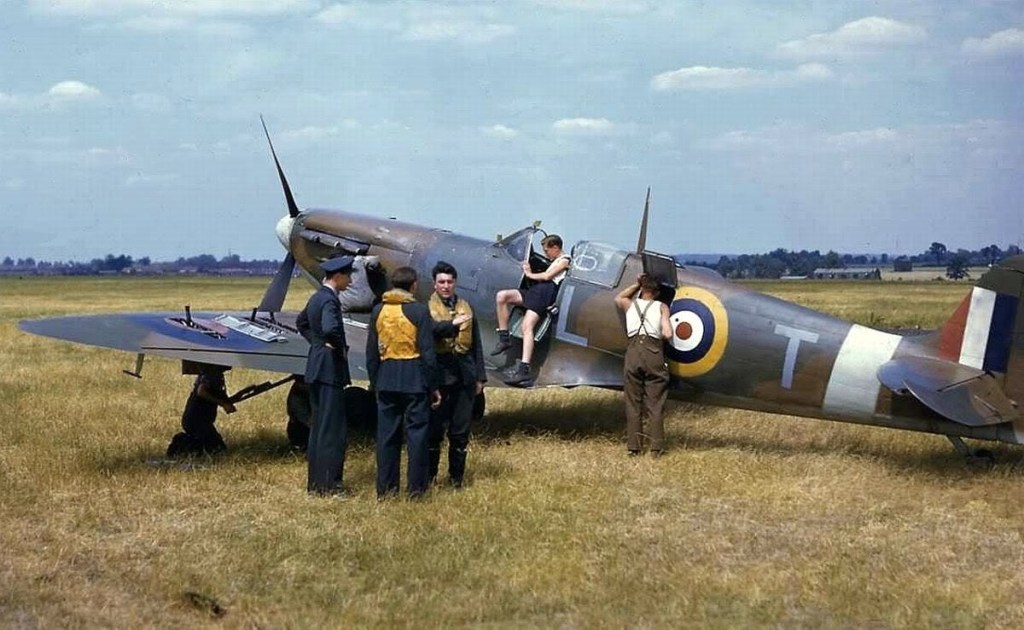
The Bf 109F-3 and F-4 models, introduced around mid-1941, improved on the E models with the help of the more powerful DB-601E engine. The new engine gave the aircraft a 30 km/h speed advantage over the Spitfire V. They also featured improved high-altitude performance; their critical altitude was 1,000 feet higher than that of the Bf 109Es.
RANGE
Combat ranges were comparable. Both designs were initially designed to defend airbases against enemy bombing, and that was reflected in their range figures on internal fuel—680 km for the Spitfire I A/B and about 660 km for the Bf 109E.
The Bf 109 was the first to be forced into an offensive role: first as a fighter that would provide top cover to an advancing German Army, and later as an escort for Luftwaffe bombers attacking Britain. The lack of range proved to be a major constraint in the second instance. It is well known by now that a Bf 109 taking off from Northern France had about 10 minutes of flying time over London, not nearly enough to battle it out with RAF Spitfires and Hurricanes. What isn’t so well known is that this was when the planes undertook independent fighter sweeps. When tasked with as bomber escorts, the need to fly at sub-optimal altitudes and speeds often increased fuel consumption to the point where the 109s were forced to return to France before the bombers had reached their objectives.
Spitfires tasked to carry out offensive fighter sweeps and raids over Northern France in 1941 faced the same issue. The reason Fighter Command didn’t suffer very heavy losses was that the Luftwaffe was by then fighting over Russia. The few fighters left to defend the western front seldom rose up to meet the RAF’s challenges.
ARMAMENT
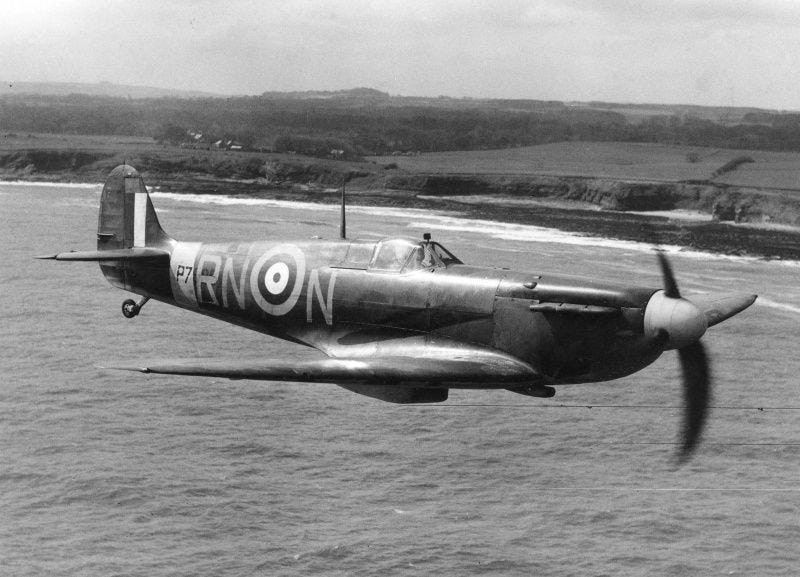
Armament-wise, neither aircraft ever had a clear advantage over the other. But it is still useful to study how the initial designs started off, and how the rapidly changing requirements of a modern air war forced changes to the weapon fit.
Both machines where primarily designed with aerodynamic performance in mind, with armament being a secondary consideration. They therefore made use of thin, tapering wings. These were excellent for speed and turning performance, but bad for firepower. There simply wasn’t any space to mount machine guns (leave alone cannon) in the wings.
The Supermarine Type-300 (an early prototype of what would become the Spitfire) was initially designed to be armed with only two machine guns. The Bf 109 wasn’t very different. The German the aviation ministry (RLM) specified two rifle-calibre (7.92 mm) machine-guns that the biplanes of the mid-30s carried. These were easy enough to concentrate in the nose. Willy Messerschmitt always wanted his fighter to be “a true application of light construction principles”. By mounting the guns in the nose and attaching the cantilever undercarriage to the fuselage rather than the wings, he could make use of a small, simple, low-drag wing that could be detached easily for maintenance and road transport.
However, this relevance on a mere two machine-guns was to change. The RAF’s requirements branch came to believe that two machine guns were inadequate to shoot down modern metal-skinned fighters, and in 1935, the RAF specified that it wanted eight machine guns on all new fighters. It was also asserted that this was an interim requirement. Follow-on designs would have to be armed with cannon. This was easy enough to accommodate in the Hurricane’s thick wings. But the Type-300’s thin, tapering wings had to be abandoned in favour of elliptical wings to house the increased armament. The Germans reached similar conclusions in combat over Spain. The Bf 109 would require cannon armament to damage metal airframes.
But this was easier said than done. The requirement for increased firepower led to persistent teething troubles with the armament of both aircraft well into their service lives. The Spitfire’s machine guns tended to freeze solid from the cold at high altitudes (this issue also affected Hurricanes). Initially, Fighter Command had Spitfires take off with adhesive tape covering the gunports in order to prevent the condensation from entering and icing the gun barrels. This did not always work. Later, a portion of the engine exhaust was ducted into the wing to heat the guns. This system proved to be mechanically complex and unreliable. It wasn’t until electric heating was introduced that the issue was fully resolved. Integrating 20mm cannon was also a great challenge. The belt that fed rounds to the weapon would frequently jam. The technical issues plaguing the Spitfire 1B proved so problematic that the type was withdrawn from service and replaced by the 1A.
Following feedback from pilots of the Condor Legion, Messerschmitt also modified the Bf 109 prototypes with a 20 mm cannon mounted between the engine cylinder banks, firing through the propeller hub. However, the vibration from the cannon was so severe that it proved to be unworkable. This problem was resolved much later in the war. In the meantime, several alternatives were trialled. The Bf 109B utilised an engine-mounted machine gun in place of the cannon. This, too, proved to be problematic. The Bf 109C featured a redesigned wing to accommodate two 7.92 mm machine guns, with ammunition boxes stored in the fuselage. The system worked in tests, but failed under the strain of air combat. The Bf 109D carried four guns – two in the nose and two under the wings. Bf 109E-1s carried the same armament. The E-3 models, though, were equipped with a 20 mm cannon under each wing, installed in two streamlined blisters along with a 60-round ammunition drum. Finally, the issues with the engine-mounted cannon were resolved in the F-4 model, which flew with a 20mm cannon that proved to be very accurate.
PILOT FRIENDLINESS AND HANDLING
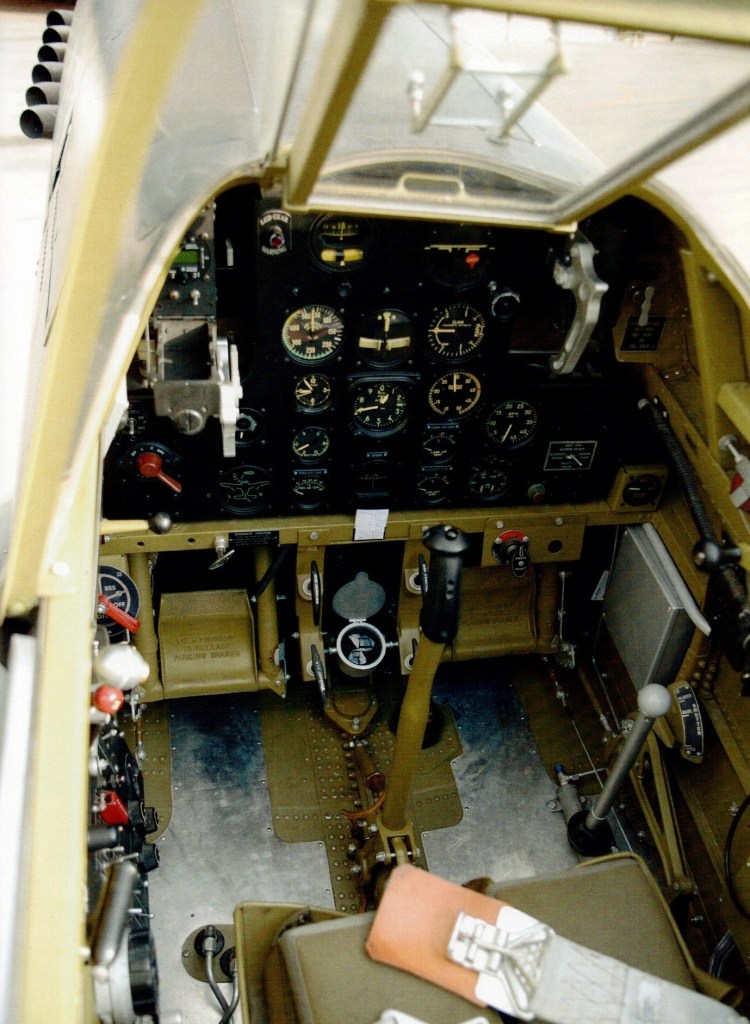
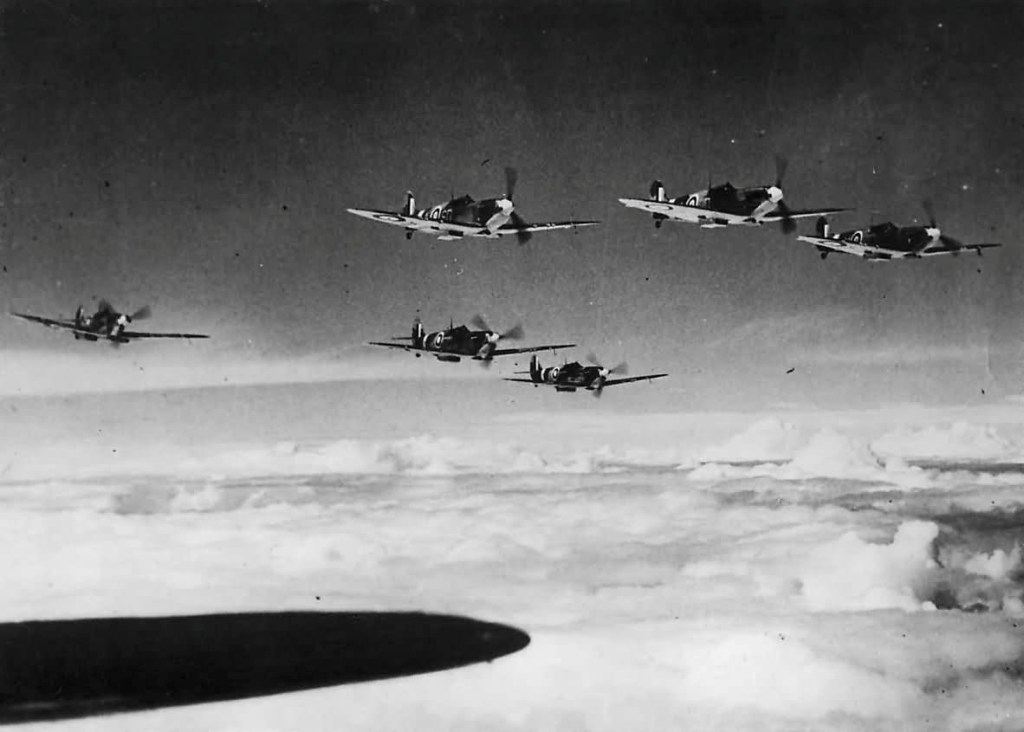
In terms of ease of operation, there were advantages and shortcomings to both designs. The Spitfire’s bubble canopy and large mirrors offered excellent views and better situational awareness to the pilot. The Bf 109s angular canopy with its thick frame fell short. On the other hand, the Bf 109’s Revi gunsight was far ahead of the early Spitfire’s ring-and-bead type sight. It eliminated parallax errors and made deflection shots more accurate. The aircraft’s engine and propeller controls were also more automated, which reduced pilot workload.
On the flip side, the Bf 109’s small size made the cockpit very cramped. Not only was it uncomfortable, it also restricted the force that pilots could apply on the controls, with obvious effects on flight performance. Post-war testing by the RAF revealed that under certain conditions, the force that pilots could exert on the Bf 109’s control column was only 40% of what they could apply in the Spitfire. In an era when hydraulically boosted controls were not available, this was a serious deficiency. The Spitfire’s two-step rudder pedals also allowed the pilot to raise his feet high during high-G manoeuvring, delaying the onset of blackout. The Bf 109 had no such pedals.
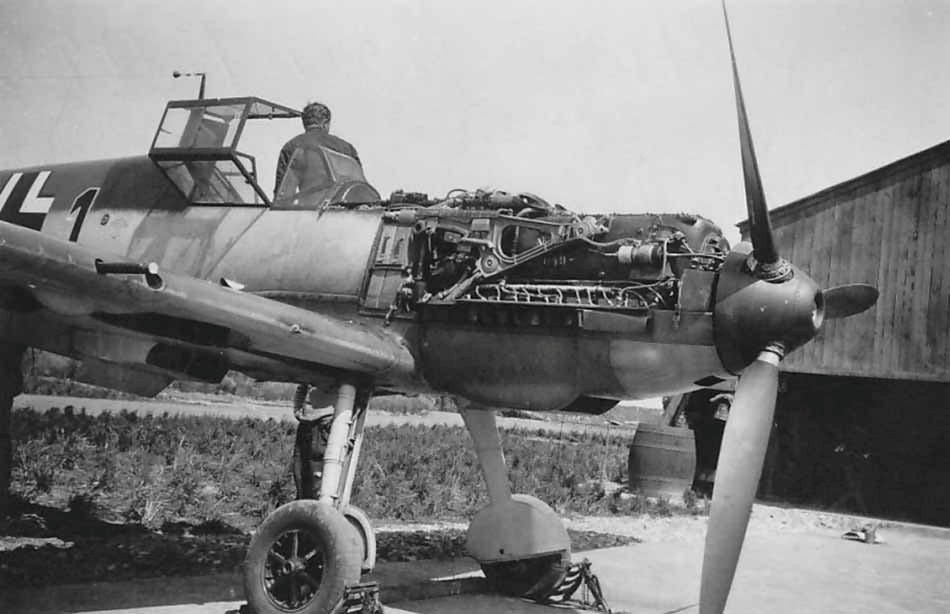
The Bf 109 also suffered from handling challenges, both in the air as well as on the ground. The most critical one was the issue with its undercarriage. There were two major problems with the landing gear design that caused serious losses of Bf 109s on take-off and landing. One was the tendency to ground loop. The Bf 109’s canted undercarriage often caused aircraft on landing runs to suddenly spin around and suffer serious damage if one wheel lost traction. On rough airstrips that were cobbled together in the later stages of the war, this problem was particularly acute.
Secondly, Willy Messerschmitt wanted his aircraft structures to be as light as possible. That structure lacked the strength to endure hard landings. As the Bf 109’s received more powerful engines and armament, it got heavier, which led to increased wing loading and higher landing speeds. That put additional strains on the landing gear. The result was that quite often, even experienced pilots ended up collapsing the undercarriage. In 1939 alone, the Bf 109 fleet suffered 255 landing accidents that resulted in damage to the airframe. The Spitfire, Hurricane, and Fw-190, with their “vertical” landing gear and heavier structures, fared much better.
ABILITY TO UPGRADE
The changing nature of the air war over Europe drove a slew of upgrade programmes for both aircraft. But the Spitfire—with its larger airframe, stronger structure, and superior engine—was better able to support the installation of advanced engines, armour, and heavier armament.
The Spitfire IX, often seen as the ultimate evolution of the type, was able to outclass the Bf 109G as well as the newer Focke-Wulf Fw 190A in combat. Its superlative Merlin 61 engine (powered by 100-octane fuel of US origin) gave it a 110 hp advantage over the DB 605-powered Bf 109G at sea level. But it truly came into its own at high altitude: At 30,000 feet, its two-stage supercharger gave it a whopping 300 hp advantage over its German counterpart. Further, its armament of two 20mm cannon and four 0.303 inch machine guns packed a formidable punch against not just aircraft, but also ground targets.
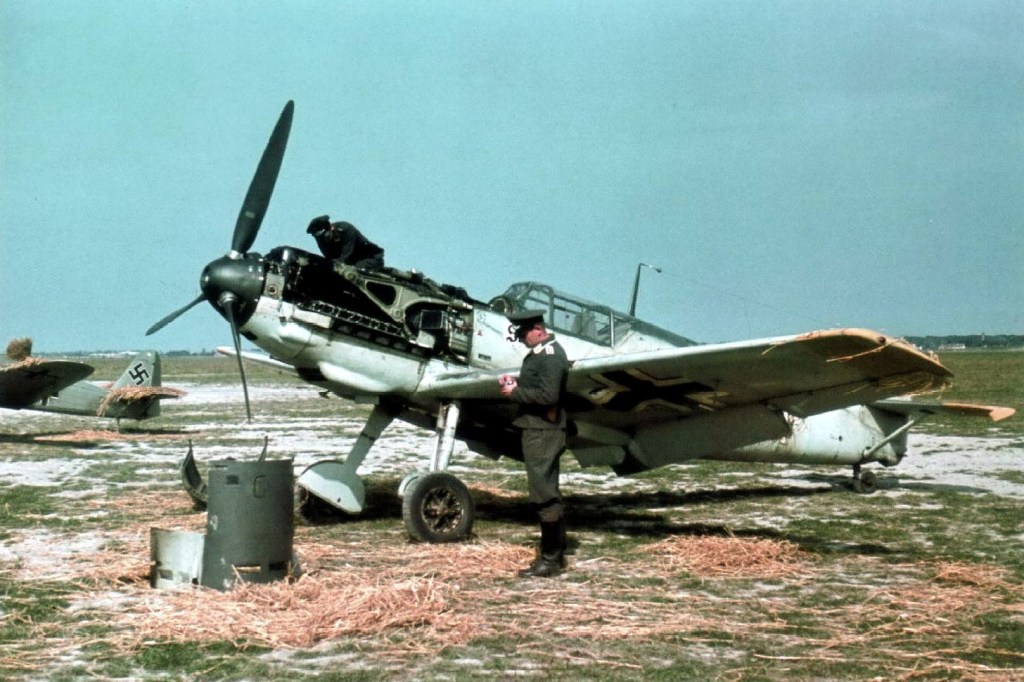
The Bf 109’s simplicity and light weight, however, proved to be its Achilles’ heel. Accommodating a more powerful engine, increased armament, new radios, and armour plate within the Bf-109G’s tiny airframe was a major challenge. The aircraft’s small cowling was inadequate for heat dissipation, which made the DB 605 engine prone to overheating and catching fire. Its firepower was only about half of what the Spitfire IX carried: two nose-mounted 7.92mm machine guns in the G-1 variant (upgraded to 13mm guns in the G-5) and one 20mm cannon firing through the propeller hub.
With the steady increase in weight, the Bf-109G’s handling qualities suffered. As the wing loading increased, so did the demands on brute muscle power to actuate the controls. Capt. Eric Brown, a Royal Navy test pilot who evaluated a captured Bf-109G, commented that “in a dive at 400 mph, the controls felt as though they had seized!” The addition of a water-methanol tank—whose contents were injected into the engine to provide a short burst of additional power—adversely affected the centre-of-gravity and made handing unpredictable in some portions of the flight envelope. The uparmed BF-109G-6, often equipped with 20mm or 30mm underwing cannon to attack Allied bombers, proved so sluggish in combat, that its pilots nicknamed it the Kanonenboot (Gunboat).
The larger, structurally stronger Spitfire IX suffered no such problems. Indeed, the powerful Merlin 61 and four-bladed propeller allowed it to outrun, out-turn, and out-climb the Bf-109G. The ‘quantum leap’ in performance that the Spitfire IX achieved over the Bf-109G was never reversed.
Ease of manufacture
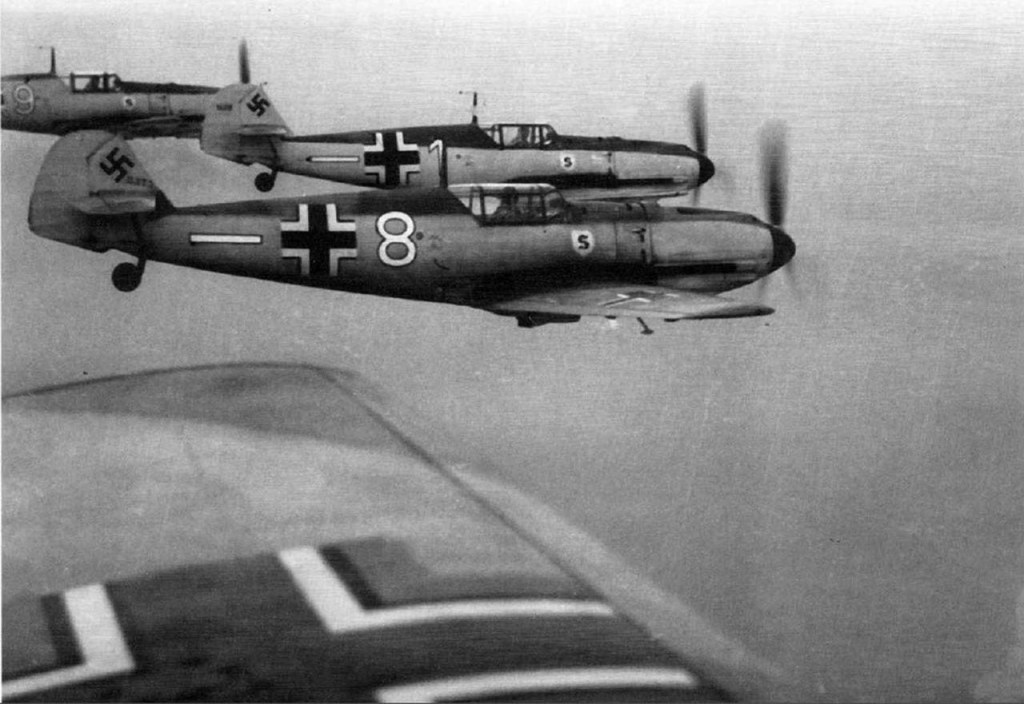
This is one area where the Bf 109 comes out the clear winner. The Spitfire’s complex design, coupled with Supermarine’s utter lack of experience with modern production line techniques made Spitfire production problematic. Its elliptical wing proved to be difficult to fabricate. Delays in transferring knowledge and drawings to various subcontractors slowed down production. And the fine tolerances demanded by the design team—not something that British industry was used to—led to quality issues. The company faced major schedule slippages in delivering the initial batch of 310 fighters, and the RAF at one point considered cancelling the order outright. The Bf 109’s transition to production, on the other hand, was very smooth. The RLM was able to have it mass-manufactured without much of a hassle.
This disparity is clearly visible when you look at the numbers. In January 1940, it took 15,000 man-hours to build a Spitfire 1A and 9,000 to build a Bf 109E. By 1942, that gap had only widened. The Bf 109F needed only 4,000 man-hours to build whereas the Spitfire Mk V required 13,000.
In a Wehrmacht that had increasingly begun to equip itself with poorly conceived, overly-complicated weapons whose paper performance was never quite realised in the field, the Bf 109 stood out as a rare example of German engineering that was cheap, reliable, maintainable, and easy to manufacture—all while delivering superb performance on the battlefield. There’s a reason that more than 34,000 were built despite the Germans’ severe mismanagement of production resources at the strategic level. It remains to this day the third most produced aircraft in the world.
VERDICT
In the final analysis, it is difficult to declare an overall victor without going into the details of each variant. For the most part, the Bf 109 and Spitfire were both well-matched, with own unique strengths and shortcomings. In the early part of the war, it could be argued that the Bf 109 (E and F variants) held the upper hand over the Spitfire Mk 1A/B and Mk V. But as the war wore on, the Spitfire’s inherently more advanced design, as well as the infusion of US technology (100-octane fuel, Browning machine guns, TR.5043 VHF radios, and so on) gave it a clear advantage over the simpler and lighter Bf 109 that persisted right up to the end.