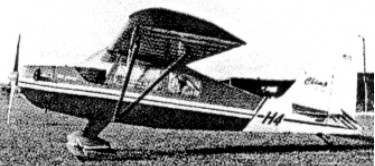
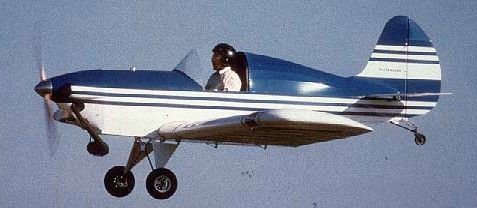
The H-3 Pegasus is a low-wing, open cockpit monoplane by noted lightweight sportplane designer Bert Howland. It features a lightweight fuselage, based on TIG-welded, square aluminum tubing that weighs only 18 pounds. The internal construction of the wings features a cantilevered design that eliminates struts and cables. Powerplant range is 28 hp to 55 hp. The prototype H-3 first flew in 1988 and won the “The Most Innovative Unltralight” award at Sun ‘N Fun 1989. The design was also designated “Best Commercial Ultralight’ at the 1990 event. The H-3 is not an ultralight vehicle as defined in FAR Part 103. Gross weight of the Pegasus is between 500 and 595 lbs. Pegasus plans cost $250 in 2009 and were available from Classic Aero Enterprises.
Speed max: 60 mph. Cruise: 55 mph. Stall: 27 mph. ROC: 600 fpm. Take-off dist: 200 ft. Landing dist: 250 ft. Service ceiling: 8,000 ft. Engine: Hirth F263, 31 hp. HP range: 28-65. Fuel cap: 5 USG. Weight empty: 252 lbs. Gross: 555 lbs. Height: 4.75 ft. Length15 ft. Wing span: 25 ft. Wing area: 110 sq.ft. Seats: 1. Landing gear: tail wheel.
Classic Aero H-3 Engine: Hirth 2703, 55 hp Wing span: 7.6 m Wing area: 10 sq.m MAUW: 226 kg Empty weight: 114 kg Fuel capacity: 45 lt Max speed: 100 kph Cruise speed: 88 kph Minimum speed: 43 kph Climb rate: 3 m/s Fuel consumption: 12 lt/hr Seats: 1 Plan price (1998): US$250
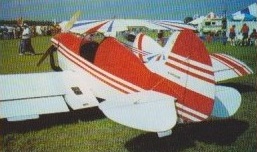
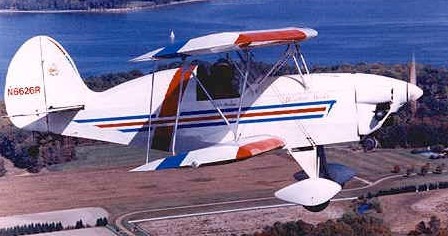
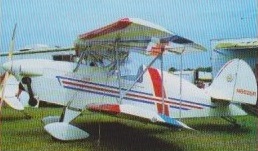
The H-2 Honey Bee is a lightweight aerobatic biplane first flown in 1986. With the H-2, designer Bert Howland introduced the technique of TIG-welding the fuselage from square 6061-T6 aluminum tubing, yielding a strong and rugged fuselage frame that weighs only 24 pounds. The airfoil on the 4 equal span wings is 6-1/2” thick and features 7 aluminum-capped foam ribs per panel with a D-cell leading edge spar and a C-section rear spar. Design load factor is +8g to -6g. The prototype and early versions used engines in the 40-46 horsepower range, but the designer later moved up to an engine of 65 horsepower as standard. The plans provide a two or four aileron option for those who wish a more responsive roll rate. When that option is selected, together with an engine in the 85 horsepower range or better (such as the Hirth F-30), and with an inverted fuel system, the H-2A is suitable for use in competition aerobatics up to the International Aerobatic Club’s “intermediate level.” In 1992, an H-2A Honey Bee was named “Best” in the combined Ultralight/Lightplane category during the EAA East Coast Fly-In at Wilmington, Delaware. The aircraft has been powered with engines from 40 to 95 hp. Homebuilder plans cost $250 in 2009 and consist of 40 engineering drawings and designer construction notes.
Classic Aero H-2A Honey Bee
Speed max: 68-80 mph. Cruise: 55-68 mph. Stall: 25-35 mph. ROC: 400-850 fpm. Take-off dist: 125-200 ft. Landing dist: 150-275 ft. Service ceiling: 8,000 ft. Engine: Hirth 2705, 65 hp. HP range: 40-95 Prop: 60-69in. Fuel cap: 7.5-12 USG. Weight empty: 335-496 lbs. Gross: 550-725 lbs. Length: 15.75 ft. Wing span: 19 ft. Wing area: 140 sq.ft. Seats: 1. Landing gear: tail wheel. Design load at 550 lbs: +8,-6g.
Classic Aero H-2A Honey Bee Engine: Hirth 2706, 65 hp Wing span: 5.8 m Wing area: 13 sq.m Empty weight: 150 kg MAUW: 270 kg Fuel capacity: 40 lt Max speed: 130 kph Cruise speed: 108 kph Minimum speed: 48 kph Climb rate: 6 m/s Fuel consumption: 12 lt/hr Seats: 1 Plan price (1998): US$250
1996: 27518 County Rd. 561, Tavares, FL 32778, USA.
LSA builder
Howland Aero Design was liquidated in 1995, after the death of Burt Howland. Classic Aero Enterprises handled the Howland’s designs since the liquidation in 1995.
Designed in 1937, the Howitt Monoplane was a parasol single-seat. It was built by the designer. R.C.Howitt, at Cowley with a 600cc Douglas conversion. It was registered G-AEXS c/n H.23D and first flew in 1937, at Abingdon.
It was re-engined in 1939 with a four cylinder but was not flown as such. It was put into store at Abingdon but lost during World War 2.
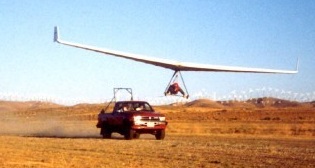
A 1995 hang glider for Advanced pilots, the Apex has a D-tube structure at the leading edge and dacron at the trailing. Unlike the Swift, though, the leading edge is not structural. The D-tube stops short leaving a fiberglass fairing to absorb the impact of an ungraceful landing.
The Apex was built by Danny Howell, Monte Westlund, Lonnie Fiester, Mitch McAleer, & Floyd Fronius, to name a few.
The original Apex had some damage after a truck tow ended with the Apex upside down and still attached by the nose safety line. One rudder damaged which Chuck Rhodes rebuilt and the tow rig frame bent beyond repair.
In 1998 Danny Howell, the designer of the Apex, offered the use of the molds to build another Apex. They had been stored in Mitch McAleer’s workshop for the previous 2 years. With the help of Mitch and Roy, the wing mold clam shells and the spar tools were moved to Roy Bailets’ hanger in Mojave.
They were machining a redesigned root fittings to allow the wings to fold in the usual hang glider fashion and carry the loads of the 42 ft. span in just 16% chord D-tube.
This new Apex will have the same 42 ft. span with rudder tips. Danny had wanted to put some spoilers on the upper surface near the tips. The entire wing (including D-tube) was to be covered with Poly Fiber P-106 fabric and 2 light coats of Poly Brush. The smaller and lighter D-tube will still have a forward and aft spar. Spar caps are pultruded carbon bar stock. These changes have resulted in a calculated 80 lb. glider. The orginal Apex had a 135 fpm minimum sink rate and the spoilers will make it easier to turn and ground handle. The Apex wing alone, without a pilot suspended below it, has a calculated 28:1 glide. The pilot will lower it to around 18:1.
Wing area: 16.4 m² Wing span: 12.8 m Aspect ratio: 10 Hang glider weight: 36 kg Minimum sink rate: 0.7 m/s
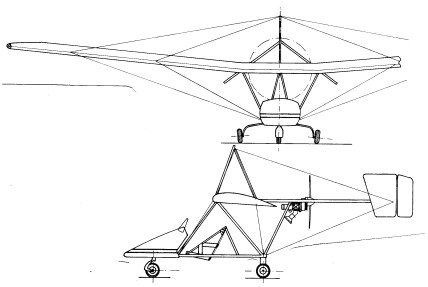
Single seat single engined high wing mono¬plane with conventional three axis control. Wing has unswept leading and trailing edges, and constant chord; inverted V tall. Pitch/yaw control by elevon; roll control by ailerons; control inputs through stick for pitch/roll and pedals for yaw. Wing braced from above by kingpost and cables, from below by cables; wing profile; double surface. Undercarriage has three wheels in tricycle formation; suspension on all wheels. Push right go right nosewheel steering connected to yaw control. Brakes on main wheels. Aluminium ¬tube framework, with pod. Engine mounted at wing height driving pusher propeller. Flown for the first time publically at the Aero 83 salon at Friedrich¬shafen, the prototype Milan from Howatherm UL Systeme made its first flight in March 1983. The prototype is fitted with a KFM 107 twin cylinder engine mounted level with the wing and driving a pusher propeller between the two booms carrying the tail¬plane, which is stiffened by cables. By 1983 two prototypes had been built and the first production run of 10 machines was being laid down. This machine will be fitted as standard with drum brakes on the main wheels.
Length overall 18.0 ft, 5.50 m. Height overall 8.5ft, 2.60m. Wing span 34.4ft, 10.50m. Constant chord 3.9 ft, 1.20m. Dihedral 4 deg. Sweepback 0 deg. Tailplane span 8.2 ft, 2.50 m. Total wing area 136 sq.ft, 12.6 sq.m. Total aileron or spoiler area 25.8 sq.ft, 2.40sq.m. Tailplane area 32.3 sq.ft, 3.00 sq.m. Wing aspect ratio 8.8/1. Wheel track 4.9ft, 1.50m. Nosewheel dia¬meter overall 10 inch, 26cm. Main wheels diameter overall 12 inch, 30cm. Engine: KFM 107, 25 hp at 6300 rpm. Propeller diameter and pitch 54 x 20 inch, 1.37 x 0.51 m. V belt reduction, ratio 2.1/1. Max static thrust 143 lb, 65 kg. Power per unit area 0.18 hp/sq.ft, 2.0hp/sq.m Fuel capacity 5.3 US gal, 4.4 Imp gal, 20.0 litre. Empty weight 214 lb, 97kg. Max take off weight 442 lb, 200 kg. Payload 228 lb, 103 kg . Max wing loading 3.25 lb/sq.ft, 15.9 kg/sq.m. Max power loading 17.7 lb/hp, 8.0kg/hp. Load factors; +6.0, 3.0 ultimate. Max level speed 62 mph, 100 kph. Never exceed speed 68 mph, 110 kph. Max cruising speed 56 mph, 90 kph. Economic cruising speed 37 mph, 60 kph. Stalling speed 27 mph, 43 kph. Max climb rate at sea level 400 ft/min, 2.0 m/s. Best glide ratio with power off 13/1. Take off distance 100 ft, 30 m. Landing distance 100 ft, 30 m.
The Speed 4000 four seat aircraft was available with a nosewheel only. Engine options include Lycoming O-360 160hp or IO-360 180hp, or Subaru auto conversion (Turbo) with an IVO prop. Registration: As VH Experimental GA Aircraft. The undercarriage is spring steel heat treated nose leg and mains, steered by castering nosewheel, brake steering, rudder is effective at about 15 kts airspeed. Wing area: 12.62 sq.m