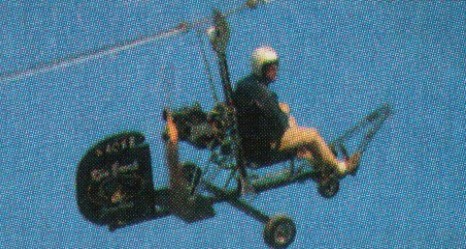
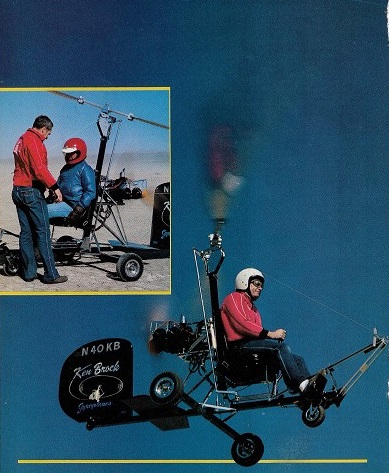
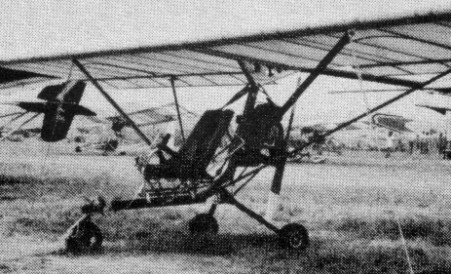
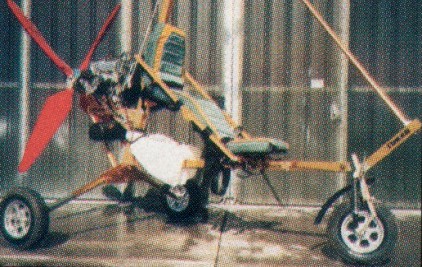
First flown in 1980, the KB-2 Gyroplane has quite a few features that distinguish it from other similar aircraft. These include: an aircraft-type joystick for con¬trol; its fuel tank seat which is molded from polyurethane to save on weight and add to the clean-looking design; its choice of rotor blades and its wheels. Construction has been simplified by packaging into seven separate kits (airframe, landing gear, rotor head, rotor blades, rotor hub, joystick, rudder/horizontal stabilizer and an optional kit for a prefab metal tail). Engine: 72 or 90 hp McCulloch, VW, or similar.
The KB-2 was sold in sub-kits. Price may vary with options, but the average is $12,500 in 2001.
Plans 2001 Plans for the McCulloch-powered KB-2: $125 2001 Plans for the Volkswagon-powered KB-2: $135
Engine: McCulloch, 90 hp. Rotor blades: 22’ x 7” Brock riveted aluminium, adjustable hub. Prop: Brock 48” x 18-20” wood fixed pitch. Speed max: 95 mph. Cruise: 70 mph. Range: 150 sm. ROC: 1200 fpm. Take-off dist: 200 ft. Landing dist: 15 ft. Service ceiling: 12,000 ft. Fuel cap: 9 USG. Weight empty: 240 lbs. Gross: 650 lbs. Height: 7 ft. Length: 12 ft. Disk span: 22 ft. Disk area: 380 sq.ft. Seats: 1. Landing gear: nose wheel.
Offered as a completely finished, unassembled kit. A high-wing monoplane with conventional tail group and three-axis stick-and-rudder controls. Steerable nosewheel. Strut-braced, built-up rigid wings, Dacron cover-ing. Fuel tank built into pilot seat. POWERPLANT: Yamaha 15 hp, 2:1 reduction drive, 48-inch prop. LANDING GEAR: Spring tube.
Has produced since 1987 plans and kits to build Tukan single-seat or 1+1 -seat microlight with Rogallo wing and trike. 1995: 8710 W. Carefree Hwy, Peoria, AZ 85382, USA.
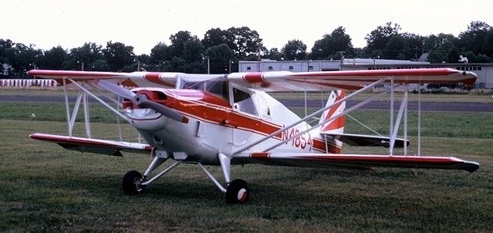
The second, and last, plane constructed by the Cabool R-4 school students was a Cabin Biplane named the KG Special. The plane was designed by Dr. Harry B. Kelly, DDS and Bill Ghan. During the class, students drew the plans and constructed the plane. This project continued on into a second school year as both drawing and building the plane took more time. The completed plane was taken to the West Plains airport, assembled and flown. Bill Ghan was the first to fly this plane
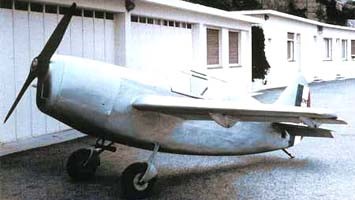
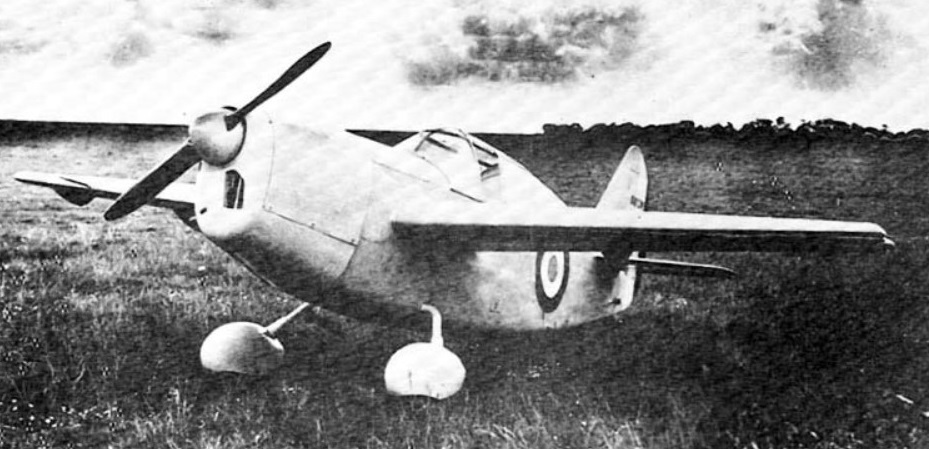
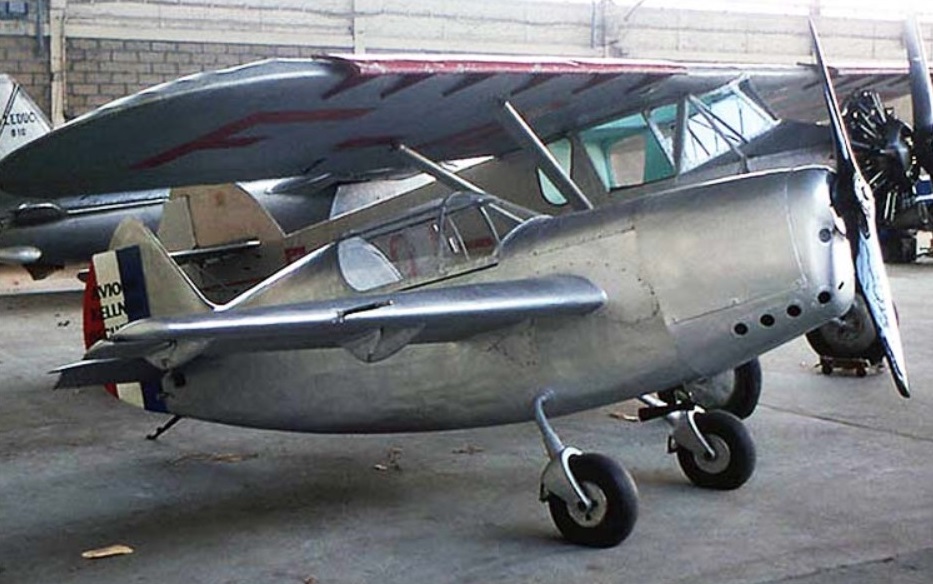
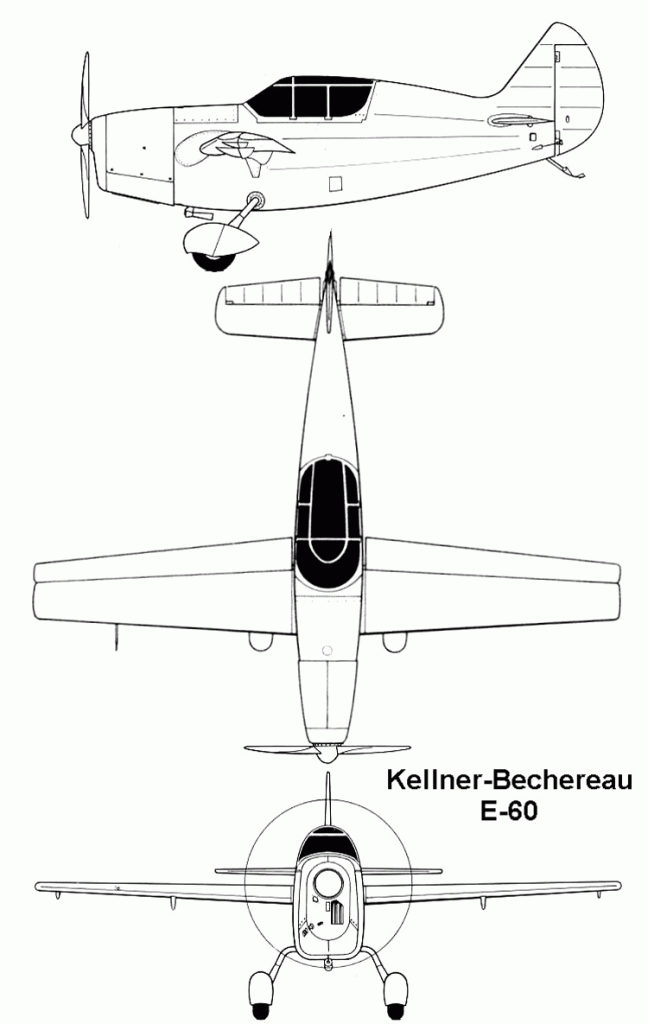
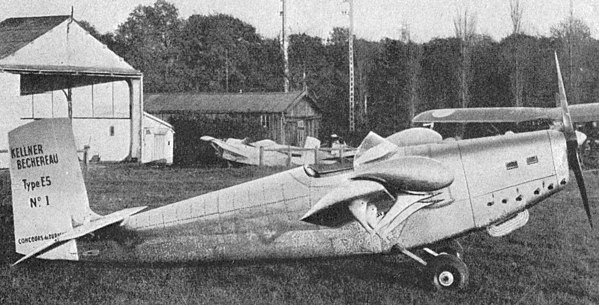
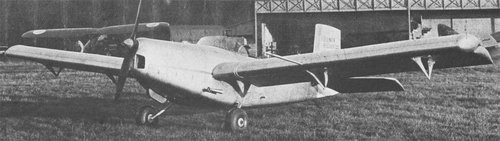
The E-60 is one of many attempts to create a cheap and efficient training aircraft that combines high flight performance, small size and modern appearance. After conducting a series of studies, French designer Louis Bechereau began construction of such a machine in 1939. Its design was distinguished by a very small size – length 4.9 m, wingspan – 5.4 m with an area of only 3 sq.m. To ensure flights at ultra-low speeds, an absolutely new aileron system was installed on the E-60. All the originality of the plane was due to this ” wing in drawer ” design. The first works on the drawer wing had started in 1936, and found their first application on the Kellner-Béchereau E.1. This system consisted of a wing in two parts, the movable rear part of which could move backwards by lowering for landing, like the Fowler flaps. The mobile part of this wing could also partially retract, the two extreme positions corresponding to the “low speed” configuration (fully free wing) and “high speed” configuration (mobile wing partially retracted).
Tests carried out on September 22, 1939 at the Eiffel Laboratory allowed to establish the polar (curve characterizing the profile). This resulted in a profile with low drag (therefore allowing high speeds) and high lift, allowing a large speed difference. However, the high angles of attack were hardly usable, due to the lack of visibility when the aircraft was taking a very nose-up attitude.
The airplane was a monoplane with a mid-wing and a streamlined fixed landing gear. The construction was carried out in spruce and plywood. The fuselage had only three frames: the sheet metal firewall, the pilot’s backrest and the sternpost support. The engine was a Walter Micron of 62 hp, driving a two- bladed propeller. The engine rested on a frame of steel tubes. The simplified landing gear consisted of a single axle.
The completion of the construction of the E-60 just coincided with the competition announced by the fleet on a training aircraft. The plane left the factory in the early days of March 1940 and was brought by road to Buc (Yvelines) and reassembled for his first flight. This took place on 7 March 1940. The test pilot was François Bruneteau. He took off from the 900m grass runway, which was in poor condition that day, plowed by the landings of British heavy aircraft the day before. Takeoff was bumpy. As soon as it took off, the plane took a strong 45- degree right tilt, due to the improper adjustment of the slots. The pilot’s skill allowed him to reduce the incline to 30 degrees and bring the plane back onto the runway, the left wheel touching first. The following tests focused on longitudinal and transverse stability, and revealed acute problems.
A presentation flight was carried out on April 25, 1940 by François Bruneteau before the Naval Air Commission, which was very interested. This flight, which lasted 40 minutes, highlighted the qualities of the aircraft. Due to its small size, it became practically invisible at 1,500 meters. The Navy planned to use it as a reconnaissance aircraft. The aircraft was able to be fitted with light bombs.
The last two flights took place on June 1 and June 3, 1940. The first included engine temperature tests, and the second included level speed tests at different altitudes, recorded with the barograph. This last flight, lasting 1 hour 45 minutes, almost ended badly for François Bruneteau. A leak of ethylene fuel took place, the vapors spreading in the cockpit.
Before the advance of the Germans, who were already at the gates of Paris, the prototype was evacuated to the South on June 5, 1940. Mounted on a truck, it left Paris by the Porte de Saint-Cloud, when the Germans had arrived at Le Bourget. The destination was the fall-back factory in Alençon, but the Germans were already there. The truck took the direction of Castelnaudary. François Bruneteau left the convoy at Clermont-Ferrand to reach Marseille where he embarked on a boat bound for North Africa. From there, he joined the Free French Air Force in London. The truck continued to Air Base 745 Aulnat, where the plane was hidden throughout the war.
After the war a scrap dealer, “aviation fan”, found the prototype among the wreckage of planes which he found in Aulnat and sold it to his test pilot, François Bruneteau, or rather to his wife, who offers it to her husband as a Christmas present. François Bruneteau completely restores the aircraft (except the original paint and without engine) on his property in Èze-sur-mer (Alpes-Maritimes). In 1975, following the publication of the article in the Fanatique de l’Aviation (number 72), the Air and Space Museum contacted the Bruneteaux. The aircraft was donated to the museum.
Engine: Walter Mi-2, 62 hp Wing span: 5.40 m Wing area: 3.20 sq,m Length: 4.90 m Height: 1.80 m Empty weight: 410 kg MTOW: 580 kg Maximum speed: 215 km / h Cruising speed: 168 km / h Range: 400 km Ceiling: 4000 m Crew: 1
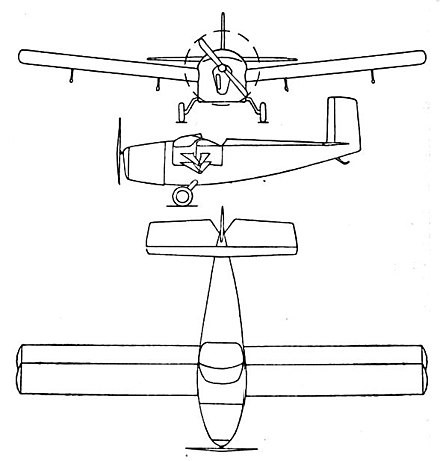
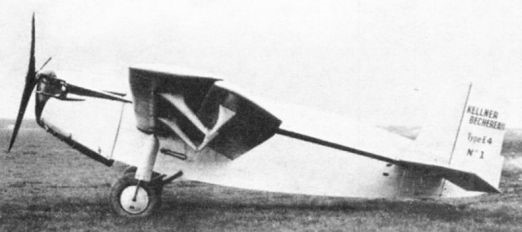
The Kellner-Béchereau EC.4 and Kellner-Béchereau ED.5 were a pair of French training aircraft with side-by-side seating and a novel “double wing” patented by their designer, Louis Béchereau. The principal difference was that the EC.4 had an all-wood structure whereas the ED.5 was all-metal. Both were single-engine, mid-wing cantilever monoplanes.
In 1936–37 Avions Kellner-Béchereau built a short series of small monoplanes exploiting one of Béchereau’s patents, a full span lateral division of the wing into two sections forming a “double wing”, a little like that used by Junkers but with a more equal division of area. The wing was first tested on the single-seat Kellner-Béchereau E.1 on 1936, which was followed by two larger and more powerful two-seaters, the EC.4 and ED.5. Both of these were designed to meet the French Air Ministry’s requirement for a pre-military trainer aircraft to be used by the clubs set up in the “Aviation Populaire” programme.
The ED.5 was similar to the EC.4 except that it was a metal aircraft. The forward part of the wing and the whole fuselage were constructed in a process also patented by Béchereau. It involved the use of wooden formers, shaped to the required skin profile but with cut-outs for strengthening members such as ribs. These were placed into the mould before the duralumin skin was fitted over the former and held down with leather belts. Once secured, the internal pieces and skin could be joined, still in the mould, by screws or rivets. The rear wing surfaces were also metal, though more conventionally built.
The dimensions of the EC.4 and ED.5 were the same, as were seating, engine and undercarriage. The loaded weight of the metal aircraft was 25 kg (55 lb) lower. Performance was similar, with identical maximum speeds; the lighter ED.5 had a 5 km/h (3 mph) lower stalling speed but a 55 km (35 mi) shorter range.
The ED.5 first flew in 1937.
The Kellner-Béchereau designs were not ordered for the Aviation Populaire programme, the Air Ministry preferring the Caudron C.270 and the Salmson Cri-Cri which were both bought in large numbers. Instead, Kellner-Béchereau, along with other manufacturers, built the Cri-Cri under licence.
ED.5 Engine: 1 × Train 6T, 45 kW (60 hp) Propeller: 2-bladed Wingspan: 8.80 m (28 ft 10 in) Wing area: 8.2 sq.m (88 sq ft) Length: 5.30 m (17 ft 5 in) Height: 1.60 m (5 ft 3 in) Gross weight: 500 kg (1,102 lb) Maximum speed: 160 km/h (99 mph, 86 kn) Stall speed: 60 km/h (37 mph, 32 kn) Range: 790 km (490 mi) Rate of climb: 2.0 m/s (390 ft/min) Seats: 2
The Kellner-Béchereau EC.4 and Kellner-Béchereau ED.5 were a pair of French training aircraft with side-by-side seating and a novel “double wing” patented by their designer, Louis Béchereau. The principal difference was that the EC.4 had an all-wood structure whereas the ED.5 was all-metal. Both were single-engine, mid-wing cantilever monoplanes.
In 1936–37 Avions Kellner-Béchereau built a short series of small monoplanes exploiting one of Béchereau’s patents, a full span lateral division of the wing into two sections forming a “double wing”, a little like that used by Junkers but with a more equal division of area. The wing was first tested on the single-seat Kellner-Béchereau E.1 on 1936, which was followed by two larger and more powerful two-seaters, the EC.4 and ED.5. Both of these were designed to meet the French Air Ministry’s requirement for a pre-military trainer aircraft to be used by the clubs set up in the “Aviation Populaire” programme.
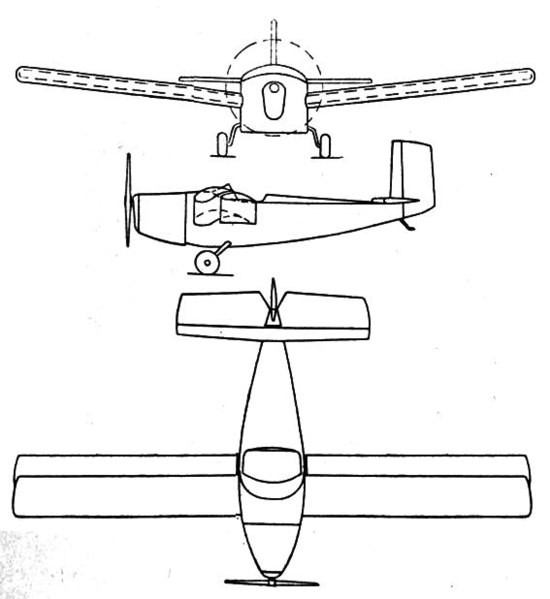
Like the E.1, the EC.4 was a wooden aircraft with spruce frames and plywood covering. It was a mid-wing cantilever monoplane with straight, thick section, constant chord wings of quite high aspect ratio (9.45). The lateral division was at about 65% chord, with the rear part joined to the front with conspicuous V-shaped faired underwing hinges. In normal flight the two parts were close together and the rear sections acted both as lifting surface and, differentially, ailerons but they could also be lowered together as slotted flaps, moving rearwards as well as down to produce a slot between fore and aft parts.
The fuselage was rectangular in cross section, with an open cockpit seating two side-by-side at the wing trailing edge and an inverted in-line 40 kW (60 hp) Train T6 in the nose. A straight edged tailplane was mounted on the upper fuselage longerons and carried elevators with a small cut-out for rudder movement. The latter, mounted on a very narrow fin, was rectangular and extended to the bottom of the fuselage. The rear control surfaces were fabric covered. The EC.4 had a conventional undercarriage with cantilever main legs hinged on the lower longerons, rubber sprung inside the fuselage.
The EC.4 first flew in 1937.
Thee dimensions of the EC.4 and ED.5 were the same, as were seating, engine and undercarriage. The loaded weight of the metal aircraft was 25 kg (55 lb) lower. Performance was similar, with identical maximum speeds; the lighter ED.5 had a 5 km/h (3 mph) lower stalling speed but a 55 km (35 mi) shorter range.
The Kellner-Béchereau designs were not ordered for the Aviation Populaire programme, the Air Ministry preferring the Caudron C.270 and the Salmson Cri-Cri which were both bought in large numbers. Instead, Kellner-Béchereau, along with other manufacturers, built the Cri-Cri under licence.
EC.4 Engine: 1 × Train 6T, 45 kW (60 hp) Propeller: 2-bladed Wingspan: 8.80 m (28 ft 10 in) Wing area: 8.2 sq.m (88 sq ft) Length: 5.30 m (17 ft 5 in) Height: 1.60 m (5 ft 3 in) Gross weight: 525 kg (1,157 lb) Maximum speed: 160 km/h (99 mph, 86 kn) Stall speed: 65 km/h (40 mph, 35 kn) Range: 845 km (525 mi, 456 nmi) Rate of climb: 2.0 m/s (390 ft/min) Seats: 2