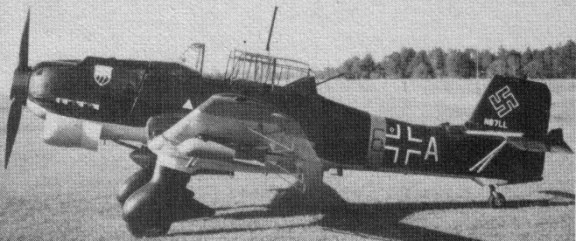
Langhurst JU87-B2 Stuka

Like the original, the Langhurst replica Stuka is a two-place aircraft with a single control from the front seat. The rear seat faces the tail. The replica is completely of metal construction. Basically, it is a com¬posite. It has an inner steel-tube frame and an aluminum skin. Because the original rib type was unknown, Langhurst utilized the NACA 2415, which looks very much like the original.

The 7/10 Stuka is actually a full-sized airplane by most homebuilt standards. It has a full electrical system, full hydraulic system and complete fuel manage¬ment system. The landing gear and tailwheel units are standard from a PT-19.

Registered N87LL, the Stuka first flew on 19 July 1978.

The aircraft is now on loan to the San Diego Aerospace Museum.

Engine: 220-hp Lycoming GO-435
Wingspan: 32’6”
Length: 24’0″
MTOW: 2275 lb
Empty weight: 1680 lb
Top speed: 137 mph
Cruise: 120 mph
Stall: 62 mph
Climb rate: 1100 fpm
Lange EA 42

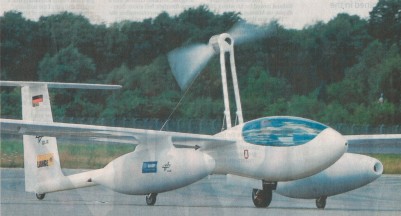
First run in 1995, the Lange EA 42 is an electrical aero engine designed for self launching gliders. It is produced in Germany by Lange Aviation for their Antares 20E glider.
Contents

The EA 42 combines an EM 42 brushless 42 kW electric external rotor motor with a related engine control system and power electronics. The motor drives a two-bladed composite fixed pitch propeller with a diameter of 2 m (7 ft). It is powered by a battery pack.

Applications:
Lange Antares 20E
Lange Antares 23E
Schempp-Hirth Arcus E

Specifications:
Power 38.5 kW

EM42 electrical engine
Diameter 25 cm (10 in)
Length 27.2 cm (11 in)
Mass 29.12 kg (64 lb)

LE 42 power electronics
Length 42.2 cm (17 in)
Width 16.9 cm (7 in)
Height 20.8 cm (8 in)
Mass 9.58 kg (21 lb)

Lange Antares 20E / Antares 23E / E1 Antares

The E1 Antares is a composite single-seat self-launching powered glider with an electric motor. The E1 Antares (also known as the “Antares 20E”) is an all new design with a shoulder-mounted 20 metre span wing with flaperons and winglets. The aircraft is constructed from CRP/GRP-composites, with a T-shaped horizontal tailplane with fin and elevator, Schempp-Hirth airbrakes on the upper wing, and wing water ballast tanks. The retractable landing gear is equipped with brake and spring suspension.

The EA 42 electric drive system consists of the electric motor EM42, power-electronics LE42, engine control system EDCS2 and the sensor, data and power cables. The 42kW brushless DC electric motor is powered by a SAFT lithium-ion battery system, spilt into two packs positioned in the leading edge of both wings and composite two-blade fixed-pitch two metre diameter propeller.

E1 Antares EASA Type Certificate A.092, and includes the EA 42 engine based on EASA Type Certificate E.015 and the LF-P42 propeller based on EASA Type Certificate P.015.

The Lange EA 42 is an electrical aero engine designed for self launching gliders. It is produced in Germany by Lange Aviation for their Antares 20E glider.

E1 Antares
Engine: Lange EA 42
Propeller: Lange LF-P42
MCTOW: 660 kg (with water ballast)
MCTOW: 602 kg (without)
No. of Seats: 1

Langdon Helicopter

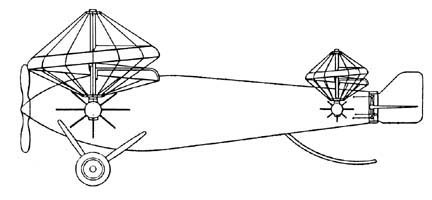
The 1929 single-place Helicopter used a helical vane arrangement with a myriad of wires replacing the wings and stabilizers on a heavily-modified Curtiss JN-4D fuselage. US patent #1,694,880 was granted in 1928. The rotor was driven by a disc drive, with friction providing speed control.

The plane was apparently built, but flight info, if any, was unrecorded.

Engine: 150hp Hisso A
Rotor: 26’0″