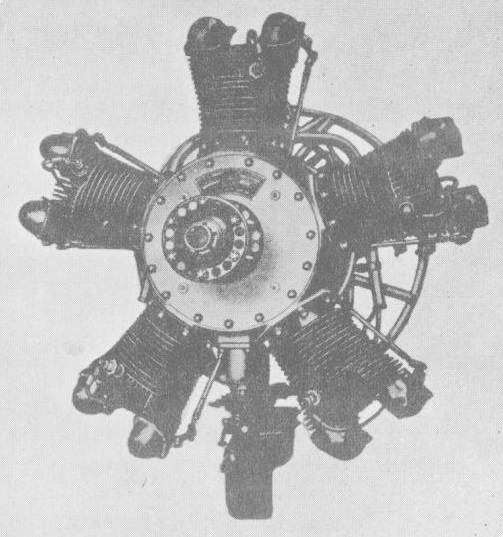
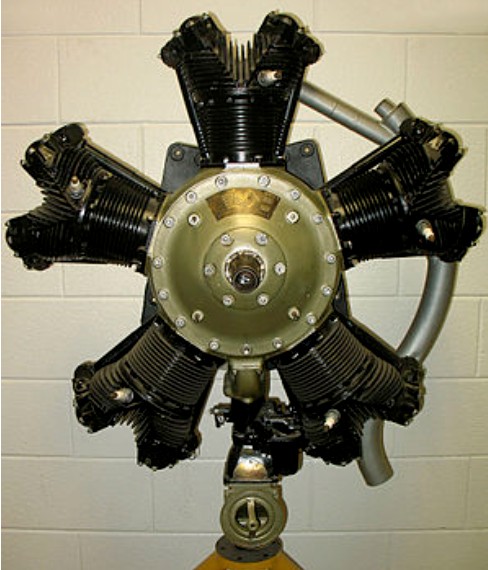
Introduced in 1928, the 60-5D was a 60 hp (45 kw) 5-cylinder, air-cooled, radial piston engine with a displacement of 234 cu.in (3.8 l). This model used iron cylinder heads and was a direct development of the Detroit Air Cat. An Eclipse starter was available at extra cost.
Type: 5 cylinder air cooled radial Approved Type Certificate No.12 Rating: 65 hp at 1950 rpm Displacement: 351 cu.in Compression ratio: 5.42-1 Bore: 4 1/8 in Stroke: 3 3/4 in Length: 22 1/4 in Diameter: 32 3/4 in Weight: 222 lb Fuel consumption: not more than .55 lb/hp/hr Oil consumption: not more than .015 lb/hp/hr Lubrication: Dry sump, full pressure feed Ignition: Dual Robert Bosch Carburation: 1 Stromberg Spark plugs: 2 per cylinder Champion Price: $1230
The LeBlond radial engines were a family of 5-cylinder and 7-cylinder, air-cooled radial engines for aircraft, built in the 1930s by the LeBlond Aircraft Engine Corporation.
Variants:
LeBlond 70-5DE Introduced in 1930, the 70-5F was a 70 hp (52 kw) at 1,950 rpm 5-cylinder, air-cooled, radial piston engine, (4.125 x 3.75 = 250.57 cuin (4.11 l)), using iron cylinder heads and two bearings.
LeBlond 85-5DF Introduced in 1930, the 85-5F was a 85 hp (63 kw) at 1,975 rpm 5-cylinder, air-cooled, radial piston engine, (4.25 x 3.75 = 265.99 (4.36 l)), using aluminum cylinder heads and three bearings.
LeBlond 70-5E Introduced in 1930, the 70-5E was a 70 hp (52 kw) 5-cylinder, air-cooled, radial piston engine. Production of the 5E continued in production under Ken-Royce as the Rearwin Ken-Royce 5E.
LeBlond 80-5F Introduced in 1930, the 80-5F was an 80 hp (60 kw) 5-cylinder, air-cooled, radial piston engine with a displacement of 266 cubic inches (4.4 litres) Using three bearings as developed for the earlier 5DF series, the LeBlond 5F was introduced in 1930. When aircraft powered with the 5F were commandeered by the U.S. Army, the engine was re-designated the R-265. This engine was the last of the so-called ‘greasers’. Production of the 5F continued under Ken-Royce as the Rearwin Ken-Royce 5G.
LeBlond 85-5DF Introduced in 1930, the 85-5F was an 85 hp (63 kw) 5-cylinder, air-cooled, radial piston engine with a displacement of 266 cubic inches (4.4 litres)
LeBlond 90-5F Introduced in 1930, the 90-5F was a 90 hp (68 kw) 5-cylinder, air-cooled, radial piston engine with a displacement of 266 cubic inches (4.4 litres)
LeBlond 90-5G Introduced in 1930, the 90-5G was a 90 hp (68 kw) 5-cylinder, air-cooled, radial piston engine with a displacement of 266 cubic inches (4.4 litres) Production of the 5G continued under Ken-Royce as the Rearwin Ken-Royce 5G.
LeBlond 110-7DF 110 hp (82.1 kW) at 2,150rpm 4.25 x 3.75 = 372.39 cu in (6.10 L) (Rearwin (Ken-Royce) after 1937)
LeBlond 120-7
Applications: Aeronca L Arrow Sport Rearwin Sportster Vulcan American Moth Monoplane
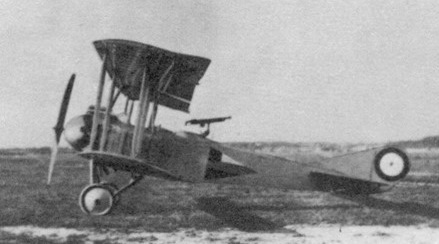
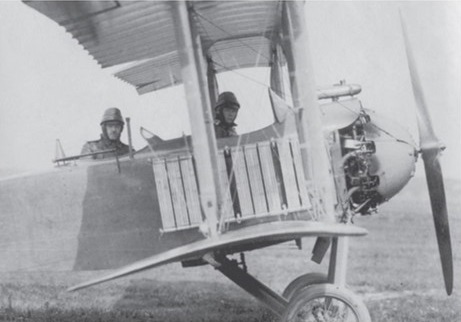
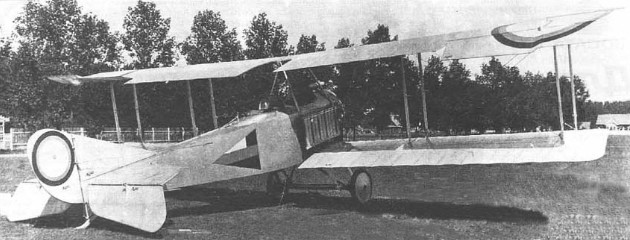
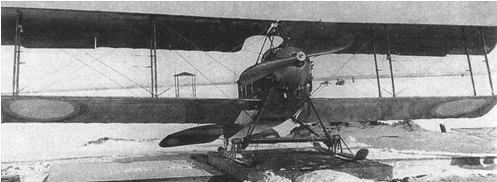
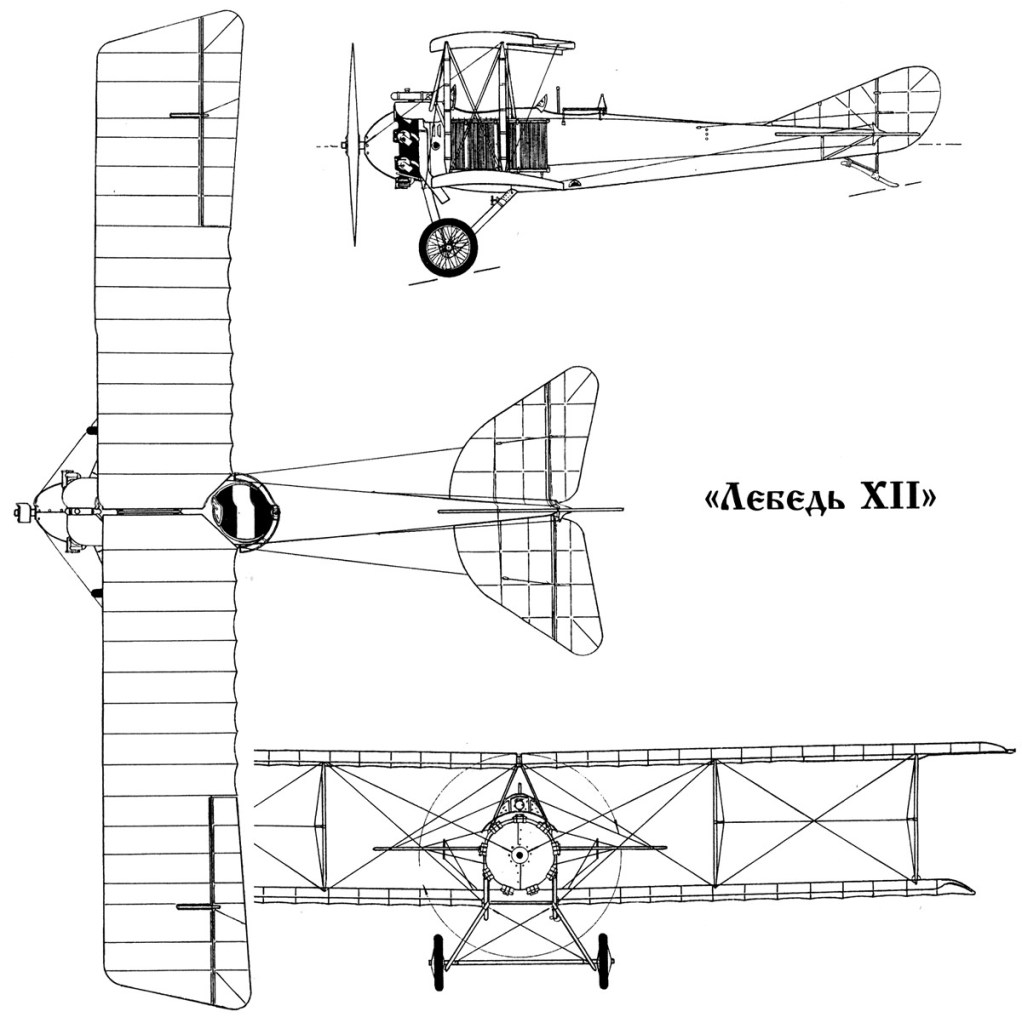
The Lebed XII was a Russian military reconnaissance aircraft produced during the First World War for the Imperial Russian Air Force. It was one of the few domestically designed aircraft to see production in Russia during the war, but was based on designs and techniques learned from Lebed’s rebuilding of captured German types. The fuselage was a plywood structure of rectangular cross-section with seating for the pilot and observer in tandem, open cockpits. The wings were built around a pine spar and covered in fabric, and the empennage (tail assembly) was of welded steel tube with fabric covering.
Test flights commenced on 28 December 1915, but were interrupted by bad weather in St Petersburg, where the Lebed factory was located. Testing was therefore moved to Kiev, and then to the Anatra factory at Odessa on 11–15 February 1916. Grand Duke Alexander Mikhailovich ordered 400 aircraft on February 23, but the final contract on 19 April was for 225 aircraft, 245 sets of spare parts and 10 static airframes for a total of 5,153,500 rubles.
Before production began, a number of handling difficulties noted by the test pilots were being corrected in the design, along with a new set of problems caused by a change in powerplant. The prototypes had been flown with 97 kW (130 hp) engines, but the production contract called mostly for 112 kW (150 hp) engines, plus some machines equipped with 104 kW (140 hp) engines for training. These heavier powerplants shifted the aircraft’s centre of gravity, and the mountings for the engine and cooling system had to be revised before a final round of tests began in October. Serial production finally commenced in November and delivery to squadrons soon afterwards.
The Lebed XII started appearing on the front line in quantity in early 1917, but problems quickly became apparent. In particular, a number of engine fires and crashes due to structural defects led to deliveries of the type being suspended by mid-year while an investigation was held. Army test pilots concluded that the version with the more powerful engine was unfit for frontline service, and recommended that it be relegated to training use only, while the lower-power version was regarded as not even fit for training. Lebed disputed the findings, blaming the poor results on the inexperience of the test pilots and on poor weather while the tests were conducted. The Army therefore held a second inquiry. On 2 October 1917, this panel concluded that the type was obsolete and unfit for service, recommending that production be halted and the type withdrawn altogether. However, due to a shortage of aircraft, production continued into 1918, and eventually 214 of the original order were delivered.
The Lebed XII saw limited frontline service in the North and North-western parts of the front with Germany, equipping four air divisions of the 38th Corps, 5th Army. Aircraft delivered in the second half of 1917 went mostly to training units, however. These included the Imperial aviation school, the Gatchinskoy military flying school, the Odessa flying school, Kiev school for pilots and observers and the flying school of the Caucasus. Over 50 were supplied to the Navy’s school of air combat in Krasnoye Selo alone. Survivors were taken over from the Imperial Russian Air Force by the Soviet Air Force.
The Estonian Air Force operated one aircraft only.
Variants:
Lebed XII Main production type
Lebed XIIbis Two aircraft constructed with alternative engines – one with a Hispano-Suiza engine, the other with a Green
Lebed XIII High-speed version, anticipated to reach 150 km/h (94 mph). Planned for March 1916, but possibly not built.
Engine: 1 × Salmson, 115 kW (150 hp) Wingspan: 13.15 m (43 ft 2 in) Length: 7.96 m (26 ft 1 in) Height: 3.25 m (10 ft 8 in) Wing area: 42.0 m2 (452 ft2) Empty weight: 820 kg (1,800 lb) Gross weight: 1,350 kg (2,970 lb) Maximum speed: 135 km/h (84 mph) Endurance: 3 hours 0 min Service ceiling: 3,500 m (11,500 ft) Crew: Two, pilot and observer Armament: 1 × machine gun on flexible mount for observer Bombload: 220 lb / 90.7 kg
USSR Established at Petrograd in 1912, during First World War built numbers of aircraft of British and French origin. The original two-seat reconaissance Lebed 12 was built until early 1919.
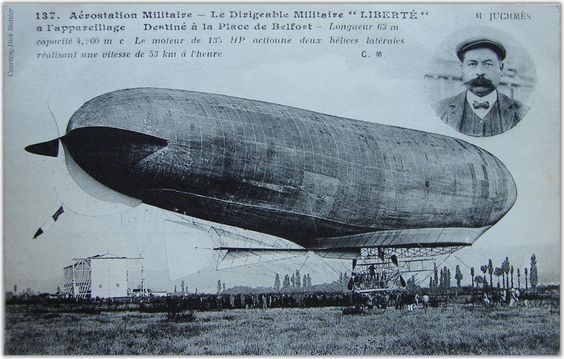
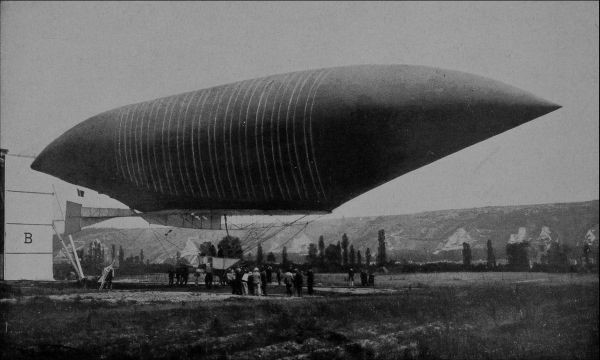
In 1909 Lebaudy produced two other vessels patterned after the République. The Russie and La Liberté, built respectively for Russia and France. The fourth designed dirigible, the Russie made her first voyage on May 29th, ascending 600 feet with eight passengers, and manoeuvring under perfect control. After her official trial, in June, she was sent to St. Petersburg, being the first dirigible furnished to a foreign government by a private concern.
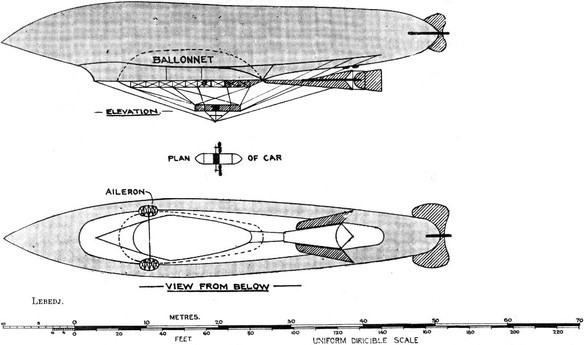
This dirigible was originally known as La Russie, and later renamed by the Russians as Lebedj, and was supposed to be an exact copy of the République.
Featuring a single Panhard-Levassor motor, twin propellers capable of 70 horsepower, the Lebedj dirigible had a volume of 3,800 cubic meters, and could achieve a speed of 49 kph.
Length: 61.2 m Beam: 10.9 m Volume: 3,800 m³ Engine: 1 x Panhard-Levassor, 70 hp Props: 2 Ballonet: 900 m Speed: 49 km/h
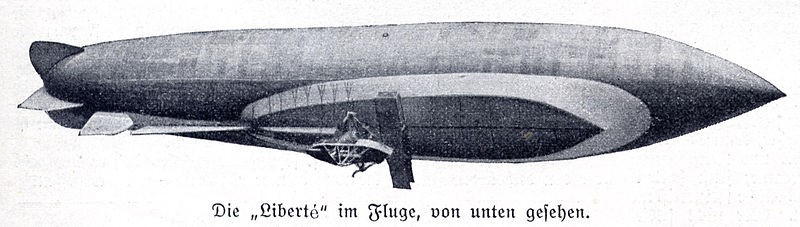
In 1909 Lebaudy produced two other vessels patterned after the République. The Russie and La Liberté, built respectively for Russia and France.
The Liberté was launched the last week in August and, after various practice and official tests, was accepted by the French government two months later. On a notable voyage, made on September 20th, she sailed ten hours with her Panhard motor constantly working.
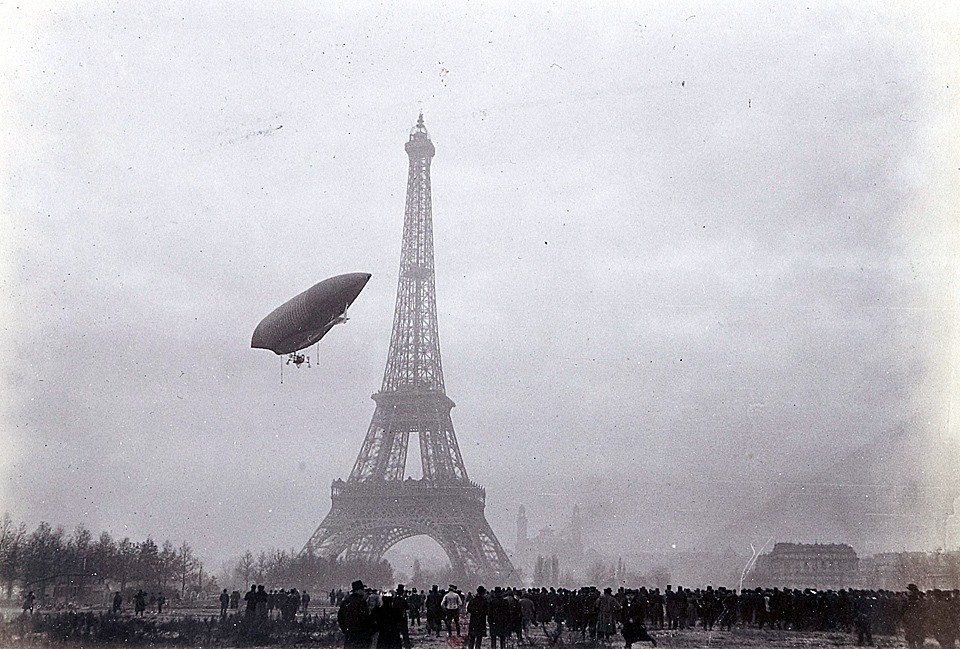
The company’s first airship, simply known as the Lebaudy, and dubbed by the French public “Le Jaune” (“The Yellow (One)”) because of the yellow colour of the lead chromate paint on its cloth exterior, was considered the most successful airship then in operation.
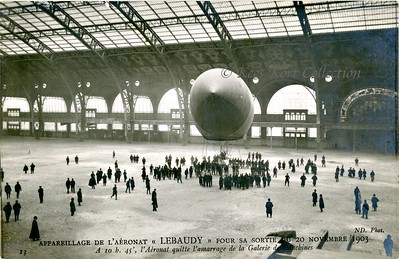
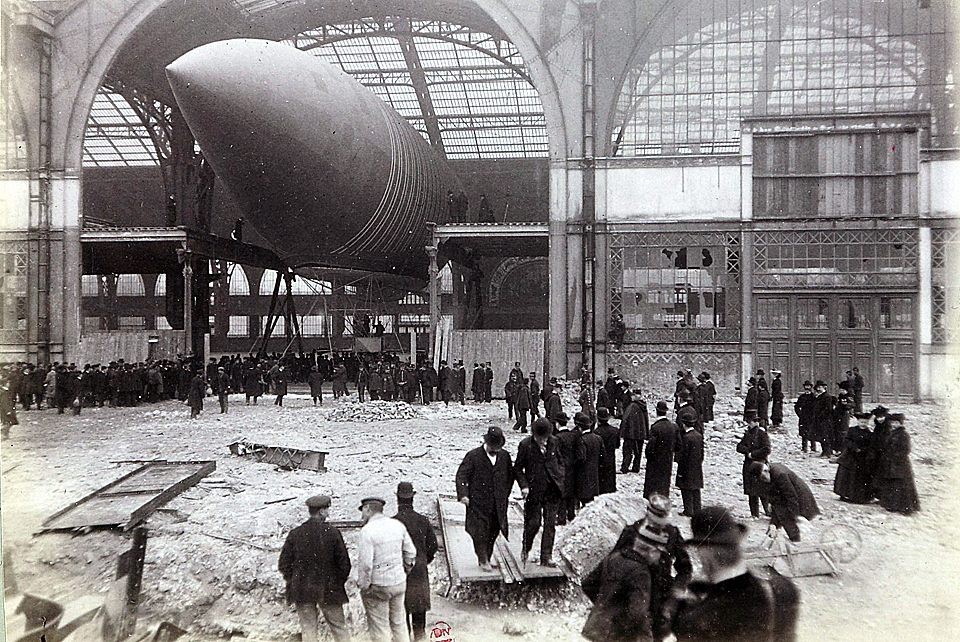
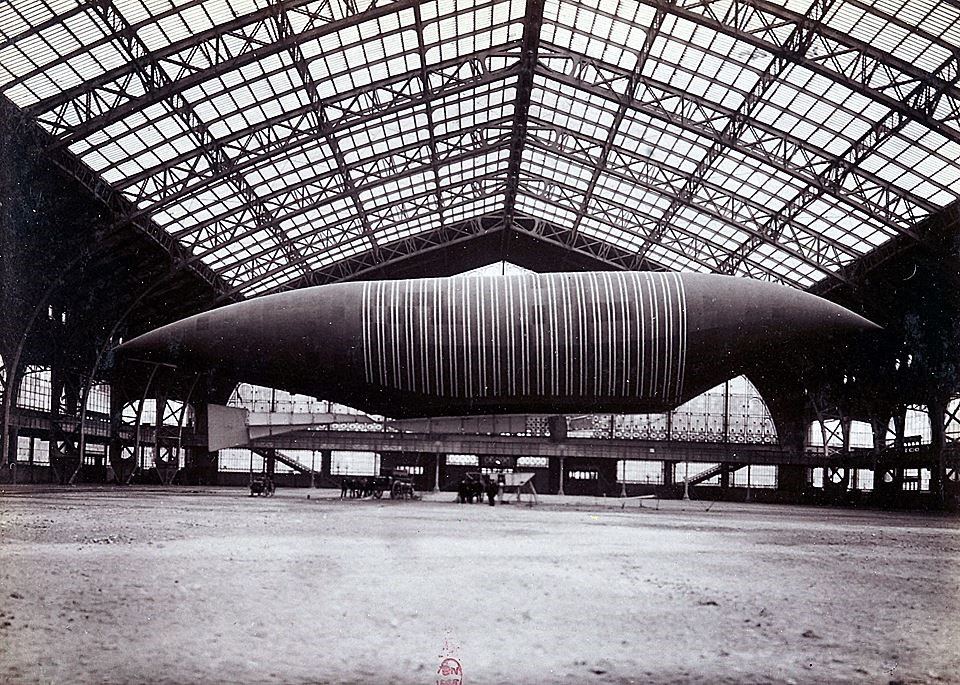
The Lebaudy Le Jaune (‘The Yellow’) dirigible was in the enormous Halles des Machines in Paris on 20 November 1903 in preparation for a flight over Paris. The flight got enormous publicity and a series of 30 (!) photographs / postcards were published to commemorate the event.
The Halle des Machines or Galerie des Machines was built specially for the Exposition Universelle in Paris of 1889. The Galerie des Machines had a span of 115 metres (377 ft) and height of 45 metres (148 ft). The whole building was demolished in 1910.
It had a 35 hp Daimler Mercedes engine driving two propellers. The ship was further improved on several trips, including one of 2 hours and 46 minutes. These activities continued in the following years, with the ship being rebuilt several times after crash landings in trees.
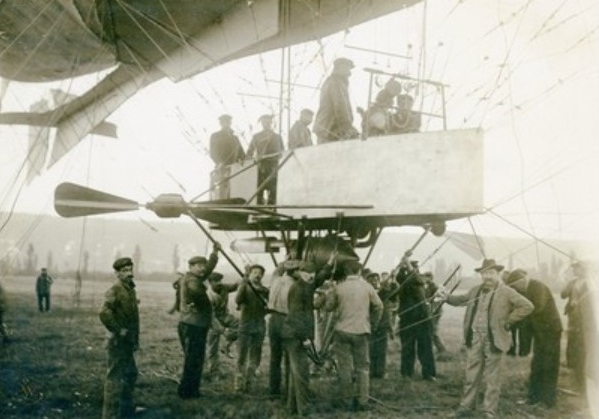
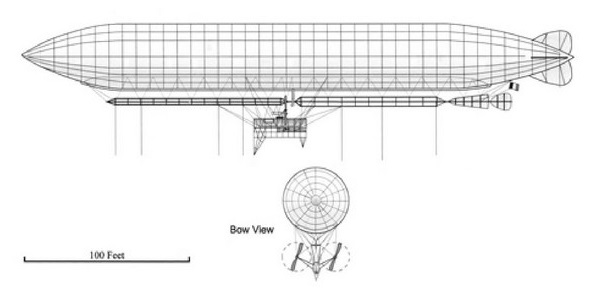
Two large dirigibles were ordered by Great Britan from France. The second airship, the Lebaudy, was purchased by the Morning Post newspaper as a gift to the nation, despite the fact there was at that time no shed large enough to house the 337 foot long craft. After protracted negotiations with the War Office agreement was reached to provide a new shen at Farnborough.
The Lebaudy had a gas capacity of 353,000 cu.ft giving a gross lift of 10.4 tons, powered by two 135hp Panhards. Colonel Capper had flown aboard her during trials earlier in the year in France and had reported favourably on her capabilities.
The airship was flown to England on 26 October 1910, maned by a French crew of seven and two representatives of the War Office including Major Bannerman who had succeeded Templer as superintendent at Farnborough. They crossed the coast at Cao Gris Nez, the airship easily overhauling the escorting destroyers at a speed of 35 mph.
After an uneventful flight of 5 hours 15 minutes the airship landed at Farnborough. On being taken to the shed the major in charge of docking became concerned that the top of the airship was too high to pass under the shed entrance, but was overruled by a senior officier who insisted the ship be walked in at once.
As the Lebaudy entered the shed the upper portion of the envelope was torn by the roof girder work, causing the ship to collapse and become a total wreck. It would appear that the dimensions of the ship supplied before the erection of the shed were different from the craft as completed, with the diameter being some 10 feet wider. The wreckage was dragged into the shed and followed by an inquiry, during which the War Office refused to pay the purchase price to the Lebaudy Company, declared them negligent in not advising them of the increased diameter of the envelope. It was eventually agreed the Lebaudy Freres would foot the bill to repair and make the ship airworthy.
During the winter months the shed roof was raised by 15 ft, and a complete reconstruction was started. A test flight of the refurbished airship took place in May 1911 in the hands of the manufacturers with an all French crew. Soon after takeoff and following a short flight, problems with directional control were experienced, most likely due to the craft being badly rigged following certain modificatins to the suspension system.
The crew limped back to Farnborough where while attempting to land the airship lost control and dived into the round, crashing on to a house and becoming a complete wreck. There was no fire and the crew suffered only minor injuries.
Lebuady 190 Envelope volume: 353,000 cu.ft Length: 337 ft Width: 39 ft Height: 64 ft Gross lift: 10.4 ton Disposable lift: 2.6 ton Engines: 2 x 135 hp Panhard Speed: 38 mph Range: 600 mi Crew: 7