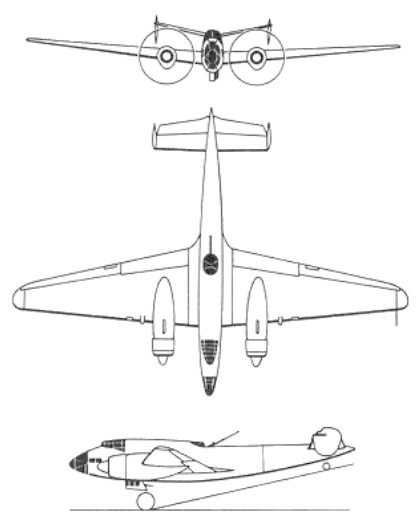
Soaring plane, Germany, 1929
Length : 17.257 ft / 5.26 m
Height: 5.741 ft / 1.75 m
Wingspan : 43.307 ft / 13.2 m
Crew : 1
Soaring plane, Germany, 1929
Length : 17.257 ft / 5.26 m
Height: 5.741 ft / 1.75 m
Wingspan : 43.307 ft / 13.2 m
Crew : 1
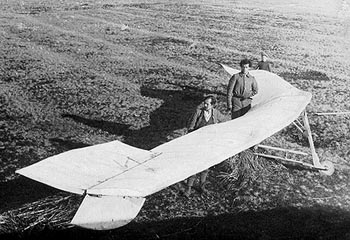
Alexander Lippisch designed his first tailless glider in 1921.
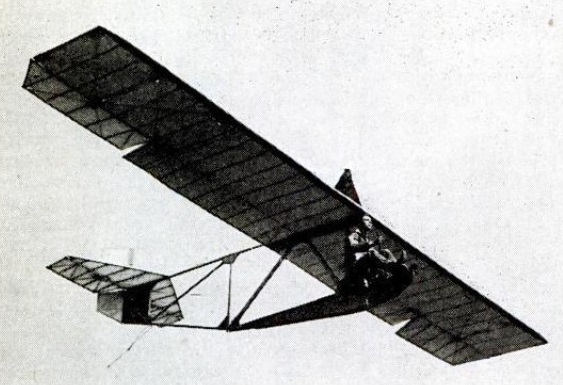
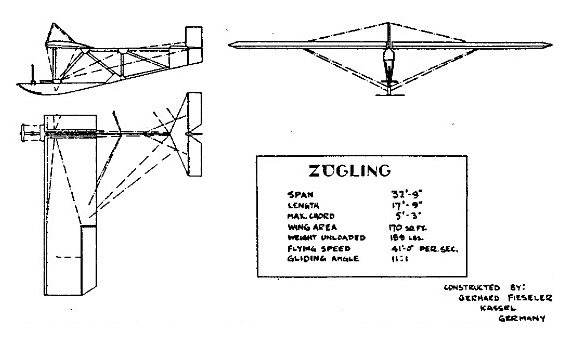
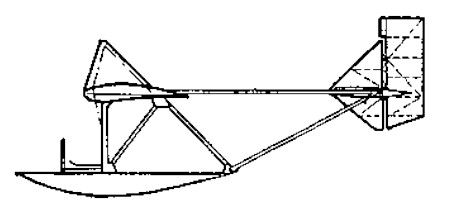
The 1926 Zögling was a simple lightweight glider for basic flight instruction. It was designed to start with rubber ropes, a common way to start a glider in the years short after WWI. It was designed by Alexander Lippisch.
On 27 December 1929 the Dutch Gliding Club was founded. For a few guilders, Theo E. Slot, an aircraft designer at the Pander Aircraft Factory, bought the construction rights to the Zogling glider and on 21 January 1930, the construction of this machine began. By April the PH-1 was completed and flew for the first time in Holland on 6 April, piloted by J. E. van Tijen. A record flight of 43 min 25 sec was made on 4 October with van Tijen at the controls.
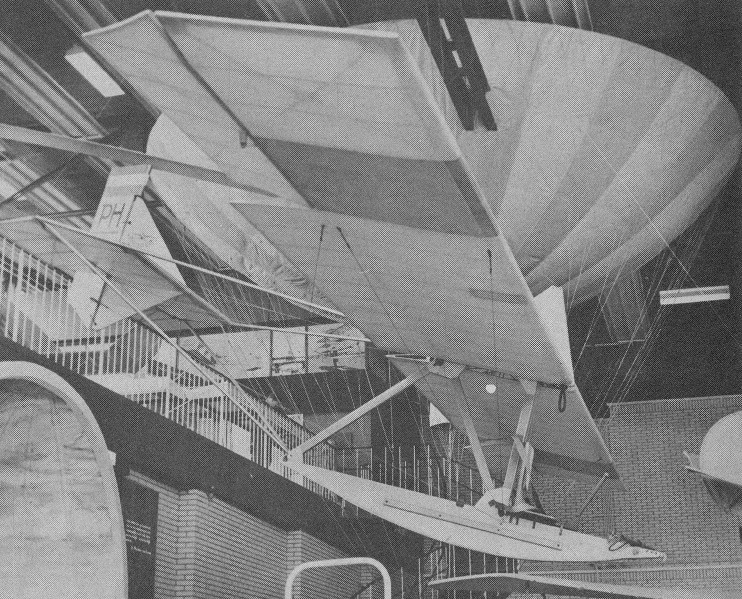
Zögling
1926
Length : 17.356 ft / 5.29 m
Height : 6.594 ft / 2.01 m
Wingspan : 32.94 ft / 10.04 m
Crew : 1
Zögling 33
1933
Length : 17.356 ft / 5.29 m
Height : 6.988 ft / 2.13 m
Wingspan : 32.94 ft / 10.04 m
Crew : 1
Zögling 35
1935
Length : 17.356 ft / 5.29 m
Height : 7.612 ft / 2.32 m
Wingspan : 32.94 ft / 10.04 m
Crew : 1
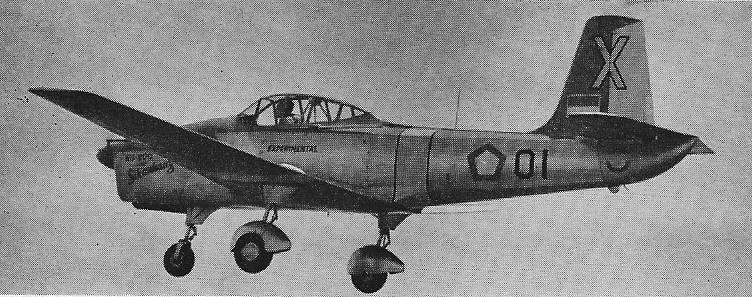
The NU-200 Sikumbang (Bee) was designed in 1953 by Major Nurtanio Pringgoadisuryo of the Experimental Section of the Indonesian Air Force’s Technical Staff.
Of mixed construction, the wing being of all-wood construction with plywood covering and the fuselage being a welded steel-tube structure with metal covering. The Sikumbang was to carry a fixed forward-firing armament of two machine guns and various underwing stores.
The prototype Sikumbang was first flown on 1 August 1954 and the type was intended as a light ground support monoplane.
Engine: 200 hp de Havilland Gipsy Six
Wingspan: 34 ft 9.5 in
Length: 26 ft 9 in
Height: 11 ft
Loaded weight: 2400 lb
Max speed: 160 mph at SL
Cruise: 140 mph
ROC: 1000 fpm
Service ceiling: 16,500 ft
Range: 600 mi
Seats: 2

1961:
Departemen Angkatan
Udara
Reaublik
Indonesia
Lembaga Persiapan Industn Penerbangan
Husein Sastranegara
Air Force Base
Bandung
In 1953, the Indonesian Air Force began the development of a series of light combat and training aircraft at its research, development and production depot near Bandung.
The first was a single-seat light ground support aircraft named the Sikumbang, of which two prototypes were built.
It has been followed by the Belalang, a major conversion of the Piper L-4J, and an ultralight single-seater called the Kunang.
The Belalang was in production at the depot in 1961, which was renamed the Lembaga Persiapan Industri Penerbangan (Institute for the Preparation of an Aircraft Industry) in August 1961.
Formed at Bandang in 1966 from the Institute for Aero Industry Establishment. LIPNUR built a prototype series of light aircraft and from 1963 began production under license of the Polish PZL 104 utility aircraft under the name of Gelatik (Rice Bird). It was hoped to assemble DH Canada Otters at the Institute.
Also manufactures the LT-200, a modified Pazmany PL-2 light aircraft, for military and civil training.
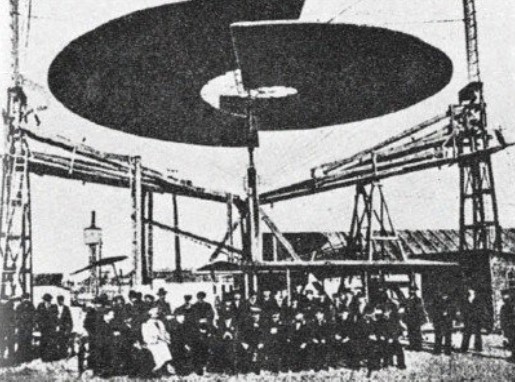
Jozef Lipkowski, a Polish engineer and inventor working in France and Russia, designed a huge helicopter-type flying machine in Russia at the end of 1904. According to descriptions in the contemporary press, the proposed aircraft featured two vertical co-axial shafts of steel tubes, to which two gigantic contra-rotating ‘screws’ (rotors) were attached. Each ‘screw’consisted of two half-circular ‘wings’ (blades) which were supported by a long steel tube and comprised a wooden ‘felloe’ and steel ‘spokes’ covered with doped silk. A nacelle, accommodating the aviators and two engines, one for vertical and the other for horizontal flight, was mounted beneath. A rudder and a propulsive airscrew on a horizontal shaft were attached to the nacelle and provided means of control.
Early in 1905 the Pitulovskie Establishments in Petersburg constructed one complete rotor for the proposed aircraft for tests which were aimed at determining whether a vertical ascent would be possible. Ground trials with the gigantic rotor device, driven by an electric motor, yielded remarkably interesting results, confirming in full the designers calculations. An official report, dated 16 March, 1905, and signed by Prof N. L. Shtchukin, who was appointed to witness and supervise the experiment, stated that Lipkowski’s rotor, consisting of two ‘half-wings’ with an overall diameter of 16m and a combined gross area of 200 sq m, which were powered by a 35hp (electric) motor, lifted 778kg at 40rpm, this indicating a lift/power ratio of 22.22kg/hp (or more than twice as good as the then best achievements).
For these initial tests the half-circular blades were set at a very efficient angle of incidence of 3.5°. Later Lipkowski made further trials with the blades set at various angles from 5° to 8°. Allowing for unforeseen contingencies and the possible loss of rotor efficiency in a complete machine, the designer accepted a lift/power ratio of 12.5kg/hp as the basis for his final calculations. Estimated weights of various elements of his giant helicopter included: two rotors 2000kg; nacelle, steering and transmission systems 1000kg; crew and fuel 1000kg; two engines 4500kg; the estimated gross weight of the machine being 8500kg. Lipkowski proposed using a 700hp engine for vertical movement and a 150hp engine for horizontal flight. In later years he went to France to see whether he could obtain the required engines, but impressed with Wrights’ and Bleriot’s flights, he came to the conclusion that the future of flying belonged to fixed-wing aircraft and abandoned work on his pioneering project.
Young (a pupil at the secondary school at the time) aeroplane enthusiast Kazimierz Lipczyński designed in 1925 a small (wingspan: 8,54m, length: 5,4m) monoplane aircraft. Design was scrutinized and approved by aeroclub specialists and construction begun, although most likely was never completed for financial reasons.
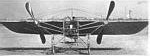
The 1911 Liore et Olivier monoplane designed and built by Liore et Olivier featured two tractor propellers.
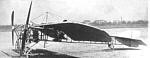
Span: 28’2″
Length: 29’6″
Weight: 770 lb
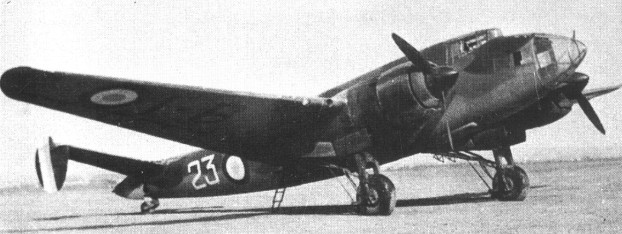
The LeO 45.01 B4 – designed by Jean Mercier to Armee de l’Air Programme A21 (1934) – first flew on 16 January 1937. It was an all-metal low-wing monoplane powered by two 805-kW (1,080-hp) Hispano¬Suiza 14Aa radial radial engines. The wings had considerable dihedral and the streamlined elliptical monocoque fuselage had a pointed and fully glazed nose. The landing gear was fully retractable. Accommodation provided for a pilot in an enclosed cockpit, behind which was the radio operator’s panel and below the retractable ventral gun turret.
Trials revealed that the tail needed revision, and development problems with the Hispano-Suiza engine led to the decision in favour of Gnome-Rhone 14 radials in the LeO 451, which was built by SNCASE, the nationalised organisation into which LeO had been absorbed.
Production LeO 451s had two 849.5kW Gnome-Rhone 14N 48/49 or 38/39 radial engines in specially designed Mercier cowlings. Despite excellent performance, construction of the type was slow. The first production aeroplane flew in March 1939, and although 1,783 aircraft were ordered only 452 had been produced by the fall of France. Only five LeO 451s were on first-line strength by 3 September 1939. Subsequent production amounted to 225 more aircraft.
Liore et Olivier LeO 451 Article
A number of modifications were incorporated during series production, the principal being a totally redesigned fin and rudder assembly. Armament included a fixed 7.5mm MAC 1934 nose machine-gun, another gun of the same type flexibly mounted in the ventral gondola, and a somewhat troublesome 20mm HS-404 on a special mounting in the dorsal position. Maximum bomb load – carried in fuselage and wing bomb bays – was 2,400kg.
The LeO 451s were used initially for long-range reconnaissance missions, then for daylight bombing during the Battle of France and in night raids on Italian targets during June 1940. A further 225 were ordered by the French Vichy regime, the type serving in French overseas territories, later relegated to transport and liaison duties (a number flown in these roles by the Luftwaffe). Twenty-seven LeO 451s were ceded to Italy in 1941 but saw little service.
Variants with different engines reached prototype form, and some production aircraft were modified as transports, glider tugs, mailplanes and trainers. There were numerous experimental conversions of the basic design. Several examples remained in use in secondary roles for several years following the end of the Second World War.
LeO 451
Engines: 2 x Gnome-Rhone 14N-48/49, 850kW (1,140 hp).
Span: 22.5m (73 ft 9.75in).
Length: 17.17m (56 ft 4in).
Max T/O weight: 11400 kg (25,133 lb).
Max speed: 308 mph at 15,750ft.
Operational range: 1,429 miles.
Armament: 1×20-mm Hispano¬Suiza cannon and 2×7.5 mm (0.295-in) MAC machine-guns plus up to 1500 kg (3,307 lb) bombs internal.
LeO 451 B.4
Engine: 2 x Gnome-Rhone 14N 48/49, 850kW
Max take-off weight: 11400 kg / 25133 lb
Loaded weight: 7815 kg / 17229 lb
Wingspan: 22.5 m / 73 ft 10 in
Length: 17.17 m / 56 ft 4 in
Height: 5.24 m / 17 ft 2 in
Wing area: 68.0 sq.m / 731.95 sq ft
Max. speed: 495 km/h / 308 mph
Ceiling: 9000 m / 29550 ft
Range: 2300 km / 1429 miles
Crew: 4
Armament: 2 x 7.5mm machine-guns, 1 x 20mm cannon, 1500kg of bombs